

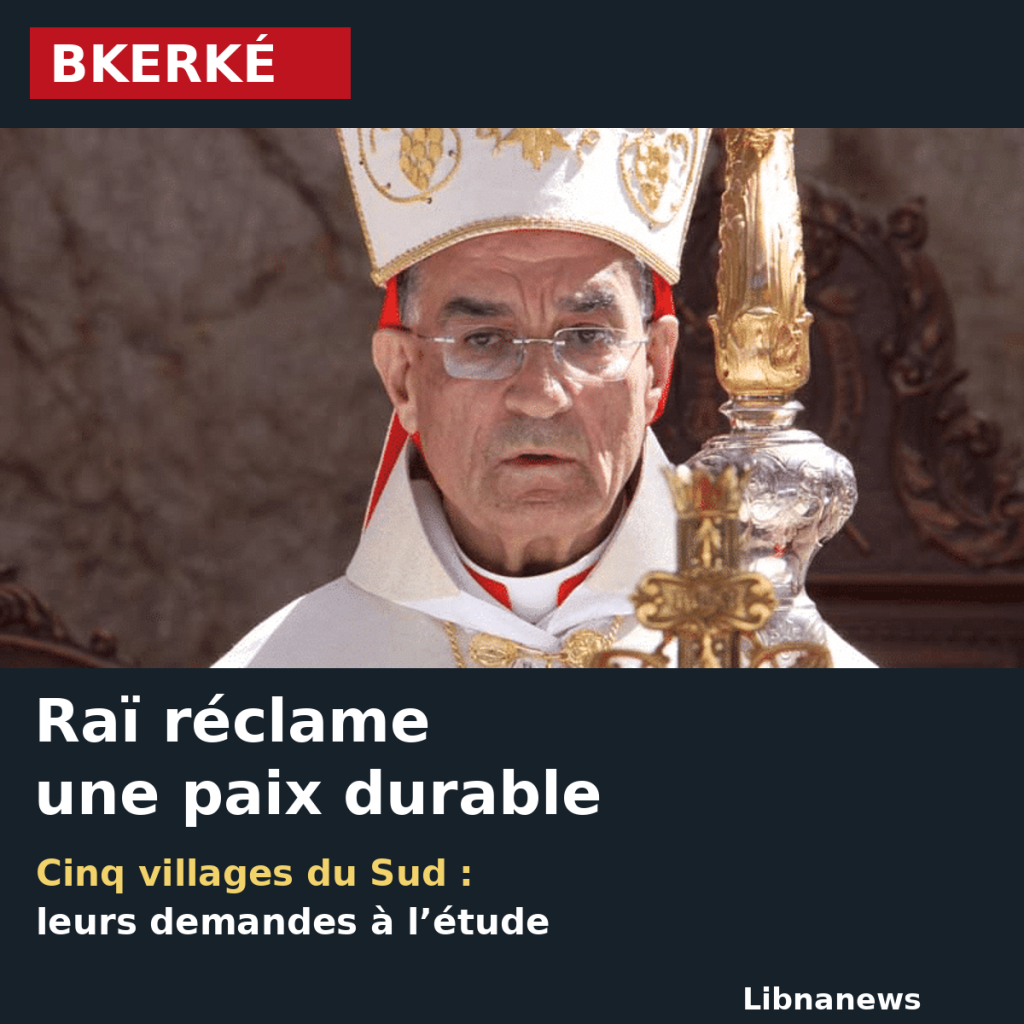
Maronite Patriarch Béchara Rai called for a lasting peace for Lebanon on Sunday, November 8, rather than a permanent expectation of the next regional war. In his homily in Bkerké, he linked this requirement to a single national authority on security and peace. He also announced that requests from five Christian villages bordering the South would be considered at the next session of the Catholic Patriarchs and Bishops.
A lasting peace based on the decision of the State
The cardinal presided over Sunday Mass in the church of Our Lady in the patriarchal seat. His intervention enshrines the protection of the country in an institutional choice: a State that controls its decisions and institutions capable of preserving stability.
Rai defended neutrality as a means of keeping Lebanon away from conflicts between regional axes. According to him, this orientation does not mean abandoning just causes or breaking with the Arab environment of the country. It must prevent Lebanese territory from becoming a permanent place of confrontation between external powers.
The Patriarch did not present a new negotiation or agreement. It formulates a political and pastoral position on the security conditions in Lebanon. It combines peace with the existence of a common national reference, rather than only provisional balances between regional actors.
The requests of five villages before the bishops
Rai announced that the Council of Patriarchs and Catholic Bishops of Lebanon would open its annual one-week session on Monday, November 9. He reported receiving a letter from the villages of Rumaysh, Debel, Ain Ebel, Alma al-Sha`b and Qauzah.
The document contains ten requests which the patriarch has described as hurgent and legitimate. He assured the inhabitants that they would occupy an important place in the deliberations. However, these ten points are not reproduced in the House. It therefore does not make it possible to announce a financial measure, a protective measure or a reconstruction programme already adopted.
This announcement gives a clear next step to the call of border localities: its collective examination by Catholic leaders. It also distinguishes the receipt of a request from the response that can be provided. Possible decisions are expected at the end of the work.
Electricity, waste and food security
The patriarch then discussed the functioning of public services. He referred to electricity cuts that affected administrations, facilities and communications services due to accumulated unpaid payments. In his view, these situations illustrate the consequences of administrative disorder for citizens.
This passage comes after the launch, on 2 November, of Lebanon’s electricity recovery campaign with public bodies. EDL announced on November 5 the receipt of $28 million. Parliament must now consider an additional appropriation to settle part of the arrears. The Patriarch’s speech focuses on the continuity of services, without providing a new financial balance sheet.
Rai also criticized waste management limited to their movement between landfills and regions. He argued for sorting, treatment and recycling, recalling the link between environmental protection and health. He did not mention any new public procurement or specific site in this passage.
On food security, he stressed control and responsibility when the health of the inhabitants was exposed to negligence or fraud. These words extend his call for reform to include daily actions of the administration, beyond political institutions alone.
Dahr al-Baidar’s investigation must continue
The patriarch mentioned the case of Dahr al-Baydar, indicating that he was entering a new judicial phase. He requested that the investigation take place fully, at a distance from the anticipated positions and political exploitation.
He did not announce any results of instruction or established individual responsibility. His intervention called for respect for judicial work. It does not resolve the charges or controversies surrounding the case.
The homily was pronounced on Sunday the renewal of the Church. Rai has linked this religious theme to the restoration of trust in institutions, law and public service.
It also welcomed the Cross Road Association, founded in 1995 and engaged with injured or disabled veterans from various political backgrounds. He mentioned his medical assistance, the provision of medicines and the follow-up of accompanied persons. From Monday, the Council of Patriarchs and Bishops must consider the appeal of the five border villages, whose detailed requests and concrete follow-up have yet to be clarified.





Comments