

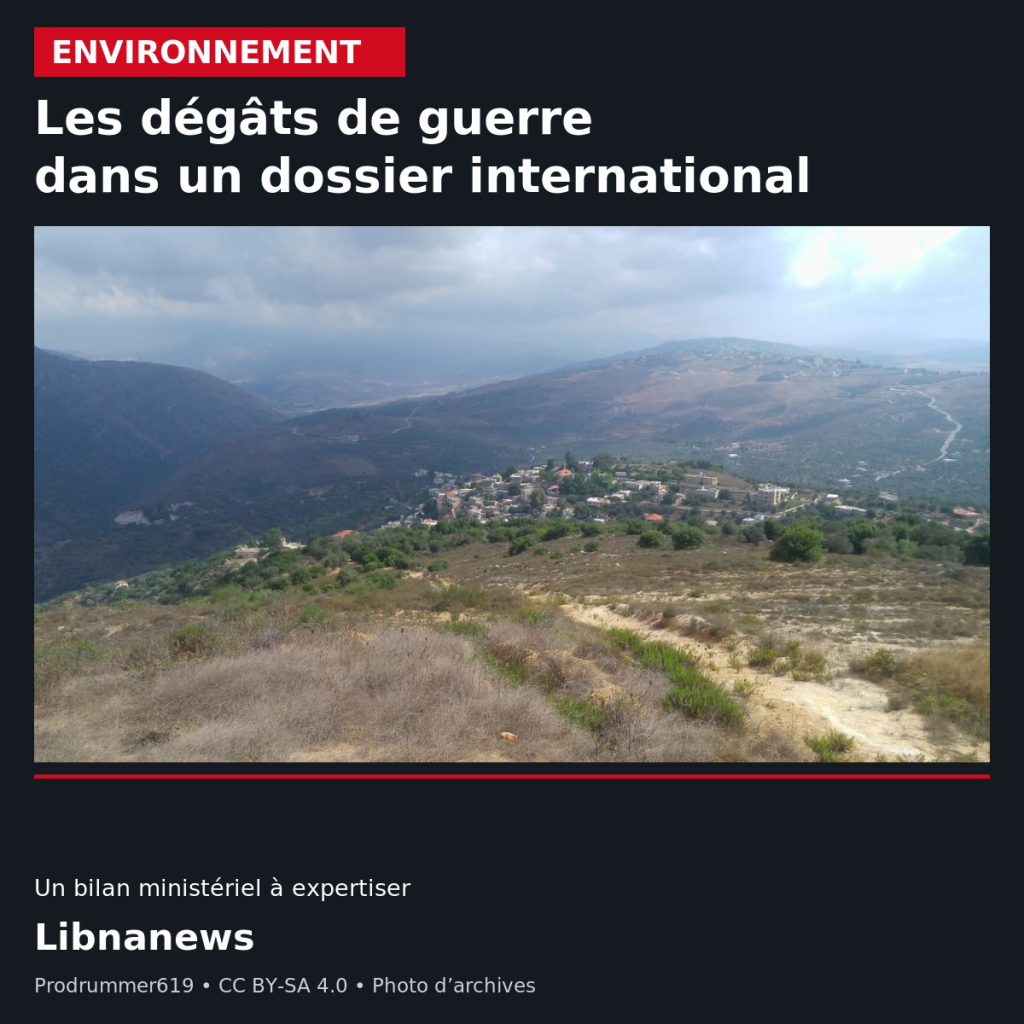
Lebanon is preparing an international complaint file on the environmental damage caused by the Israeli attacks. In an appeal released on 6 November, Environment Minister Tamara el-Zein presented the destruction recorded between October 2023 and September 2026 and requested support for their reparation. The approach aims to transform the documentation of damage into a demand for responsibility and funding.
The file is still in preparation. The announcement does not mean that a court has already established liabilities or that compensation has been granted. However, it gives a concrete perimeter to a subject that does not stop with the end of the bombings: the state of the land, water and ecosystems on which the inhabitants depend.
Environmental Damage: Departmental Figures
Tamara el-Zein reported over 16,000 hectares of agricultural and forest land burned during the reporting period. It attributes these fires to Israeli bombings, including phosphorus munitions and other projectiles. These figures are those of the ministerial review presented in his appeal.
The Minister also mentions more than 550 hectares affected within the perimeter of the Jabal Rihane Biosphere Reserve. It cites several other protected or natural areas, including Ramiyé, Beit Lif, Wadi Hujair, Debel, Abbassiyé, Tyre, Kafra and Nmeiriyé.
The surfaces indicated shall not be added as necessarily independent categories. The public balance sheet does not provide a detailed mapping of their possible overlaps. It describes damage to agricultural land, forest areas and protected areas, without allowing an additional total area to be calculated from these numbers alone.
Glyphosate and soil analysis needs
The Ministry claims that more than 2,000 hectares were damaged by spraying of glyphosate over southern villages. This allocation is contained in the ministerial declaration. The complete results of the samples, their location and the method used to define the surfaces are not attached to the elements consulted.
For the agricultural recovery, these details count as much as the announced extent of the damage. An affected area alone does not provide information on the concentration of a product in the soil, its evolution or its consequences for a particular crop. We must avoid turning a spatial balance into a uniform diagnosis of all products in the region.
The Minister calls for monitoring of pollutants and remnants of ammunition in soil and water. It links this monitoring with the safety of production and the return to the fields. The need for control does not mean that an identical hazard would have been established on each parcel.
Explosions to study, without announcing an earthquake
A preliminary report of the Ministry, based on data from the National Geophysical Centre, is also invoked concerning explosions in the South. Tamara el-Zein quotes Majdal Zoun, the outskirts of Beaufort Castle and the hill of Ali Taher. It describes similar signals, in the measurements reported, to tremors of different magnitudes.
The Minister herself requests specialized studies before concluding an effect on faults or subsequent seismic activity. The detection of vibrations caused by an explosion therefore does not establish that a tectonic earthquake has been triggered. This point must remain separate from the assessment of damage to buildings, terrains or natural environments.
Scientific conclusions require measurement sets, uncertainties and appropriate expertise. The geographical proximity of a fault, mentioned in the call, does not replace this demonstration. The environmental assessment must maintain this reserve rather than turn preliminary data into a disaster scenario.
A case before international bodies
Tamara el-Zein reported that the damage had been documented with the National Council for Scientific Research. The reports were presented to the Council of Ministers and data were provided to a mission of the Office of the United Nations High Commissioner for Human Rights. She also mentioned coordination with the National Commission on International Humanitarian Law.
The preparation of a complaint is the announced stage. The material made public does not yet specify in sufficient detail the final procedure, its timetable and all the documents to be filed. An international claim for reparation is not confused with the confirmed commencement of a trial.
The Minister also intends to raise the environmental and climate costs of wars in COP31 discussions. Local documentation and international negotiation are complementary functions here: establishing damage on one side, seeking support mechanisms on the other.
For the inhabitants, the expected result exceeds the recognition of a figure. It concerns the possibility of returning to cultivation, using water and restoring a safe environment. The next steps will need to specify the actual expertise, rehabilitation needs and funding available, without assuming compensation already acquired.





Comments