

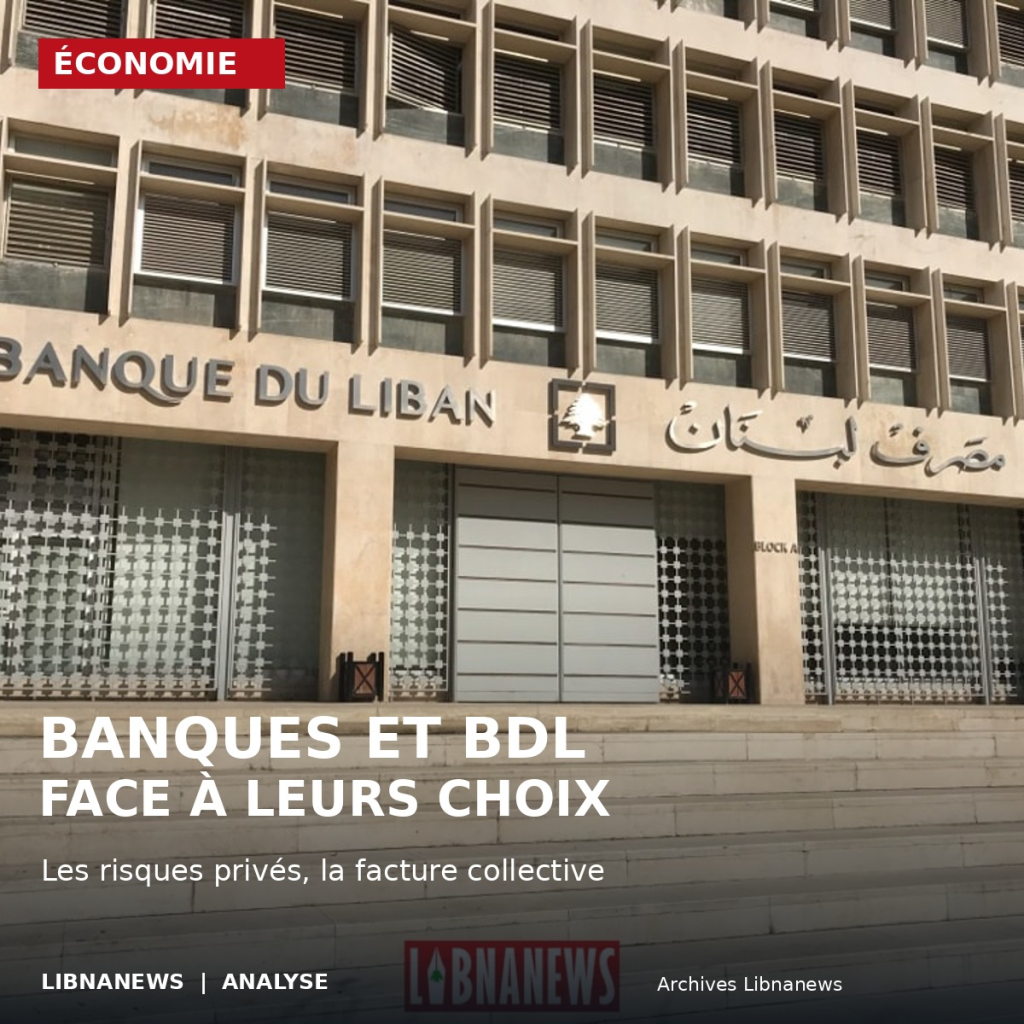
The Lebanese crisis is not only that of a State that has borrowed too much. It is also the case of banks that have concentrated their customers’ deposits on public risk, a central bank that has paid more and more the dollars needed for the survival of the model, and then institutions that have allowed savers to bear part of the adjustment without general settlement of losses. These responsibilities complement each other. None can serve as an alibi to others.
The financial record must therefore be placed differently than by the confrontation between « the state spent the money » and « the banks took the deposits ». It is necessary to replenish commitments, distinguish the resources actually available from accounting records and identify who has chosen risks, collected revenues and retained decision-making power. A household that entrusts its savings to a bank does not lead its risk committee or exchange rate policy. It is already a way of diluting responsibilities.
The stake goes beyond repairing the past. Lebanon must find a system capable of financing companies, not just managing blocked accounts. Saving this function is essential; preserving owners and managers of establishments at all costs is not. A restructuring that would require citizens to pay without having first assessed assets, absorbed losses from equity and examined management decisions would recur the central defect of the model: private incomes on one side, collective risks on the other.
The public balance sheet to which banks have attached themselves
In July 2019, before the open explosion of the crisis, the IMF estimated the banks’ sovereign exposure to 68.5% of their assets, more than eight times their first-class equity. Government securities accounted for about 14% of assets, and deposits with BDL about 55%. The State and central bank risks therefore did not form two independent protections. They were the two sides of the same dependence on the country’s financing.
This proportion allows us to understand vulnerability without invoking an unpredictable disaster. In a purely arithmetic illustration, an institution exposed to eight times its own funds loses the equivalent of these own funds if the value of this exposure decreases by 12.5 %. This calculation is neither an estimate of the losses of each Lebanese bank nor a complete simulation of their balance sheets. It shows why extreme concentration can absorb a seemingly comfortable capital cushion very quickly.
Diversification does not involve multiplying the names of instruments when their repayments depend on the same source. Holding a Treasury bond, a central bank deposit certificate and a debt on a mechanism that refinances the Treasury can multiply portfolio lines without diversifying its economic risk. The real test is that of a common shock: what remains if currency inflows slow down, if the currency loses its credibility and the state can no longer borrow normally?
For the banks, the primary responsibility is here. They accepted a dependency that was measurable in size. Regulatory authorities do not erase this management decision. An authorized asset may be dangerous when it dominates the balance sheet, especially when the resources that finance it belong to customers who are likely to claim repayment.
The State has created an unsustainable demand for financing
The role of governments must not disappear behind that of bankers. In its July 2019 diagnosis, the IMF estimated public debt at 151% of GDP for 2018 and the budget deficit at 11%. Interest accounted for over 9% of GDP. These figures described an economy in which debt servicing absorbed considerable resources even before properly financing infrastructure and public services.
A deficit alone is not an economic fault. Borrowing for productive investment can increase future revenues. The problem arises when successive borrowings do not build proportionate repayment capacity and interest requires new financing. The cost of the past then weighs on each budget, while the promise of reforms justifies the continuation of credit. The following loan does not resolve the imbalance: it postpones its settlement.
The World Bank described this political economy in its 2022 report on public finances. It analyses a resource capture for established interests and a model that has allowed essential services to deteriorate. Electricity, water, health, education and social protection are not secondary elements of the financial crisis. When the public service operates poorly, households pay again to obtain a private service, often of unequal quality.
This prohibits two simplifications. The first would be to make banks the only source of the disaster. The second would be to conclude that, since the State has a major responsibility, all citizens must guarantee unlimited bank commitments. Public debt calls for restructuring and fiscal reform. It does not automatically transform the wrong choices of professional investors into fully protected claims on the company.
Two deficits, same dollar dependency
The budget deficit and the external deficit are often confused. The first measure is the difference between revenue and public expenditure. The second, in its current dimension, describes trade in goods, services and income with the rest of the world. Lebanon could therefore need funding both for its treasury and for the external payments of its economy. The same capital inflows helped to support both balances.
In February 2018, the IMF recorded a current account deficit of more than 20% of GDP, while private deposit growth was only 3.8% in 2017. Fragility was not simply due to the existence of imports. It was the result of long-term financing dependent on financial inflows, in a system whose monetary stability encouraged confidence in dollar commitments.
Money sent by the diaspora can finance a family, a real estate purchase or a bank deposit. It does not necessarily constitute a productive investment which then generates the currencies necessary for repayment. An inflow of dollars can give liquidity today while creating a debt for tomorrow. This difference between income and financing is essential: both bring in currencies, but only the latter must be returned to a creditor.
BDL and banks could not control external trade, public spending or geopolitics alone. However, they could measure their dependence on these flows and draw limits from them. Mismanagement is not just about risk. It also involves organizing its activity as if a known risk could never materialize.
A central bank does not make the promised dollars
A central bank may issue its national currency. It cannot create the motto of another country at will. This limit gives particular importance to Lebanese dollarization. A dollar-denominated deposit is an undertaking in a unit that neither the commercial bank nor the BDL can produce by simply issuing books.
The difference between liquidity and solvency becomes decisive. An institution may temporarily lack liquidity while possessing assets whose value covers its debts. It may also have some liquidity but not enough assets to repay all its creditors. In the first case, temporary funding can solve the problem. In the second, one must recognize a loss, make capital or change commitments.
The diagnosis is therefore not deducted from the only amount of tickets available at the counters. A bank able to satisfy a small fraction of withdrawals does not prove that it could honour all its deposits. Conversely, a rationing can preserve cash without restoring credit. The confusion between these two concepts has a political consequence: it allows us to present as provisional a disability that requires restructuring.
We must also look at the currency of repayment. Returning a claim in dollars to books at an unfavourable rate is not a neutral transaction. The nominal amount may remain on a document, while its use value has been reduced. For a depositor who has to pay for hospitalization or study abroad, it is the currency actually available and transferable that counts, not only the account title.
Financial engineering paid for the postponement of the problem
BDL operations sought to attract the currencies needed by the system. Among other things, the 2019 IMF report describes a mechanism in which a new dollar deposit was valued at 6.5%, with the possibility of borrowing slightly more than 2% in pounds and placing it with the BDL at 10.5% for 10 years. Transactions since autumn 2017 had attracted more than $24 billion from banks until February 2019.
The mechanism is more revealing than its name. The commercial bank contributes dollars and earns a return, plus a margin on a low-cost book transaction. The central bank immediately obtains the currencies, but accepts the financial liabilities. The operation improves cash flow while increasing future bills. It does not create, on its own, an export, a tax revenue or an activity capable of providing the dollars of repayment.
It would be wrong to mechanically add up the two rates to announce a universal yield: currencies, amounts, maturities and conditions differ. But the incentive is clear. The more advantageous the public institution pays for investments, the less the financing of ordinary enterprises seems attractive at comparable apparent risk. Bank profitability can then depend more on a monetary decision than on the productive capacity of the economy.
As early as January 2017, the IMF Board of Directors warned that the 2016 non-conventional transactions had strengthened reserves without constituting a durable solution. Their criticism, therefore, is not just a retrospective one. The problem was what kind of reform the time purchased should be used for, and who would bear the bill if this reform did not happen.
The stability displayed had an increasing cost
Defending an exchange rate can limit uncertainty and temporarily protect income. But parity is not sustainable only because it remains visible. It must be based on compatible resources, fiscal policy and external financing. When these conditions deteriorate, maintaining the price requires an increasing cost or adjustment elsewhere.
The IMF reported in February 2018 that BDL’s operations had preserved stability but had caused market distortions, created money and weakened the balance sheet of the central bank. It recommended a more conventional policy and a reduction of certain interventions in public debt markets. He also highlighted the risks associated with the maturity and sovereign exposure of the banking sector.
These warnings require a distinction between tactical success and strategic failure. Avoiding a breakup for a few months can be useful if this delay reduces vulnerability. If the liabilities accumulate faster than the capacity to repay, the delay instead increases the size of the future adjustment. The visible result remains reassuring until continuity becomes impossible.
The governance problem is precisely to subject these arbitrations to control. A policy that engages the public balance sheet on a sustainable basis should not be evaluated solely on the basis of the daily rate or the annual bank profit. It is necessary to know its total cost, beneficiaries, deadlines created, unfavourable scenarios and means of exit. Without this information, stability becomes an argument of authority instead of being a verifiable result.
Why gross reserves are not enough
A stock of currency is not necessarily a wealth available without consideration. When a central bank receives dollars from banks, its assets may increase, but its liabilities to them also increase. Presenting only the first movement gives an incomplete picture of the country’s financial protection.
An example allows you to follow the circuit. A customer deposits 100 dollars in a bank, which places 80 with the central bank. The bank still owes 100 to the client and holds a debt of 80 on the BDL. If it uses the dollars to satisfy other payments, the bank debt does not disappear. But its presence in a balance sheet no longer means that the corresponding $80 is immediately available. The remaining assets and their salvage value should be reviewed.
This example is an illustration, not the reproduction of a particular Lebanese operation. It also explains why the addition of losses can become misleading. A loss of BDL on an asset can be passed on to the value of the bank claim and then to the ability to repay the depositor. Counting each event as an independent loss would artificially inflate the total. Conversely, eliminating claims between institutions when consolidated does not cancel the lack of resources vis-à-vis depositors.
A serious estimate must therefore specify its scope: BDL, banks, state or consolidated ensemble; nominal value or recoverable value ; books or dollars; date and conversion rate. The large amounts without these definitions serve the political confrontations more than they help decide who should contribute how much.
The default of March 2020 does not explain October 2019
On 7 March 2020, the government announced the suspension of the payment of a $1.2 billion Eurobond due on 9 March. The Department of Finance news release invoked the protection of foreign currency reserves. This decision constituted a major break in the relationship with bond creditors.
However, it did not retrospectively create the banking difficulties of 2019. The restrictions on access to deposits and the scarcity of dollars were earlier. The IMF 2023 report places the reversal of flows before the sovereign default. The pandemic and explosion of the port of Beirut then aggravated an already-initiated crisis. Respecting this chronology prevents turning a decisive event into a unique explanation.
The banking sector defended another reading of its responsibilities. In its 2020 annual report, Crédit Libanais stresses the consequences of default and the absence of a capital control framework, presenting banks as exposed to public decisions. This argument identifies real institutional failures. It does not answer the previous question: why did the institutions have so many risks associated with the same institutions?
The defect can be criticized for its preparation and for the lack of rapid settlement which followed. But continuing payments would not have created a new source of dollars. The real choice was the use of scarce resources and the organization of losses already accumulated. Opposing full payment and disaster avoids discussing the scenario that should have been prepared: a coordinated restructuring of the state, banks and central bank.
Professional responsibility, not just victim status
The regulations set a minimum of constraints. It does not replace the judgment of the leaders. The Basel Committee’s banking supervision principles give the board the ultimate responsibility for a sustainable strategy and place the focus on risk concentration. These standards are a benchmark for good management; They alone are not valid for judgment on a specific violation of Lebanese law.
To assess the responsibilities of an institution, it is necessary to examine its concrete decisions. What proportion of the balance sheet depended on the public sector? With what deadlines? What resistance tests were performed? Did management limit its exposure when pay increased? Were profits retained to absorb losses or distributed? Did clients receive information proportionate to the risks?
These are management issues before being criminal issues. A choice can be legal and yet reckless. An administrator may have underestimated a risk without diverting funds. But the absence of a conviction is not enough to demonstrate that its management deserves public financial protection. Conversely, a fraud charge requires proper evidence and procedure; it is not deduced from a bad collective result.
The distinction must have practical consequences. Shareholders have provided the capital that pays and absorbs entrepreneurial risk. The leaders exercised decision-making powers. Ordinary depositors purchased a retention and payment service, not a participation in the investment committee. Divide the losses as if these three positions were equivalent would remove the very meaning of bank liability.
Past profits and present losses must be reconciled
A report published on a given date does not tell everything. To understand economic responsibility, it is necessary to follow several years: interest income, dividends, remuneration, capital injections, transactions with related parties and changes in claims. A bank may have posted profits before a latent risk becomes a recognised loss. The question is how much of this income was based on sustainable payments and what proportion depended on commitments that could not normally be met.
A rigorous analysis cannot announce that any past dividend was illegal. It must look for the accounting basis, the information available at the time of distribution and the applicable rules. On the other hand, requiring this review is not excessive when a recapitalisation or a public contribution is envisaged. It would be inconsistent to treat as permanently private the income from a risk whose realization would then be fully collectived.
The same reasoning applies to leaders. Their responsibility is not limited to their personal wealth or their presence in an institution at the time of the collapse. It depends on their functions, approved decisions, alerts received and powers available to them. Recaptures of assets or remuneration may be sought where a legal basis permits. They must be encrypted from files, not advertised as a certain money reserve.
The order of operations counts. The valuation of assets and capital must precede the promise of support. Otherwise, the amount requested from the community becomes the starting point, while the management review is referred to an indefinite future. This is exactly the type of reversal that a credible crisis exit must prevent.
BDL has a specific institutional responsibility
The central bank was not one of several depositors. It defined the instruments, set their conditions and held a central position in the organisation of financing. Its economic responsibility therefore lies in the design of the scheme, its continuation, the quality of the published information and the way in which risks have been monitored.
Personal responsibilities must be established separately. Reducing the whole crisis to a single governor would leave out of scope collegial decisions, supervisory arrangements and participating banks. Conversely, invoking collective responsibility should not allow everyone to disappear behind the institution. The useful chain is that of acts: proposal, approval, execution, control and information.
The BDL announced in September 2026 the launch of a new audit by Alvarez & Marsal, which began on 17 August. It concerns selected transactions related to external assets between October 2019 and December 2023, including grants, transfers and letters of credit. The launch of a mission is not its result. It does not make it possible to state in advance that a particular transaction was fraudulent or that an amount would be recovered.
Its interest will be to document decisions and their beneficial owners. For essential import support operations, a distinction must be made between the cost of an economic policy choice, mistargeting, possible abuse and established infringements. Misconceived spending and embezzlement are not the same. Confounding them would make it more difficult, rather than easier, to identify real responsibilities.
The rationing also distributed the losses
Failure to quickly adopt a comprehensive solution does not mean that losses wait intact in a trunk. They are distributed through limited withdrawals, conversions, sales of haircuts and erosion of purchasing power. Households who need money immediately do not have the same bargaining power as those who can wait.
A conversion illustrates this transfer. If a debt of $1,000 is paid in pounds at a rate of 20 per cent of the rate at which its recipient can redeem dollars, it returns only the equivalent of $200. The economic loss then reaches 80%, regardless of the word used on the survey. This example is hypothetical and does not describe a rate currently applicable. It explains why the settlement of a deposit must be valued, not only in accounting units.
Time produces another haircut. To receive $10,000 in ten years does not amount to receiving them today. With an illustrative discount rate of 5% per year, the present value is about $6,139. This rate is neither a forecast nor a bank rate. The calculation shows that a full nominal repayment, very delayed and possibly risky, may leave a significant economic loss.
The IMF estimated in 2023, in a restructuring scenario comparing March 2020 and January 2023, the decrease in recoverable deposits due to the postponement of the treatment of the crisis to approximately $10 billion. This is a scenario calculation, not an individual account. His teaching is direct: waiting has a cost, and it is not necessarily distributed according to the responsibility of each.
Circulars do not replace restructuring
Withdrawal schemes bring usable money to beneficiaries who need it. Their immediate usefulness should not be minimized. However, they do not regulate the valuation of all assets, the capital required by each bank, or the final treatment of the rights of all depositors.
According to the presentation published on 4 November 2026 by the Economic Research Unit of Crédit Libanais, the 3 November amendments to Circulars 158 and 166 are to enter into force on 1 December. They raise the monthly limits to $1,200 and $600 for eligible beneficiaries. Cash components remain at $800 and $400, respectively; The increase relates to expenses per card. Therefore, the new ceilings should not be presented as fully withdrawable in banknotes or as already applicable on 8 November.
This distinction reveals the administration of the device. A right of use limited to certain payments does not exactly have the same properties as a freely transferable dollar. The monthly ceiling is also not sufficient to determine the final recovery: account must be taken of eligibility, cumulative limits, duration and future deduction rules.
For the applicant, transparency should be kept in a few details: recognized amount, value already refunded, balance, currency of return, calendar and right of appeal. A succession of circulars can improve certain flows without providing this complete contract. Therefore, their extension should not serve as evidence that the establishments have recovered from normal activity or that the loss conflict is resolved.
Productive credit remains the major victim
BDL data for December 2025 provide a measure of the impasse. Total bank assets amounted to $102 billion. The BDL currency and deposit line accounted for 77.5 billion, or 76% of the total. Credit claims fell to $5.2 billion, down from $58.1 billion in January 2019, accounting for only 5.1% of assets.
The dollar comparison should be interpreted with methodology. It combines repayments, contraction of activity, exchange changes and valuation effects. It does not mean that the totality of the difference corresponds to new loans refused or the same amount physically disappeared. But the weakness of the credit position in the final balance sheet shows that the intermediation function remains profoundly damaged.
A company can have orders and lack cash to buy its raw materials. An exporter may need financing between production and customer payment. Cost-effective equipment may require several years of depreciation. Without adequate credit, these projects depend on the property of the owner, relatives or investors able to bring funds immediately.
The result is an economic selection that no longer relies solely on the quality of the projects. It favours those who already have liquidity. An economy can continue to trade in cash while losing the mechanisms that finance investment, allocate risks and allow new entrepreneurs to enter the market. The number of open agencies or transactions carried out is therefore not sufficient to measure bank recovery.
A crisis that changed income distribution
The World Bank measured poverty at 44 per cent in 2022 in the areas covered by its survey, up from 12 per cent in 2012. For Lebanese nationals from these areas, the figure was 33 per cent. The study published in May 2024 covers five governorates and must not be transformed into an exhaustive measure of the entire Lebanese population in 2026. Nevertheless, it shows a considerable social deterioration.
Access to the dollar separated situations. A household receiving transfers from abroad does not suffer the same shock as an employee paid in pounds, even if both live in the same neighbourhood. The existence of visible consumption, frequent restaurants or real estate purchases therefore does not refute the impoverishment of other groups. An average and some signs of prosperity do not describe the distribution of resources.
The cost exceeds immediately lost revenues. Postponing care, interrupting training or selling an asset to finance current expenses can permanently reduce household opportunities. These effects must be distinguished from the book value of bank losses: they cannot be added without a method, but cannot be excluded from an analysis of the consequences.
In 2023, the IMF described an economy that had lost about 40 per cent of its activity since the beginning of the crisis and a depreciated currency of 98 per cent. This is dated order of magnitude, not an updated calculation to November 2026. They show why the banking issue cannot be settled by closed negotiations between balance sheet holders: it involves citizens who sometimes have never owned a significant deposit.
To absorb losses in the right order
The principle is not an improvised sanction against the private sector. The Financial Stability Board defines an effective banking resolution as a mechanism that preserves essential functions while allowing the absorption of losses according to the debt hierarchy, without exposing taxpayers to an undue invoice. It therefore distinguishes the continuity of services from the survival of owners.
In September 2026, the IMF explicitly reminded Lebanon that no depositor should absorb losses before shareholders and subordinated creditors. It also requested that the repayment be compatible with bank viability and public debt sustainability. These two conditions go together: protecting depositors cannot be a promise of impossible public financing, but protecting public finances cannot justify maintaining the capital of owners intact at the expense of customers.
In practical terms, assets must first be valued at defensible value, losses must be measured and the capitals that absorb them must be identified. Sustainable institutions need to have truly available inputs. A promise of capital, an uncertain future profit or a debt to an institution itself insolvent are not equivalent to new resources.
Banks which cannot fulfil these conditions must be subject to an orderly restructuring, business transfer or liquidation mechanism, according to the applicable framework. Useful jobs and functions deserve to be protected as much as possible. Control of existing shareholders does not, however, constitute a right to retain independently of the losses incurred by their institution.
Public contribution must be limited and justified
The State cannot declare itself alien to the consequences of its debts. But its ability to contribute depends on future revenues, core expenditures and other commitments. Offering a guarantee without defining its financing moves the problem to taxpayers or to the currency, without creating any additional resources.
A simple budget example makes it possible to see the cost of a promise. An annual public payment of $1 billion over 10 years represents $10 billion before interest and discount. It must come from revenue, savings, assets or borrowing. This illustrative amount does not describe any plan adopted. It only requires that the consideration be named: which taxpayers pay, which services are reduced, what goods are mobilized and what new debt is created?
A contribution may be discussed to protect essential functions or a category of applicants. It must then be capped, transparent and accompanied by counterparties. It shall not be used to replenish without charge the value of shares whose losses should have been recognized. Monitoring the use of funds and publication of economic beneficiaries becomes as important as the amount announced.
Mobilizing a public asset requires the same review. Its sale is not a reproducible income; it exchanges a heritage for a one-time resource. It can also deprive subsequent generations of a reserve or income. The gold file falls under this specific heritage issue. It should not be used as a shortcut for banks to assess their own losses and recapitalisation capabilities.
Recaptures of justice do not replace own funds
Searching for assets unduly obtained is necessary where there are elements and legal basis. This makes it possible to restore resources and make accountability effective. But an amount referred to in a proceeding is not necessarily a recoverable amount, immediately available and available to depositors.
Several steps must be distinguished: the identification of an asset, its possible freezing, the court decision, the appeals and its effective restitution. Barriers to ownership, jurisdiction or enforcement may occur. A financial plan should therefore incorporate future recoveries only with explicit assumptions, rather than as liquidity already held.
This discipline is not a reason to slow down investigations. It prevents them from being used as a justification for postponing restructuring. The response to personal faults and the restoration of a solvent system can progress simultaneously. Pending the end of all litigation to deal with balance sheets would impose additional uncertainty on depositors without a guarantee of better results.
The same applies to transfers made during the crisis. The dates, conditions, beneficiaries and then applicable rules must be examined, without assuming that any transfer was fraudulent. Transactions prioritising related parties or circumventing obligations must be established and treated as such. It is the documented investigation that makes it possible to recover funds and incur liability, not a general accusation against all customers who have been able to withdraw money.
The criteria for reparation that does not protect decision-makers
Lebanon had reached an agreement at the IMF service level in April 2022 on a programme of approximately $3 billion over 46 months. This was not definitely approved funding: pre-measures and validations were still needed. The amount represented potential support for a reform strategy, not an amount capable of repaying accumulated financial commitments alone.
The quality of a crisis exit will now be measured on observable results. Each institution must have an independent assessment of its assets and liabilities. Capital inflows must be verifiable. Small applicants need to know their rights and timing. Resolution decisions must identify what is preserved, what is restructured and what owners lose. The authorities must publish a coherent vision of public commitments rather than a series of separate promises.
Governance must change with the balance sheet. Maintaining the same powers without reviewing old decisions would weaken the credibility of new commitments. The reconstitution of risk committees, transparency of related parties, control of distributions and quality of financial information are not technical accessories. They determine whether new deposits and credit will be protected against repetition of the same concentrations.
Finally, repair must be judged from the point of view of those who use the system. Can an applicant know the value of his claim and challenge it? Can a viable company obtain financing without belonging to a privileged circle? Does a taxpayer know what contribution is being requested and why? As long as these answers are not concrete, announcing the return of trust does not replace the work that makes it possible.





Comments