

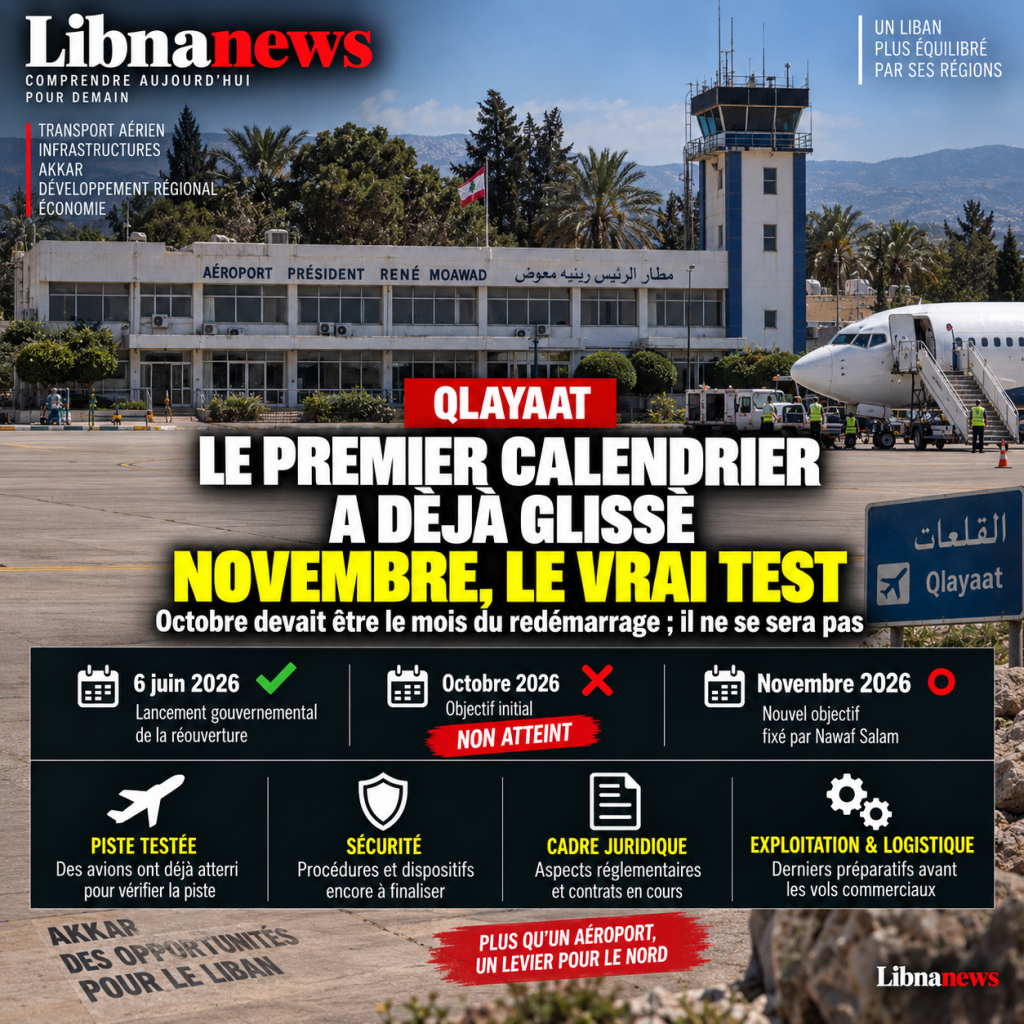
October was to be the month of restart; He won’t be
On 7 October, Nawaf Salam set a new target: commercial flights are scheduled to start from the President René Moawad airport in Qlayaat in November. This announcement takes on another dimension when it is placed in the timeline of the last few months. On 6 June, the government announced the reopening of the site by presenting the project as a political, national and development decision. The month of October was then selected for the start of the activity. Upgrade work continued during the summer and aircraft landed on the runway to verify availability. In August, a first aircraft from the company to operate the airport even landed in Qlayaat, a preparatory stage for the partial civilian start-up which was still expected in October. This calendar was ultimately not kept.
The delay is not explained by a runway problem. Public Works and Transport Minister Fayez Rasamny identified two remaining categories of files: the security and legal components. He also described a weekly follow-up involving administrations, security services and relevant agencies, with verification of legal, technical, operational and logistical dimensions. On 6 October again, he refused to set an exact date and indicated only that he intended to start before the end of the year, insisting that the airport would not be open until it was fully ready, particularly in terms of security and logistics. Twenty-four hours later, Salam tightened this calendar by announcing November. The case has therefore changed at the top of the executive.
The meeting on 7 October shows what really remains to be locked
The composition of the meeting chaired by Salam is much more instructive than a general formula on Akkar development. Around the table were Rasamny, the president of the civil aviation regulatory authority Mohammad Aziz, his member Rabih El Khatib, Minister Hadi Moussa’s adviser, the head of airport security Fadi Kfoury, the president and general manager of the Beirut International Airport Mohammad Choucair, the general manager of roads and buildings Pierre Maalouf, as well as Ziad El Mouna, linked to the operating company, and other officials. In other words, the actors present correspond precisely to the issues that still prevented openness: regulation, law, security, operation, infrastructure and logistics.
This was not the first time these officials were gathered around the case. On 11 September, the Parliamentary Committee on Public Works had heard from Rasamny, a representative of the Court of Auditors, Mohammad Aziz, Pierre Maalouf, the chairman of the board of directors of the operating company Qlayaat, Ziad El Mouna, and its managing director, Elie Sfeir, among others. The Court of Auditors’ presence is particularly interesting because it confirms that the case is not limited to aeronautical conformity: the legal and financial form of the operation is one of the questions followed. On October 7, when Salam spoke of a « final phase », he did not describe a simple end of the project. He describes the simultaneous closure of several administrative files that have already moved the first calendar.
An operating company already exists, which changes the nature of the project
One of the elements missing from a superficial reading of the file is the existence of an identified operating company. As early as September, Ziad El Mouna was presented as Chairman of its Board of Directors and Elie Sfeir as its Managing Director. The landing in August of a first aircraft of this company also shows that the project had gone beyond the stage of intentions. This does not mean that a regular commercial network was ready to start: the available sources do not yet list the airlines that will sell tickets, destinations or frequencies. But exploitation is no longer just a project that the administration would seek to entrust one day to an operator.
Previous discussions on the economic model of the site also show that private exploitation was seen as a central element. A May dossier referred to a formula whereby an operator would operate for four years, with a 10% share of the annual revenue from the State, as well as maintenance and aircraft responsibilities. This scheme must be handled with caution: the elements found do not allow to assert that this precise formula is today the final contract in force, nor that all its parameters have been retained. However, it reveals the type of assembly studied during the year and explains why legal, financial and public control aspects remain decisive before the opening.
The blocking point is no longer « can we land a plane? »
The summer trials have already moved the issue. Aircraft used the runway and the first operating aircraft landed in August. The problem is therefore no longer that a device can physically land in Qlayaat. A commercial airport must be able to provide the whole of a rotation: arrival, security, handling of passengers and baggage, ground operations, coordination with civil aviation control and departure. It was this chain that Rasamny designated when he spoke of the technical, operational and logistical requirements that still need to be completed.
The difference explains the difference between the image of a ready runway and the absence of scheduled flights. An infrastructure can pass a test landing while not yet having all the necessary permits or procedures for daily commercial operation. The government seems to have chosen not to symbolically open the site before closing these files. This decision is consistent with the sentence repeated by Salam on 7 October: no acceleration should be made at the cost of technical and security standards. However, it makes the November deadline much more demanding, since the first October target was not met for these reasons.
Safety is not a detail added at the last moment
The presence of Fadi Kfoury in the prep device confirms that airport security is one of the last locks. Rasamny had explicitly cited the previous day as one of the areas in which full availability had to be verified. It’s not just about placing agents in a terminal. The opening of a civilian airport means that control responsibilities are defined, access is secured and procedures are compatible with air transport standards. The corpus does not provide details of the personnel, equipment or control procedures already installed; Inventing them would give a false impression of accuracy.
The Lebanese context gives this issue additional weight. One of the historical arguments of the Qlayaat defenders is precisely the need to have an airport of withdrawal if Beirut’s activity is interrupted. Jamal Khodr, chairman of the civilian committee for the development and operation of Qlayaat, defended this logic of continuity of air transport in May. An airport designed as an emergency solution must be able to operate under difficult circumstances, not only during an opening. The robustness of its security system is therefore part of its raison d’être.
Qlayaat is officially presented as a complement to Beirut, not as its rival
A further clarification can be seen from the year’s statements. Mohammad El Hout, president of the national company, welcomed the launch of the project by stating that Qlayaat was an addition to Lebanese air transport and did not compete with Beirut airport. This distinction illuminates the model sought. The State does not appear to be planning a transfer of main traffic from Beirut to the North. It seeks to add a platform that can meet different needs and provide redundancy to the air system.
This complementarity may take several forms, but not all are yet confirmed. An August dossier referred in particular to the study of the use of Qlayaat to welcome and transport Syrian travellers, as part of a possible reorganization of flows between Lebanon and Syria. This was a study option, not a commercial line announced. The difference is important. The potential of Qlayaat is real, but the corpus still does not allow to publish a list of destinations as if it were decided. The government today has a timetable for opening up; it has not yet made public the commercial programme which will give its content to this opening.
The project is linked to a much broader plan for the North
Salam does not present Qlayaat as an isolated infrastructure. In a September intervention, he placed him in a broader vision for the North and Akkar including the development of the Tripoli port, the railway project, the activation of the special economic zone and the role of the Rachid Karami complex. This articulation is more substantial than the general formula of « regional balance ». It indicates that the government is seeking to create several connectivity points in the north of the country: air, sea, land and economic. The Tripoli port project and the recent integration of Lebanese ports into a network linked to the India-Middle East-Europe corridor further reinforce this logic.
The success of Qlayaat will therefore depend in part on its ability to fit into this set. An airport with few flights will remain local equipment. An airport linked to logistics, Tripoli and Akkar’s economic needs can have a different effect. Again, the figures are missing: the corpus does not provide an up-to-date study of the number of jobs, expected traffic or revenues. The right way to deal with the case is not to make these projections, but to see that the government has already defined the political architecture in which it wants to register the airport.
The file also has a story of promises, which explains the local mistrust
Qlayaat was not born in 2026. The site was inaugurated in 1949 and its return to a regular civil service has been claimed for years. Talal El Merhebi recalled in June that the project was already one of Rafic Hariri’s priorities and felt that the airport had the space and capacity to offer services comparable to those in Beirut. Jamal Khodr, for his part, stressed that the recovery could support tourism, transport, services and the export of agricultural products. These statements are those of advocates of the project; They express expectations, not results already achieved.
Even more interesting is their concern about governance. Khodr had explicitly requested a transparent plan and international tendering based on a model of partnership with the private sector. This request shows that the local debate is not just about openness. It covers the way the airport will be operated, the transparency of the installation and the share of revenue to the State. The subsequent presence of the Court of Auditors in parliamentary meetings confirms that this question is not an accessory. For a long-delayed project, the quality of the operating contract will weigh almost as much as the date of the first flight.
The shift from October to November now becomes a political indicator
Salam’s new commitment must be read in the light of this first delay. In June, October was the beginning horizon. On 6 October, Rasamny further explained that he could not give an exact date before full availability and was simply aiming for an opening before the end of the year. On October 7, the Prime Minister announced commercial flights for the following month. This is not a simple repetition. Salam tightens the window and turns November into a political deadline.
If the airport actually opens in November, the government will be able to argue that the postponement of October was the closure of security and legal files, not a stalemate. If November passes without commercial flights, it will be necessary to identify the remaining lock: certification, security, operating contract, logistics or lack of commercial offer. This distinction will be essential for judging the project. A further delay without a precise explanation would bring back the story of the ads not followed with effect that has accompanied Qlayaat for years.
The first flight will not be enough: one will have to look who flies, where and according to which model
The government can now hold an inauguration. The economic question begins after. A one-time flight does not prove that an airport has a sustainable model. The information that is still missing is precisely the information that will enable it to be assessed: company identity, destinations, frequency, pricing policy, conditions granted to operators and articulation with Beirut. Sources available as at 7 October do not provide these responses. It is their absence, not editorial weakness, that must appear in the article.
The Qlayaat file is therefore more advanced than a limited reading of the announcement of the day suggests, but less complete than the formula « flights next month » suggests. An operating company exists, devices have tested the site, the first calendar has slipped, parliamentary committees have examined the assembly and the managers of safety, regulation and operation are now working in the same sequence. November will be the time when these parts will finally have to produce a real commercial service. Only then will Qlayaat cease to be a recurring development project to become an airport used by travellers.





Comments