

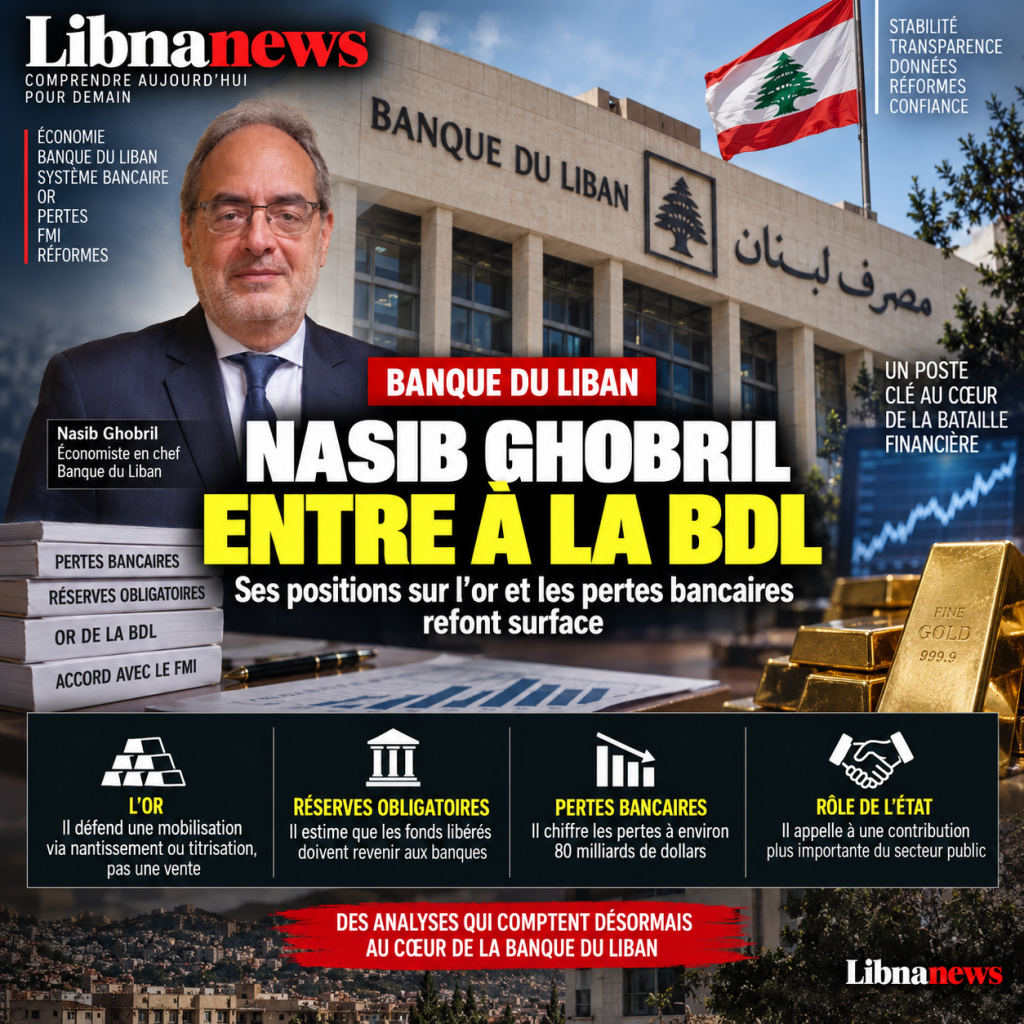
An appointment that reopens an older case than the crisis
Nasib Ghobril arrives at the Bank of Lebanon with a public past that largely precedes the collapse of 2019. For two decades at the head of Byblos Bank’s economic research, he commented on the debt, deficits, reserves, books and strength of the banking sector. Its analyses recognized the difficulties of the real economy, but mainly attributed the danger to the state, its deficits, its bureaucracy and the absence of reforms. The monetary and banking pillar remained the mechanism capable of preserving stability despite these weaknesses. His appointment as chief economist of the Bank of Lebanon therefore requires us to examine not only his positions since the crisis, but also what he said when the imbalances that were going to cause the collapse were already visible.
It would be excessive to write that Ghobril denied any crisis before 2019. He warned about low growth, debt, public spending and the lack of reforms. However, it did not publicly describe the banking and monetary system as moving towards systemic collapse. However, the signals existed: public debt over 150 per cent of gross domestic product, high interest rates, permanent need to attract foreign exchange, Bank of Lebanon interventions to defend parity and massive exposure of banks to the state and central bank. The difficulties were recognized, but the risk inherent in the financial model was relegated to mismanagement.
Before 2019: symptoms are recognized, the heart of the model remains defended
In 2018, Ghobril highlights the hiring of an additional 26,000 civil servants in three years, while the public debt is approaching $80 billion and about 150% of gross domestic product. It criticizes spending and political inability to initiate reforms. This reading is based on real imbalances. However, it leaves another mechanism behind: deficits are financed by a system in which banks attract deposits, place a considerable share of their resources with the Bank of Lebanon or in public debt, and benefit from high returns in order to maintain capital flows.
At the same time, other economists already explicitly speak of systemic risk and book overvaluation. The Bank of Lebanon is mobilizing its foreign exchange reserves to maintain parity. Rates on book deposits reach high levels, up to 6% to 9% in some 2018 observations. The model therefore increasingly depends on the country’s ability to attract new dollars. In the Ghobril grid, the problem remains mainly political and budgetary. The banking system appears to be more like the bulwark that absorbs the dysfunctions of the State than part of the mechanism that accumulates the risk.
However, the fragility of the reserves was identified
Long before 2019, Ghobril warned against the Bank of Lebanon using resources including financial sector deposits and minimum reserves to intervene on public debt. He explained that the problem would arise if a bank needed to recover that liquidity when it had been mobilized elsewhere. It therefore recognized that part of stability was based on an internal flow of resources between banks, the Bank of Lebanon and the State.
Other economists already described a circular relationship more frontally: banks financed the Bank of Lebanon, the central bank financed the State and the whole depended on continued deposits. Ghobril also acknowledged that some of the Central Bank’s operations aimed at maintaining stability weighed on its balance sheet and were contested by the Monetary Fund. He did not draw a global challenge to the model. The priority remained to preserve stability while reforming public finances.
The collapse reveals a massive concentration of risk
When flows slow down and the crisis erupts in 2019, the structure of the system appears. Banks have considerable exposure to the Bank of Lebanon and the State. The central bank owes large sums to the banking sector, while the state is unable to generate the resources necessary to meet its commitments. Client deposits have been converted into claims on banks, much of which depend on the repayment of the Bank of Lebanon. The stability of parity and high yields had not eliminated risk; They had it concentrated.
Two stories then oppose. Bank critics point out that institutions have voluntarily increased their exposure to high yields and have not sufficiently protected their depositors. Banks respond that they have placed their resources in the instruments of a system regulated by the State and the Bank of Lebanon. Ghobril is largely part of this second reading, even when he speaks of a shared responsibility.
The 2020 default: preserving financial continuity
Prior to the default on the euro bonds of March 2020, Ghobril opposes a unilateral cessation of payments. He believes that a default without a comprehensive programme and without credible negotiation would damage Lebanon’s reputation, further cut the market country and weaken the financial sector. It then refers to available assets, including gold, as resources that can be mobilized by guarantee or securitisation rather than by direct sale.
This position objectively protects the interests of eurobond holders, including Lebanese banks. It can be defended as an attempt to preserve future access to financing. It can also be criticized for delaying the recognition of the insolvency of a State already unable to refinance itself normally. After the default, Ghobril will continue to regard this breakdown as an error that has aggravated financial isolation.
Minimum reserves: direct convergence with banks’ interests
By the end of 2020, the Bank of Lebanon is planning to reduce the minimum reserve ratio in order to free up billions of dollars and extend subsidies. Ghobril then defends an unambiguous position: if the ratio is lowered, the amounts released must go back to the banks that deposited them. They do not, in his view, constitute a central bank’s own resource available to finance the State or public policies.
This thesis has become one of the pillars of the argumentation of the Banking Association. The ABL refuses to treat minimum reserves as a source of financial deficit and presents them as funds linked to banks and, behind them, to depositors. Convergence with Ghobril’s position in 2020 is direct.
Gold: another convergence that becomes clearer
Ghobril’s position on gold evolves in its modalities but retains a principle: the asset can be mobilized if the mechanism is credible. In February 2020, it refers to collateral or securitisation. In December, it considered the operation impracticable within the existing legal framework. In 2025, when the value of the stock increases sharply, it comes back with a numerical proposal: to provide the equivalent of three to four billion dollars in order to obtain liquidity for defined priorities. It therefore does not propose a general liquidation of ingots.
The Bank Association also places the Bank of Lebanon’s assets and gold-related gains among the resources to be examined in the resolution of the crisis. In 2026, it devoted a position to gold gains and depositors and criticized the proposed settlement of losses for failing to take sufficient account of the assets of the Central Bank. Convergence is based on the principle that the Bank of Lebanon’s assets must contribute to settlement before an excessive burden is imposed on banks.
State responsibility: the most structuring alignment
The clearest reconciliation concerns State responsibility. Ghobril describes the crisis as the product of decades of mismanagement, deficits, abuse of political power and lack of reform. He argues that a solution must involve the State, the Bank of Lebanon and banks. It considers that earlier recognition of the State’s financial responsibility would have reduced the duration of the crisis and the cost borne by depositors.
LABL today defends almost the same architecture. In its statement of 5 January 2026, it presents the State as the main beneficiary of the expenditure that generated the financial deficit and accuses it of not clearly recognizing its debts to the Bank of Lebanon. It invokes article 113 of the Currency and Credit Code and asserts that compliance with public obligations would significantly reduce the gap. On this issue, the doctrinal proximity between Ghobril’s positions and those of the ABL is particularly strong.
What this reading leaves behind: banks’ own decisions
However, the responsibility of the State does not remove the responsibility of banks in managing their risks. Institutions have chosen their exposure level to the Bank of Lebanon and sovereign debt. They benefited from high returns and continued to attract deposits as the system’s dependence on foreign exchange inflows increased. Boards and management had a responsibility to their institutions and clients. The fact that the investments were authorized or encouraged by the authorities does not remove this responsibility.
A solution that increases the contribution of the State, protects the minimum reserves and mobilizes the assets of the Bank of Lebanon mechanically reduces the amount of losses absorbed directly by the banks. On the contrary, the Monetary Fund insists on the hierarchy of losses: capital and shareholders must absorb losses before protected classes of creditors. The conflict therefore determines in concrete terms who will pay.
The « systemic crisis » is also a battle on the bill
Ghobril as the ABL describe the crisis as systemic. This qualification corresponds to the interlocking of the State, the Bank of Lebanon and banks. However, it has a political consequence: the more the crisis is presented as the result of the entire system, the less it can be attributed mainly to banks. This concept is used precisely by the ABL to demand a significant public contribution and to challenge projects that would absorb a portion of the bank’s money that it considers excessive.
Associations of depositors responded that the systemic nature of the crisis should not erase the hierarchy of responsibilities. They accuse the banking lobby of seeking to transfer part of its losses to the state, therefore to taxpayers, and to public assets. The debate over the term « systemic crisis » thus covers a concrete financial conflict.
Before and after 2019: intellectual continuity
Timeline shows continuity. Before the collapse, Ghobril identified fiscal and political weaknesses but continued to treat banking and monetary stability as a bulwark. After the collapse, it explains the crisis by the same public deficits and the mismanagement of the state, while defending banks’ rights on minimum reserves and refusing a distribution that would make the banking sector the main absorber of losses. The mechanism has collapsed, but the hierarchy of causes remains largely the same.
This continuity feeds the criticism of his appointment. She is not just based on her former position at Byblos Bank. It covers a grid developed for years: the state is the structural problem, the banking sector has served as a financing and stability mechanism, and exiting the crisis must make a significant contribution to the state and the assets of the central bank. This grid is now very close to that which the Association of Banks defends against the government and the Monetary Fund.
Its link with the ABL research apparatus adds an institutional dimension
Ghobril’s professional biography mentions his participation in the research and study committee of the Lebanese Banking Association. This does not mean that he has drafted or approved all the positions of the organization. This shows, however, that his relationship with the sector exceeds his employment at Byblos Bank. He participated in the ecosystem in which banks produce their economic analyses and structure their arguments on public policies.
His arrival at the Bank of Lebanon moves this expertise to the heart of the institution that must participate in resolving the crisis. He will no longer comment only on central bank policy from a commercial establishment. The department under its direction must produce periodic analyses and reports. The figures themselves are contested: the size of the hole, the banks’ real liquidity, the capacity of the State to contribute, the value of the Bank of Lebanon’s assets and the resources needed to return the deposits.
Each Bank of Lebanon hypothesis will distribute billions of dollars
Karim Suaid defends the independence of the Bank of Lebanon and refuses to return to automatic financing of government deficits. This doctrine marks a break with certain practices of the past. On the allocation of losses, however, the central bank must arbitrate issues on which ABL has direct interests: State contribution, reserve status, bank survival and the use of the Bank of Lebanon’s assets.
A technical hypothesis can move billions of each actor to another. Considering minimum reserves as untouchable reduces the resources immediately available. The recognition of a larger government debt increases the public burden. Mobilizing gains on gold or other assets reduces the share of the gap left to banks. Applying strictly the loss hierarchy instead increases the contribution of shareholders and bank capital. The Bank of Lebanon’s economic research is therefore not external to the conflict.
The first reports will be read through this past
The Bank of Lebanon presents the creation of the post of Chief Economist as a strengthening of research and analysis. The department must produce annual and quarterly reports. These publications will show how the institution calculates State responsibility, bank liquidity, the value of its assets and the capacity to repay.
Ghobril’s expertise has been built within the banking sector and is accompanied by an identifiable doctrine. If future analyses also document the banks’ responsibility for the concentration of exposures, the returns sought, the governance of risks and the contribution of shareholders, they will broaden this grid. If they focus mainly on government deficits, bank debt and the assets of the Bank of Lebanon, they will extend a reading already defended by the ABL.
A nomination at the heart of the conflict on the story of the collapse
Seven years after 2019, Lebanon has still not agreed on a common version of the crisis. For ABL, the State and the Bank of Lebanon bear central responsibility and must mobilize their bonds and assets to return the deposits. For the Monetary Fund and the advocates of stricter restructuring, shareholders and bank capital must first absorb losses in a clear hierarchy. Between these two approaches is the fate of tens of billions of dollars.
Nasib Ghobril’s appointment comes exactly at this breaking point. Prior to 2019, he denounced public imbalances while maintaining confidence in the ability of the banking and monetary system to maintain stability. After 2019, he defended several theses that became central in the arguments of the Association of Banks: financial responsibility of the State, protection of minimum reserves, possible mobilisation of the assets of the Bank of Lebanon and refusal to have the banks bear the bulk of the losses. This grid will no longer be worn only from a commercial bank or bank research committee. Its author will lead part of the Bank of Lebanon’s economic research at the very moment when the institution must help decide how the losses will ultimately be distributed.





Comments