

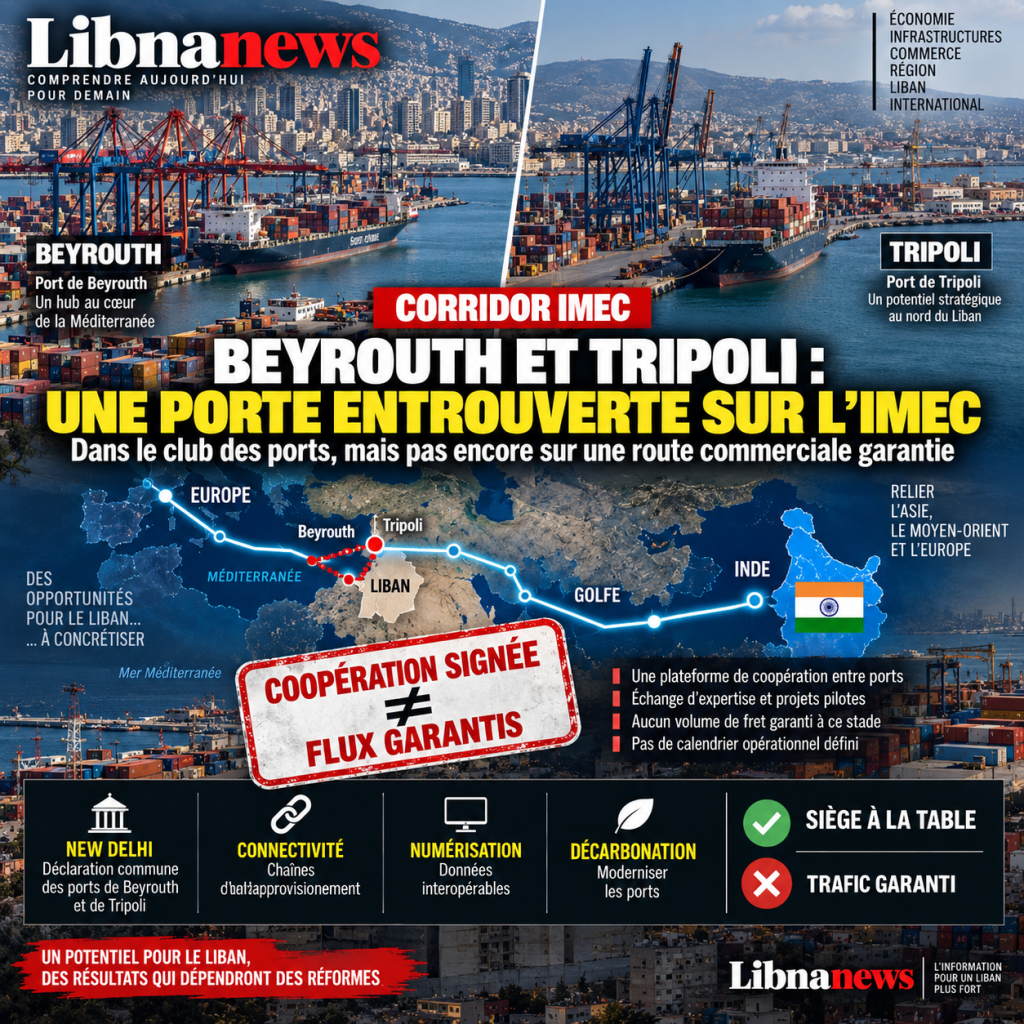
What was actually signed in New Delhi
The entry of the ports of Beirut and Tripoli into the « port club » linked to the economic corridor between India, the Middle East and Europe was presented in Lebanon as a strategic success. The event is real, but its scope must be precisely defined. In New Delhi, the administrations of the two Lebanese ports signed the joint declaration launching a platform for cooperation between ports on the corridor axis. The port of Beirut was represented by the chairman of its board of directors and general manager Marwan El Najjar, while the port of Tripoli was represented by the chairman of its board of directors, Iskandar Bandali. The signed text does not create a new international organization with a heavy structure. It establishes an open framework for dialogue and cooperation between ports.
The content of the declaration allows you to measure exactly the step taken. Cooperation should cover connectivity and supply chains, trade and procedural facilitation, energy and decarbonisation, and digitisation and interoperability of data. The club must also allow the exchange of expertise and the launch of initiatives or pilot projects which could be expanded. This is important for Lebanon, as Beirut and Tripoli are now present in a discussion network linked to one of the major connectivity projects between Asia, the Gulf, the Mediterranean and Europe. But this accession does not mean that the containers in the corridor will automatically pass through the Lebanese docks tomorrow.
The point not to be exaggerated: Lebanon is not yet a guaranteed operational step
The distinction between joining the port club and becoming a stage of the corridor is central. The India-Middle East-Europe economic corridor is based on a logic of connection between several modes of transport and several territories. In order for a port to be a real operational stage, commercial flows must be oriented, infrastructure must be able to absorb them, land and sea connections must exist and economic operators must find the route competitive. The New Delhi Declaration opens a possibility; it does not guarantee these conditions. There is no evidence in the corpus that a specific volume of goods has already been allocated to Beirut or Tripoli, that a regular line specific to the corridor is decided or that a Lebanese exploitation schedule has been agreed.
This caution is precisely what makes the agreement interesting. Lebanon gets a seat around the table before getting a definitive place on the logistics map. It can therefore use this phase to defend its ports, present their capabilities and seek investments. Joseph Aoun described the accession of important institutional acquis and a window to strengthen partnerships and develop the logistics and commercial sector according to international standards. This presidential statement expresses Lebanese ambition. It should not be confused with a decision by other partners to make Lebanon a mandatory passage through the corridor.
Why Beirut still has arguments despite the crises
The port of Beirut retains an obvious advantage: it is the country’s main port and remains connected to the largest Lebanese economic and commercial concentration. Its historical role in imports and exports gives it an existing basis of activity. For an international corridor, a port is not only worth the depth of its docks or the number of cranes. It is valued by the surrounding ecosystem: freight forwarders, carriers, customs, warehouses, banks, insurance, marine services and market access. Beirut has a part of this environment, even though the financial crisis, the explosion of the port and institutional dysfunctions have profoundly weakened its attractiveness.
Membership in the club can therefore be used as a lever to speed up upgrading rather than crowning an already ready system. The areas of cooperation chosen in New Delhi correspond precisely to the weaknesses that need to be corrected: procedures, data, connectivity and decarbonation. A modern port should allow operators to know the state of a cargo, transmit documents without multiplying physical steps and coordinate customs, terminal, land transport and ships. If Beirut remains dependent on slow or fragmented procedures, its geographical advantage will not suffice. The corridor will compete with routes, and goods will first choose reliability.
Tripoli offers Lebanon a second logistics map
Tripoli’s presence in the same statement is equally important. It avoids the Lebanese application for the new network being reduced to the port of Beirut alone. Tripoli has a different position, in the north of the country, with a particular proximity to Syria and land axes that could, in a stabilized regional environment, connect the Mediterranean coast to the interior. The port has also been presented in recent years as an infrastructure with development margins. However, the corpus does not provide a comprehensive investment plan to quantify the additional capacity required for the corridor. It would therefore be premature to present Tripoli as a future large transit centre already funded.
The strategic interest lies in possible complementarity. Beirut has the main trading ecosystem; Tripoli can offer space, a northern position and a different potential connection to the hinterland. Lebanon can thus defend a two-port offer rather than a single site. But this complementarity will really exist only if the State defines the functions of each. Two competing ports that seek the same flows with different policies can disperse investment. On the contrary, two coordinated ports can offer specialisations and rescue solutions, which is an advantage in a corridor whose resilience is one of the stated objectives.
The corridor makes sense for Lebanon only if the goods can leave the port quickly
The main challenge may be outside ports. An economic corridor does not involve bringing a ship to a wharf. It must allow the goods to continue their journey. For Lebanon, this raises the issue of roads, borders, regional connections and customs procedures. The sources of the corpus do not yet describe a Lebanese rail or land network specifically funded for the corridor. They therefore do not make it possible to assert that logistical continuity is ensured. This is a major limitation: a successful port can become a cul-de-sac if the freight remains blocked or if the cost of land transport cancels its maritime advantage.
The regional situation adds a difficulty. Any terrestrial connection to the east depends on the Syrian environment and relations between states. Wars, sanctions, border controls and security risks can change the competitiveness of a route in a few weeks. This is why entering the port club is above all an opportunity to prepare the necessary standards. Lebanon can improve its procedures even before all regional axes are available. If the geopolitical situation then opens, it will be better placed to capture some of the flows.
Scanning data: the invisible yard that will decide on competitiveness
The New Delhi Declaration insists on data interoperability. This technical term hides one of the most important issues in modern commerce. A container crossing several countries generates customs documents, manifests, certificates, security information, invoices and logistical data. If each port uses an isolated system, the same information must be entered several times and errors multiply. On the contrary, interoperability aims to enable systems to communicate. For Beirut and Tripoli, integration into such a network can become as important as purchasing new equipment.
The potential benefit is concrete: reducing transit times, improving the visibility of cargoes and facilitating controls. But it requires IT investments, data protection rules and coordination between administrations. The sources do not yet provide a Lebanese budget for this adaptation or a detailed technical timetable. The club therefore creates a framework within which these projects can be discussed; It does not mean that they are already realized. Real progress can be measured when operators actually use procedures compatible with those of other ports in the network.
Decarbonation and energy: a commercial criterion, not only environmental
The other axis chosen by the club concerns energy and decarbonation. This may seem secondary for a country that is first seeking to restore its basic infrastructure. Yet it becomes central in the harbour competition. International logistics chains are seeking to reduce their emissions, and ports are increasingly being evaluated for their energy consumption, equipment efficiency and services offered to ships. A port that wants to integrate sustainably into an international corridor will therefore have to modernise its energy operation along with its docks and IT systems.
For Lebanon, this requirement can be transformed into an opportunity if investments related to the corridor finance part of the modernization. But there is nothing in the corpus to announce amounts already committed to Beirut or Tripoli in this area. The objective of funding must therefore be separated. The club indicates the direction: ports are more integrated, more digital and less carbon. Lebanon still needs to convert this focus into bankable projects capable of attracting partners.
Lebanon enters a regional competition where geography is no longer enough
One of the pitfalls would be to consider that Lebanon’s position on the Mediterranean naturally guarantees its place. Modern corridors are designed to reduce delays, costs and risks. They can bypass one country if another road is more reliable. Geography gives Lebanon an argument, not a monopoly. Ports in the region also invest in terminals, logistics, data and terrestrial connections. The final choice of operators will therefore depend less on political declarations than on actual performance.
This competition makes membership of the club useful precisely because it exposes Beirut and Tripoli to the standards of other ports. Lebanon can compare its procedures, identify delays and seek common projects. But he will also have to accept a logic of results. Customs clearance time, service reliability, handling costs, security and business continuity will be more important than the diplomatic prestige of the signature.
The file intersects with another project: making Lebanon a platform for Iraqi energy
The timing of accession is interesting because Beirut is working alongside Baghdad on energy and logistics projects. The Government has prepared measures to enable Lebanon to serve as a storage and re-export platform for Iraqi crude oil and petroleum products in a first phase. Discussions focused on roads, border crossings, storage capacity, security and customs procedures. This project is not legally identical to the India-Middle East-Europe corridor, but the two dossiers converge on one point: they assume that Lebanon becomes a reliable transit space.
This convergence can strengthen the interest of Tripoli and Beirut. A country capable of managing energy flows, goods and data in modern procedures can regain a regional function that goes beyond its internal market. But it also increases the requirement. Foreign partners will look at Lebanon’s ability to meet its commitments, manage its infrastructure and secure payments. The debt accumulated in the Iraqi fuel mechanism recalls that logistical credibility and financial credibility are linked.
What the government needs now: projects, not just invitations
The next step should be to transform institutional membership into a list of specific projects. It is necessary to identify the necessary investments in both ports, the procedures to be harmonised, the digital systems to be connected and the terrestrial links to be improved. It is also necessary to determine what functions Lebanon wants to offer to the corridor: transshipment, storage, regional distribution, logistics services or a combination of several activities. Without a national strategy, each port risks looking for opportunities separately without creating a coherent Lebanese offer.
Funding will be the second test. The corpus does not yet mention a package of investments guaranteed by club membership. Public or private partners will therefore have to be convinced. To achieve this, Lebanon will have to present projects with predictable revenues, stable rules and clear governance. A diplomatic signature may open doors; it does not replace an economic model. It is precisely at this stage that many major regional projects are transformed into either real infrastructure or paper-based announcements.
A rare opportunity, provided you do not confuse presence on the map with real flows
The entry of Beirut and Tripoli into the port club is therefore a real acquis. It places both Lebanese infrastructures within a framework of cooperation directly linked to a strategic project between India, the Middle East and Europe. It opens discussions on logistics, procedures, energy and data. It also provides Lebanon with an opportunity to present its ports to partners who reason on the scale of entire commercial channels. It would be a mistake to minimize this step.
It would be an equivalent mistake to present it as the final integration of Lebanon into the corridor. No guaranteed cargo volumes, Lebanese operational schedules and overall infrastructure funding are yet available. Real success will begin when pilot projects are launched, procedures are connected and operators will actually choose Beirut or Tripoli for their flows. Lebanon now has an entry ticket. It has yet to prove that its ports can become a road rather than just a point on a map.





Comments