

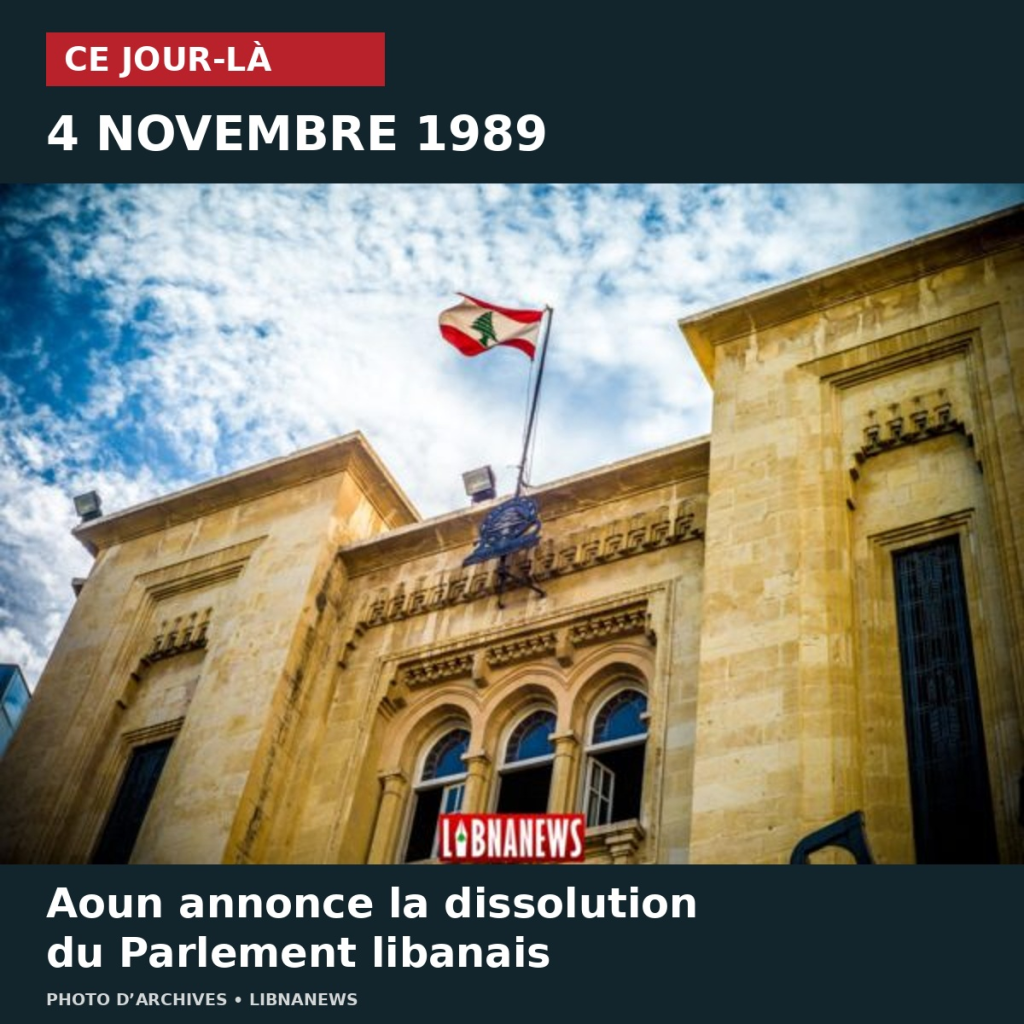
This day in the history of Lebanon.On 4 November 1989, Michel Aoun announced the dissolution of the Lebanese Parliament. The head of the military government intends to prevent MPs from continuing the Taif process and electing a president. Disputed by his opponents, this decision did not block the election: René Moawad took office the next day.
The dissolution of the Lebanese Parliament announced at dawn
At five o’clock in the morning, this Saturday, November 4, the general entered a stage in his confrontation with the House. It announces its dissolution and provides for new parliamentary elections from 7 January 1990. The decision comes as Members prepare a meeting to revive the institutions.
The schedule explains the urgency of the announcement. Parliamentarians must institutionally translate the compromise negotiated in Saudi Arabia. In particular, they wanted to put an end to the presidential vacancy, which had been opened since September 1988. Michel Aoun rejected this approach and demanded that Members come to meet him before the election.
However, the decree does not produce an agreement between the institutions. For the general, it deprives elected officials of their capacity to act. For the supporters of the Taif Rules, the Chamber retains its legitimacy and can continue its work. Dissolution thus becomes a new object of conflict, rather than a solution.
Two Governments since September 1988
This confrontation is part of a crisis that began more than a year earlier. At the end of Amine Gemayel’s term of office, Parliament failed to elect a successor. On 22 September 1988, the outgoing president appointed Michel Aoun as head of a transitional military government.
The general then led the Lebanese army. But his appointment does not bring together the various political forces. Selim Hoss maintains a rival government. The country now has two competing executive authorities, while the presidency remains vacant. This division adds to militia-controlled territories and foreign military presences.
Michel Aoun invokes the presidential prerogatives exercised during the vacancy to justify his decision of 4 November. Its opponents contest this reading and its authority. The disagreement therefore relates as much to the person empowered to decide as to the content of the proposed settlement to emerge from the war.
Taef, in the centre of the force test
The Arab mediation led the Lebanese deputies to meet in Taif in autumn 1989. After several weeks of discussions, they agreed to a national agreement. This text proposes a reorganisation of powers and a framework for restoring State authority.
In particular, it provides for an equal distribution of parliamentary seats between Christians and Muslims. It strengthens the role of the Council of Ministers in the exercise of executive power. The document also provides for the dissolution of Lebanese and non-Lebanese militias and the handing over of their weapons to the State.
The Syrian presence is a central point of Michel Aoun’s refusal. The text provides for the Syrian forces to assist in the restoration of Lebanese authority and then redeployment. It refers to an agreement between the two Governments defining the duration and modalities of their subsequent presence. It therefore does not set a full and immediate withdrawal date.
On 14 March 1989, the General launched a war against the Syrian forces, which was described as a war of liberation. His opposition to Taif prolongs this confrontation. He considered that the compromise did not sufficiently guarantee Lebanese sovereignty. On the contrary, the defenders of the agreement see it as a way out after fourteen years of war.
A Chamber elected in 1972
The composition of Parliament is also fuelling the conflict. The last parliamentary elections date back to 1972. The war prevented the normal renewal of the House, whose mandate was extended. In November 1989, several of the deputies elected 17 years earlier died or left their seats.
Michel Aoun challenges the representativeness of such an ancient assembly to engage the country’s future. Members in favour of Taëf rely on institutional continuity to continue the regulation. They intend to elect a President with the existing House, without waiting for the organisation of new legislation.
The announcement of elections in January does not alone address material obstacles. The territory remains divided and the competing authorities do not control the entire country. Organizing a national election requires security conditions and an administration which the dissolution cannot restore by decree.
November 4th, the mobilization wins Baabda
During the day, thousands of supporters of Michel Aoun gather in front of the Baabda Palace. Lebanese flags and portraits of the general accompany their support for his opposition to the compromise. This mobilization gives a popular translation to the institutional battle.
However, the Christian camp does not have a common front. Political and religious leaders support the Taif process. Christian parliamentarians wish to continue the presidential election despite the general’s refusal. The confrontation thus goes beyond a simple opposition between communities: it also divides the actors of the same community.
The Speaker of the Chamber, Hussein Husseini, is working to bring the deputies together. Some are still in Paris, while others are in northern Lebanon. The choice of place becomes decisive: the session must be able to be held outside the area controlled by Michel Aoun.
The next day René Moawad was elected
On 5 November, parliamentarians met at the air base of Qleiat, in the north of the country. They ignore the dissolution announced the previous day. The meeting culminated in the election of René Moawad, MP for Zghorta, as President of the Republic.
This election does not end the confrontation. Michel Aoun refuses to recognize the new institutional order resulting from the Taif process. René Moawad was murdered in Beirut on 22 November, 17 days after his election. On 24 November, the deputies met again and chose Elias Hraoui to succeed him.





Comments