

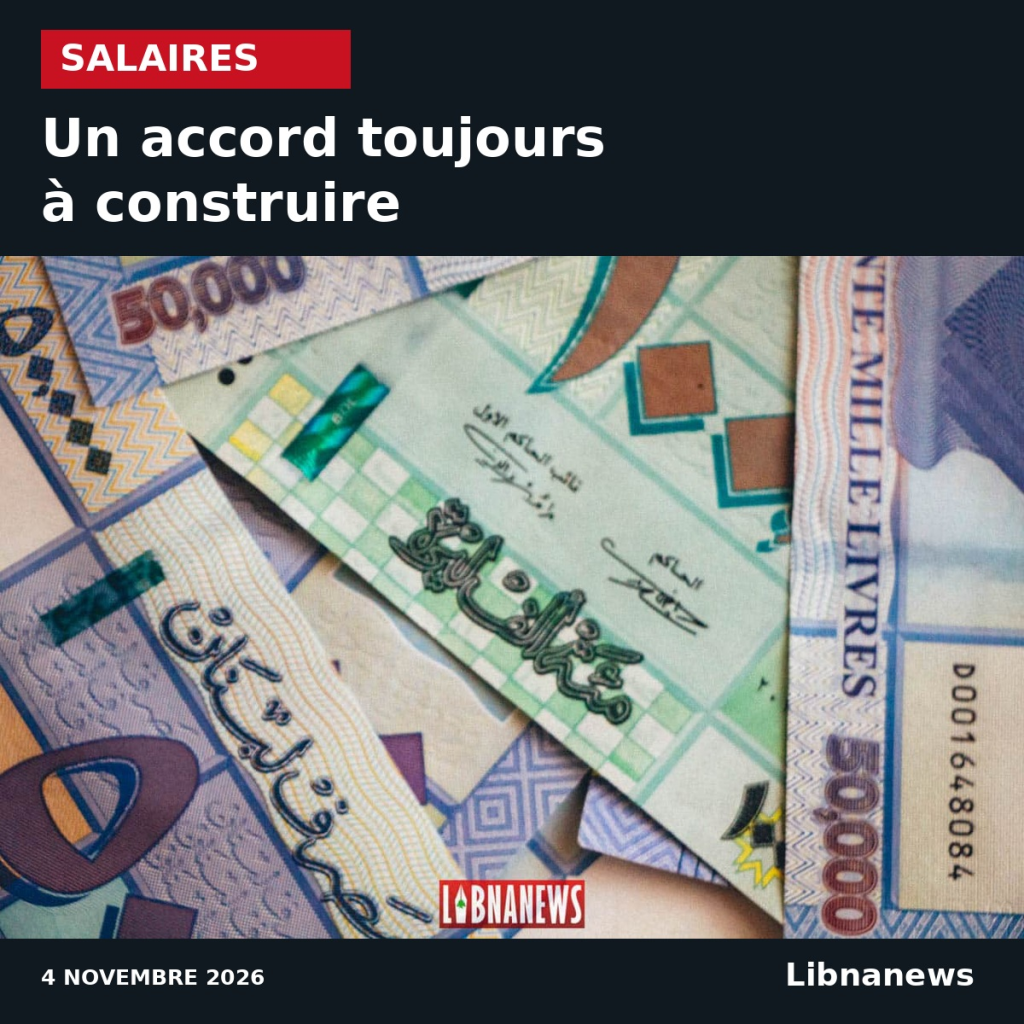
The minimum wage in Lebanon remains at £28 million in the ongoing discussions, without any announced agreement on its next increase. As of November 4, employers’ and union representatives still do not describe the state of negotiations in the same way. Nabil Fahd states that economic bodies have not agreed on a costed proposal. Béchara Asmar, on the other hand, evokes leads from certain employers. This difference prevents the amounts circulating from being considered as a common offer.
Trade resumed in early September within the index commission. A meeting with the Minister of Labour is expected to extend the discussions this week, following the postponement of a previous appointment. No final timetable for adoption is announced. The disagreement concerns the monthly income, but also the obligations of companies to the National Social Security Fund.
Minimum wage in Lebanon: two readings of proposals
Vice-President of the economic organizations, Nabil Fahd said that their position has not yet been discussed in figures. It distinguishes their internal exchanges from talks with other parties. According to him, employers’ representatives have not set an acceptable amount or ceiling for the capacity of companies.
Fahd also refers to the $600 figure as a level considered logical by the other party. It does not present it as a proposal accepted by employers. This clarification means that quoting an amount in a negotiation does not mean that a negotiator undertakes to support it.
The President of the General Confederation of Lebanese Workers, Béchara Asmar, provides another light. It reports increases of 70-80% envisaged in some economic circles. The Panel finds them insufficient in relation to the loss of purchasing power. This declaration, however, does not allow a formal offer to be made to all economic bodies.
The two officials therefore speak of different levels of discussion. Asmar evokes ideas circulating among some interlocutors. Fahd asserts that a collective position remains to be defined. Bringing them together in a single proposal would mask the uncertainty surrounding the resumption of the talks.
A minimum in books, markers in dollars
The £28 million threshold is about $313 at the rate of £89,500 per dollar. This conversion describes a comparison value. It does not transform the legal minimum into a dollar-denominated wage.
Asmar uses the $450 minimum before the crisis as a benchmark. In 2019, it reached £675,000 at the official rate of £1,507.5 per dollar. The nominal increase since this period therefore does not mean that employees have recovered equivalent remuneration.
However, the dollar comparison remains incomplete to measure purchasing power. It alone is not an index of the cost of living. The price of housing, transport or services may change from the exchange rate. Negotiators must specify what they want to correct: the wage threshold, labour costs or social benefits.
Asmar also excludes a minimum of $1,200 under current circumstances. He said he was open to compromises. This availability does not amount to an acceptance of a specific sum or a waiver of an increase.
Social liabilities accompany wage discussion
The other sensitive point is the amounts owed by companies to CNSS for end-of-service benefits. A spread of payments is one of the tracks discussed. The amount, duration and treatment of interest remain to be determined.
Fahd defends two parallel jobs: correct the minimum wage and deal with these obligations. He hoped that neither of the two files would await completion of the other. This method is not yet an enforcement agreement.
Asmar lays down a condition for any adjustment: it must not defer payment of employees’ rights at the end of their service. The debate therefore also focuses on how to protect beneficiaries while companies settle their liabilities.
Transport follows a separate decision
The transportation allowance falls under another mechanism, linked to the price of gasoline. Its adjustment does not constitute an increase in the minimum wage. Both lines may change an employee’s disposable income, but they are not interchangeable.
For the November discussions, the point to be drawn up remains a common proposal and the conditions that would accompany it. The next meeting should specify the numbers defended by each party and the fate of the end-of-service allowance file.





Comments