

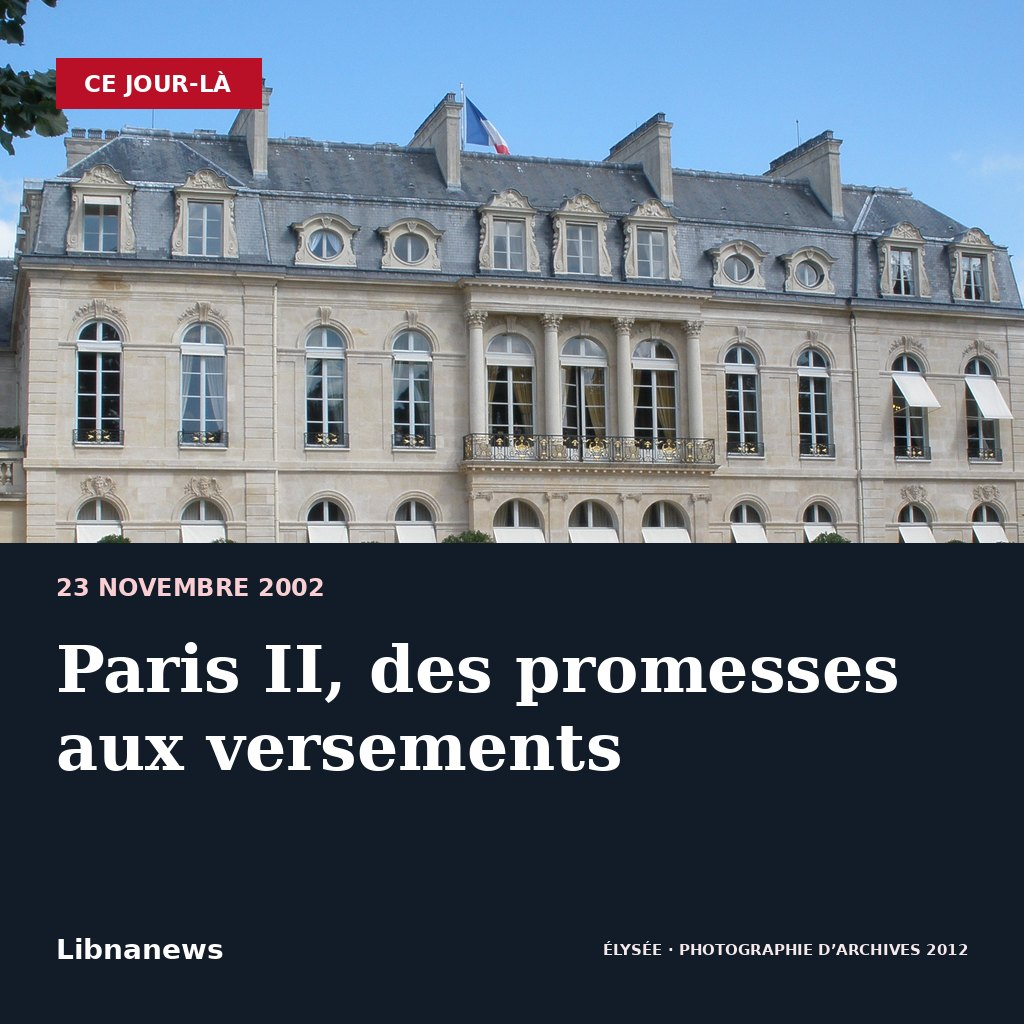
On 23 November 2002, in Paris, the government of Rafic Hariri obtained commitments to refinance part of the Lebanese public debt. The $4.4 billion announced covers two different uses: debt management and financing development projects. The report published six months later by the Lebanese Ministry of Finance makes it possible to track some of this money, from the promise to the payment of the deadlines.
In Paris, Lebanon takes time to repay
Jacques Chirac welcomes the Lebanese Prime Minister and delegations gathered in Paris. At the press conference, the French President explained that Lebanon had financed much of its reconstruction through expensive short-term loans. Rafic Hariri presents international support as support for his recovery program. The two governments then talk about making debt less expensive to serve, not erasing.
According to the Lebanese Ministry of Finance, public debt reached about $32 billion in November 2002, or almost 185 per cent of gross domestic product according to its estimate at the time. The problem was also that of timing: at each maturity, the Treasury had to find something to pay for capital or interest, even if it had to borrow again. Borrowing in the longer term made it possible to spread these repayments; borrowing at a lower rate was to reduce the cost of new bonds.
The $4.4 billion announced is not a single payment
The Department recognizes $3.1 billion in debt reduction and management commitments and $1.3 billion pledged by multilateral institutions and funds for development projects. The project money was not an envelope available to the Treasury to pay its creditors indifferently. The total announced in Paris added promises, not amounts already in the state account.
The first example appears in the department’s writings. On 27 December 2002, Lebanon issued $950 million worth of 15-year-old securities, paid at 5 per cent a year. Malaysia, Oman, Kuwait and the United Arab Emirates subscribe. The State receives funds but contracts a new debt. The transaction therefore changes the cost and date of repayment of the amounts borrowed; It does not turn securities into gifts.
What the ministry finds six months later
In its June 2003 report, the Ministry recorded approximately $2.46 billion received from participating countries and institutions, representing almost 80 per cent of debt management commitments. Its usage table shows about 2.13 billion spent on payment of capital and interest, including on treasury bills in books and foreign currency bonds. This breakdown does not measure the financing of development projects.
The Lebanese authorities deal separately with operations with the Bank of Lebanon and commercial banks. In one case, one is to exchange securities already held by the central bank. In the other, banks subscribe to two-year interest-free securities, providing liquidity or securities according to the scheme. These domestic transactions are not payments from foreign partners.
One year after Paris II, the IMF looks back on the other components of the programme, including the improvement of public finances and the reform of deficit public enterprises such as Electricity in Lebanon. The follow-up makes it possible to distinguish the measurable effect of the Paris rendezvous, which changed the timing and cost of part of the debt, from the reforms on which the State’s ability to avoid replenishing the same financial pressure depended.





Comments