

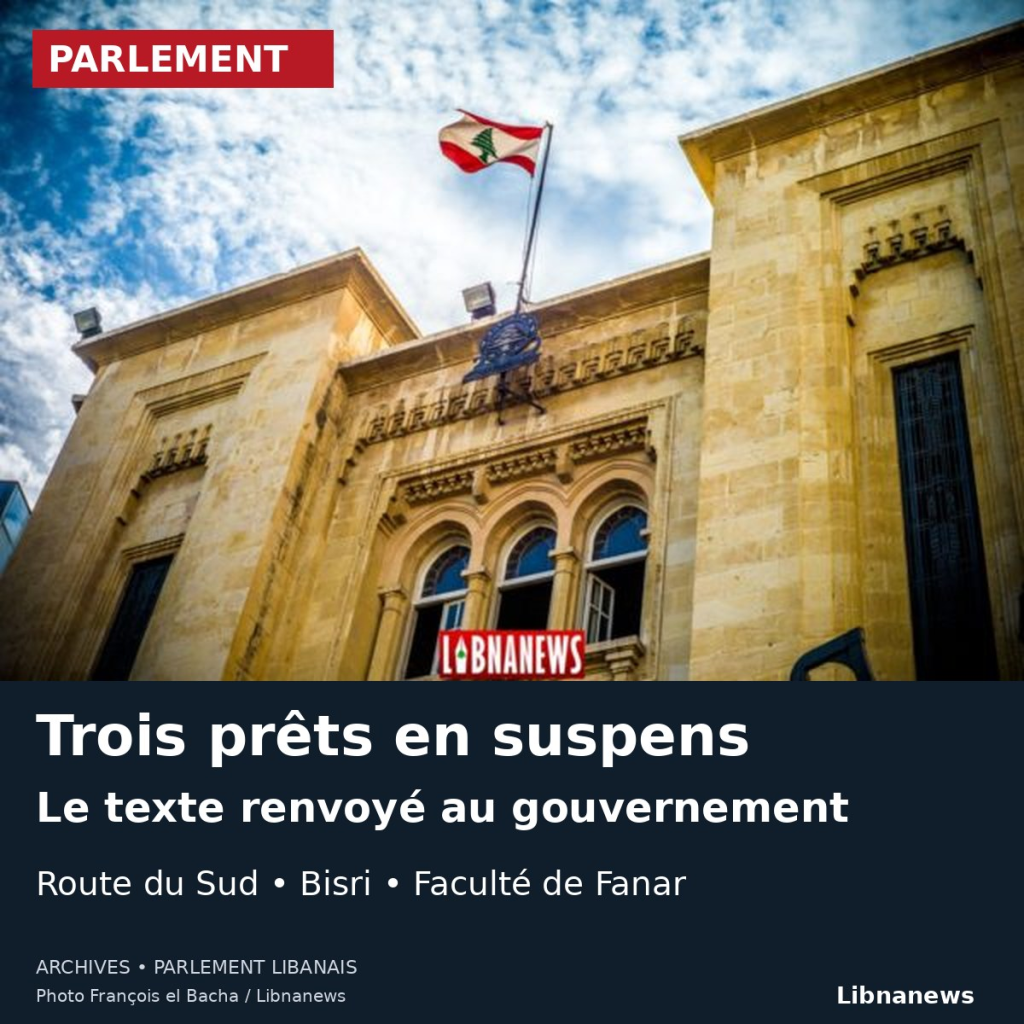
On 12 November 2026 Parliament referred to the government the plan to cancel three loans linked to the southern coastal road, Bisri’s water supply to Greater Beirut and Fanar’s health school. MEPs therefore did not vote for their cancellation. Nor does their decision constitute a relaunch of the projects: it puts the question of the future of these financings to the government.
Three projects in one text
The bill was transmitted by Decree No. 3323 of 30 June 2026. Its title includes three different operations: a road infrastructure in the South, a water supply project for the capital and its periphery, and a university building in Fanar, as part of the development of the Lebanese University.
The decision taken at the plenary meeting concerns the cancellation text. It leaves open the discussion on loan contracts and commitments for each project. It does not set new work dates, additional envelopes, or schedule for commissioning.
A refusal already expressed in committees
The disagreement did not first emerge on 12 November. On 14 October, parliamentary committees meeting under the chairmanship of the Vice-President of Parliament, Elias Bou Saab, rejected the draft and announced a recommendation for refusal at the plenary session.
In the official report, Bou Saab asked why funding for the Lebanese University should be abandoned. He criticized the government for failing to provide the expected explanations on several texts submitted to the deputies. He also distinguished Bisri’s file from the other two operations, challenging their collective treatment.
The removal of 12 November extends this request for explanation. The issue goes beyond the formal maintenance of a loan: Members want to know the reasons for the planned abandonment and the fate of the expenses already incurred.
Basil claims investment accounts
During the debate, Gebran Bassil asked whether the initiative to cancel the loans came from the government or donors. The president of the Free Patriotic Current defended the economic utility of the projects and denounced the risk of losing previous investments.
He cited an estimated $35 million hydroelectric facility and the Wardaniyé treatment plant, for which he advanced $45 million. These amounts correspond to the arguments put forward by the Member. They do not constitute a new budget adopted on 12 November.
Bassil argues that works related to Awali and Bisri must be valued together, due to the water transport infrastructure already planned or completed. He also challenged the political and environmental reasons for the dam. This position remains that of the Member, in a case where the conditions for implementation and funding have been broken several times.
Bisri: do not confuse the current debate with the cancellation of 2020
The World Bank had cancelled $244 million of its funding for the Bisri project in September 2020. Its closing assessment recalls that the conditions required prior to the start of the dam had not been met. The dam was not built as part of this project, which closed on 30 June 2024.
This assessment distinguishes the World Bank loan from parallel financing from the Islamic Development Bank. The amounts announced, cancelled and actually disbursed thus fall under different agreements and stages. The parliamentary dismissal of 12 November did not automatically restore the amounts abolished by a lessor several years earlier.
For the South Road and Fanar School as well as for the Water of Greater Beirut, the continuation now depends on the government’s responses on each loan: remaining bonds, expenses realized and the possibility of still carrying out the project. No new construction work was announced in the referral decision.
The Lebanese Parliament in Beirut. Photograph of archives, date of shooting not established. François el Bacha / Libnanews. This image does not represent the November 12, 2026 sitting.





Comments