

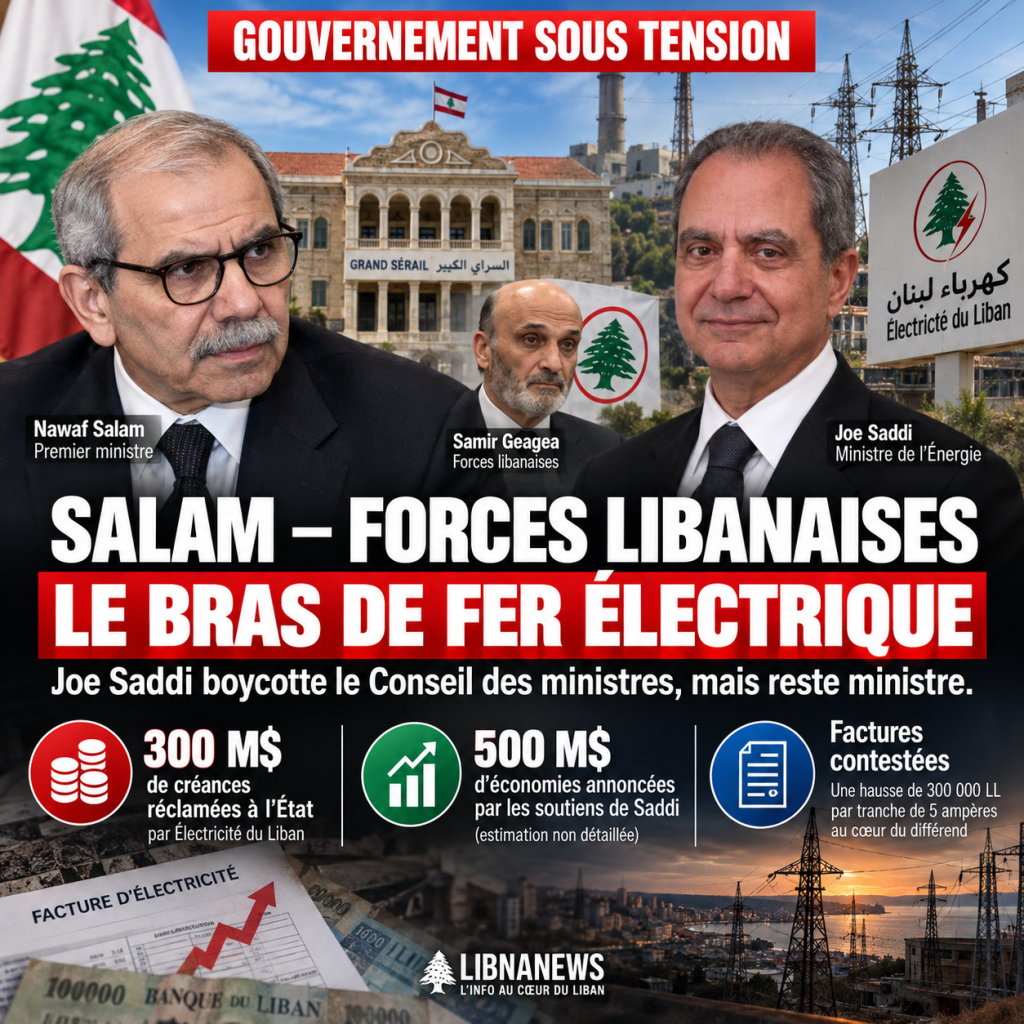
Joe Saddi dismisses resignation and chooses confrontation without leaving power
Joe Saddi considered resigning before choosing a less radical formula: suspending his participation in Council of Ministers meetings while retaining his energy portfolio. This choice, defended by the Lebanese Forces, allows the Samir Geagea party to maintain pressure on Nawaf Salam without immediately causing a government breakdown. The minister continues to direct his administration, but refuses to participate in the collective deliberations of the executive. This unusual situation puts the Prime Minister before an institutional as well as political problem.
On Wednesday, October 7, 2026, Nawaf Salam received Joe Saddi and invited him to lunch. This meeting took place after a visit by the minister to the Baabda Palace, where he explained to President Joseph Aoun the reasons for his withdrawal. The successive passage by the President of the Republic and the Grand Serail shows that the dispute has gone beyond the scope of the Ministry of Energy. Discussions now focus on the conditions for Lebanese Forces participation in the Government and the financial decisions requested by their Minister.
The resignation would have opened a different crisis. It reportedly deprived the Lebanese Forces of a strategic portfolio, while forcing the government to organize its replacement. Another advantage of boycotting is that it keeps the minister in office and turns his absence into a means of pressure. This formula also allows Meerab to challenge certain government decisions without abandoning its presence in the executive.
Nawaf Salam did not choose immediate confrontation. The possibility of resorting to ministerial substitution was mentioned, particularly around Environment Minister Tamara El Zein. However, the Prime Minister has favoured direct dialogue with Saddi. No decision announcing its replacement or any change in its powers has been made public.
Three hundred million dollars in claims at the centre of the dispute
The first financial dossier concerns the sums owed to Electricity of Lebanon by public administrations and institutions. They are valued at approximately $300 million. The supporters of Joe Saddi are demanding the settlement of these claims, which they consider a necessary condition for the improvement of the electrical situation.
This claim highlights a contradiction in public finances. Lebanon’s electricity needs to finance its fuel purchases, maintain its facilities and meet its operating costs. Yet some of its own debtors belong to the public sector. The institution is thus deprived of revenue from institutions which depend directly or indirectly on the State.
The available information does not provide a full breakdown of $300 million. They do not permit the precise determination of the amounts owed by each department, administration or public institution. They do not distinguish between old and recent invoices. This lack of detail prevents measuring the immediately recoverable share.
The settlement of these amounts also involves intervention by the Department of Finance. Some jurisdictions may need additional funding to meet their obligations. Others may face cash flow difficulties. The payment of receivables would improve the financial availability of Electricity in Lebanon, but would require arbitration within the public budget.
For Joe Saddi, the problem is directly related to his ability to act. The Lebanese Forces argue that their minister cannot be held responsible for the sector’s performance unless the financial resources expected are mobilized. This position shifts part of the responsibility to the government as a whole.
The dispute therefore does not relate solely to the technical management of electricity. It concerns the State’s financial obligations to its own institution and the decisions necessary to enable their settlement.
Electric bill becomes a purchasing power issue
Joe Saddi’s claims also include a change in pricing. The information published on 8 October indicates a request to abolish an increase of 300,000 Lebanese pounds applied to the fixed part of the invoice, for each additional five amperes.
This measure concerns the power subscribed by subscribers. Unlike the amount charged on consumption, the fixed part constitutes a charge independent of the volume of electricity actually used. It can therefore affect household spending even when consumption remains limited.
The Minister’s support calls for a reduction in this burden. They see this as an immediate response to the economic difficulties of subscribers. Their argument is based on the possibility of reducing certain expenditure without waiting for a complete reform of the sector.
Comparison with private generators is also important. According to the figures put forward by the media favourable to Saddi, public electricity would be cheaper about 15 cents for an equivalent amount of energy. This difference is one of the arguments used to defend an increase in the power supply hours provided by the national network.
However, the amount actually saved by subscribers depends on several factors. It varies according to the subscribed power, consumption, fixed charges and conditions of invoicing of generators. The published data do not provide a complete simulation to measure these savings for the different categories of households.
The tariff debate thus involves two imperatives. The first is to reduce the burdens borne by citizens. The second concerns the preservation of the revenues necessary for the operation of electricity in Lebanon. A reduction in certain tariffs must be accompanied by adequate funding to avoid creating new imbalances.
The $500 million in savings announced by the Minister’s supporters
Close to Joe Saddi, there is a more ambitious goal. The measures advocated by the Minister would, in their view, save up to $500 million for citizens and the state.
This amount is a central argument in the confrontation with Nawaf Salam. It allows the Lebanese Forces to present their claims as a program to reduce expenses, rather than as a mere request for additional resources.
However, the available information does not sufficiently specify the method of calculation. It is not possible to determine what share of the savings would directly affect households, what share would benefit public finances and when the gains would be realized.
The figure must also be distinguished from the $300 million in claims claimed by some jurisdictions. The settlement of a debt is a different financial operation from a functioning economy. The two amounts cannot be added together to measure the benefits of a reform.
This distinction is essential to assess the scope of the claims. The savings announced could depend on a reduction in the use of private generators, an improvement in recovery or a change in public expenditure. However, the published material does not allow the exact composition to be reconstructed.
However, the Lebanese Forces uses this estimate to question the slow pace of government decisions. Their argument is that measures that could reduce citizens’ spending would remain blocked despite the Minister’s proposals.
Controversy thus takes on a political dimension. It contrasts the results announced by a component of the government with the arbitrations that the Prime Minister must make between several financial priorities.
Georges Adwan hardens the tone against government inaction
MP Georges Adwan publicly expressed the discontent of the Lebanese Forces. He believes that the government could immediately reduce certain burdens borne by citizens and that his party cannot remain spectators of the absence of decisions.
This intervention gives political significance to Joe Saddi’s claims. The dispute no longer concerns only relations between a minister and the Prime Minister. He now engages the Lebanese Forces leadership and how he evaluates the executive’s performance.
The party clearly distinguishes national issues from economic issues. It continues to support policy directions aimed at strengthening State sovereignty and reserving arms to legitimate institutions. On the other hand, it criticizes the management of social and economic difficulties.
This separation allows the Lebanese Forces to preserve their governmental participation while challenging certain decisions of Nawaf Salam. It also avoids turning the electrical conflict into a general disagreement on sovereignty issues.
Georges Adwan’s position, however, reveals a political difficulty. The Lebanese Forces participate in the government they criticize. Their minister has responsibilities in a particularly sensitive area. The party must therefore defend its record while explaining why the expected results are not yet achieved.
Public debt, tariffs and announced savings become the main elements of this defence. Party leaders present Joe Saddi as a minister with concrete proposals, but facing government obstacles.
This reading is questionable in terms of collective responsibilities. Budgetary decisions are made by several institutions. Their implementation depends on constraints beyond the Ministry of Energy alone. However, it allows the Lebanese Forces to focus their criticisms on the functioning of the executive rather than on their own participation.
Nawaf Salam seeks to preserve a politically fragile coalition
Nawaf Salam’s caution is explained by the balance of his government. The Lebanese Forces are an important component of the ministerial team. Their departure would change the political representation of the executive, although it would not necessarily cause its fall.
The Prime Minister must also take into account ongoing diplomatic issues. Lebanon awaits a new stage in the negotiations with Israel. Discussions include Israeli withdrawal, the deployment of the Lebanese army and the future of the international presence in the South.
A major government crisis could complicate coordination among the institutions responsible for these issues. It could also slow down certain economic decisions expected by international partners.
The available political information suggests an external preference for the stability of the government team. However, they do not establish the existence of an official US or Saudi veto against a reshuffle. The positions assigned to foreign partners must therefore be distinguished from the decisions actually taken by the Lebanese authorities.
In this context, Nawaf Salam favours a negotiated solution. The meeting with Joe Saddi aims to maintain a direct channel between the Prime Minister and the protesting minister. It also helps to prevent exchanges from being limited to public statements by politicians.
However, the problem remains. To obtain Saddi’s return to the meetings of the Council of Ministers, Salam will probably have to provide answers on financial issues. These responses require decisions that affect several departments.
The Prime Minister must therefore preserve two elements: the political cohesion of his team and the possibility of making budgetary arbitrations without every disagreement causing a ministerial boycott.
Joseph Aoun receives Saddi and warns against politicizing the economy
The meeting between Joseph Aoun and Joe Saddi took place in a context marked by the proliferation of economic criticism. The Minister briefed the President on the reasons for his withdrawal from government meetings. He also confirmed his intention to continue managing his portfolio.
No presidential decision announcing a final solution has been made public. Nor has the Head of State announced any change in the Minister’s responsibilities.
Joseph Aoun, however, took a position on the political climate surrounding the economic difficulties. He denounced the attempts to politicize the financial situation and the speeches announcing a new monetary crisis comparable to that of 2019.
In particular, the President referred to rumours about an increase in the dollar exchange rate. It considers that their dissemination can fuel concern and undermine stabilization efforts.
His statements take place as several claims movements and government tensions develop around social issues. However, they do not explicitly target the Lebanese Forces alone.
Joseph Aoun also recalled that political parties are a wealth for democratic life, but that they should not be an obstacle to state authority.
This position sheds light on the institutional dimension of the dispute. A minister may belong to a political formation and defend his orientations. However, it is exercising its responsibilities in a government whose decisions are based on collective mechanisms.
The boycott of Joe Saddi places this link between partisan membership and ministerial responsibility at the centre of the debate.
The question of Hezbollah prevents a simple political break
The economic tensions between Nawaf Salam and the Lebanese Forces contrast with their proximity to several institutional issues.
On the occasion of the centenary of the Lebanese Constitution, the Prime Minister reaffirmed his commitment to the full implementation of the Taif Agreement. In particular, he stressed the need to reserve decisions on war and peace to constitutional institutions.
Nawaf Salam also recalled that the application of the agreement could not be limited to the redistribution of powers between the institutions. It should include the planned reforms, including those relating to the organisation of the State and the exclusivity of legitimate force.
These positions join several historical demands of the Lebanese Forces. The party also supports strengthening the army and limiting military decisions to state institutions.
This convergence makes a government breakup more complex. The Lebanese Forces do not dispute the entire political programme of Nawaf Salam. They focus their criticisms on economic and social results.
The Prime Minister therefore retains a political interest in maintaining their participation. Their presence helps to support certain governmental guidelines concerning the role of the State and the weapons of Hezbollah.
For the Lebanese Forces, the situation also has an advantage. The party can continue to support decisions on sovereignty while seeking to stand out from the economic record.
The conflict around Joe Saddi does not necessarily call into question convergence on national issues. Rather, it reveals the limits of these convergences when economic decisions become a confrontational ground.
A reshuffle mentioned, but no announced decision
Tensions around the Ministry of Energy arise while some political circles question the effectiveness of several members of the government.
Discussions focused on the possibility of changing the composition of the ministerial team. These include those managers whose results are deemed insufficient.
No information available as of 8 October 2026 confirms, however, that a reshuffle has been decided. No official calendar has been announced.
The issue remains politically sensitive. A change imposed on Joe Saddi could be interpreted by the Lebanese Forces as questioning their government involvement. Conversely, a broader overhaul could open up further negotiations on portfolio allocation.
The Prime Minister must also measure the administrative consequences of such a change. The electricity sector requires continuity in the management of contracts, fuel purchases and financial decisions.
A ministerial replacement would not automatically resolve public claims or the structural difficulties of electricity in Lebanon.
On October 8, Joe Saddi remained Minister of Energy. It retains its administrative responsibilities, but maintains its withdrawal from government meetings. Nawaf Salam continues the dialogue without having announced a definitive compromise.
Financial claims remain identified: settlement of approximately $300 million in public debt, revision of certain tariff charges and review of a program that is presented as likely to generate $500 million in savings.
Their treatment now depends on the budgetary and administrative decisions that the government will accept. The continuation of the boycott, its possible lifting and the consequences for the relations between Nawaf Salam and the Lebanese Forces remain, by that date, officially unannounced.





Comments