

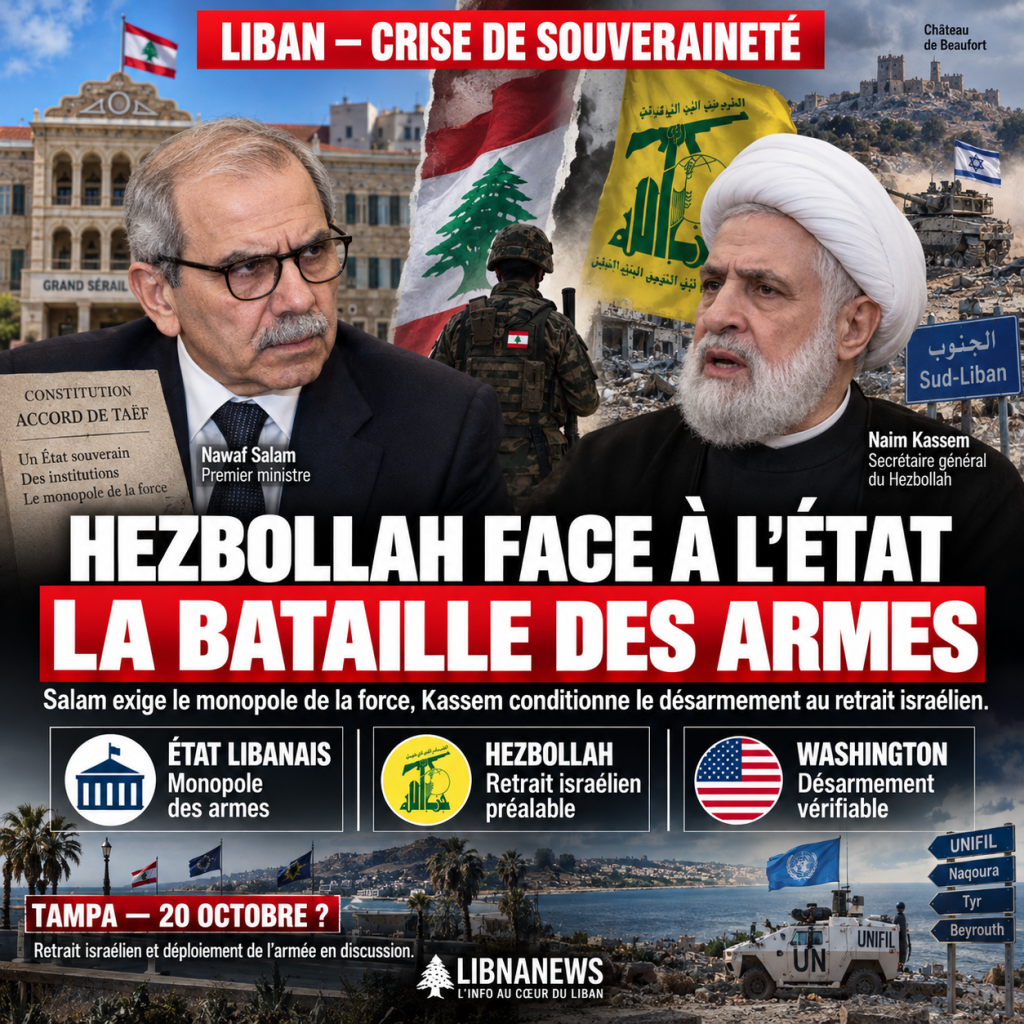
Nawaf Salam claims the monopoly of force, Naim Kassem refuses political surrender and Washington demands results. Between the Israeli positions in the South, the Tampa negotiations and the government divisions, the conflict now focuses on the very definition of Lebanese sovereignty.
Nawaf Salam places Hezbollah’s weapons at the heart of the constitutional question
On 7 October 2026, on the occasion of the centenary of the Lebanese Constitution, Nawaf Salam delivered a speech that went well beyond historical commemoration. The Prime Minister puts at the centre of the debate a question that successive governments have avoided deciding: who really has the power to decide on war and peace in Lebanon? His intervention, at the opening of the exhibition « Between the lines of the Constitution », establishes a direct link between popular sovereignty, the authority of institutions and the existence of armed forces beyond government control. Without limiting his remarks to Hezbollah, Salam clearly aims at a situation in which military decisions can be taken outside constitutional mechanisms.
The Prime Minister recalls that the Taif agreement was not limited to redistributing competences between institutions. It also provided for the dissolution of militias and the restoration of State authority throughout the territory. However, more than three decades after its implementation, several fundamental provisions remain unimplemented. Salam stresses this contradiction by recalling that political leaders have accepted changes in power-sharing, while postponing reforms aimed at building a fully sovereign State. This reading calls into question a political practice based on the selective application of institutional agreements.
The reference to Taëf is of particular significance. Historically, Hizbullah considers its arsenal to be resistance against Israel and cannot be assimilated to the weapons of the civil war militias. This distinction made it possible to maintain an exceptional situation after the official dissolution of the other armed formations. Nawaf Salam now places the debate within a broader constitutional framework. It is no longer just a question of determining whether Hezbollah’s weapons are needed against Israel. The question is whether a political organization can maintain a lasting military capability independent of national defence institutions.
This position is not a new disarmament decision. However, it reinforces the institutional justification for the Government’s efforts. The Prime Minister seeks to establish that the monopoly of force is not a claim imposed by the United States or Israel, but an obligation arising from the Lebanese constitutional organization. It is precisely this interpretation that Hezbollah contests when it associates disarmament requests with foreign pressures.
Naim Kassem refuses to dissociate weapons from Israeli withdrawal
Hezbollah’s position is based on a different reading of sovereignty. Under the leadership of Naim Kassem, the party considers that the issue of its arsenal cannot be separated from the Israeli military presence in South Lebanon, Israeli operations and the security guarantees offered to the population. For its officials, calling for the surrender of arms while the Israeli army retained positions on Lebanese territory would be tantamount to unilaterally changing the balance of power.
This argument is based on military developments in recent months. Israeli forces continue to occupy positions in several sectors of the South. The vicinity of Beaufort Castle, the heights of Ali al-Taher and the areas close to Litani are among the sensitive areas mentioned in the diplomatic discussions. The destruction of houses and restrictions on the return of residents also complicate the normalization of the situation. Hezbollah uses these elements to defend the maintenance of a resilience until the Israeli withdrawal is complete.
The party does not necessarily reject any discussion of the future of its weapons. Its positions, however, favour an internal dialogue, conducted without external ultimatum. This distinction is fundamental. A national negotiation on a defence strategy does not produce the same obligations as a disarmament schedule defined under US pressure. In the first case, Hezbollah could seek to negotiate the role of its military capabilities in a national arrangement. In the second, he would be faced with a requirement to surrender his arsenal without collateral to obtain the counterparties he claims.
The difficulty is that both parties do not agree on the order of decisions. The government defends the strengthening of state authority as a condition of sovereignty. Hezbollah believes that the disappearance of Israeli threats must precede any fundamental change in its military machinery. This divergence prevents the conflict from being reduced to a mere question of timing. It concerns the very definition of national security.
Washington demands actions and no longer wants to be content with statements
American demands add direct pressure to the government. Washington officials present their Lebanese policy as a process leading to an exclusive State authority in its territory, weapons and security decisions. This orientation goes beyond military arrangements to reduce confrontation at the border. It aims at a lasting transformation of relations between Lebanese institutions and Hezbollah.
The American statements of 7 October show that Washington does not consider political commitments sufficient. United States officials are calling for verifiable measures regarding Hezbollah’s military infrastructure, particularly in areas close to the border. They want to prevent the destruction of facilities from being rebuilt after a possible Israeli withdrawal. This demands a considerable responsibility for the Lebanese army: to control sensitive areas while avoiding direct confrontation with an armed organization in Lebanese society.
Former US diplomat Dennis Ross defended an approach based on concrete verification of Lebanese commitments. It stresses the need to see the actual dismantling of military infrastructure and to prevent their resettlement. This position reflects continued mistrust of mechanisms based solely on political guarantees.
Washington also believes that Hezbollah bears a major responsibility for the current situation in South Lebanon. American officials believe that its military operations provided Israel with the necessary arguments to justify its actions against the party’s positions. This interpretation is challenged by Lebanese officials who denounce the continuation of Israeli operations despite security arrangements.
The government of Nawaf Salam is thus subject to two difficult requirements. He must demonstrate to the Americans that the state is effectively regaining control of arms. But it must also prevent coercive application of this policy from causing internal confrontation. The margin of manoeuvre is even narrower because Washington does not seem willing to consider the government’s only verbal commitment as a sufficient result.
Tampa negotiations trap: disarming without Israeli withdrawal
The discussions announced in Florida around October 20 are a decisive deadline. The Lebanese authorities want to see progress on the Israeli withdrawal, the release of prisoners and the deployment of the army in the areas currently occupied. However, the information available on 8 October does not definitively confirm the holding of the meeting or the existence of an agreement on its agenda.
The main difficulty lies in the divergent objectives of the participants. Lebanon is seeking to restore its territorial authority. Israel wants guarantees that prevent Hezbollah from rebuilding its military capabilities near the border. The United States favours a mechanism to verify security commitments and prepare for broader political developments.
An international diplomatic official points out that discussions remain blocked by the lack of Israeli progress in meeting Lebanese expectations. According to the information available, Israel wishes to retain the possibility of intervening militarily when it considers that a threat appears. This position directly contradicts the Lebanese objective of restoring complete sovereignty over the territories concerned.
The disagreement includes areas in which the Lebanese army could deploy after an Israeli withdrawal. Washington supports an experimental sector approach. The Lebanese army would be responsible for providing security, preventing the return of Hezbollah military infrastructure and controlling the areas concerned. But Israel would also seek to maintain a capacity for intervention.
This approach poses a risk to Beirut. The State could be held responsible for the security of areas where a foreign army would retain the possibility of conducting operations. The Lebanese authority would then be subject to constraints that would limit its actual exercise.
For Hezbollah, such a situation would reinforce the argument that disarmament does not guarantee Israeli withdrawal. For Nawaf Salam, it would complicate the demonstration that the strengthening of the state actually restores sovereignty.
Beaufort Castle and the heights of the South become strategic issues
The Israeli positions around Beaufort Castle illustrate the territorial dimension of the conflict. This fortress dominates an important part of South Lebanon. The surrounding heights allow to monitor several axes and localities. Their control therefore represents a military issue that exceeds the site’s only symbolic value.
The Lebanese authorities are seeking Israeli withdrawal from the villages in the area in order to allow the deployment of the army. Discussions should also focus on the destruction and restrictions imposed on the inhabitants.
Israel stands for a different approach. Its military officials consider that certain heights are essential positions to prevent infiltration or attack against Israeli northern localities. This approach is based in particular on the lessons learned from the attack of 7 October 2023.
The question of the heights of Ali al-Taher and the vicinity of Beaufort Castle shows that the conflict does not only concern the number of Hezbollah fighters or missiles. It also covers the control of reliefs, roads and inhabited spaces.
A lasting change in these positions could transform the living conditions of the people of the South. The villages concerned could remain subject to restrictions on movement and reconstruction. The return of internally displaced persons would then depend on military decisions taken beyond the control of the Lebanese authorities.
The government must therefore simultaneously defend two objectives: to secure Israeli withdrawal and to strengthen the army’s presence. One does not automatically guarantee the other.
The Lebanese army facing a politically explosive mission
The army is the main instrument available to the State to implement its policy of sovereignty. However, the missions requested of him far exceeded traditional territorial control.
It must ensure security in areas affected by the fighting, control arms movements, prevent the rebuilding of military infrastructure and prepare for its deployment in areas evacuated by Israel. These responsibilities require considerable human, technical and financial resources.
The information published on 8 October refers to training programmes conducted with more than seven countries. These exercises include advanced ground and air missions. They demonstrate efforts to strengthen the operational capabilities of the military institution.
But material resources are only part of the problem. The army must also preserve its cohesion in a country where the issue of Hezbollah weapons deeply divides political forces.
An operation to impose disarmament by force would pose different risks to a monitoring mission carried out under a political agreement. In the first case, the army could face armed resistance. In the second, it should verify the implementation of negotiated commitments.
The information available does not indicate that an order of direct military confrontation with Hezbollah was given. They show, on the other hand, that American demands and Israeli expectations place the institution before increasing responsibilities.
This distinction is essential. The desire to strengthen State authority does not mean that an internal coercive disarmament operation has been decided.
Two hundred million dollars: Iranian financing complicates the balance of power
The debate on weapons comes at a time when new information relates to Hezbollah’s financial resources. Two informed sources claim that the party received $200 million from Iran in the previous month. These funds would be intended to assist Lebanese displaced by the war with Israel.
According to the reports, the transfers were made despite the strengthening of US sanctions. Intermediaries reportedly required commissions representing up to four times the usual rates, due to the risks involved. Some reports suggest a commission of up to 20%.
Hezbollah acknowledged that it had obtained financial resources for aid, without confirming their origin or exact amount advanced. The U.S. State Department challenged information about an Iranian transfer of this magnitude.
These conflicting versions prevent the presentation of the $200 million as definitive funding. However, they reveal a major challenge: Hezbollah’s ability to retain financial resources despite sanctions and regional difficulties.
Funding for internally displaced persons also has a political dimension. In areas affected by destruction, the ability to support families and finance certain reparations helps to maintain social influence. This activity is not confused with military financing, but it operates in the same political environment.
For the Lebanese State, the problem therefore goes beyond the issue of arms. It also concerns the capacity of public institutions to provide services and social protection in areas where Hizbullah has networks of assistance.
Three years after 7 October, the military record feeds the divisions
The third anniversary of the attack of 7 October 2023 took place in a very different context from that prevailing at the beginning of the confrontation. The fighting has caused significant destruction in Lebanon and has altered military conditions in the South.
Hizbullah’s statements on that occasion reaffirmed its commitment to the Palestinian cause. They describe the continuation of the conflict as a consequence of Israeli occupation and operations.
However, the consequences of the war also fuel questions about the party’s strategic choices. The destruction, displacement and loss of life have profoundly affected the regions concerned.
The debate includes the relationship between the military objectives announced and the results achieved. Action can produce a tactical effect without guaranteeing a lasting political advantage. The ability to engage in confrontation must also be distinguished from the ability to protect people and preserve infrastructure.
These issues are of particular importance in the disarmament debate. Supporters of the State monopoly of force believe that military decisions must be subject to national political responsibility. Hezbollah believes that its capabilities remain necessary in the face of Israel.
The difference therefore concerns both the record of past clashes and the preparation of possible future confrontations.
An institutional crisis without an immediate solution
As of 8 October 2026, there was no comprehensive political agreement to resolve the issue of Hezbollah’s weapons. Nawaf Salam maintains its demand for institutional sovereignty. Naim Kassem defends the maintenance of a resilience related to the Israeli threat. Washington calls for verifiable results, while Israel seeks to maintain military safeguards on the ground.
The Tampa negotiations could change certain parameters, particularly if they led to Israeli withdrawals and a wider deployment of the Lebanese army. But their record and results remain uncertain at the time of the information available.
Nor does the government have a mechanism agreed upon by all parties to integrate or dismantle Hezbollah’s military capabilities. No consensus timetable is established. The monitoring procedures, security guarantees and the treatment of military infrastructure remain contested.
The disagreement thus contrasts two concepts of sovereignty. The first is the institutional exclusivity of military decisions. The second considers that an independent resistance capacity remains necessary as long as the State cannot guarantee the protection of the territory against Israel.
This opposition is manifested in government decisions, diplomatic negotiations and debates on the role of the army. It also concerns the inhabitants of South Lebanon, whose return and reconstruction depend on the changing security situation.
The crisis is therefore not limited to a confrontation between Nawaf Salam and Naim Kassem. It commits the functioning of the institutions, the definition of national defence and the conditions under which Lebanon can exercise its authority over its entire territory.





Comments