

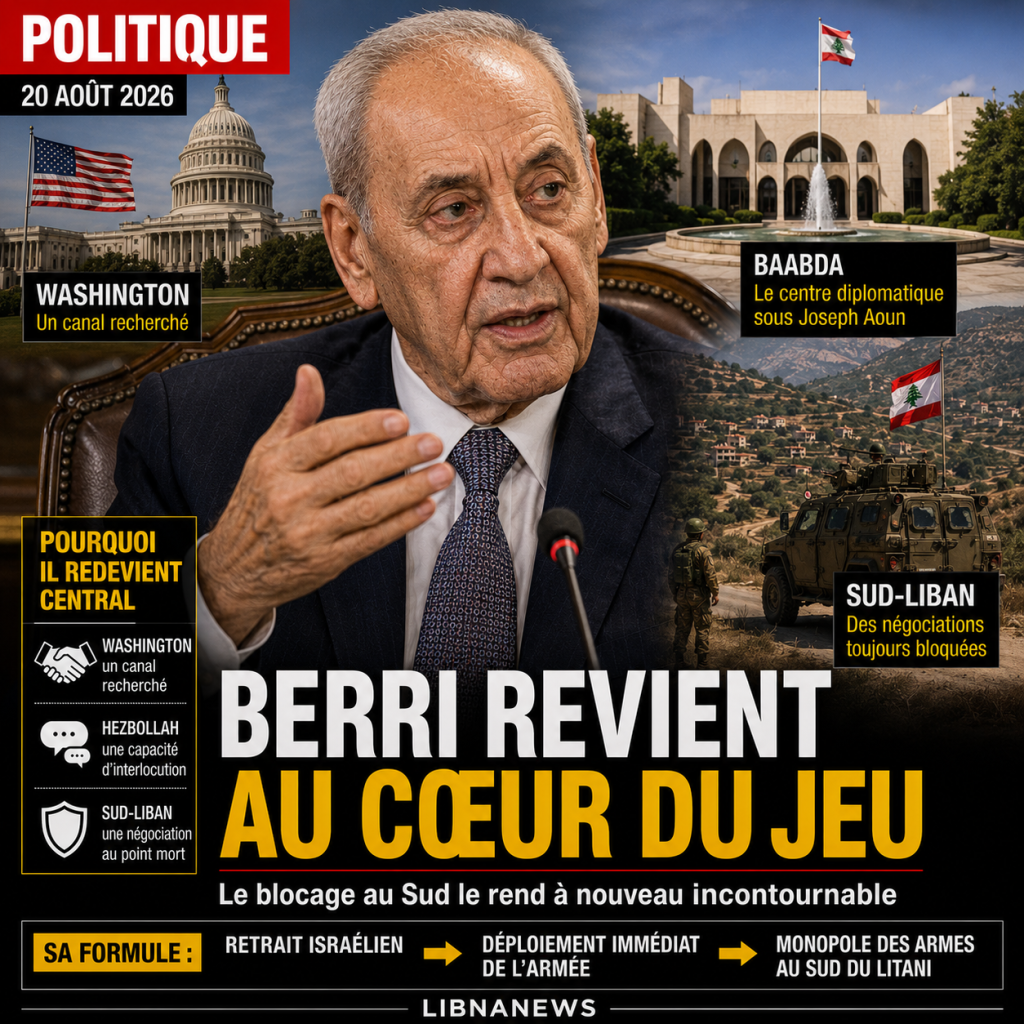
Analysis — Relatively down since Joseph Aoun and Nawaf Salam took over the institutional leadership of the Israeli-Lebanese case, Nabih Berri returns to the forefront. His statement of 19 August 2026 before an American delegation marks this development: the President of the House now explicitly links an Israeli withdrawal to the immediate deployment of the Lebanese army and its arms monopoly south of the Litani. His return comes at the very moment when negotiations move towards their most sensitive issue, that of Hezbollah’s weapons. However, the formula is facing an Israeli refusal to withdraw, hardened to less than ten weeks in the 27 October parliamentary elections.
Since the election of Joseph Aoun, Nabih Berri had not disappeared from discussions with the United States or from the South Lebanon file. His role had changed, however. The President of the Republic and the Government of Nawaf Salam had taken up the initiative on long-negotiated issues through channels where the President of the House held a decisive position. Foreign policy, contacts with Washington, negotiations with Israel and, above all, the state monopoly of arms had been gradually repositioned at the level of Baabda and the Council of Ministers.
The sequence opened on Wednesday 19 August shows a reverse movement. In front of a delegation from the American Task Force for Lebanon led by Edward Gabriel, Berri made a proposal that directly affects the current deadlock. Israel would stop its military operations, withdraw its forces to the international border and the Lebanese army would immediately deploy to the evacuated areas. Above all, it would become the only armed force in the area south of Litani.
This declaration is not Berri’s commitment to the general disarmament of Hezbollah. It is geographically limited to the south of Litani. Nevertheless, it represents an important development: Hezbollah’s main institutional ally publicly places the Lebanese army’s arms monopoly in a sequence that can accompany Israeli withdrawal.
It is precisely on this ground that Nabih Berri now finds a centrality that he had partially lost.
From indispensable negotiator to Joseph Aoun’s partner
The contrast is significant with the period before Joseph Aoun’s arrival in Baabda. For years, Nabih Berri had been one of the main passages between Washington, Lebanese institutions and Hezbollah on Israel-related issues. Its role had been instrumental in the long maritime border negotiations. It had also occupied a central place in the discussions prior to the ceasefire of November 2024.
This function was based on several realities. Berri has been President of the House since 1992, leading the Amal movement and has an ancient relationship with Hezbollah. It can thus engage with Western diplomats while maintaining political access to the main Lebanese armed movement. This position gave him a special function when American authorities sought an indirect channel to Hezbollah.
The election of Joseph Aoun changed this organization. The new President has made State sovereignty and the arms monopoly two pillars of his mandate. The former Commander-in-Chief of the Army also had a direct relationship with the international partners of the military institution. With Nawaf Salam in the Grand Sérail, the executive sought to regain political control of a case that directly committed national sovereignty and security.
In the spring and early summer of 2026, this shift became particularly visible. Lebanese positions prior to negotiations with Israel were jointly announced by Joseph Aoun and Nawaf Salam. Both officials defended the ceasefire, the Israeli withdrawal, the deployment of the army to the recognized border, the return of detainees and reconstruction. The negotiations themselves were presented as a decision and a responsibility of the State.
Berri remained consulted. He met Lebanese and foreign officials and continued to intervene in the South. But he was no longer the principal custodian of the negotiation channel.
This situation has sometimes revealed differences. In June Berri himself acknowledged that Joseph Aoun and Nawaf Salam had different ideas on certain aspects of the case. However, he stressed their common priorities: Israeli withdrawal, army deployment, return of residents, release of detainees and reconstruction.
It was therefore not a complete institutional gap. Rather, the change was that of the hierarchy of roles: Baabda and the government led the process, while Berri retained his mediation capacity.
The weapons file brings Berri back to the center
That sharing could work as long as the discussions focused on the diplomatic framework, the schedule of negotiations or the Israeli withdrawal. It becomes more difficult to maintain when the central issue becomes that of Hezbollah weapons.
This is where Berri’s weight becomes decisive again.
The Speaker of the Chamber does not control Hezbollah’s decisions and cannot engage the movement in his place. His relationship with Lebanon nevertheless gives him an unparalleled position among the leading Lebanese institutional leaders. Any formula aimed at extending the monopoly of State weapons in areas where Hezbollah still has a military infrastructure necessarily raises an internal political question to the Shiite community.
The framework negotiated under American mediation makes this difficulty even more obvious. The framework agreement signed in Washington, D.C., on 26 June provides for an increase in pilot areas: Israeli withdrawal, Lebanese army takeover, non-State armed forces, reconstruction and return of the inhabitants. Hezbollah rejected this framework and refused to treat its disarmament as a precondition for the Israeli evacuation.
Yet Joseph Aoun himself recognized Berri’s importance in this equation. During his visit to Washington in July, the Lebanese President defended with Donald Trump the role of the Speaker of the House and stressed the sensitivity of his position and his relations with Hezbollah.
A few weeks later, Berri now publicly formulates his own sequence.
Withdrawal, army, arms monopoly: Berri formula
The proposal of 19 August is based on a very precise order. Israeli operations must first stop. Israel must then withdraw its forces to the international border. The Lebanese army must immediately take a position in the evacuated areas and become the only armed force there.
The order of the steps is essential. Berri does not say that Hezbollah must be disarmed before the Israeli withdrawal. He claims that after the withdrawal, the army will assume sole armed control of the area south of Litani.
This formulation separates two often confused issues: the effective demilitarization of the South and the general disarmament of Hezbollah throughout Lebanon. The first is explicitly covered by Berri’s declaration. The second is not.
This distinction also explains the difference with Samir Geagea’s position. The leader of the Lebanese Forces calls for parallel progress in the disarmament of Hezbollah and Israeli withdrawal. Berri favours a sequence where withdrawal immediately opens the way for exclusive control of the army in the area concerned.
The two positions converge on the principle of state monopoly of arms, but they diverge over its immediate timing and perimeter.
Berri returns the Israeli part of the equation to Trump
Nabih Berri adds another element to his proposal: he designates directlyDonald Trumpas a man capable of making Israel act.
This reference to the US President reflects the limit of Lebanese power in the negotiations. Beirut may decide on the deployment of its army, define the missions entrusted to it and take decisions concerning the weapons present in its territory. He cannot order the withdrawal of the Israeli army.
Berri therefore asks Washington to get the other half of the exchange. Edward Gabriel, who led the delegation received at Ain al-Tiné, said the positions of the Speaker of the House would be passed on to American decision-makers.
This intervention puts Berri in a familiar position: to present to the United States a Lebanese formula that could be acceptable to the political environment of Hezbollah, and then to ask Washington for an Israeli counterpart.
The difference with previous periods is significant. Berri is no longer alone in the centre of the device. Joseph Aoun owns his own channel with Trump, and Nawaf Salam’s government is directly involved in the negotiations. The Speaker of the Chamber therefore returns to play as the third component of an institutional arrangement, rather than as an almost exclusive intermediary.
Israeli refusal blocks first step
The main difficulty of the formula, however, appears even before the question of its application in Lebanon arises. Israel is currently refusing the prerequisite requested by Berri.
The Israeli Minister of Defence,Israel Katzrepeated repeatedly that the Israeli army would not leave southern Lebanon until Hezbollah was disarmed. On 29 June, he stated that Israel would not withdraw further until that goal was achieved. At the beginning of July, after Donald Trump’s comments on an Israeli withdrawal, Katz had further tightened his tone by saying that Israel had not asked anyone for permission to enter Lebanon and did not need permission to stay there.
On 13 August, after American criticism, the minister again explicitly linked the withdrawal to the disarmament of Hezbollah. This position places the order of concessions exactly the opposite of that defended by Berri.
Benjamin Netanyahu had also stated in June that Israeli forces would remain in their safe area in Lebanon for as long as necessary. The maintenance of a military presence is presented by his Government as a guarantee to prevent Hezbollah from re-establishing a threat against northern Israel.
The disagreement, therefore, is not simply about a technical timetable. It concerns the very logic of the process. In Berri’s view, the withdrawal must allow the military monopoly in the South. In the view of the Israeli Government, disarmament must provide the guarantee for withdrawal.
Israeli elections boost the bid
This opposition takes place in an Israeli political context that further reduces the margins of compromise. The parliamentary elections are fixed in27 october 2026In just over two months. Benjamin Netanyahu approached the election with a weak coalition in the polls and a particularly lively competition on the right.
The Likud primaries of 17 August confirmed this pressure. The internal competition strengthened several personalities from the party’s hard wing, while Netanyahu sought to maintain control over a formation faced with a decrease in its support over the elections of 2022. Security issues remain at the centre of the campaign after the wars in Gaza, Lebanon and Iran.
In this context, Lebanon is also becoming an Israeli electoral subject. A withdrawal can be attacked by opponents to the right of Netanyahu as a concession granted before the disarmament of Hezbollah. On the contrary, maintaining the army in the South can be presented as a guarantee for the inhabitants of northern Israel.
The statements of Israel Katz take on a particular significance in this sequence. They meet a security imperative claimed by the government, but they are also part of a campaign where Likud leaders and their nationalist allies are subject to strong competition on their right.
This does not mean that Israeli positions on Lebanon are solely electoral. The Hezbollah requirements precede the current campaign. However, the proximity of the election may make it politically more difficult for public easing to take place before 27 October.
For Berri, this is a major limitation. Its formula presupposes precisely that Washington obtains from Israel the gesture that several Israeli leaders are currently promising their voters not to accomplish without prior disarmament.
Army, second condition of success
Even if Washington obtained a withdrawal, the Berri formula could only work if the Lebanese army was able to take over immediately.
It is not enough to deploy soldiers to the evacuated villages. The army must be able to control the axes sustainably, check the absence of non-State weapons, secure the population, monitor movements and prevent the return of parallel military infrastructure. It must also have sufficient resources to remain on the ground.
The question of capabilities thus becomes inseparable from political negotiation. Lebanon’s international partners are working to strengthen the army’s capacity precisely because it is expected to become the main instrument for restoring the state authority in the South.
This dimension is also used to measure the difference between a political declaration and an applicable agreement. The monopoly of arms is not only due to military presence. It requires a real capacity to control the territory and a mechanism to verify commitments made.
This mechanism remains under discussion. The discussions with the United States included a possible verification by third parties. On 13 August, a Lebanese official denied that Beirut had already accepted a final list of countries responsible for the mission.
Berri’s return reveals the new phase of negotiations
The return of Nabih Berri therefore does not mean that he took over the case to Joseph Aoun or that the President of the Republic lost the initiative. Rather, it shows that negotiations have changed in nature.
When the priority was to put the state at the centre, negotiate with Washington and establish a framework with Israel, Joseph Aoun and Nawaf Salam could occupy the foreground. As the process addresses the concrete issue of the arms monopoly and how it can be applied without causing internal confrontation, Berri’s role becomes particularly valuable.
His return is based precisely on this paradox. His proximity to Hezbollah had helped to limit his place in a sequence where the new executive wanted to affirm state autonomy. The same proximity becomes an asset once the State has to transform the principle of arms monopoly into an arrangement applicable on the ground.
Berri thus has a role that none of the other Lebanese officials exactly reproduces. Joseph Aoun can negotiate from state to state with Washington and defend the authority of the army. Nawaf Salam can hire the government. Berri can help to make politically practical a formula that directly affects Hezbollah and the Shiite population of the South.
However, this complementarity remains suspended under conditions largely beyond the control of Lebanese officials. Israeli operations are continuing, no definitive verification mechanism is yet established and the two sides remain opposed in the sequence of stages. Israel calls for guarantees on disarmament before its withdrawal; Berri asks for withdrawal to allow exclusive control of the army.
The weight of the Speaker of the Chamber will therefore be less measured by the number of delegations received in Ain al-Tiné than by four concrete developments:verified israeli withdrawalimmediate deployment of the lebanese army, the establishment of aexclusive armed control of the State south of Litaniandreturn of residents to the evacuated areas.
The declaration of 19 August puts Nabih Berri back at the centre of the search for a compromise. It does not solve the obstacle that is now facing him: to obtain the first Israeli withdrawal when the Netanyahu government publicly states that it will not grant it under these conditions and that the campaign of 27 October is already pushing a part of the Israeli political class to show more firmness.




