

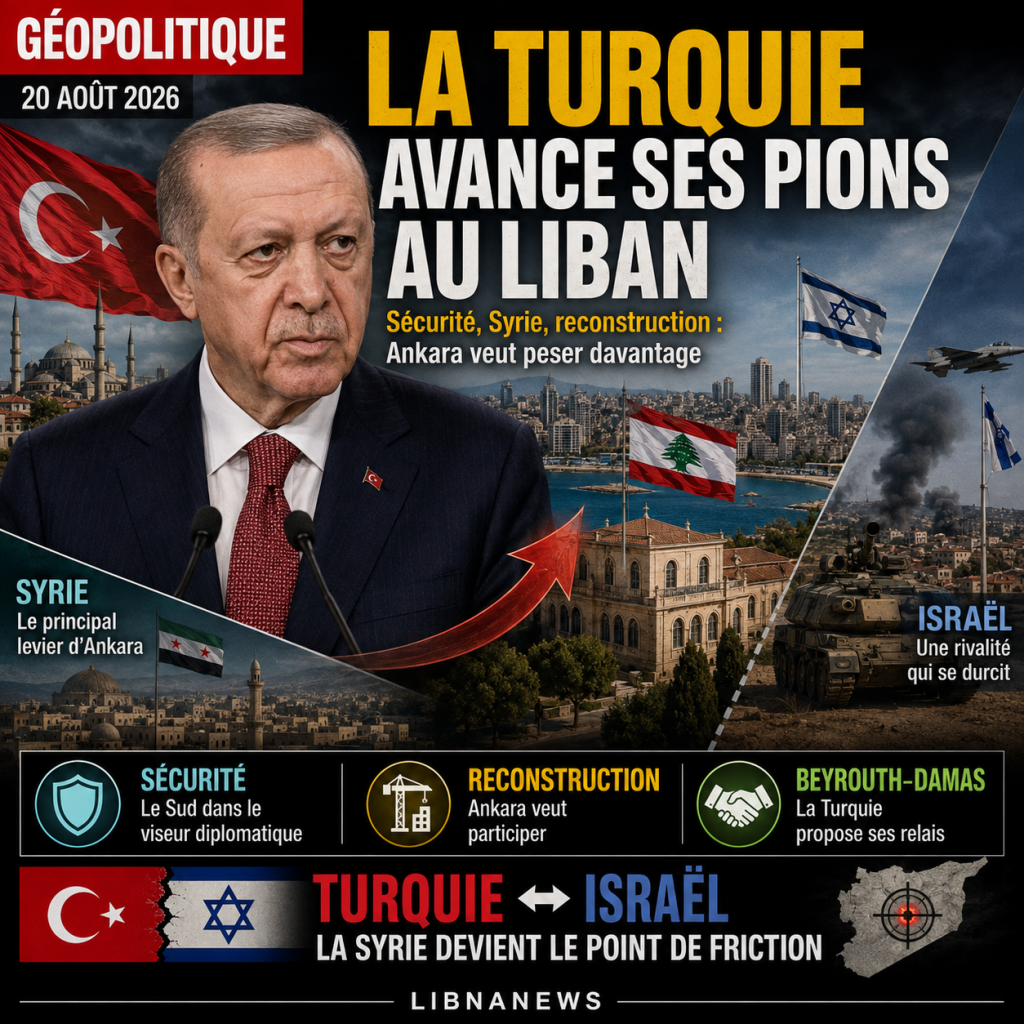
Turkey is accelerating its engagement in Lebanon. In the space of a few weeks, Prime Minister Nawaf Salam and President Joseph Aoun were received by Recep Tayyip Erdogan, while Ankara has multiplied the signals for a more active role in security, reconstruction and relations between Beirut and Damascus. This rise in power comes at a time when tensions between Turkey and Israel are intensifying in Syria, so much so that several Israeli analyses now point to the risk of future confrontation between the two regional powers.
Ankara accelerates its contacts with Beirut
The movement is first diplomatic. Nawaf Salam was received in Istanbul on 10 July by Recep Tayyip Erdogan. Both leaders discussed bilateral relations, the regional situation and Turkish support for stability in Lebanon. The Turkish President then declared that he wanted to intensify political contacts and continue humanitarian aid, while stressing the value of improving relations between Lebanon and Syria.
Three weeks later, on 30 July, Joseph Aoun travelled to Ankara for his first official visit to Turkey since his election. Recep Tayyip Erdogan then expanded the scope of the proposed cooperation. He affirmed that Turkey was following efforts to end the Israeli attacks and that it wished to contribute to the arrangements to protect Lebanese sovereignty. Ankara also announced its desire to continue its humanitarian, technical and institutional support.
The succession of these two visits shows that Turkey no longer limits its relationship with Lebanon to conventional diplomacy. It seeks to place itself in the dossiers where today the country’s balance is being played: security of the South, reconstruction, relations with Syria and the ability of the Lebanese State to regain control of its territory.
Bilal Erdogan and Ibrahim Kalin, two different registers
This strategy also goes through different channels. Lebanese press reports referred to the displacements of Bilal Erdogan and Ibrahim Kalin in Lebanon. Until these visits are formally confirmed in their schedule and content, they must be treated as announced or reported projects, not as actual events.
Bilal Erdogan, son of the Turkish president and involved in a number of civil and educational structures, would be associated mainly with a humanitarian and social aspect. Such a visit would be part of the influence diplomacy that Turkey has been developing for several years through aid agencies, foundations, educational programmes and actions to support populations affected by crises.
The case of Ibrahim Kalin is of another nature. The head of MIT, the Turkish Intelligence Service, occupies a position directly related to regional security issues. On 6 August, he received in Ankara Syrian Foreign Minister Assaad al-Shaibani. According to the information provided at the end of the meeting, the discussions included developments in Lebanon and Syrian-Lebanese relations.
A possible visit by Kalin to Beirut would therefore have a much stronger political and security impact. It could allow Ankara to deal directly with the situation in the South, the mechanisms of de-escalation and, according to reports in the press, the possibility of a dialogue around tensions between the Lebanese State and Hezbollah. At this stage, however, no formal Turkish mediation on this file can be considered as acquired.
South Lebanon enters Turkish interest
Turkey has several reasons to want to get more involved in the Southern issue. The first relates to regional security. Ankara now considers that Israeli operations in Lebanon and Syria have a direct impact on its own interests. Recep Tayyip Erdogan publicly said in June, believing that the Israeli attacks against these two countries ended up also threatening Turkey.
The second is the diplomatic vacuum that can be created around the Lebanese security arrangements. Ankara indicated its willingness to participate in initiatives that will follow the transformation or termination of the current role of the Final. At this stage, Turkey does not have a specific mandate on Lebanese ground, but it is clearly seeking to be present in discussions on the security architecture that might emerge.
This does not mean that Ankara can replace Washington. The United States remains central to the negotiations between Lebanon and Israel, including the Israeli withdrawal, the deployment of the Lebanese army and verification mechanisms. Turkey may offer additional channels, facilitate some dialogues or support reconstruction, but it does not control Israeli decisions or American guarantees.
Syria as Turkey’s main lever
Turkey’s main strategic advantage lies in Syria. Since the fall of Bashar Al-Assad, Ankara has had considerable influence over Damascus’s new power. It participates in the formation of certain forces, supports the reconstruction of Syrian institutions and maintains a close political and security dialogue with the country’s leaders.
This position gives Turkey a special leverage on the Lebanese issue. The relations between Beirut and Damascus remain responsible for sensitive issues: borders, security, refugees, smuggling, missing persons, economic cooperation and the movement of goods. By encouraging a rapprochement between the two capitals, Ankara can seek to stabilize its regional environment while consolidating its own role as a mediation power.
Recep Tayyip Erdogan explicitly encouraged Lebanon and Syria to develop good neighbourhood relations during his meeting with Nawaf Salam. He repeated this provision before Joseph Aoun. The subject was then discussed between Ibrahim Kalin and the Syrian Foreign Minister.
This continuity is significant. It shows that the Lebanese case is now integrated into Turkey’s Syrian policy, and not dealt with separately.
Israel and Turkey face increasing challenges in Syria
It is precisely this Turkish influence in Syria that today fuels tensions with Israel. On 18 August, the Israeli army struck the Abu al-Dhour airbase in north-western Syria a few hours after a Turkish delegation visited the site. Israel claimed that it wanted to prevent a Turkish military deployment which it considered a potential threat.
Damascus denied that such a deployment was planned. Ankara rejected Israeli accusations and denounced an attempt to destabilize. Israel’s Defense Minister, Israel Katz, has also increased warnings against Turkish military expansion in Syria.
This episode does not yet constitute a direct confrontation between the two countries, but it shows that their rivalry has changed in nature. It is no longer limited to Gaza, relations with Hamas or exchanges of statements. It now covers issues of military presence, bases, airspace and strategic balance in Syria.
Several Israeli analyses have begun to treat Turkey as a long-term regional threat. The Israeli Institute for National Security Studies has raised, in some scenarios, the possibility that political and military friction in Syria could go as far as direct confrontation. In the Israeli press, other analyses present Turkey as a growing strategic rival as Iranian influence recedes.
Nevertheless, it would be excessive to present an Israeli-Turkish war as inevitable. Turkish Foreign Minister Hakan Fidan himself said in July that there was no reason to lead to an open conflict. Ankara remains a member of NATO, maintains important relations with Washington and seeks to prevent regional competition from turning into direct war.
Lebanon in the midst of wider rivalry
Turkey’s growing interest in Lebanon must therefore be read within this competition. Ankara wants to strengthen Lebanese stability, but it also wants to prevent the Israeli influence from spreading unbalancedly in Syria and the eastern Mediterranean. Lebanon thus becomes an additional space where broader regional strategies intersect.
This dimension can reinforce Turkey’s interest in reconstruction. The Turkish authorities have announced their willingness to contribute to the areas affected by the destruction, without specifying at this stage detailed amounts, timetables or projects. Humanitarian aid is already one of the traditional instruments of the Turkish presence in the region.
In the Lebanese case, reconstruction offers less conflict than security issues. It enables Ankara to support institutions, improve its image among the people and strengthen its relations with the State without directly intervening in the most sensitive internal balances.
Visible influence beyond institutions
The Turkish presence is not limited to presidential palaces and inter-governmental contacts. In several parts of Lebanon, including Tripoli, Akkar, Saida and around Beddawi camp, there are regular signs of sympathy with Turkey and Recep Tayyip Erdogan in some political, religious or popular circles.
These manifestations should be interpreted with caution. The presence of Turkish flags, portraits of Erdogan or associations close to Turkish networks does not statistically measure Ankara’s influence on the whole of a city or community. It only shows that a capital of sympathy exists in certain sectors, particularly in Sunni regions where Turkey has developed cultural, educational and humanitarian diplomacy for several years.
For Ankara, this social anchor can complement official relations. However, it does not replace the weight of traditional Lebanese actors, whether they are political parties, Gulf powers, France, the United States or Iran.
How far can Ankara go?
Turkey now has several cards. She has direct relations with Joseph Aoun and Nawaf Salam. It has privileged access to the new Syrian power. It has significant humanitarian, economic and security capabilities. Its head of intelligence directly follows the Lebanese and Syrian files, while Recep Tayyip Erdogan publicly announces his willingness to participate in Lebanese stabilization.
However, its limits are equally clear. Ankara does not control Israeli decisions and its relations with Israel have deteriorated sharply. Its growing involvement in Syria can even make Israel more suspicious of a Turkish role in Lebanon. Nor can Turkey replace the United States in discussions on the Israeli withdrawal or impose a compromise on Hezbollah alone.
Its influence will therefore depend on its ability to transform its many contacts into concrete functions: aid, reconstruction, facilitation between Beirut and Damascus, support for Lebanese institutions or participation in a future security mechanism.
The forthcoming Turkish movements announced, if confirmed, will help to measure this ambition. A predominantly humanitarian visit by Bilal Erdogan would be a political and social signal. A visit by Ibrahim Kalin, on the other hand, would show that Turkey intends to enter more directly into Lebanon’s security issues. It is on this difference that the real scope of Ankara’s diplomatic offensive will be measured.




