

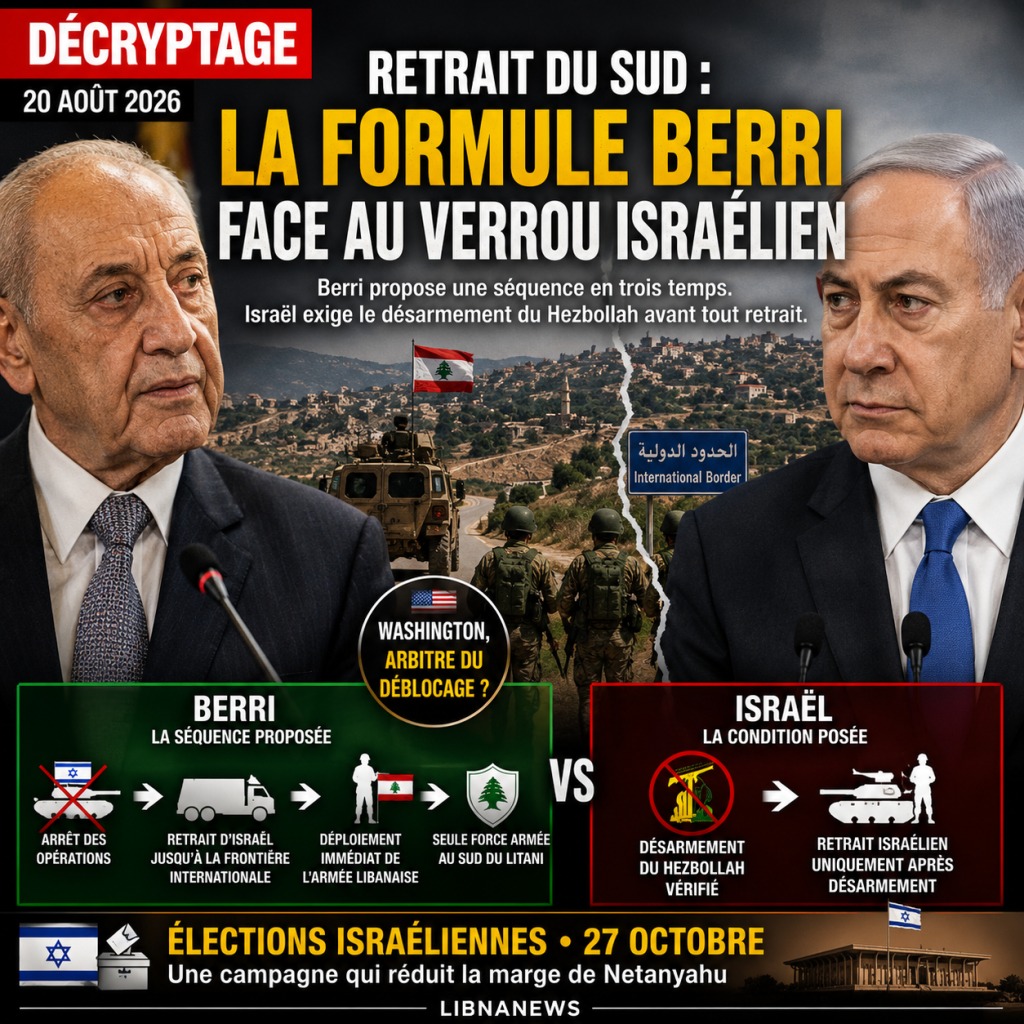
Nabih Berri proposes a precise sequence to break the impasse in the South: stop Israeli operations, withdraw Israel to the international border, and immediately deploy the Lebanese army, which will become the only armed force south of the Litani. This formula places Washington at the centre of the scheme, but it faces the repeated refusal of several Israeli officials to consider a withdrawal without the prior disarmament of Hezbollah. Two months before the Israeli elections on 27 October, Benjamin Netanyahu’s margin of manoeuvre was further reduced by a campaign marked by right-wing competition and security overbidding.
TheNabih BerriWednesday, 19 August, Ain al-Tiné, introduced a more precise element in the discussions on South Lebanon. To a delegation from theAmerican Task Force for Lebanon, led by the former us ambassadorEdward GabrielThe President of Parliament has set a sequence in three steps: Israel stops its operations, its forces withdraw to the international border, and the Lebanese army immediately deploys.
Berri added a fourth essential element. In the areasouth of Litanithe lebanese army would then become the only armed force.
The formulation is politically important. However, it is not in itself a commitment to the general disarmament of Hezbollah throughout Lebanese territory. It explicitly concerns the area south of Litani and links its exclusive military control to an Israeli withdrawal.
It is this articulation that forms the core of the proposal:israeli withdrawal against army deployment, with a clearly defined execution order.
Berri proposes Israeli withdrawal followed by army
The President of Parliament is no longer simply calling for a ceasefire. It describes what should happen immediately after an Israeli withdrawal.
In his outline, there would be no military vacuum between the departure of Israeli forces and the return of Lebanese authority. The army would enter the evacuees and perform the military function alone.
This clarification responds to one of the main arguments put forward by Israel to maintain its positions in Lebanon. The Government ofBenjamin Netanyahuclaims that its army must maintain a safe area as long as Hezbollah remains capable of threatening northern Israel.
Berri reverses logic. He first called for an end to operations and Israeli withdrawal. Lebanon would then provide the territorial guarantee: the army would deploy and have the arms monopoly south of the Litani.
This difference in sequence remains one of the main blocking points.
Negotiations conducted under American mediation have so far failed to fully reconcile these positions. At the seventh discussion session in Rome in early August, Israel refused to withdraw from a new sector. It previously requested verification that the Lebanese Armed Forces effectively controlled two pilot areas already affected by the scheme.
Noneeighth meetingis, at this stage, confirmed.
Berri asks Trump to get the Israeli movement
Nabih Berri mainly addresses his proposal to Washington.
In front of Edward Gabriel and the American delegation, he felt thatUnited Stateswere the only country capable of forcing Israel to cease its operations and withdraw. He directly appointed the PresidentDonald Trumpas the leader with the necessary leverage.
This insistence reflects the division of roles that Berri seeks to establish.
Beirut can make commitments concerning its own territory. It may decide on the deployment of the army and the principle of a monopoly of arms. He cannot, however, order the withdrawal of the Israeli army.
The American demand is therefore to produce the reciprocity that is currently lacking in the process.
Edward Gabriel indicated that he would transmit the positions expressed to Ain al-Tiné to American officials. His tour took place as Washington increased contacts between Beirut and Israel in order to avoid the collapse of the negotiating framework.
American diplomacy has a special weight. The United States played a central role in concluding the framework negotiated in June. They are also involved in military discussions to define the modalities for Lebanese withdrawal, deployment and verification.
But Berri’s statement implicitly raises a more difficult question:Can Washington obtain from Israel a withdrawal that several important members of the Israeli government say publicly refuse?
In Israel, several ministers reject the principle of withdrawal
Today it is one of the most visible obstacles to the Lebanese formula.
The Israeli Minister of Defence,Israel Katzrepeatedly claimed that Israeli forces would remain in southern Lebanon. As early as June, he mentioned a lasting presence in the « safe areas » occupied by Israel in Lebanon, Syria and Gaza.
On 9 July, after Donald Trump had referred to an Israeli withdrawal, Katz replied that Israel had not requested anyone’s permission to enter Lebanon and did not need permission to stay.
On 13 August, after American criticism, he nuanced this position without accepting the principle of immediate withdrawal. He linked the departure of the Israeli army to thehezbollah disarmament.
This condition maintains disagreement over the sequence of steps.
Berri proposes: withdrawal, deployment of the army, exclusive control south of Litani.
Katz defends a different logic: verified disarmament of Hezbollah before withdrawal.
Israeli Minister of Finance,Bezalel Smotrich, went further. He claimed that there would be no Israeli withdrawal from southern Lebanon as long as Hezbollah existed in Lebanon and had a military capacity. In particular, he included the Beaufort region in the areas Israel should retain.
The Minister of National Security,Itamar Ben-Gviralso defended the continued existence of Israeli forces in Lebanon and rejected the idea that an agreement negotiated by Washington could automatically force Israel to evacuate the occupied positions.
Not all of these statements constitute Israel’s definitive diplomatic position. However, they show the political pressure on Netanyahu as soon as a withdrawal is mentioned.
Israeli elections are further tightening the equation
The Israeli political calendar reinforces this difficulty.
The parliamentary elections are scheduled on27 october 2026. The campaign has therefore entered its decisive phase. The security, war and control issues of the occupied territories are central to the political confrontation.
Primary educationLikud, organized on August 17, confirmed the internal competition around figures positioned very right. Netanyahu retained strong control of his party, but he must simultaneously protect his electorate from competition from more radical formations.
Smotrich is himself in a difficult electoral situation. His party of religious Zionism may not cross the electoral threshold according to several polls. This fragility leads to a particularly hard line on territorial and security issues.
In this context, accepting a complete withdrawal from Lebanon could expose Netanyahu to the accusation of yielding under US pressure.
Israeli officials quoted by the Israeli press have already described a complete withdrawal from Lebanon as politically extremely difficult for the Prime Minister. Some went so far as to talk about possible « political suicide ».
This electoral dimension does not make it possible to say that a compromise is impossible. However, it reduces the space available to negotiate it before the election.
The Lebanese question is also part of a broader Israeli debate. Netanyahu also defends a demanding position on Gaza, where he refuses that the withdrawal precedes an effective disarmament of Hamas.
The security logic defended is therefore similar on several fronts:disarmament must precede withdrawal rather than succeed it.
This is precisely the opposite of the sequence Berri seeks to obtain in South Lebanon.
What the military monopoly would really mean
However, the Lebanese proposal cannot be evaluated solely on the basis of political declarations.
For the army to become the only armed force south of the Litani River, it must be able to exercise permanent control on the ground.
This requires rapid entry into areas evacuated by Israel. The military must then establish positions, control roads, monitor armed movements, secure villages and allow the return of the inhabitants.
Control cannot therefore be limited to the symbolic presence of a few units.
The experience of the pilot areas already shows the difficulty of exercise. Israel required verification mechanisms before it continued to withdraw. Lebanon, for its part, considers that the Israeli presence and continued strikes hinder the normal deployment of its army.
The problem is also material.
The Lebanese Armed Forces must have sufficient personnel, vehicles, communications, surveillance equipment and logistical capabilities to sustain the areas transferred to it.
International support thus becomes directly linked to the content of the Berri proposal. A promise of deployment has operational value only if the army has the means to execute it.
International discussions on support for the Lebanese armed forces focus specifically on these needs: equipment, logistics, training, financing and the ability to exercise State authority on a sustainable basis.
The debate on Israeli withdrawal and the debate on the strengthening of the army have thus become inextricably linked.
Hezbollah: Berri and Geagea don’t propose the same sequence
The question of the weapons ofHezbollahremains the most sensitive political point.
The formulations should be distinguished here.
Berri talks about the army’s arms monopolysouth of Litanionce Israel has withdrawn to the international border. Its commitment is therefore territorially defined and conditioned by a prior step.
The Head ofLebanese forces,Samir Geagea, formulates the problem differently.
Geagea believes that the demand for Israeli withdrawal must go hand in hand with the disarmament of Hezbollah. It refuses to treat withdrawal as an issue independent of that of arms escaped from the State.
Both positions can converge on one goal: to restore the authority of the state and give the army the monopoly of legitimate force.
However, they differ on the method and especially on the sequence.
Berri’s formula is based on an initial Israeli movement followed by an exclusive Lebanese deployment in the evacuated area.
Geagea’s position emphasizes a parallel progression between Israeli withdrawal and disarmament.
This shade is important. It prohibits presenting Berri’s statement as explicit acceptance of the immediate and general disarmament of Hezbollah.
It also prohibits the conclusion of a definitive rupture between the various Lebanese positions. Part of the negotiations is whether these approaches can be transformed into verifiable steps in the same process.
Why the Berri formula can still fail
The first obstacle remains the continuation of Israeli operations.
Hits killed again11 people in Lebanon on 15 August, in one of the most deadly escalations since the truce came into effect in June. Israel claimed to have targeted Hezbollah. The Lebanese authorities have denounced attacks undermining the negotiations and stabilization of the South.
This makes it difficult to set up a mechanism based on a lasting cessation of operations.
The second obstacle concerns the occupied and disputed sectors. The parties do not yet have a common timetable for moving progressively from pilot areas to full withdrawal.
The third concerns verification.
Discussions focused on possible third country intervention to monitor the implementation of the commitments. But Beirut denied, on 13 August, that a definitive agreement had already been reached on a list of countries entrusted with this mission.
Without a mechanism accepted by both parties, each step may be challenged.
Israel might consider Lebanese control insufficient. Beirut might estimate that Israel is using verification requirements to indefinitely defer its withdrawal.
The fourth obstacle is political. Hezbollah continues to reject imposed disarmament as long as Israel occupies Lebanese territories. Israel now refuses to withdraw until Hezbollah is disarmed.
The risk is thatcircular conditioneach requires that the other act first.
The Berri formula precisely tries to break this circle by fixing an order. But for the time being this order remains rejected by Israeli officials who require prior disarmament or, at least, verified in parallel with withdrawal.
Four tests to determine if the formula works
The actual scope of the declaration of 19 August will therefore be measured on the ground, not in diplomatic formulations.
The first test will be that ofverifiable israeli withdrawala new sector. After the difficulties encountered at the seventh session, a new movement would be the first tangible sign of unblocking.
The second will beimmediate deployment of the lebanese armyin the evacuated area. Any delay between the two operations would fuel Israeli objections and weaken Berri’s proposal.
The third will beeffective exclusive control. The presence of the army will have to correspond to a real military mastery of the area, not only a change of flag or the installation of some posts.
The fourth will besustainable return of inhabitants. The stabilization of the South cannot be regarded as achieved until the displaced people are able to return to their villages without fear of further strikes or renewed fighting.
Berri’s statement thus provides a more legible sequence than the Lebanese positions expressed so far: stop operations, withdrawal, deployment of the army and military monopoly of the State south of the Litani. But it does not resolve the question of verification, the question of timing, or the disagreement over Hezbollah’s weapons beyond that zone.
Above all, it comes at a time when a number of Israeli ministers are making Lebanon an argument for internal security and the campaign of 27 October is pushing right-wing forces to tighten their positions. The next key clue, therefore, will not come from a new statement in Beirut, but from Washington’s ability to obtain a verifiable first withdrawal from Israel, to which a Lebanese deployment would immediately respond.




