

From Washington to Nabatiyeh, two dimensions of the same folder
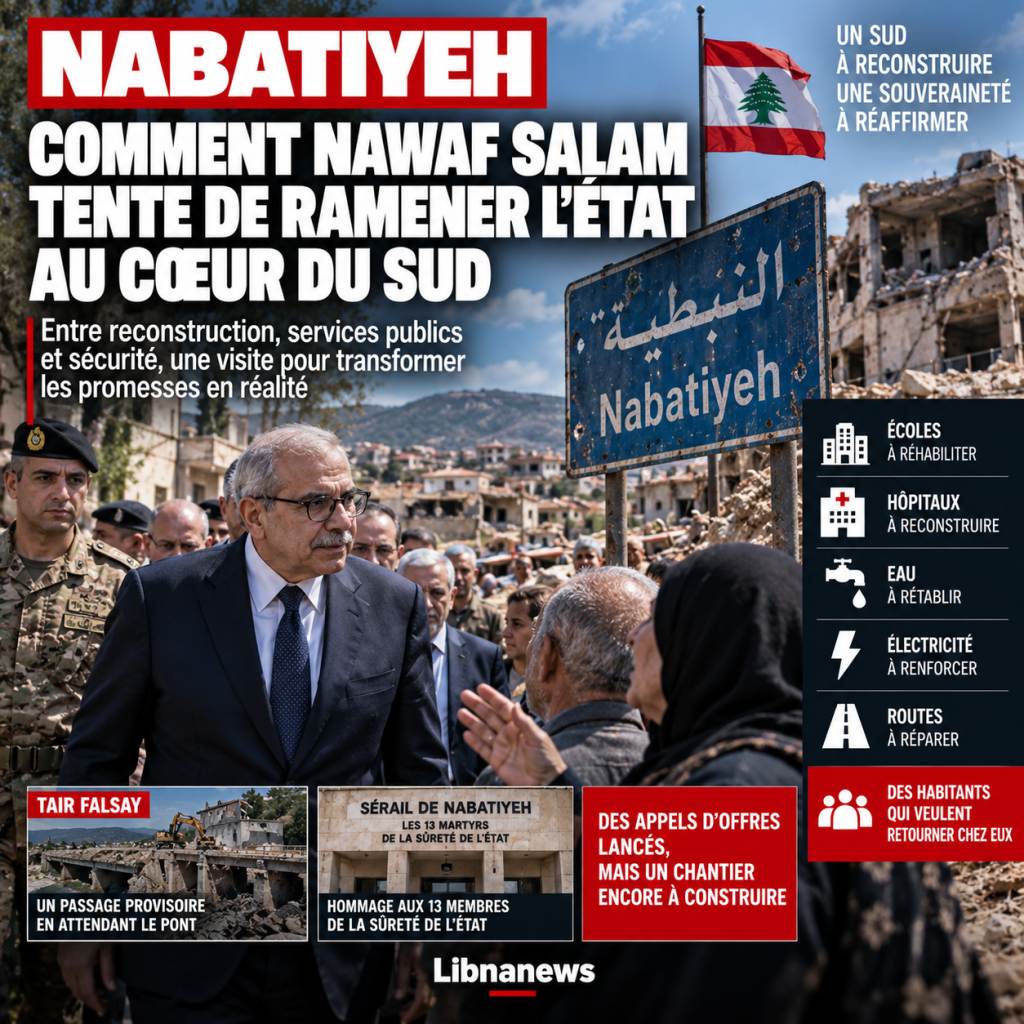
Nawaf Salam’s displacement to Nabatiyah is not limited to a ministerial tour of a war-stricken area. It intervenes almost immediately after its American sequence and places side by side two dimensions of government policy: negotiating outside Israeli withdrawal and sovereignty, and then showing inside that the state can return to the South with something other than a speech. The visit thus becomes a test of credibility. A sovereignty defended in Washington was of lasting scope only if it was translated into an administration, schools, hospitals, roads, water, electricity and services capable of functioning in Nabatiyah and the surrounding localities.
The context makes exercise particularly difficult. Israeli bombing and destruction continue in several areas. Villages remain inaccessible or under heavy military pressure. Residents returning have to deal with damaged homes, destroyed infrastructure and a deeply weakened local economy. Under these circumstances, the presence of the State cannot be measured solely by the number of soldiers or officials present during a visit. It measures the possibility of living again in the southern localities.
However, the visit produced a visible political signal. Official, security and local officials accompanied or welcomed the Prime Minister. Some of the inhabitants came to meet him. Sheikh Abdel Hussein Sadek, imam of Nabatiyeh and influential figure of the city, received. These elements gave the displacement a scope that previous official visits to the region had not always achieved. The government was precisely trying to show that it could enter the South not as an external authority, but as an institution that would carry out its responsibilities in a sustainable manner.
Sovereignty also goes through hospital, school and tap
Nawaf Salam chose to insist on a concrete conception of the state. In a region where sovereignty is almost always discussed through arms, borders and international resolutions, his speech moves part of the question to services. A citizen does not only measure the state’s presence at the flag placed on a public building. It measures it to an administration which opens up, to a hospital which welcomes the sick, to a school which can normally resume the courses, to a road which can be used and to a water or electricity network which works.
This approach responds to an old weakness in the relationship between central and southern power. For decades, public presence has often been perceived as insufficient, discontinuous or slower than partisan and community structures. The war has further aggravated this situation. Destruction has increased needs at a time when public finances remain very limited. Restoring sovereignty means, therefore, simultaneously restoring an administrative capacity that the State was already struggling to achieve before the last fighting.
The government is trying to make this reconstruction part of its security policy. The idea is simple: asking the inhabitants to turn to the state assumes that it can meet their needs. A village where the army is present but where the school remains closed and the water is not present is only part of normality. Similarly, a family cannot return for a long time if it has to choose between staying near its damaged house without services or continuing to live elsewhere.
Calls for tender, but the real project still needs to be built
Government announcements cover several categories of work: rehabilitation of public infrastructure, water and electricity networks, health facilities, schools and facilities necessary for the operation of public administrations. The corpus refers to tendering procedures already initiated and others in preparation. In the health sector, operations also involve equipment and rehabilitation of damaged facilities. In water and electricity, technical records and allocation procedures must be used to repair the affected networks and facilities.
But there is a fundamental difference between starting a procedure and starting a project. A call for tenders means that the administration has identified a need, prepared a file and started the award process. It does not guarantee that financing is fully available, that the contract is awarded without delay or that the company can work immediately in a still exposed area. It is precisely this difference that the government will have to explain in order to prevent the proliferation of advertisements from creating expectations that cannot be met quickly.
The South needs reconstruction that combines emergency and planning. Temporary repairs are essential for return. However, they cannot replace the sustainable rehabilitation of networks. A summarily repaired pipeline, a road opened by a temporary crossing or a partially restored public building can solve an immediate problem. They are not yet a complete reconstruction. The transition from urgency to normality will require financing, ongoing public procurement, expenditure monitoring and, above all, minimum security for businesses to work.
In Tair Falsay, a temporary passage summarizes the urgency
A concrete example illustrates this logic. The Ministry of Public Works and Transport, in coordination with the Litani National Office, has begun to create a hydraulic bridge to temporarily replace a destroyed bridge in Tair Falsay during Israeli strikes. The solution must restore traffic until the permanent bridge is rehabilitated.
This kind of intervention seems modest in the face of the scale of destruction. Yet it is essential for everyday life. A destroyed bridge does not just cut a road. It extends the journey to a school, hospital, business or farm. It complicates the movement of relief services and increases the cost of transporting goods. An interim crossing can therefore have an immediate effect far greater than its apparent cost.
But this example also shows the risk of a two-speed reconstruction. Temporary solutions can last if funding for final works is delayed. The Government will therefore have to avoid the emergency becoming a new normality made up of temporary bridges, minimally repaired networks and partially functioning public buildings.
The memory of the thirteen members of the State Security
Nawaf Salam’s visit also included a symbolic dimension linked to the price paid by the public institutions themselves. The Nabatiyeh Government Serail was named « Serail of the Martyrs of State Security », in tribute to the thirteen members of the General Directorate of State Security killed in the Israeli attack on Nabatiyeh on 10 April 2026. Salam unveiled the commemorative plaque in the presence of officials, members of security and military institutions, local representatives and families of the victims.
This ceremony gives another dimension to the speech on the return of the state. The institutions do not return to a space from which they would have been completely absent; They themselves suffered losses. The commemoration therefore sets out the public presence in continuity and recalls that public officials died during the performance of their duties.
However, the symbol cannot be sufficient. For the inhabitants, honouring the deaths of the state and rebuilding its buildings makes sense only if the administration regains daily capacity. The challenge is to make the Serail something other than a place of ceremony: a centre where citizens can do their job and find services that are normally provided.
A reception with political significance
The Prime Minister’s welcome was quickly interpreted as a political indicator. Some see it as a break with a period of mistrust between the government and part of the population of the South. Others stress the presence of officials close to the Amal movement and read there a sign of differentiation with Hezbollah. These readings must remain cautious. A favourable reception during an official visit is not enough to demonstrate a lasting recomposition of Southern political alliances.
However, it shows that the government has a space for action. The public may want more public presence without this automatically changing its political affiliations. A resident can support training, defend certain positions on resistance and at the same time demand more schools, hospitals and public administration. Reducing the South to a binary choice between state and Hezbollah would prevent understanding this reality.
The government seems to be trying to occupy this space. It cannot compete with political force only through declarations of sovereignty. It must demonstrate that public institutions are capable of producing results. That is why the most important battle after the visit will be played less in speeches than in the execution of announced projects.
Hezbollah in the face of the institutional return of the state
Hezbollah continues to defend the principle of resistance and its weapons in a context of Israeli occupation and strikes. At the same time, its officials stress the need to rebuild the South, allow the return of the inhabitants and strengthen their capacity to remain on their land. The government is therefore in a situation where some of the stated objectives overlap, while the disagreement over weapons remains deep.
This configuration explains why the social presence of the State becomes strategic. If the discussion remains exclusively military, each camp can remain locked in its positions. The government is defending the arms monopoly. Hezbollah believes that the occupation and attacks maintain the need for resistance. But when it comes to repairing a hospital, school or water system, the question changes. The State can act without waiting for all strategic disagreements to be resolved.
However, the success of this method depends on its continuity. A one-off visit followed by months of inaction would reinforce the discourse that the state appears at ceremonies and then disappears when difficult work begins. Conversely, a regular administrative presence can gradually change the relationship between residents and institutions without requiring an immediate political break with local forces.
Money, immediate limit of strategy
Nawaf Salam does not hide that the state’s means are insufficient in the face of the scale of destruction. This recognition is important. The public budget does not allow for the rapid financing of all schools, hospitals, roads, water and electricity networks, administrative buildings and affected housing. Lebanon must therefore mobilize Arab and international financing, as well as loans and programmes related to the international financial institutions.
But external money will not only arrive on the basis of a call for solidarity. Donors will request costed projects, transparent allocation mechanisms, schedules, audits and guarantees that the reconstructed infrastructure will not be immediately destroyed by a new phase of war. The reconstruction of the South therefore depends directly on diplomacy and security.
This dependency creates a difficult circle. Without stability, financing is more difficult to mobilise. Without reconstruction, the return of the inhabitants remains fragile. And without sustainable return of the population and institutions, the state struggles to demonstrate that it really exercises its authority. Nabatiyah’s visit seeks precisely to break this circle by starting with what can be done immediately, while preparing for heavier projects.
A visit that now creates an obligation of result
Nawaf Salam’s displacement raised expectations. Prior to the visit, the government could invoke security and financial constraints to explain the slow pace of its action. After publicly stating that the South is a priority and announcing concrete interventions, it will now have to report on their progress. What contracts have been awarded? What projects have started? Which establishments have reopened? What networks have been repaired? How many families have been able to return under acceptable conditions?
This obligation of result is probably the most important political effect of the visit. The state can no longer only promise its return: it has begun to stage and claim it. Each delay will therefore become more visible. Conversely, each service re-established will give content to a notion of sovereignty often reduced to military matters.
In Nabatiyeh, the government tried to show that the state could come back through several doors at once: security, administration, health, education, public works and institutional memory. The bet is ambitious because it has to be carried out under blows and with exsanguous finances. Its success will not be measured at the reception of a day. It will be measured in the coming months, when residents will be able to check whether the ads have actually produced open schools, repaired hospitals, practical roads and administrations capable of functioning.





Comments