

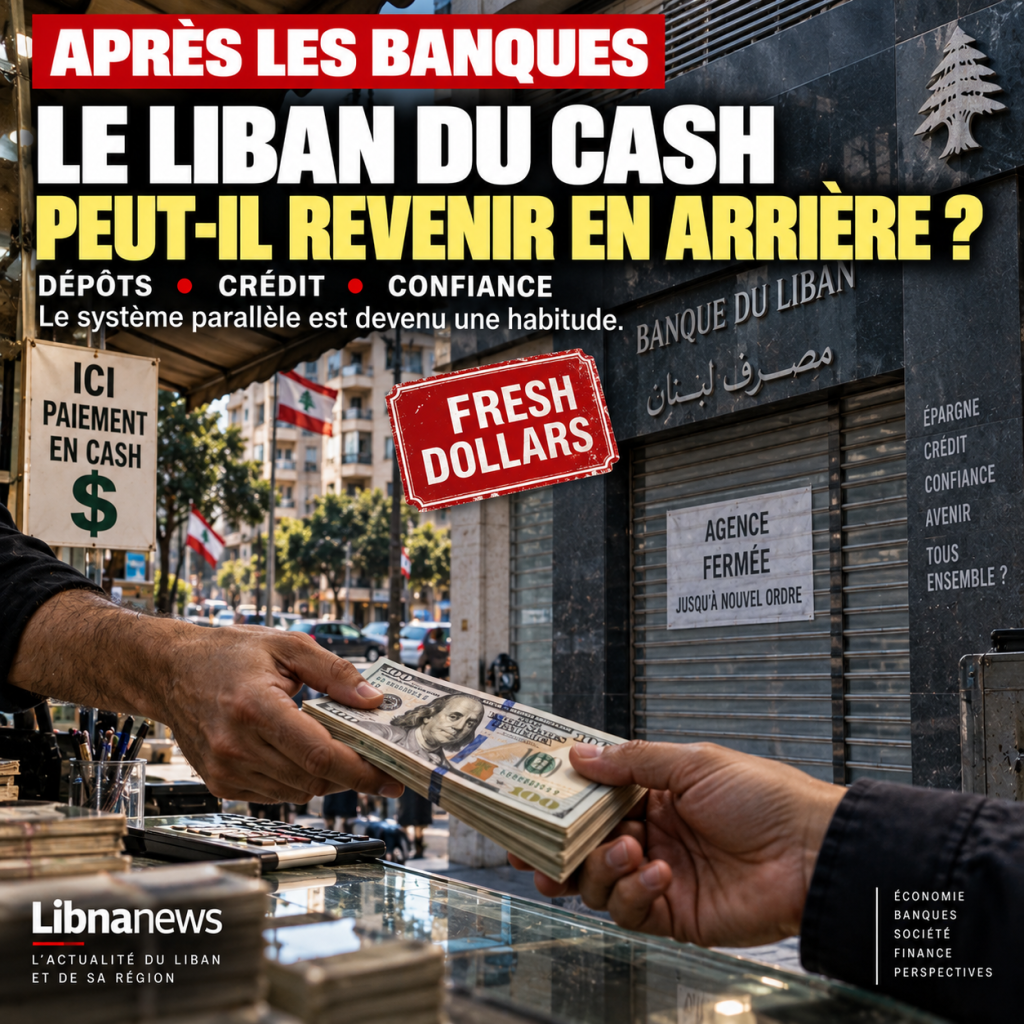
The cash had to be an emergency solution. It has become an infrastructure. After the bank collapse, Lebanese learned to receive their income in fresh dollars, to keep more banknotes, to pay directly suppliers and traders and to carefully distinguish the money newly entered into the old deposit system. This has enabled a considerable part of the economy to continue to function when banks are no longer normally fulfilling their role. Several years later, however, it posed an opposite problem: the system designed to survive without banks had become sufficiently effective so that the return to banks could no longer be considered automatic.
This is one of the most complex challenges facing the government of Nawaf Salam and the Bank of Lebanon led by Karim Suaid. Lebanon can restructure its banking sector, gradually resolve the issue of losses, strengthen controls and resume negotiations with the International Monetary Fund. It can also promote electronic cards and means of payment to reduce cash flow. But none of these measures alone answers the central question: why would a Lebanese who learned to operate without leaving his money to the bank decide to return it? The problem now goes beyond balance sheets. It affects a profound transformation of economic behaviour.
Cash did not replace money: it replaced part of the bank
The crisis did not prevent the dollars from entering Lebanon. Expatriates continued to support their families, businesses continued to trade and households to consume. What has changed is the path taken by money. A large part of the flows were organized around the fresh dollars, cash and mechanisms to enable the recipient to immediately dispose of its funds. The economy has thus built a system of circumvention that met a priority that has become absolute: no longer risk losing access to its own money.
The extent taken very early by this economy makes it possible to measure the depth of the phenomenon. An estimate of 2022 estimated about$9.9 billiondollarised economy operating in cash, i.e45.7% of gross domestic productof the time. This figure is old and does not directly measure the situation of 2026. However, it shows that only a few years after the crisis began, cash was no longer a marginal phenomenon. It had become one of the pillars of economic functioning.
The most profound change is psychological. Before the crisis, a dollar deposited in a bank and a dollar note were perceived as two almost perfectly interchangeable forms of the same wealth. The experience of restrictions has broken this equivalence in the minds of many savers. The ticket is immediately available. Deposit is a claim on an institution. This difference obviously existed before 2019, but it seemed theoretical. The collapse turned into a collective experience.
Money accessibility has become a return
Before the crisis, the choice to deposit money in a bank was based on an obvious logic. The client obtained the physical security of his funds, means of payment, transfers, sometimes remuneration and possibly access to credit. Keeping large amounts in cash had little benefit from this combination of services. The calculation was reversed when depositors discovered that a bank balance could continue to appear on a statement while ceasing to be freely available.
Since then, the cash holder accepts certain costs in exchange for a guarantee that has become essential. His notes are of no interest. They must be protected against theft and may be difficult to use for some important transactions. But their owner knows he can take them immediately. This availability now has its own economic value. It works almost like an invisible yield: savers give up earning more to keep their money in full control.
This transformation considerably complicates the reconstruction of the banking sector. Even if a bank offers a paid product tomorrow, the customer will no longer simply compare its interest rate with that of a competitor. He will first ask if he will be able to recover all his money whenever he wishes. The yield will only arrive afterwards. Banks will therefore have to sell something they almost never needed to sell before: the credibility of the promise of restitution.
Repairing the balance sheets will not be enough to bring back the dollars
The Government can adopt the best possible prudential rules and the Bank of Lebanon can considerably strengthen its supervision without immediately causing the return of savings. Restructuring responds to an institutional problem; trust responds to a lived experience. Both are linked, but they do not necessarily advance at the same pace. A law can be passed within a few weeks. Changing the behaviour of millions can take years.
The real test will come after the reform. A client may deposit a small sum and observe what happens. He will check if he can remove it freely. He will look at the treatment of other applicants. It will follow any regulatory changes. It is only after an accumulation of normal experiments that the amount he agrees to leave in the system may increase. Trust will probably not return in the form of a large collective movement. It will have to be rebuilt after transaction.
This issue gives additional importance to the settlement of old deposits. To ask the Lebanese to trust the new system while leaving without clear solution the money immobilized in the old would create a contradiction difficult to defend. The restructuring of banks and the treatment of the financial hole are therefore not only used to pay off the past. They determine the credibility of everything that must come after.
Lebanese paradox: a lot of dollars, but little credit
The cash economy makes it possible to understand a paradox often misperceived. A country can have large amounts of dollars and suffer simultaneously from a lack of funding. The physical presence of banknotes does not mean that such savings are available to finance businesses, housing or infrastructure. This requires an intermediary capable of collecting money, assessing risks and turning it into loans.
Let us take a simple example. Ten thousand people, each holding $50,000, would collectively have $500 million. That wealth exists. But if it remains scattered in safes, houses or commercial caisses, it does not spontaneously become a ten-year loan to build a factory or residential complex. Cash allows you to pay a transaction today; it does not automatically create the necessary financing for an investment that will generate its revenues in several years.
The real estate market provides a concrete illustration of this breakdown. Purchases continue to be made by people with fresh dollars, wealth or income from abroad. On the other hand, a large part of households can no longer turn 20 years of future income into immediate purchasing capacity thanks to conventional real estate credit. The market therefore still has money, but much less mechanisms to mobilise it for the benefit of those who do not already own capital.
This is where the cash economy reveals its limit. It is extraordinarily effective in maintaining trade. It is much less so to finance growth.
The ticket in the drawer does not finance the company next door
The problem goes beyond housing. A modern economy needs credit to enable a company to buy a machine before it realizes the income it generates, to an entrepreneur to open an establishment before its first customers arrive or to a farmer to finance a season before the harvest. Without a financial intermediary able to take this risk, investment depends much more heavily on personal wealth.
This situation favours mechanically those who already own capital. A family business with hundreds of thousands of dollars can invest in equity. An entrepreneur with an excellent project but with no initial capital risk to remain blocked. The cash economy can thus maintain activity while reducing economic mobility.
In the long term, the cost is considerable. Money circulates, but it circulates mainly to settle immediate operations. It produces less easily the multiplier effect associated with a functional banking system. Savings do not disappear; It becomes less productive. This explains why bank reconstruction is far more important than banks themselves. Without intermediation, the country risks maintaining a liquid but underfunded economy.
Diaspora transfers fuel economy without necessarily rebuilding banks
The diaspora is one of the country’s main sources of foreign exchange. These transfers support consumption, allow families to pay their expenses and help maintain activity. But the way this money is used determines its effect on the financial system. If the beneficiary withdraws funds quickly or prefers a circuit guaranteeing their immediate availability, the dollars enter the economy without staying long enough in the banks to serve as a basis for further intermediation.
Lebanon thus faces an unusual problem. It does not only need to attract currencies; he must convince their owners to leave them voluntarily in the system. Nuance is fundamental. Forceting money into banks or making cash artificially difficult to use could produce the opposite effect of the desired one. Savers would seek new means of circumvention, precisely because the crisis taught them to be wary of constraints.
The most credible strategy is therefore to make the bank more interesting than cash rather than just making cash more painful. This requires legal certainty, full availability of new deposits, properly capitalized banks and credible supervision of the Bank of Lebanon. The customer must be able to conclude for himself that he loses more by keeping his tickets out of the system than by depositing them.
Credit card doesn’t solve the trunk problem
The desire to develop electronic payments is a clear logic. Digital transactions improve traceability, reduce the risks associated with cash transport and facilitate the formalisation of the economy. They can also improve knowledge of flows and help reduce certain forms of fraud. But using a card more does not necessarily mean trusting banks more.
A consumer can keep most of his wealth in cash and deposit only what he needs for his monthly expenses. He will then use a card at the supermarket, pay his bills electronically and contribute statistically to the growth of digital payments, without putting his savings back into the system. Lebanon would have succeeded in the bankarisation of payments without successful rebanking of savings.
This distinction must be at the centre of future policies. Reduction of cash in daily transactions is a goal. The reconstruction of a stable deposit base is another, much more difficult. It is this second step that will eventually allow banks to start financing the economy on a large scale.
Cash is expensive, even when it seems free
Keeping tickets seems to avoid bank charges and institutional risks. Yet this freedom has several costs. Households and businesses must physically protect their money. Cash transport is becoming more important. Flight risks are increasing. Large transactions are less practical and some international transactions remain difficult without going through the financial system.
The collective cost is even higher. A species-dominated economy is more difficult to measure and control. Part of the activity can be more easily exempt from taxation. Suspicious operations are harder to trace. The State has a less accurate picture of income and trade, which complicates both fiscal policy and the fight against money laundering.
This opacity explains the importance of the subject in relations with international partners. The United States insists on monitoring financial networks linked to Iran and Hezbollah, as well as on combating money laundering and illicit channels. But the Lebanese interest in further formalizing the economy exists independently of these demands. Better traceability facilitates relations with foreign banks, protects legitimate businesses and helps restore the country’s credibility to investors.
However, the government must avoid this reform being perceived only through the American confrontation with Hezbollah. Reducing the informal economy and strengthening controls are national issues. Presenting them exclusively as a response to foreign pressure could politicize a transformation that the whole economy needs.
Cash now has its own beneficiaries
Mistrust of banks alone does not explain the persistence of cash. Several years of operation have created habits and interests. Some players appreciate the discretion of cash transactions. Informal activities benefit from reduced traceability. Businesses or individuals may find a tax advantage. The longer the system lasts, the more difficult it becomes to distinguish what is still a legitimate protection against bank risk from what is an interest in maintaining opacity.
This evolution is classic when an emergency solution becomes permanent. At the beginning of the crisis, using cash could be a defensive reaction. In 2026, the phenomenon was a complete economic architecture. It has its circuits, its business habits and its beneficiaries. Reducing it therefore means convincing savers while confronting those who profit from its lack of transparency.
This makes any brutal policy particularly risky. If the authorities simultaneously attack the cash without restoring banking confidence, they can give both groups a common reason to resist: savers will fear for their money and beneficiaries of informality will defend their interests. The order of reforms therefore becomes as important as their content.
Old banks have a handicap that capital will not be enough to erase
A deeper question arises behind the restructuring: will the Lebanese agree to entrust their new savings to the institutions they associate with the immobilization of the old? The problem no longer only concerns solvency. It affects the very identity of the institutions and the perception of their directors and shareholders.
A bank can be recapitalised and meet new ratios. It can change its governance and be subject to much stricter oversight. But if the customer continues to identify him at the depot he has not had access to for years, his commercial reconstruction will remain difficult. The way in which banks will participate in the settlement of old losses will therefore be observed with as much attention as their future balance sheets.
This explains why some call for the arrival of new establishments or for a much deeper transformation of the banking landscape. Creating new banks would obviously not solve the fate of old deposits. However, this could respond to another demand: to have institutions that do not directly bear the reputational liabilities of the crisis. The debate cannot therefore be limited to the number of banks that will survive. It also concerns the degree of breakage required with the old model.
The real sign of normalization will be the return of the loan, not that of the card
Lebanon will be able to consider that its financial system will actually begin to function once banks are able to lend sustainably. An easier international transfer would be an improvement. Wider use of maps too. Totally available fresh dollar accounts are essential. But these services are not enough to recreate the economic role of a bank.
The real test will be elsewhere: can a healthy company borrow to finance a machine over several years? Will a young solvent household be able to buy a dwelling without having the full price immediately? Will an entrepreneur be able to turn a credible project into an investment through credit rather than the sole wealth of his family? As long as the response remains largely negative, the country will mainly have an improved payment system, not yet a fully restored financial system.
The return of credit will require recapitalised banks, but also a sufficiently stable deposit base. The two problems are therefore circular. Lebanese are reluctant to deposit because they do not trust banks. Banks can hardly lend massively without stable deposits. And the economy continues to operate with cash because bank credit remains low.
Breaking this circle will probably be much harder than passing a law.
Lebanon could succeed in its agreement with the IMF and still maintain a parallel economy
This is the most interesting scenario, because it shows the limits of only institutional reform. Let us imagine that the government is reaching an agreement with the International Monetary Fund, that the financial hole is finally treated, that some banks are recapitalized and that others are restructured or liquidated. There is no guarantee that the Lebanese will immediately hand over the billions kept out of the system in these new establishments.
They could continue to use banks as service providers while retaining the bulk of their assets elsewhere. The account would be used for cards, transfers and expenses. The safe, real estate or assets held abroad would retain the saving function. Such an architecture would be more stable than that of the crisis, but it would still severely limit the ability of banks to finance the economy.
This is why the reconstruction has two separate construction sites. The first is visible: repairing balance sheets, allocating losses, strengthening supervision and negotiating with international institutions. The second is much more difficult to measure: gradually convincing citizens that leaving their money in a bank is no longer a higher risk than keeping it elsewhere.
The cash enabled Lebanon to survive when its banking system could not normally perform its functions. It maintained trade, supported consumption and gave households immediate control over their resources. This success in survival today explains the difficulty of going back. For many Lebanese, the ticket is no longer just a means of payment. It has become an insurance against the financial system itself.





Comments