

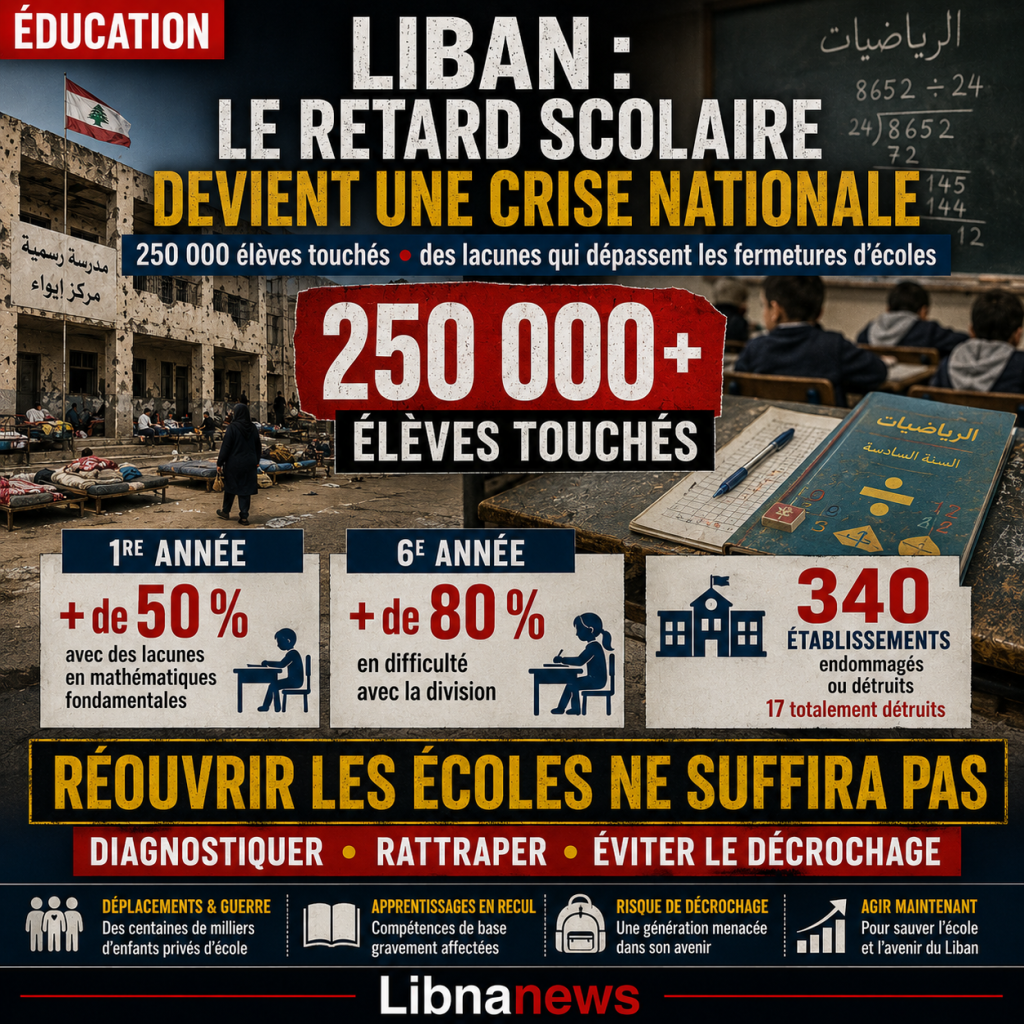
More than 250,000 students in Lebanon have been deprived of education or severely affected by war, displacement and closure of schools. The figure, reported on August 25, 2026 byAl Akhbar, not only describes a problem of access to school. It reveals a deeper crisis: a significant part of Lebanese children are now suffering from delays in basic skills, to the point that simply reopening classes will not be enough to put the education system back on track.
The available data are of concern. More than half of first-year primary school students would not have mastered some basic mathematical skills. In grade 6, more than eight out of ten students would encounter difficulties with the division. These results are derived from evaluations carried out before the last phase of war and show that the loss of learning had already been established. The conflict has therefore aggravated an old problem rather than created it.
Over 250,000 students affected by school interruptions
The 2026 crisis disorganized education at a national level. Population displacement, bombing, closures and the transformation of many public schools into shelters have prevented hundreds of thousands of children from attending normal school.
According to data reported at the end of August, more than 250,000 students were affected by displacement, school closures in conflict zones or their use as shelters. UNICEF estimates that approximately 256,000 students were affected by these disturbances.
The situation has particularly affected the public network.Al Akhbarreports that about half of the official schools at one time served as accommodation centres. This was a clear humanitarian emergency, but it had an immediate consequence: school buildings temporarily ceased to fulfil their educational function.
The Ministry of Education had tried to ensure minimum continuity. By March 2026, Minister Rima Karami had asked public and private institutions to adopt flexible solutions combining physical presence, distance learning and hybrid models. Specific decisions had also framed distance education in closed public schools.
In practice, this continuity has remained very uneven. Access to electricity, the Internet, digital equipment and a quiet environment varies greatly among families. A theoretically available distance learning does not necessarily mean real learning.
Open school does not guarantee that a child learns
This is where the problem changes in nature. An educational crisis can be measured by the number of days closed, but this statistic is not enough. It is also necessary to measure what students really know when they return to class.
Lebanon now has sufficient data to measure this difference. The Ministry of Education and the Centre for Educational Research and Development conducted a national diagnosis of more than 135,000 students in grades 1-6 of primary school in public schools.
The rate of participation in this evaluation was about 96 per cent. The exercise focused on basic skills in Arabic, foreign language and mathematics. He therefore sought not only to award a school grade, but to determine whether the essential skills for further learning had actually been acquired.
Results analysed byAl Akhbarreveal significant shortcomings. More than half of first-year students would have deficiencies in basic mathematical skills. In the sixth year, more than eight out of ten students would not be properly mastered.
These figures are all the more important as they relate to basic skills. A difficulty in an isolated chapter can be corrected relatively easily. A persistent weakness in computing, reading or writing, on the other hand, compromises a significant part of subsequent learning.
The school delay already existed before the last war
However, it would be incorrect to attribute these results exclusively to the conflict of 2026. The evaluations cited by the press show that the delay had begun to accumulate much earlier.
Since 2019, the Lebanese education system has experienced an exceptional succession of crises. The economic collapse reduced teachers’ incomes and caused repeated strikes. The Covid-19 pandemic then led to long periods of distance learning in a country where access to digital equipment remained very uneven.
In addition to these events, the port of Beirut exploded, the devaluation of the pound, the increase in the cost of transport and the successive conflicts. Each of these episodes reduced the number of actual teaching days.
Al Akhbarreports that the diagnostic assessment for the years 2024 and 2025 showed a loss equivalent to about three out of five learning days. This does not necessarily mean that schools were physically closed three days out of five. Rather, it reflects the extent of the backlog in learning.
The problem has therefore become cumulative. Students currently in grade 6 have experienced several interruptions since entering school. Some children have experienced successive school years amputated by the pandemic, strikes, economic crisis and war.
Why gaps multiply over time
School learning works as a progressive construction. Some skills are the foundation needed to acquire the following. When they are missing, each new step becomes more difficult.
In mathematics, a student who does not master the addition and multiplication will have more difficulty understanding the division. These difficulties will then affect fractions, proportions, algebra and more complex problems.
The same logic exists in reading. A child who slowly deciphers devotes much of his attention to recognizing words. As a result, there are fewer cognitive resources left to understand the meaning of the text, identify key ideas or use information in other subjects.
An initial delay can increase with age. Two students separated by a few months of first-year apprenticeship may be separated by several years of college skills if no corrective action is organised.
It is this dynamic that turns school backwards into a national crisis. The problem is no longer just the number of days lost, but the possibility that a generation advances in the curriculum without having the necessary knowledge at its administrative level.
Division in sixth year becomes an alert indicator
The divisional figure illustrates this difficulty. If more than eight out of ten pupils in grade 6 do not properly master this operation, this means that a skill normally acquired several years previously remains fragile in a majority of children.
The consequence is not limited to mathematics courses. The division is involved in understanding the proportions, percentages, averages, speeds, conversions and many scientific exercises.
A student who has difficulty with this operation will have to devote more effort to a basic stage when he or she encounters more complex problems. He can then conclude that he is « bad in mathematics », while the difficulty sometimes comes simply from an old deficiency never corrected.
This accumulation also has an educational effect on teachers. In the same class, some students can follow the planned curriculum while others need to go back to much older concepts.
The teacher then finds himself confronted with a class whose levels are extremely heterogeneous. Following only the official curriculum risks abandoning the weakest students. On the other hand, it slows down those who already control them.
Returning to school will not be enough
The traditional response to a school break is to reopen schools and resume the program to the point where it was interrupted. This method becomes insufficient when the delay is massive and very different according to the students.
Priority should first be diagnostic. Schools must determine what each group of students actually masters before deciding what to teach.
This logic is already partially recognized by the department. In August 2026, an exceptional national assessment was announced for some children with non-formal education. It must measure their skills in Arabic, foreign language and mathematics in order to facilitate their return to formal education.
The principle could be extended. After such a major disruption, the administrative level on the school bulletin is no longer necessarily a sufficient indicator of the actual level.
A student may be officially enrolled in the fifth year while in need of catching up on third or fourth grade skills. The difficulty is then to organize this support without having it repeated automatically and without stigmatizing it.
Catch-up should be targeted and not uniform
An effective catch-up policy is probably not simply adding a few weeks to the school calendar. Not all students lost the same skills or amount of learning.
Some have been able to attend online courses. Others have changed accommodation several times. Some had a computer and a stable connection. Others were eventually taking classes from a shared phone with several family members.
Catching up must therefore begin with a short and precise assessment of the core competencies. The results could then allow for the temporary formation of educational groups according to needs rather than by age alone.
For the first years of primary school, the effort should focus on reading, writing and elementary digital skills. These fields produce the most important educational performance because they then serve in almost all subjects.
For intermediate levels, the essential concepts that determine the continuation of the programme should be identified. Finding to catch up with every missed chapter would probably be unrealistic.
Increasing risk of dropping out of school
Delay in learning also increases the risk of abandonment. A child who no longer understands enough what is taught can gradually withdraw from school.
This stall is not always immediate. It often starts with a decline in participation, more absences, weaker results and then a sense of failure. When these difficulties combine with economic constraints, leaving the school system becomes more likely.
Displaced families are particularly vulnerable. Some have lost their housing, economic activity or part of their income. The costs of transportation, supplies and school food can then become difficult to finance.
For adolescents, the opportunity cost of school increases. A family in difficulty may need additional income and encourage a young person to work. The longer its school delay is, the less profitable it seems to be in the short term.
The danger is particularly high when schooling has already been interrupted for several months. Every month spent out of school reduces the strength of school habits and can make return more difficult.
Economic crisis amplifies school losses
The link between economy and education thus becomes central. Lebanon is experiencing a new recession and high inflation simultaneously. Households must balance more essential spending with often limited resources.
The direct cost of education is not reduced to the cost of enrolment. It includes transportation, books, supplies, clothing, meals and sometimes digital equipment.
In private schools, economic difficulties can lead to transfers to the public sector. It must already manage the physical damage caused by the war and the use of many buildings as accommodation centres.
Pressure can therefore move from one network to another. A family that can no longer finance private schools increases the needs of the public system when it has less material capacity.
340 establishments damaged or destroyed
The real estate issue also remains important. A national assessment conducted by the Ministry of Education in June, with international technical support, identified 340 public, private or technical schools damaged by the conflict.
Seventeen establishments were reportedly completely destroyed. At the beginning of July, at least 100,000 children were at risk of not having a classroom for the next school year in the absence of urgent work.
These data recall that the learning crisis also has a physical dimension. Organizing educational support is impossible if children do not have a building to return to.
But rebuilding schools only addresses part of the problem. An institution can be repaired within a few months while a learning delay accumulated over several years may require several school cycles to be corrected.
Educational reconstruction must therefore treat buildings and skills simultaneously.
The risk of a two-speed system increases
The crisis can also exacerbate differences between institutions. Families with significant resources can finance private lessons, school support, digital equipment or an institution that can quickly organise alternative solutions.
The poorest families have much fewer opportunities. Their child depends almost entirely on what the public school can provide.
Two students who have lost the same number of school days can therefore experience completely different trajectories. One quickly compensates through private courses. The other comes back after several months without real learning.
This inequality can continue throughout education. The results of national assessments should therefore be analysed not only by level of education but also by region, institution and socio-economic context.
Teachers themselves will have to be supported
Any policy of catching up will ultimately be based on teachers. However, they themselves suffered several years of wage crisis, monetary instability, strikes and school disruption.
Asking teachers to recover several years of delay without changing their educational organization would be difficult to achieve. They will need tools to quickly diagnose gaps and prioritize core competencies.
Too many programmes can become counterproductive. A teacher who is forced to complete the textbook may move forward while a part of the class does not master the previous knowledge.
The system will therefore have to accept a form of hierarchy. Not all the concepts in the programme are of equal importance when an entire generation has to recover basic skills.
Common reading, writing, elementary calculation and understanding are the obvious priorities of the early years. The catch-up programmes will then have to gradually rebuild the more complex skills.
Measuring skills rather than counting days
The main necessary transformation is probably about how Lebanon measures the educational crisis. For a long time, the discussion focused on the number of school days lost and the dates of recovery.
These indicators are still useful, but they do not say whether the child has learned. Two students can attend the same number of courses and leave the year with very different skills.
The data collected from more than 135,000 students therefore provide a particularly valuable tool. They make it possible to move the debate from the school presence to the real gains.
This approach must be repeated. An assessment before a catch-up program identifies needs. A new evaluation a few months later shows whether the intervention worked.
Without this measure, the system may confuse administrative progression with educational progression. Automatically passing a child into the upper class can mask the delay without solving it.
Economic cost will appear several years later
The school crisis has a long-term economic dimension. A less skilled population is generally less productive and has lower future incomes.
The loss of current learning can thus affect the labour market in ten or fifteen years. Children who leave school today without proper literacy, numeracy or language skills will find it more difficult to access technical, academic and vocational training.
Lebanon risks losing an additional part of its human capital at the same time as the emigration of young graduates already reduces its skill pool.
Therefore, the educational issue is directly linked to economic reconstruction. Repairing a road or power plant can take a few years. Rebuilding a generation of lost skills takes much longer.
The figure of 250,000 private pupils in education is thus less a definitive assessment than a warning. The real indicator of the coming months will be the ministry’s ability to accurately identify the deficiencies of these children, to bring students at risk of dropping out to classes and to organize a sufficiently targeted catch-up to prevent the temporary losses of 2026 from becoming permanent handicaps.




