





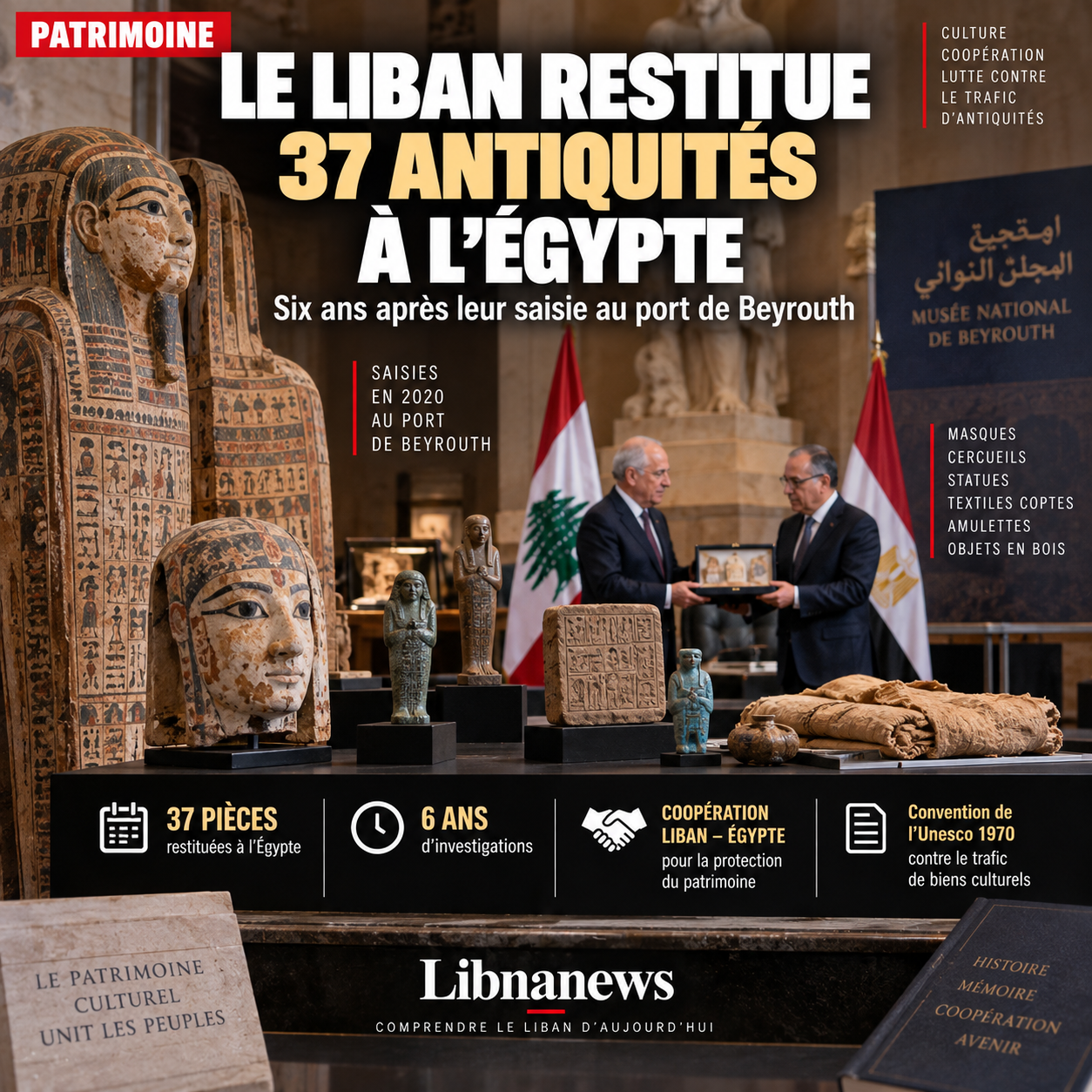
Lebanon returned 37 antiquities from ancient Egyptian civilization to Egypt on Wednesday, September 16, 2026, six years after their seizure at the port of Beirut. Lebanese Minister of Culture, Ghassan Salamé, officially handed over the pieces to Egypt’s Ambassador to Lebanon, Alaa Moussa, at a ceremony at the Beirut National Museum. The Lebanese authorities had intercepted the objects in 2020 in a container arrived from an Arab port. Investigations conducted since then have established their Egyptian origin and allowed their restitution.
This restoration concludes an administrative, judicial and archaeological process initiated after the discovery of the objects. The Lebanese authorities had to verify their authenticity, determine their provenance and establish Egypt’s rights in the exhibits before their return. The collection includes masks, wooden objects, Coptic textiles, amulets, statues and two decorated wooden coffins.
37 antiques returned after six years in Lebanon
The return of the 37 antiquities to Egypt took place at the Beirut National Museum in the presence of Lebanese and Egyptian officials. Ghassan Salamé handed over the documents to Alaa Moussa on behalf of the Lebanese authorities.
The case goes back to 2020. That year, the authorities discovered the objects at the port of Beirut. They were grouped in the same container from an Arab port.
The seizure immediately raised the question of their origin. The objects had characteristics corresponding to the Egyptian archaeological heritage, but their restitution required formal identification and a procedure to determine their legitimate owner.
The authorities therefore kept the documents in Lebanon during the verifications. Ghassan Salamé explained at the ceremony that investigations into their identity and property had finally established that they belonged to Egypt.
This conclusion paved the way for their surrender to the Egyptian authorities. The transfer made on Wednesday ends a procedure that lasted about six years between the seizure at the port of Beirut and the official return.
Items seized in a container in 2020
The circumstances of the discovery are a central element of the case. The 37 items were gathered in a single container when they were intercepted at the port of Beirut.
According to the information provided at the time of the return, a Lebanese national had purchased these antiquities. However, it did not have any official documents establishing their Egyptian origin or enabling them to legally trace their exit from the country.
The absence of source documents required further verification. In the field of antiques, the only appearance of an object is not sufficient to legally determine its origin and owner. In particular, the authorities must examine its authenticity and the conditions under which it circulated.
Lebanon has worked with the Egyptian authorities and with the relevant agencies to clarify these elements. Interpol and the Lebanese Prosecutor ‘ s Office also participated in the verification process.
In particular, the investigation had to determine whether the objects were genuine and confirm their origin before restitution. This step was necessary to avoid handing over documents to a State without first establishing its rights to them.
The conclusions finally confirmed the Egyptian origin of the collection. The legal procedure for his return was then completed.
Masks, coffins and textiles among the pieces
The returned collection does not consist of a single type of object. It gathers several categories of pieces related to ancient Egyptian heritage.
It includes masks made of different materials, wooden objects and figures, coptic textile fragments and amulets made of glass paste. Medium-sized statues are also among the objects recovered.
Two wooden coffins decorated with colourful decorations are also part of the set.
Only part of the collection was presented to the public at the ceremony at the National Museum. Five pieces were exhibited on that occasion. These included masks made of fabric, wood and clay.
This presentation accompanied the official handover without transforming the Beirut National Museum into a place for permanent conservation of objects. Instead, the ceremony marked their return to their country of origin after several years spent under the responsibility of the Lebanese authorities.
The 37 pieces must now reach Egypt, which thus recovers an archaeological whole from its territory without official documentation allowing to establish its provenance at the time of its discovery in Lebanon.
A restitution framed by international cooperation
The length of the proceedings is due in particular to the need to respect the legal mechanisms applicable to illicitly circulating cultural property.
The Lebanese Ministry of Culture has included this restitution as part of international cooperation against trafficking in cultural property. In particular, Ghassan Salamé referred to the implementation of the 1970 Unesco Convention on Measures to Prohibit and Prevent the Illicit Import, Export and Transfer of Ownership of Cultural Property.
This framework is based on a principle: an archaeological object identified as belonging to the heritage of a country and unlawfully removed from it may be subject to a restitution procedure where its origin and the conditions required are established.
In the case of the 37 antiquities, several actors had to intervene before the transfer was possible. The Directorate-General for Antiquities participated in the monitoring of the case in Lebanon. The security services and judicial authorities have also been involved.
Cooperation with Egypt enabled comparison of available information and the origin of objects. The Interpol intervention completed the necessary checks in this transnational dossier.
A decision by the competent Lebanese authorities was then necessary to enable the actual delivery of the documents to their legitimate owner.
Beirut officially delivers the coins in Cairo
The ceremony on Wednesday was the concrete result of these steps. It was held at the Beirut National Museum, an institution responsible for preserving a major part of the Lebanese archaeological heritage.
The choice of the museum also gave an institutional dimension to the operation. Lebanon was not simply a physical transfer: it officially recognized the belonging of the objects to the Egyptian heritage and handed them over to the representative of the State concerned.
Ambassador Alaa Moussa stressed the importance of inter-State cooperation in protecting the heritage of humanity.
This cooperation is essential in cases of antiques leaving their original territory. Objects can cross several countries before being identified and then change ownership without the necessary documents accompanying transactions.
The investigation of provenance can then reconstruct their path. They are also used to distinguish legally acquired and exported objects from those that have left their country outside the prescribed procedures.
In the Beirut case, the lack of official documentation on the origin of the 37 exhibits was precisely one of the problems encountered when they were seized.
Egypt pursues the recovery of its heritage
Lebanon ‘ s return is part of Egypt ‘ s efforts to recover antiquities illegally removed from its territory.
The phenomenon goes far beyond the Beirut issue. According to figures provided by the Egyptian authorities, nearly 30,000 archaeological objects have been recovered over the past decade.
Refunds come from several countries and may result from customs seizures, judicial investigations or investigations into trafficking in works and archaeological goods.
Last month, the US authorities returned 48 antiquities to Egypt following an investigation by the Federal Bureau of Investigation’s art-related crime team.
These operations illustrate the difficulties associated with the international circulation of antiques. When a coin appears in a foreign market without documented history, determining its origin may require several years of inter-jurisdictional research and cooperation.
The Lebanese case provides a specific example. Seized in 2020 at the port of Beirut, the 37 pieces were returned only in September 2026, after checking their authenticity and property.
The handover to the National Museum is now completing the Lebanese phase of this dossier. The objects must return to Egypt, while the mechanisms of cooperation between the two countries remain mobilizable for possible new cases concerning cultural objects circulating without documents establishing their provenance.