

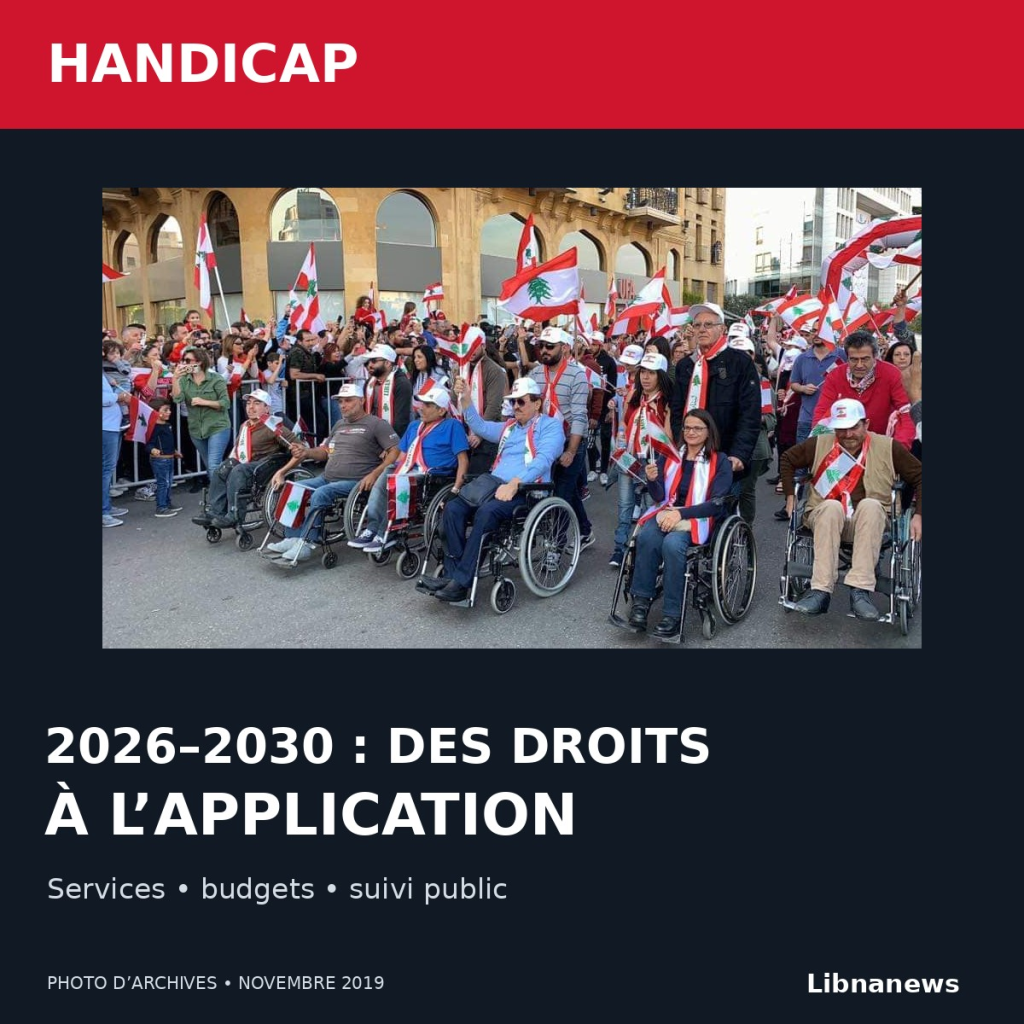
The disability strategy 2026-2030 was launched on 3 November at the Grand Sérail in Beirut. It engages all public institutions. Its application will need to be measured in schools, services, budgets and procedures beyond the launch ceremony.
The Lebanese government is opening a new phase of its inclusion policy. The National Strategy for the Rights and Inclusion of Persons with Disabilities covers five years, from 2026 to 2030. The Council of Ministers approved it on 26 February. Its public launch now puts the issue of execution at the forefront.
The Ministry of Social Affairs carries out this programme with the United Nations Population Fund and the Economic and Social Commission for Western Asia. In Serail, Prime Minister Nawaf Salam stressed a shared responsibility. Each ministry and public institution must act in their area.
A disability strategy 2026-2030 to translate into services
The programme is based on ten axes. They include laws, disability assessment, education, health and social and legal protection. Employment, accessibility, social behaviour, political participation and cultural, tourism and sports life complement this area.
This limits inclusion to an allowance or specialty service. A child may have a right to schooling without being able to join the class. An adult can fulfil the conditions of employment without access to the building or necessary tools. Follow-up should therefore focus on the complete route, rather than on an isolated measure.
Social Affairs Minister Hanine Sayed presented the ability to learn, work and participate as the criterion for success. This objective provides a concrete starting point for the evaluation. However, it requires comparable data between the beginning and end of the period.
Identifiable responsibilities and timelines
The strategy provides a national coordination framework. It should clarify roles and enhance coherence among stakeholders. It also includes mechanisms for monitoring, accountability and measuring progress. The participation of persons with disabilities and their organizations concerns preparation, implementation and decisions.
To assess these commitments, a first indicator would be the publication of a calendar by institution. Each measure should identify the person in charge, the expected date and the state of progress. A general announcement on accessibility is not enough to know what equipment will be adapted, in what order and according to what standards.
There is also a need to distinguish an announced procedure from an actually usable service. The number of buildings examined, for example, does not indicate how many were made accessible. Similarly, training of staff is a step, but does not provide information on obstacles encountered by users alone.
The budget, a separate audit
Support for the launch is focused on translating commitments into policies, legislation and budgets. It alone does not encrypt an available envelope. No overall amount of funding can be deducted from the statements made at this ceremony.
A useful financial follow-up would separate planned appropriations, committed amounts and payments made. These three steps do not answer the same question. An appropriation indicates a budgetary intention. An expenditure carried out provides information on the resources actually mobilized. The results must then be assessed with the persons concerned.
This distinction also counts for external contributions. Technical support, promise and payment are not interchangeable. The resources pledged should be reconciled with the projects for which they are intended, without assuming that each axis already has its funding.
Associate the persons concerned with the control
At the launch, a dialogue brought together people with disabilities, their organisations and several ministers. A virtual reality experience also illustrated obstacles in public spaces. Ministers recorded commitments in a common format.
The next step is to make these commitments verifiable. In particular, associations could help to test services and document continuing difficulties. In order for such participation to be effective, follow-up information and consultation procedures must themselves be accessible.
Emergency preparedness is also part of the strategy. It concerns evacuation, accommodation, access to care and protection. On this aspect, the existence of a plan must be distinguished from its testing. Exercises and audits of reception centres would allow to see if needs are integrated before a crisis.
The launch of November 3 provides a reference date. The next documents to be examined will be the assigned responsibilities, the timetables for implementation and the means actually opened. Their publication will allow the transition from commitments to services to 2030.





Comments