

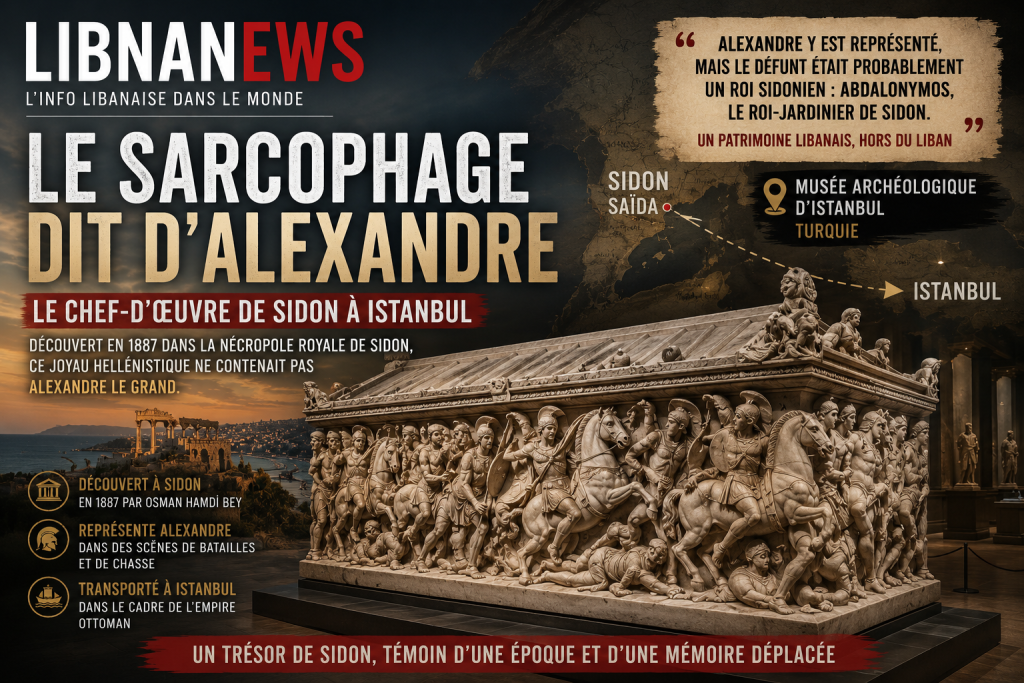
Discovered in 1887 in the royal necropolis of Sidon, this Hellenistic sarcophagus is now one of the main pieces of the Istanbul Archaeological Museums. His name is misleading: he represents Alexander the Great, but he never contained his body.
Some objects have a name that makes them famous, but betrays them. The so-called sarcophagus of Alexander is one of the most striking examples. It is known all over the world under this name. He attracts the look because he shows Alexander the Great, launched in the tumult of the battle, recognisable by his heroic attributes. Yet this sarcophagus never contained Alexander. It was not found in Babylon, Alexandria, or a Macedonian tomb. It was discovered in Sidon, the present-day Saida, Lebanon, in the royal necropolis of Ayaa, in the late nineteenth century.
The object is now preserved at the Archaeological Museums of Istanbul. It is part of these plays that tell the history of Lebanon outside Lebanon. Like the sarcophagus of Eshmunazor II in the Louvre, it belongs first to the history of Sidon. But his course is different. It has not been transferred to Paris by European consular or antiquary networks. He was sent to Istanbul as part of the Ottoman Empire, of which Sidon was a member. This is not exactly a case of European colonial spoliation. It is an Ottoman imperial centralization. But the result, seen from contemporary Lebanon, remains the same: one of the greatest masterpieces found in Sidon is today outside the country.
Imperial discovery in the royal necropolis of Sidon
It’s 1887. Osman Hamdi Bey, painter, archaeologist, Ottoman intellectual and director of the Imperial Museum, receives information about the discovery of important graves in Sidon. He gets permission to search. The context is then Ottoman: Saida is not a city of an independent Lebanese state, but a city of an Empire province. Antiquities discovered on the spot are under imperial authority.
The excavations of 1887-1888 in the Royal Necropolis of Sidon produced an exceptional set of sarcophagi. These include the so-called sarcophagus of Alexander, the sarcophagus of Crying, the sarcophagus of Tabnit, the lycian sarcophagus and the sarcophagus of Satrape. The Turkish authorities today recall that these works were brought back to Istanbul by Osman Hamdi Bey after his excavations in Sidon. Their importance was such that she justified the construction of a new building to display them, inaugurated on 13 June 1891.
The anecdote is strong. It’s not just an object from Sidon. It is a museum built around him and other Sidonian sarcophagi. Istanbul does not just receive some extra antiques. She receives a founding ensemble. The Sarcophagi of Sidon became one of the bases of modern Ottoman museology.
This point is essential to understand the difference with other Lebanese objects held abroad. The sarcophagus of Eshmunazor II arrives at the Louvre through the 19th century European networks. The so-called sarcophagus of Alexander left for the imperial capital. Lebanon does not yet exist as a State. But Sidonian memory is still out of place. She leaves the city where she was buried, becoming one of the emblems of a foreign museum.
Why is it called the sarcophagus of Alexander?
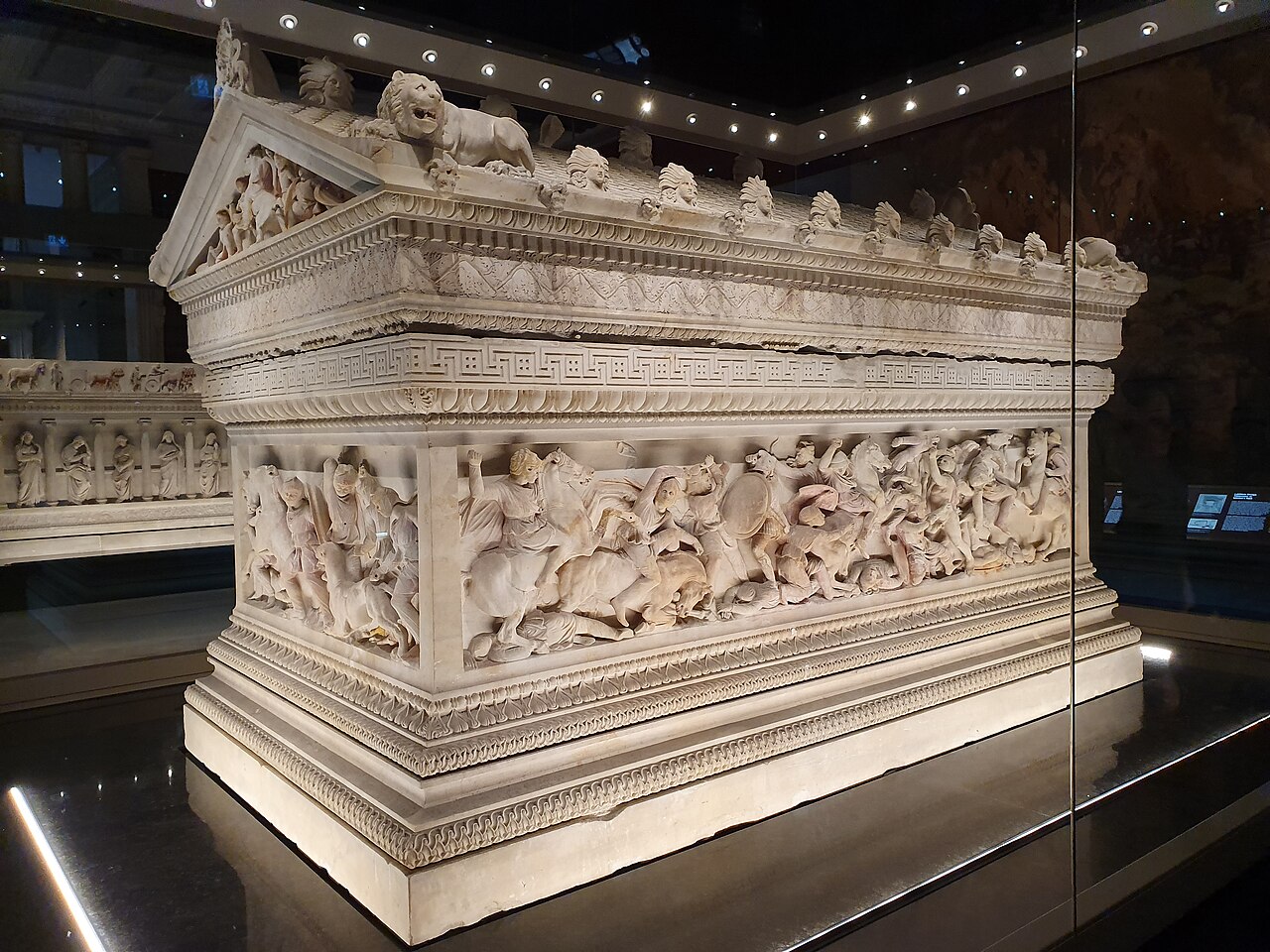
The answer is simple: because Alexander the Great appears on the reliefs. The name comes from the image, not the death. The sarcophagus represents scenes of war and hunting. On one of the great faces, a battle between the Macedonians and the Persians. Alexander is identified by several iconographic elements, including his heroic appearance and the lion’s skin which refers to Heracles, whose inheritance he symbolically claimed.
So the name has some truth and some misunderstanding. Yes, Alexander is represented. No, he wasn’t buried there. This old confusion contributed to the celebrity of the object. She even continues to give him special strength. The so-called sarcophagus of Alexander is a monument that bears the name of the winner, but probably belongs to a local Sidonian king under the new Macedonian order.
The shade is important. In ancient times, representing a powerful ruler on a tomb does not mean that this sovereign is buried there. It can express an alliance, loyalty, admiration, political legitimization. Here, Alexander works as a founding figure. His victory over the Persians changed the balance of the entire region. Sidon is moving from the Achenid world to the Macedonian world. The sarcophagus gives a carved image of this shift.
An object probably linked to Abdalonymos, King of Sidon
Whose sarcophagus was that? The most frequently retained answer is associated with Abdalonymos, king of Sidon installed by Alexander after the conquest of the region. However, caution must be exercised: the attribution is not engraved on the object as in the case of Eshmunazor II. It is based on the Sidonian provenance, dating, iconography and historical tradition around the appointment of Abdalonymos.
Abdalonymos is one of these characters whose story seems to come out of an ancient novel. According to the tradition reported by the ancient authors, he belonged to a Sidonian royal lineage, but lived in poverty, working as a gardener. After Alexander entered the region, power was to be reorganized in Sidon. The crown could only return to someone of royal blood. Abdalonymos was then chosen precisely because he possessed this dynastic legitimacy despite his modest condition.
This anecdote of the gardener who became king is one of the most famous stories associated with Sidon in the days of Alexander. She says a lot about how the Greeks and Romans liked to tell the Macedonian conquest: Alexander appears there as the one who recognizes the hidden nobility, rewards virtue and reverses the hierarchy of facades. Of course, this account must be read with caution. Ancient authors often embellish the scenes. But it remains revealing the image that one wanted to give of this change of power.
What one can say more firmly is thatAbdalonymos embodies a Sidon that passed under Macedonian rule. He is not an independent king in the modern sense. He is a local ruler, installed or confirmed as part of the conquest of Alexander. His political role is probably to guarantee the stability of the city, to integrate it into the new order, to replace the old Persian loyalty with Macedonian loyalty.
What the king did: govern Sidon after the world changed
The life of Abdalonymos is much less documented than that of Eshmunazor II. No long Phoenician text tells about its temples, titles or constructions. Its importance lies mainly in the historical moment in which it appears. He became king after Alexander’s victory over the Persians and when the Phoenician coast changed its master.
It’s not a detail. Sidon is not a city of any kind. It is a great Phoenician city, a strategic port, an ancient maritime power, a city whose aristocracy has long sailed between local autonomy and imperial dependence. Before Alexander, Sidon depends on the Persian world. After Alexander, she entered Hellenistic space. Abdalonymos is therefore the king of a transition.
What can be attributed to him in practice? First, the stabilization of an important city after the conquest. Then the integration of Sidon into the new Macedonian system. Finally, if the sarcophagus belongs to him, the command of a funeral monument of exceptional ambition. This sarcophagus is not just a tomb. It’s a political marble program. He says that the deceased belongs to the royal world, that he stands on the side of the winner, that he participates in the most refined Hellenistic aesthetic, while remaining rooted in Sidon.
The choice of images is better understood. The battles recall the break with Persia and Alexander’s victory. Hunting scenes show an aristocracy that can be measured in a common language, where Macedonians and Orientals can appear side by side. The sarcophagus not only tells of the death of an individual. It tells a political recomposition: the birth of a Hellenistic order in the Levant.
A Greek sculpture for a Sidonian king
The object itself is of exceptional quality. It is carved in pentelic marble, the famous Greek marble used especially in the great monuments of Athens. It is about 3.18 meters long, 2.12 meters high and 1.67 meters wide. Its weight is estimated at about 25 tons. He was originally painted. Traces of polychromy still exist in places, recalling a often forgotten truth: ancient sculptures were not always white. They were colorful.
This color changes everything. The modern visitor sees a large monument of light marble, almost classic. But the ancient object had to be much more alive, more dramatic, closer to a theatre scene frozen in stone. The weapons, the clothes, the flesh, the horses, the details had to detach themselves by color. The sarcophagus was not only carved. He was staged.
The reliefs are of rare richness. On one of the great faces, the battle scene shows the Macedonians facing the Persians. The movement is violent, the bodies cross, the horses hide, the fighters fall or strike. Alexander emerges as the central figure of the story. On another side, a lion hunt and other animals stage riders, hunters, opponents who may have become elite companions.
The contrast between the scenes is essential. The battle shows conquest. Hunting shows aristocratic sociability after conquest. On one side, the world is overthrown by war. On the other hand, elites learn to share one visual code. The tomb thus becomes a story of domination and integration.
Sidon before Alexander: a city wounded but always strategic
To understand the strength of the sarcophagus, we must go back a few decades. Sidon had a violent period under the Persian Empire. Ancient tradition reports a revolt against Artaxerxes III and an extremely harsh repression. The numerical details transmitted by ancient sources can be discussed, but the general idea is clear: Sidon comes out of a troubled century, caught between local ambitions, Persian domination and regional recomposition.
When Alexander arrived on the Phoenician coast after the battle of Issos in 333 B.C.E., several cities submitted quickly. Tyre resists and undergoes a famous siege. Sidon, on the contrary, is on the Macedonian side. In this context, placing a new king loyal to Alexander is politically logical. Abdalonymos then becomes the symbol of a Sidon who does not want to die with the old Persian order, but to survive in the new world.
The so-called sarcophagus of Alexander makes sense in this context. It is not just a tribute to the conqueror. This is a statement of position. Sidon represents himself in the world of Alexander. His king, or one of his kings, is buried in a monument celebrating the Macedonian victory and the integration of local elites to this victory.
The anecdote of the gardener king
The story of Abdalonymos deserves to be told, for it gives the object a human dimension. According to tradition, Alexander or his relatives are looking for a new king for Sidon. The obvious candidates refuse or disagree. Then one remembers a man of royal blood, fallen into poverty, working the earth. We find him in his garden. We’re bringing him royalty badges. He becomes king.
The scene is beautiful, almost too beautiful. It can be part of literary construction. But it has gone through the centuries because it gives a political moral: the true nobility would not be in clothes, but in the origin, virtue and ability to endure poverty. Alexander, in this account, appears as the one who knows how to recognize this invisible nobility.
For a Lebanese article, the anecdote is valuable. It links Alexander’s great story to a local, Sidonian figure. She recalls that the cities of today’s Lebanon were not mere decorations crossed by empires. They had their dynasties, their families, their traditions, their legitimacy. Even when the conqueror comes from Macedonia, he has to deal with local realities.
The sarcophagus that traveled twice
Another detail deserves to be highlighted. The sarcophagus has had at least two great journeys. The first is ancient. Pentelic marble comes from the Greek world. It is extracted, worked or transported for use in Sidon. This shows the richness of the city and its integration into Mediterranean networks. Sidon is not peripheral. She orders or receives a work from an exceptional artistic level, probably from Greek or highly Hellenized workshops.
The second trip is modern. In 1887-1888, after his discovery, the sarcophagus left Sidon for Istanbul. He passed from the tomb to the window, from the royal necropolis to the imperial museum. This second journey changes its meaning. In ancient times, it was a funeral monument for a local king. In Istanbul, it becomes a universal masterpiece, a symbol of Ottoman archaeology and one of the museum’s most famous pieces.
This dual movement is at the heart of the history of dispersed Lebanese heritage. Ancient objects were already circulating in ancient times. The Phoenicians themselves were navigators, traders, mediators between worlds. But the ancient circulation of a material or style is not the same as the modern extraction of an object discovered in a grave. The first trip tells the Mediterranean trade. The second relates the logic of empires and museums.
A Lebanese, Ottoman, Greek and global object
The so-called sarcophagus of Alexander escapes simple categories. It is Lebanese by its place of discovery, Sidonian by its funeral context, Greek by its material and artistic language, Macedonian by its iconography, Ottoman by its modern history of discovery and transfer, Turkish by its present museum, and world by its fame.
That is precisely why it is difficult to reduce it to a slogan. To say that it belongs only to Turkey would ignore Sidon. To say that it belongs only to Lebanon would forget the Ottoman framework of its discovery and the imperial history that preserved it. To say that it belongs only to Greek art would erase the local king for whom it was probably created. This sarcophagus is a crossroads. But a crossroads always has a floor. And this floor here is Sidon.
The heritage question must therefore be asked with precision. Modern Lebanon did not exist in 1887. But territory, town, necropolis and memory existed. The fact that the object was transferred within an Ottoman legal framework does not remove the question of its origin. This is not just a legal problem. This is a historical and symbolic problem.
Should we talk about restitution?
In the case of the so-called sarcophagus of Alexander, the request for restitution would be more complex than for other items passed by the private market or by donations under Mandate. The object was discovered in an Empire of which Istanbul was the capital. The Ottoman authorities acted according to their own logic of centralization. The Istanbul Museum has maintained the object since the late 19th century. He exhibited, studied, restored and integrated into his museum identity.
But complexity must not become a pretext for silence. It would be legitimate for cartels, catalogues and public presentations to place more emphasis on the Sidonian origin of the object. It would also be legitimate to imagine cooperation with Lebanon: temporary exhibitions, loans, high definition reproductions, joint research, educational programmes, exchanges between Saida, Beirut and Istanbul.
Physical restitution is not the only possible horizon. There is also a restitution of the story. And this one is urgent. Too often, large universal museums absorb objects in a narrative that takes them out of their territory. The so-called sarcophagus of Alexander must not only be presented as a Hellenistic masterpiece. It must be presented as a masterpiece discovered in Sidon, in the present Lebanon, in the heart of a Phoenician royal necropolis.
The masterpiece that hides his real death
The final paradox is there. The sarcophagus bears the name of Alexander, but it probably hides the fate of another man: Abdalonymos, king of Sidon, a transitional figure between the old Persian order and the new Hellenistic world. Alexander gives his name to the object because he is depicted on the stone. But the dead man was Sidonian.
This confusion says something of history itself. Great conquerors often take all the light. Local kings, cities, artisans, sponsors, real dead people go into the background. The so-called sarcophagus of Alexander is therefore also a reminder: behind the name of the conqueror is a Lebanese history, or more precisely Sidonian, which must be restored.
It’s not a marginal room. It is one of the largest funerary monuments of Mediterranean Antiquity. It combines the finesse of Greek sculpture, the political memory of the Macedonian conquest and the royal history of Sidon. It tells a moment when the Levant changes empire, dominant language, visual codes, but no local depth.
In Istanbul, the so-called sarcophagus of Alexander continues to attract visitors. He impresses with his size, his scenes, his name. But for Lebanon, it should also impress by something else: by its absence. It is one of these objects that measure what the Lebanese land has given to the world heritage, but also what it has lost in the windows of the world.
In Sidon, he was a royal tomb. In Istanbul, it became a museum centrepiece. In between, there is the history of empires. And, as often with Lebanese heritage, this history is never only archaeological. It is political, cultural and memorial.
Reference
- Subject matter:sarcophagus known as Alexander.
- Discovery site:royal necropolis of Sidon, today Saida, Lebanon.
- Date of discovery:1887, as part of the excavations conducted by Osman Hamdi Bey between 1887 and 1888.
- Date:late fourth century BC, Hellenistic period.
- Material:pentelic marble.
- Dimensions indicated:about 2.12 m high, 3.18 m long and 1.67 m wide.
- Estimated weight:about 25 tons.
- Character represented:Alexander the Great, especially in the battle scenes.
- Probable leak:often attributed to Abdalonymos, king of Sidon installed by Alexander, but identification remains discussed.
- Present Museum:Archaeological museums in Istanbul, Turkey.
- Transfer Context:ottoman centralization after the excavations of Sidon, and not exit to a European power.
Sources
- Archaeological Museums of Istanbul / Turkish Ministry of Culture and Tourism, official presentation of the Museum and Sarcophagus of Sidon.
- KÜRE Encyclopedia, notice .
- Livius.org, notice on Sidon in Hellenistic times, for the context of the conquest of Alexander and the appointment of Abdalonymos.
- Wikimedia Commons, photography .




