

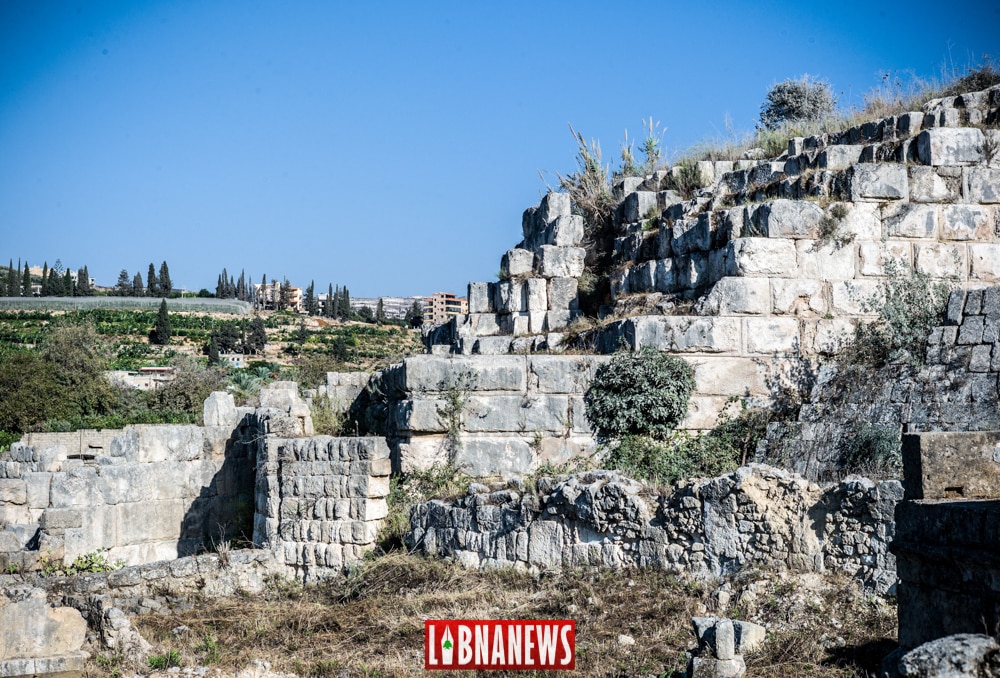
In Sidon, the sanctuary of Bostan al-Sheikh keeps the memory of Eshmoun, the great Phoenician god of healing. His myth also links him to Beirut, where tradition makes him a young hunter transformed into a deity after a violent death. Between sacred sources, ritual pools, healed children and rebirth worship, Eshmoun gives ancient Lebanon one of its most powerful religious accounts.
There is a place north-east of Saida where ancient medicine did not go through hospitals, but through water, offerings and gods. The Shrine of Eshmoun in Bostan al-Sheikh, near the Awali River, is one of the major Phoenic sites in Lebanon. It does not have the tourist reputation of Baalbek, Byblos or Tyre. However, it should be at the centre of any serious reading of Lebanese heritage.
Because Eshmoun is not a secondary god. He is the great healing god of Sidon. The one the Greeks will assimilate to Asclepios, god of medicine. The one that pilgrims came to plead for healing, purification, fertility or protection. UNESCO describes the site as a cultural complex dedicated to the healing god Eshmoun, identified with the Greek god Asclepios, built from the late 7th century B.C. and occupied for centuries.
In Sidon, healing was not only a matter of remedies. It was also sacred. We came to the sanctuary with a sick body, a disease, a fear, sometimes a fragile child. We were entering an organized space around the water. We bathed, we made ablutions, we laid offerings, we asked the god to intervene.
A god of Sidon, but a legend related to Beirut
Eshmoun belongs first to Sidon. He is one of the major gods of the city, linked to its kingship, its shrines and its religious memory. But his myth overflows Sidon. A late tradition, reported by Greek authors and preserved in the accounts attributed to Damascius and Photius, also links it to the Beirut region.
In this version, Eshmoun is a young man of great beauty, born or living near the ancient Berytos. He loves hunting and travels through the forested valleys of the region. Astarté, a great Phoenician goddess of love, fertility and royal power, falls in love with him. To escape this divine pursuit, the young man mutilates with an axe and dies. The goddess, upset, then brings him back to life with her vital warmth and transforms him into a god of healing and fertility.
The story is brutal. He’s not a sweet fable. It features beauty, desire, flight, mutilation, death, and then rebirth. Like Adonis in Byblos, Eshmoun belongs to this family of oriental figures where a young god dies before returning in another form. But where Adonis is linked to vegetation, mourning and the red river, Eshmoun becomes more directly the god of care, body restoration, life after injury.
This is where Beirut enters the legend. The city is not yet the modern capital known to us. It appears as Berytos, a space of valleys, wood, hunting and local traditions. So Eshmoun is not just the god of a Sidonian temple. It is also a mythical figure that links Sidon to Beirut, the South to the central coast, the sanctuary to the legend.
Death transformed into healing
What strikes in the myth of Eshmoun is the paradox. The healing god is born from an injury. He heals because he was himself destroyed. He becomes power of life because he went through death.
This logic is not exceptional in ancient religions. The healing gods are often linked to the snake, to regeneration, to the skin that renews, to the cycle that repeats. Eshmoun will also be close to Asclepios, whose snake stick will become one of the great symbols of medicine. Traditions around Eshmoun also mention snakes, oils, sacred waters, basins and purification rites. The rapprochement with Asclepios is gradually imposed under Greek influence, but the bottom of the cult remains Phoenician.
So you should not see in Eshmoun a simple local copy of a Greek god. It is the opposite which is historically more interesting: an ancient Phoenician god is then interpreted in Greek religious language. The Greeks recognize in him a figure comparable to Asclepios. The Romans will continue this assimilation with Esculape. But the sanctuary of Sidon, the inscriptions, the offerings and the basins remind that the heart of worship is local.
Bostan al-Sheikh, the sanctuary of water
The Shrine of Eshmoun is installed in a landscape that counts as much as the walls. It is located in a fertile valley, near Awali, in an area of gardens and citrus fruit. UNESCO places the site on the south shore of the Awali River, in the village of Bqosta, about five kilometers east of Saida, and emphasizes the importance of the natural landscape, made of mountains, rivers and vegetation, to understand the worship of the healing god.
Water is at the centre of the device. The ritual ablutions and the immersion of the sick were served by canals, cult pools and sacred pools. UNESCO reports that these water-related facilities were used from the Phoenician era to the Byzantine period.
This detail changes everything. The sanctuary was not just a temple where one prayed. It was a place where one entered the water physically. The patient wasn’t just asking for a cure. He made a gesture. He was washing himself. He was looming. It went through a form of body and spiritual cleansing.
In the ancient world, water heals because it cleans, but also because it connects. It comes from the mountain, flows underground, comes to the spring, crosses the sanctuary, touches the body, and then leaves. It is both natural and divine. In Eshmoun, this water becomes the instrument of the god.
Monumental Phoenician Architecture
The Eshmoun site is also important by its architecture. UNESCO presents it as a Phoenician site unique in Lebanon, the only one to preserve a monumental Phoenician architecture of this magnitude. The complex includes podiums from the neo-Babylonian and Persian era, Hellenistic temples, carved friezes, basins, a Roman nymph, mosaics and a Byzantine church later added to the whole.
In other words, Eshmoun is not a frozen place in a single era. It is a sanctuary that has been transformed for centuries. The Sidonians built it. The kings were enlarged. The Persian, Hellenistic, Roman and then Byzantine influences are superimposed. Each time added its layer, without completely clearing the previous one.
This continuity is essential. It shows that the site kept its religious and symbolic function for a very long time. The names of the gods may have changed, the architectural forms too, but the place remained associated with healing, water and the sacred.
The kings of Sidon and the healing god
The Shrine of Eshmoun is also a political issue. He is not only religious. The Sidonian kingship appears directly there.
The inscription of the sarcophagus of Eshmounazar II, king of Sidon, preserved today in the Louvre, mentions the religious constructions linked to the Sidonian gods. UNESCO recalls that this inscription indicates that Eshmounazar II built temples to the gods of Sidon, including one dedicated to Eshmoun near a source of healing virtues.
This connection between king and sanctuary is classic in ancient times, but here it takes on a particular dimension. To build or enlarge the sanctuary of a healing god is to show that the royal power protects the city, its bodies, its children, its sick and its continuity. The king doesn’t just rule. He presents himself as the intermediary between the city and the forces that maintain life.
The Louvre retains the registered sarcophagus of Eshmounazar, an Egyptian work of invoice bearing a Phoenician inscription. This piece alone illustrates the intersections of the Sidonian world: a Phoenician dynasty, an object of Egyptian tradition, a Semitic inscription and a political context marked by the Persian empire.
Children of Eshmoun
One of the most touching aspects of the sanctuary is the presence of many votive statues of children. These temple-boys, found in the sanctuary context, represent young boys, sometimes with an animal or object. They were offered as an offering, probably to thank the god or ask for his protection.
The educational record of the University of Le Mans dedicated to the sanctuary recalls that many votive statues of children have been found in Eshmoun, some representing very young boys, and that the so-called Baalshillem inscription demands the blessing of Eshmoun.
This point is central. Eshmoun is not only the abstract god of medicine. He is also the god entrusted to children. In an ancient society where infant mortality was high, where diseases could quickly carry the most fragile, a healing sanctuary had a direct human function. Parents came to place the image of a child, hoping to get protection or healing.
These statues give worship a concrete dimension. Behind blocks, inscriptions and scholarly debates, there are families. Sick bodies. Children threatened. Parents who hope.
Starred, empty throne and healing
Eshmoun is not alone in his sanctuary. Astarté, a great Phoenician goddess, also occupies a major place. The site preserves the famous empty throne of Astarté, flanked by sphinx. He does not represent the goddess in human form. He indicates his presence through the empty seat, as if the visible absence made the divine presence stronger.
The shrine of Astarté, with its basin, was associated with healing and purification rites. The faithful came to seek the favor of Eshmoun, Astarte and the other powers of the sanctuary. The empty throne shows another way of representing the divine: not by a carved body, but by a sacred place where the goddess is supposed to stand.
This association between Eshmoun and Astarté refers to the myth itself. In legend, it is Astarté who pursues the young Eshmoun, then brings him back to life. In the sanctuary, the two powers remain linked: the healing of Eshmoun and the fertility of Astarté respond.
Snake, oil and ancient medicine
Eshmoun is often associated with the snake, like Asclepios. This symbol is not trivial. The snake changes skin. He disappears into the earth and reappears. It can be dangerous, but also protective. In the ancient imagination, it is linked to healing, regeneration and underground forces.
Currencies of Beirut of Roman times represent Eshmoun between two snakes, a sign that his worship or image were also known in Berytos. The record of the University of Le Mans indicates in particular a currency of the third century AD struck in Beirut showing Eshmoun standing between two snakes.
This detail is important for the Lebanese angle. Eshmoun is not locked in Sidon. His worship is circulating. It is attested to in Tyre, Beirut, Sarepta, Cyprus, Carthage and other areas of the Phoenician and Punic world. UNESCO points out that Sidon is generally regarded as the main centre of his worship, while recalling that his presence is also attested to in Tyre, Beirut and Sareptah, including through registration.
The healing god therefore accompanies the Phoenician expansion. As Melqart accompanies Tyre and its colonies, Eshmoun accompanies Sidon and the Sidonian world. Sacred medicine also becomes a form of cultural outreach.
A sanctuary that survives in times
The Eshmoun site crosses dominations and cultures. Phoenician at the beginning, he received Persian, Greek, Roman, then Byzantine influences. The Greeks Hellenize the God by Asclepios. The Romans add monumental elements, mosaics, spaces of circulation. The Byzantine period established a monumental church.
This transition from one cult to another should not be read as a mere rupture. It’s also a transformation. Sacred places don’t always disappear brutally. They’re changing language. Water stays. The landscape remains. The walls are reused. The gestures are moving. The pagan god sews away, but the memory of healing attached to the place can be prolonged.
It is one of the constants of ancient Lebanon: the sites change masters, rites and names, but often retain a profound symbolic function. In Afqa, the source of Adonis keeps the memory of death and return. In Tyre, the Ambrosian rocks tell of the city born of the sea. In Sidon, Eshmoun retains the memory of healing water.
Lebanon as a territory of wounded gods
Eshmoun belongs to a series of stories where ancient Lebanon appears as a territory of young gods, wounded, dead and then transformed. Adonis died near Afqa and his blood blushed the river. Eshmoun mutilates to escape Astarté, dies, then returns as a healing god. Melqart in Tyre also has traditions of death and rebirth. These figures are not identical, but they speak the same language: that of disappearance and return.
This language is deeply related to nature. Dry vegetation then comes back. Water disappears and then comes back. The body falls ill and then heals. The fragile child survives or dies. The city itself passes through destruction and then rebuilds itself.
The healing god of Sidon therefore does not only treat a fever or injury. It gives a religious form to a universal human anguish: how can life be brought back where it seems to be extinguished?
A heritage memory underestimated
The Shrine of Eshmoun should be one of the great places of remembrance of Lebanon. It brings together everything: mythology, archaeology, ancient medicine, Phoenician inscriptions, the Sidonian kingship, the relationship to water, the continuity of cults and the link between Sidon and Beirut.
Yet, it remains less present in the national imagination than other sites. It’s a mistake. Eshmoun tells of an essential dimension of ancient Lebanon: not only trade, ports, alphabets or conquests, but care. Phoenician Lebanon was not only a country of navigators and merchants. It was also a territory of shrines where one came to seek healing.
In Bostan al-Sheikh, the stones do not only tell the past greatness of Sidon. They tell of the sick who bathed in sacred water. Parents who laid down the image of their child. Kings who built for a protective god. Priests who administered a place where faith, medicine and power were mixed.
Eshmoun did not disappear because his cult was extinguished. He remains in the landscape, in the inscriptions, in the basins, in the statues of children, in the memory of a young man of Berytos who became god after a violent death. It remains above all in this very old idea: healing is never just a repair of the body. It is also a passage. Purification. A revival.
In Sidon, this passage had a name: Eshmoun.




