

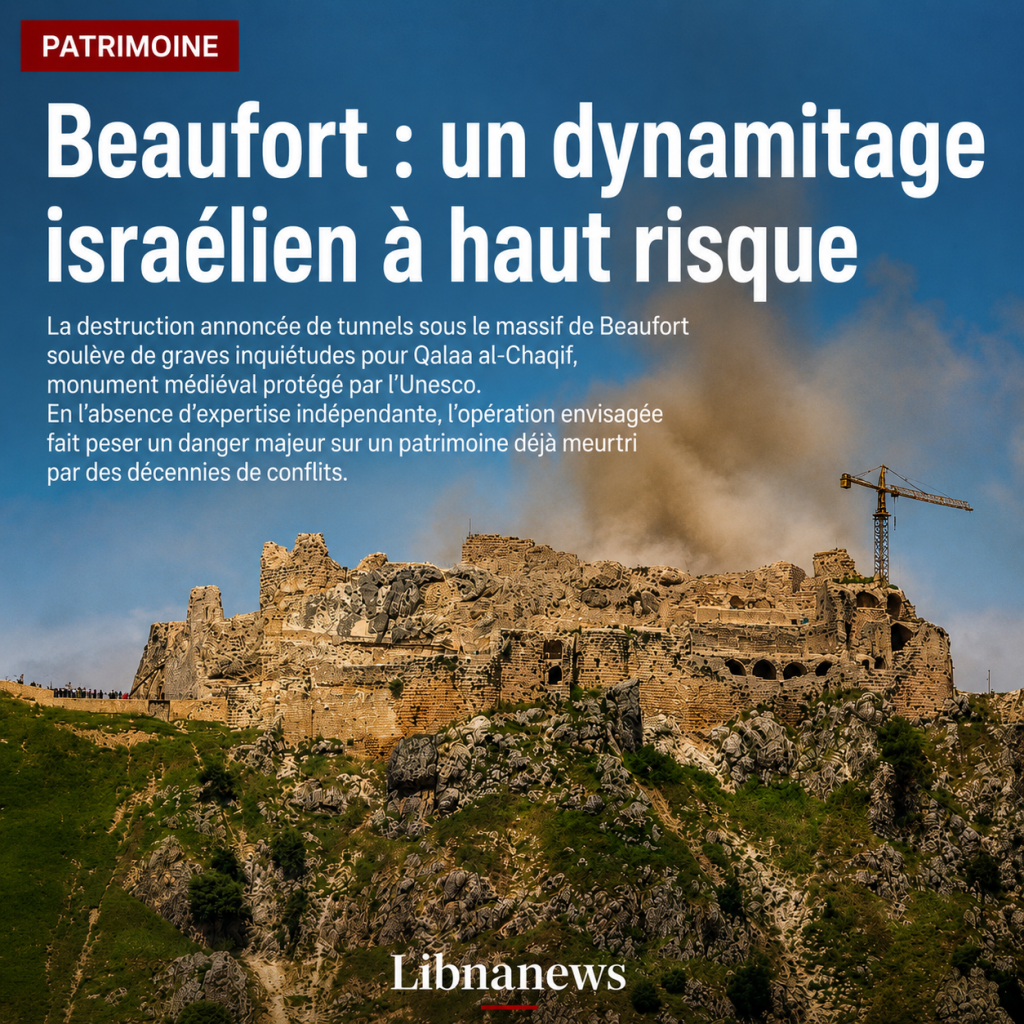
The Beaufort fortress, known in Lebanon as Qalaa al-Shaqif, is located in the centre of an Israeli operation whose consequences may exceed the military framework. The Israeli army claims to have discovered in the ridge an extensive underground network attributed to Hezbollah and is preparing for its destruction. However, it has not published any independent geological study, complete cartography of the galleries, or detailed risk assessment for the monument. This project comes at a time when Beaufort, which has been occupied by Israeli forces since the end of May 2026, already bears the traces of several wars. It is also part of a wider sequence of attacks on Lebanese heritage since October 2023. Ancient sites, historic markets, shrines, cemeteries and ancient villages have been damaged or destroyed. In this context, Beaufort appears less as an isolated case than as a new test of the ability of international law to protect cultural property during a conflict.
Beaufort in the face of a prepared destruction without control
The Israeli army describes the galleries discovered in the Beaufort Ridge as a fortified command centre. According to his version, they were used to store weapons, house combatants and prepare attacks. Israeli media also referred to logistical spaces, medical facilities and equipment presented as Iranians.
These claims were not verified by an independent mission. The images were selected by the military institution that occupies the area and is preparing for the destruction operation. They show underground passages, but do not allow to locate each gallery in relation to the walls, towers and foundations of the fortress.
This uncertainty is essential. A tunnel located directly below the monument does not present the same danger as a tunnel dug several hundred meters away. The depth, width, nature of the rock and quantity of explosives also determine the consequences of blasting.
The Lebanese Ministry of Culture challenges the presence of tunnels directly under historical structures. It does not necessarily deny the existence of galleries in the surrounding massif. Both versions cannot therefore be separated in the absence of free access to Lebanese and international experts.
Israel currently controls the area and controls technical information. It defines the threat, chooses the neutralization method and assesses the risks itself. Such concentration of responsibility is not a credible guarantee for a monument under international protection.
Beaufort blasting is not a formality
The possible existence of a military infrastructure does not automatically render its total destruction legitimate. The law of armed conflict requires military necessity, proportionality and practical precautions.
Several methods can neutralize a gallery. Accesses can be closed. Weapons can be removed. Some sections can be completed or processed separately. Monitoring can also prevent reuse.
Solid blasting remains the most visible and irreversible solution. It produces strong images, useful for military communication. It can also cause damage, the cost of which will then be borne by Lebanon.
Israel should therefore explain why less destructive methods would be impossible or insufficient. No public demonstration was provided. However, the Israeli army claims to have inspected the network and taken control of it.
The immediate urgency therefore seems difficult to establish. An infrastructure emptied of its fighters and weapons does not pose the same threat as a gallery used during a confrontation. The time required for international expertise could be allowed without profoundly changing the military situation.
Without this expertise, Israel would place all the risk on Lebanese heritage. It would transform a unilateral military decision into potential damage to the territory it occupies.
A fortress already tested by wars
Beaufort dominates the Litani Valley from a rocky spur. Its position makes it possible to observe a large part of the South Lebanon and several roads. This strategic value explains the site’s successive occupations.
The current fortress brings together structures of several periods. Its walls, towers, vaulted rooms and passageways have been built, modified and repaired over the centuries. Not all materials and techniques have the same resistance.
The site suffered the fighting of the civil war, the Israeli bombings and the 1982 assault. Israel then occupied it until May 2000. His army had installed a base, bunkers and concrete structures near the historic walls.
At the time of withdrawal, several military installations were destroyed by explosives. These operations left traces in the relief. The following conflicts continued to weaken overall.
The operations of 2026 brought the Israeli army back to the ridge. Israeli flags were raised on the fortress after its capture. This gesture recalled the previous occupation and gave the operation a strong political reach.
The blasting project extends this militarization. The monument remains treated as a strategic height before being considered a Lebanese cultural property.
Geological risks that cannot be ruled out
An underground explosion transmits part of its energy to the rock. It causes vibrations, fractures and sometimes collapses. The effects depend on the power of the loads, their depth and their distribution.
At Beaufort, the walls rest on a massif already dug, bombed and modified. Old cracks can expand. A vault can lose part of its stability. Blocks can move without collapse immediately.
The danger is therefore not limited to spectacular destruction. Internal damage may occur several weeks or months after the explosion. Water then penetrates the cracks and accelerates the degradation of the mortars.
The collapse of a gallery can also create an unstable cavity. If it is close to the foundations, the soil may fall unevenly. A few millimeters of displacement is sometimes enough to weaken an old masonry.
Other risks include stone projections, dust and fires. Ammunition, fuel or batteries could be in the network.
There is no public study to measure these scenarios seriously. Israel did not announce the installation of sensors, the prior reading of cracks or the presence of archaeologists during the operation.
Enhanced protection for Israel
Beaufort is one of the Lebanese cultural objects placed under temporary reinforced protection by Unesco in November 2024. This status corresponds to the highest level of protection provided for in the Second Protocol to the Hague Convention.
This protection does not remove any possibility of military action. However, it imposes strict conditions. The necessity must be imperative and the precautions must be maximum.
A power that controls a protected site must avoid degradation. It must also facilitate the intervention of the competent heritage authorities. Military occupation does not suspend these obligations.
Israel should therefore authorize an independent mission prior to any explosion. Geologists, engineers and archaeologists could establish three-dimensional mapping and set vibration thresholds.
Lebanon should also receive relevant plans. Without this data, it will not be able to attribute future damage or demand repairs on a sound technical basis.
The possible responsibility of Hezbollah must also be examined. The installation of military structures in the environment of a monument may expose it to attacks. However, this responsibility does not relieve Israel of its own obligations.
A violation committed by one party does not authorize the other to use any means. Israel must always distinguish the military objective from the monument and reduce foreseeable damage.
Since October 2023, a heritage exhibited
The Beaufort case is part of a much broader assessment. Since October 2023, Israeli operations have affected historical sites in southern Lebanon, the Bekaa and several urban centres.
No definitive inventory is yet available. Areas remain inaccessible. Some damage was not inspected. It is therefore necessary to distinguish between confirmed attacks, those reported by the Lebanese authorities and those still requiring expertise.
In November 2024, Unesco placed 34 Lebanese cultural objects under temporary enhanced protection. This decision followed the intensification of strikes near several major sites.
The Lebanese Ministry of Culture has since reported an extension of the damage. He claims that the Israeli attacks affected ancient remains, markets, shrines and ancient villages.
The damage does not only concern officially classified monuments. National heritage also includes traditional houses, cemeteries, squares, souks, presses and agricultural landscapes.
Tyre, between ancient remains and historical districts
Tyre is one of the main concerns. The city is home to Phoenician, Roman and Byzantine ensembles listed as World Heritage.
Israeli strikes have affected several neighbourhoods since 2023. Some explosions occurred near the archaeological areas of Al-Bass and Al-Mina.
The Lebanese authorities reported damage to old buildings and the environment of the remains. In 2026, a traditional house near Al-Bass was destroyed. Debris reached the entrance to the site and damaged ancient elements, according to information gathered on site.
The Lebanese Minister of Culture has requested the inclusion of Tyre on the World Heritage List at Risk. Unesco expressed its concern, without yet establishing a comprehensive assessment of the damage.
Tyre’s heritage is not limited to Roman columns. It also includes its port, souks, old houses and urban organization. The disappearance of traditional buildings thus alters the coherence of the whole.
Repeated evacuations also disrupted site monitoring and maintenance. A monument abandoned for several months remains exposed to looting, water infiltration and the degradation of its structures.
Baalbeck under bombardment pressure
In Baalbeck, the Israeli strikes of 2024 drew closer to the Roman temples. The monumental complex has not been destroyed, but the explosions have caused great concern among authorities and specialists.
Columns, blocks and old assemblies remain sensitive to vibration. Bombing can also damage the historic urban fabric surrounding the site.
Buildings in the city were hit. Population movements and traffic restrictions have disrupted the monitoring and maintenance of heritage.
The case of Baalbeck illustrates a form of indirect injury. A monument can stand while under new constraints. Damage is not always immediately visible.
Unesco has included Baalbeck in property under enhanced protection. This preventive measure confirmed the seriousness of the risk, even in the absence of direct destruction of the main temples.
Nabatiyah and the destruction of the old souk
In Nabatiyah, Israeli strikes reached the city centre and the old souk. Shops, old buildings and traditional structures have been destroyed or damaged.
The souk was an economic, social and memorial place. Its value did not depend solely on the seniority of each building. It was also based on the continuity of trades, families and business practices.
The strike against the municipal building also weakened the local capacity to document losses and organize initial interventions.
Reconstruction cannot be limited to the replacement of destroyed structures. Standardised architecture could erase old forms and historical market organization.
The disappearance of shops also affects intangible heritage. It interrupts habits, exchanges and collective memory related to the Nabatiyah centre.
Chamaa, a fragile citadel
Chamaa’s citadel, in the Tyre District, suffered reported damage during the fighting. Unesco expressed concern about the reported violations.
The site dominates several villages in the South. Like Beaufort, he remains vulnerable to vibration, close strikes and access restrictions.
The exact damage still requires a complete inspection. Walls, interior structures and archaeological approaches may have been affected.
The inability of Lebanese teams to intervene quickly increases the danger. Unstabilized cracks can worsen due to rain and temperature variations.
Damage to Chamaa also shows the limits of legal protection. An international classification does not physically protect a monument when conservation teams cannot reach it.
Mhaibib, an ancient village largely erased
The destruction of Mhaibib in October 2024 is one of the most significant episodes. The Israeli army detonated many buildings simultaneously after claiming that Hezbollah was using an underground network under the village.
The images broadcast showed the collapse of much of the locality. This destruction has affected homes, streets and an ancient urban fabric.
Mhaibib also housed a sanctuary associated, according to local tradition, with the prophet Benjamin. The exact state of the place still requires independent expertise.
The loss, however, exceeds the sanctuary alone. A historic village consists of houses, paths, religious places and social relations.
Modern reconstruction cannot fully restore this continuity. Even when the inhabitants return, the disappearance of the built environment transforms their relationship to the village.
Shaved or disfigured border villages
The destruction has affected many communities close to the border. Odaiseh, Kfar Killa, Aïta al-Shaab, Mays al-Jabal, Blida and Khiam are among the most affected sectors.
Not all destroyed buildings were officially classified. Many, however, belonged to an ancient rural heritage. Stone houses, squares, cemeteries and places of worship have disappeared.
Amnesty International analysed satellite images and videos taken by Israeli soldiers in particular. The organization concluded that many destructions had been carried out while Israel controlled the sectors concerned.
Its investigation covers the period from 1 October 2024 to 26 January 2025. It estimates that more than 10,000 structures have been heavily damaged or destroyed in southern Lebanon.
In the municipalities of Yarine, Dhayra and Boustane, more than 70 per cent of the structures were reportedly seriously damaged or destroyed. The organization believes that several operations appear to have been conducted without apparent imperative military necessity.
Amnesty International documented the use of manually laid explosives and bulldozers. These means require direct access and control of the sector. They do not respond to the same constraints as a strike in an immediate combat.
Israel claims to have targeted Hezbollah infrastructure and taken measures to reduce damage. These statements must be confronted with localized investigations.
Places of worship, shrines and cemeteries
The Lebanese Ministry of Culture reported damage to several places of worship and shrines in the South. Old mosques, mausoleums and cemeteries were affected.
These spaces have religious and historical value. Funeral inscriptions are used to trace the history of families and communities.
Their destruction leads to a documentary loss that is difficult to repair. It also affects collective practices, pilgrimages and rites.
Villages with a long religious history have been severely damaged. In some cases, access remains impossible, which prevents measuring the state of shrines and cemeteries.
Intangible heritage damage remains less visible. The prolonged displacement of the inhabitants interrupts the festivals, markets and traditions related to the villages.
Olive groves and cultural landscapes
Lebanese heritage also includes landscapes shaped by several generations. Olive groves, agricultural terraces and rural roads are part of the Southern identity.
In October 2023, international organizations documented Israel’s use of white phosphorus in rural areas close to the border.
Fires and contamination affected agricultural land. Old olive trees have been burned or made inaccessible to their owners.
Bulldozers used during land operations also changed plots and paths. The destruction of an agricultural landscape is not at the same rate as a building.
An ancient olive tree takes decades to reach maturity. Its loss affects the family economy, but also an agricultural tradition and a local memory.
A succession of damages that requires investigation
The Lebanese authorities accuse Israel of attacking the country’s historical identity. This serious accusation must be examined with methodology and on the basis of available evidence.
A distinction must be made between strikes directly at a monument, damage caused by nearby explosions, the destruction of villages and operations carried out after the takeover of an area.
The destruction carried out with the aid of explosives placed manually raises particular questions. They require access to the building and control of the area. They can therefore be planned, interrupted or replaced by other means.
The Beaufort blasting project must be considered in this regard. Israel controls the galleries it wants to destroy. It has the time to study a less harmful method.
An international survey is expected to identify affected sites since October 2023. It should gather satellite images, municipal archives, testimonies and architectural records.
This work must begin before the reconstruction. The rubble sometimes contains stones, inscriptions or elements to understand the history of the building.
Without a prior inventory, the work may remove the remaining traces. The reconstruction could then complete the loss begun by the bombings.
Beaufort, a test for the protection of Lebanese heritage
Lebanon should request an urgent mission from Unesco and specialized agencies. This mission should access the fortress and galleries concerned.
It should establish the state of the walls, map the cavities and install sensors. It could then recommend section processing, filling some galleries or closing their accesses.
Israel should publish the quantity of explosives planned and the security perimeter. It should inform neighbouring municipalities and allow the presence of Lebanese relief services.
The risks also concern Arnoun and nearby localities. Vibration can affect already damaged houses. Rockfalls can block roads and threaten residents.
Lack of coordination would turn the operation into a decision imposed on local populations. It would strengthen the sense that their security and heritage remain subordinate to Israeli military objectives.
The choice is specific. Israel can accept independent expertise and demonstrate that blasting really is a last resort. It can also act alone, without external control, at the risk of adding Beaufort to the list of Lebanese sites damaged since October 2023.
The next step will depend on access to experts, the publication of technical data and the decision on charges. Until these guarantees exist, the announced blasting remains an opaque, questionable and potentially irreversible operation.




