

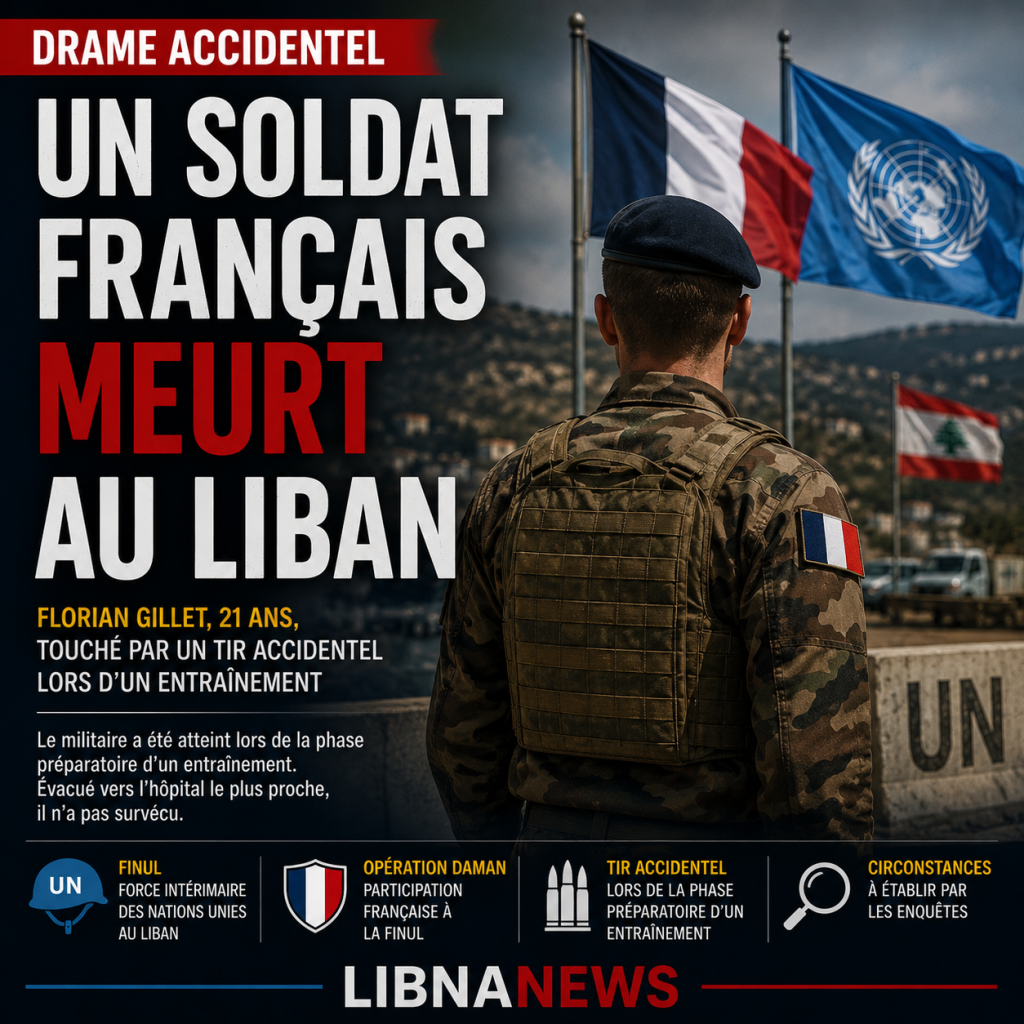
Accidental shooting during training
A 21-year-old French soldier, Florian Gillet, died in Lebanon after being shot accidentally, according to reports fromThe HuffPostbased on information provided by the Ministry of Armed Forces. The member was affected « in the preparatory phase of training », according to the wording quoted by the Ministry. He was evacuated to the nearest hospital after the shooting. The exact circumstances of the accident were not detailed in the first available evidence.
The tragedy occurred in a context of high tension in Lebanon, where the French military are engaged in Operation Daman, a French participation in the United Nations Interim Force in Lebanon. UNIFIL has been deployed in southern Lebanon since 1978. Its mission is part of peacekeeping, monitoring the cessation of hostilities and supporting the Lebanese authorities in a border area marked by recurrent tensions.
At this stage, the available information indicates a fire-related accident during a pre-training phase. It does not report an attack or an exchange of fire with an armed group. This clarification distinguishes this death from other recent losses suffered by the French contingent in Lebanon in operational circumstances. The French military authorities will now have to establish the exact facts, the security chain, the course of the meeting and the conditions under which the shooting is being carried out.
Florian Gillet, a 21-year-old soldier
Florian Gillet was 21. His death recalls the permanent risk to which the military, including non-direct combat, are exposed. Trainings with weapons, ammunition, vehicles or heavy equipment are strictly supervised, but they always involve a part of danger. The initial information reported indicates that the shooting occurred prior to the actual training, in its preparatory phase. This sequence is normally the one where weapons, instructions, personnel, firing zones and execution conditions are checked.
The reference to the « preparatory phase » is important. It suggests that the accident did not occur during the main course of the exercise, but in the operations preceding it. In the armed forces, these steps may include weapons controls, security briefings, installation movements, technical manipulations or equipment checks. However, the authorities have not publicly specified, in the available evidence, the type of weapon concerned, the exact unit, the precise location of the accident or the persons present at the time of the shooting.
The evacuation to the nearest hospital was reported by the Army Ministry. This information indicates that the soldier received care after the accident. It alone does not allow for the duration of fire, first aid, transport and death. Armed forces have procedures for medical evacuation in operation, but their implementation always depends on the location, severity of injuries, available means and security conditions.
The Ministry of the Armed Forces did not provide more information on any internal or judicial investigation in the first reports. In this type of death, investigations generally aim to determine whether the safety rules have been complied with, whether the weapon was handled in accordance with the procedures, whether the ammunition was properly controlled and whether the chain of supervision has followed the prescribed instructions. No infringement can be presumed at this stage.
The French contingent in Lebanon
France has long participated in UNIFIL. As part of Operation Daman, the French military contributed to the Commander Reserve Force, a rapid reaction capability placed in favour of the United Nations force. The official page of the Army Ministry recalls that UNIFIL was established in 1978 following the Israeli invasion of southern Lebanon to Litani. The French mission is therefore part of an old presence, regularly adapted to the tensions on the ground.
UNIFIL operates in a particularly sensitive area between the Litani River and the Lebanon-Israel boundary line. His mandate was extended until the end of 2026, before a phase-out phase planned by the United Nations, according to the decisions adopted in 2025. France supported the renewal of the mandate, stressing the contribution of the force to the stability of Lebanon and to the support of the Lebanese armed forces in southern Lebanon.
Florian Gillet’s death came after an already painful period for the French contingent in Lebanon. In April 2026, Sergeant-Chief Florian Montorio, engaged in UNIFIL, was killed in southern Lebanon during an operation to open a route to an isolated post. Three other soldiers were injured, according to the French authorities. TF1 Info reported that the soldier had been hit by a direct light weapon fire, in an attack attributed by Paris to an armed group, probably linked to Hezbollah according to the French statements of the time.
This precedent should not be confused with the death of Florian Gillet. The elements reported this time speak of accidental shooting during training preparation. Distinction is essential. One reports an incident related to the conditions of a military exercise. The other was an armed action against a patrol. But both events recall the vulnerability of French military personnel engaged in Lebanon, whether they are exposed to the risks of the ground, peacekeeping operations or accidents inherent in operational readiness.
Exercises subject to strict rules
Military training with weapons follows specific procedures. French doctrinal documents distinguish, among other things, instructional fire, training fire, tactical fire and real-fire manoeuvres. They include responsibilities for chiefs, fire directors, security officers, ammunition cadres, monitors and executioners. These rules are intended to limit the risk in handling weapons and ammunition.
Prior to firing, military personnel must verify their weapons, ammunition, instructions, gun direction, security conditions and the authorization given by the responsible officers. The general rules recall that the weapon must be kept in a non-hazardous direction and that personnel must never endanger other participants. These principles apply to shooting stands, ranges and tactical exercises, with adaptations according to the type of training.
The preparatory phase of an exercise is therefore a sensitive moment. This is where weapons, ammunition, personnel, positions and safe areas are set up. It is also a phase in which manipulation can be numerous. Investigations following a shooting accident often attempt to determine whether a weapon was loaded, whether a munition was present at the wrong time, whether a statement was misunderstood, whether a technical gesture was performed incorrectly, or whether a material defect contributed to the accident.
In the case of Florian Gillet, none of these assumptions can be taken without investigation. The information available is limited to the existence of an accidental fire, at the time the training was in preparation, and the evacuation of the member to a hospital. The authorities will have to establish the course of events. They will also have to determine whether the accident is a human error, a procedural problem, a material incident or a more complex sequence.
Non-combat military risk
The death of a soldier during training is a fact often less visible than the fighting. Operational readiness exposes soldiers to real dangers. Fire, explosives, armoured lines, crossing, diving, helipading, jumping, night manoeuvres or work in isolated areas can cause serious accidents. Armed forces seek to reduce these risks through training, mentoring and procedures, but cannot completely eliminate them.
In Lebanon, this dimension adds to the risks of the area of operation. Even when an accident is not linked to a combat, it occurs in a military environment, away from the national territory, with security, logistics and coordination constraints specific to an external mission. Units must continue to train to remain operational, taking into account local tensions, the presence of other contingents, UNIFIL requirements and security restrictions.
The death of Florian Gillet thus refers to a double reality. It is first an individual drama, that of a 21-year-old soldier. It is also an institutional reminder: armies must maintain a culture of permanent security, including in the phases that appear to be preparatory or routine. Shooting accidents rarely occur in a procedural vacuum. They still have to check what has been done, what should have been done, and what needs to change to avoid repetition.
This requirement concerns the entire military chain. Chiefs must explain the instructions. Managers must verify their application. Soldiers must know how their weapons work and respect security actions. Ammunition officials must control the holdings. Health services must be ready to intervene. In the event of an accident, feedback becomes an essential part of prevention.
A French presence under pressure
The French presence in Lebanon occurs in a very degraded regional climate. The clashes between Israel and Hezbollah, the strikes in southern Lebanon, the massive displacement of population, the tensions around UNIFIL and the discussions on the future of the United Nations force place the international military in a difficult position. UNIFIL ‘ s mandate is to contribute to stability, but its troops operate in an area where ceasefire lines are regularly tested.
France has already expressed its commitment to the role of UNIFIL. At the renewal of the mandate, the French Ministry of Europe and Foreign Affairs stressed that the force is making a valuable contribution to the security and stability of Lebanon. Paris also defended the support of the Lebanese armed forces in the South. This position is part of a historical relationship between France, Lebanon and the UN mission.
Accidents and attacks on French soldiers make this presence more visible to French public opinion. They recalled that peacekeeping missions were not safe operations. They may expose the military to direct attacks, mines, fire, traffic accidents, fire incidents or health constraints. The term peacekeeping can sometimes give the impression of an intermediate mission. On the ground, the dangers are concrete.
In the case of Florian Gillet, the initial information does not call into question a belligerent part. They’re talking about an accident. This does not reduce the severity of the death. It only guides the understanding of facts. The public treatment of the drama must avoid two confusions: presenting it as an attack without any element in this sense, or trivializing it because it would be an accident. A fatal accidental shooting is a serious event for a unit, for families and for the institution.
The need to establish the facts
The continuation of the file will depend on information provided by the Ministry of the Army and the chain of command. The location of the accident, the Florian Gillet unit, the type of training involved, the weapon used, the conditions of the preparatory phase and the measures taken after the shooting. These elements will help to understand whether the accident occurred in a context of technical fire, tactical preparation or manipulation related to a broader exercise.
French armies have procedures for returning experience after accidents. These procedures are used to identify causes, strengthen instructions, modify methods or recall rules. They may be accompanied by administrative, technical or judicial investigations, depending on the circumstances. The aim is to establish the truth of the facts and prevent further accidents. No conclusions can be drawn before these steps.
Florian Gillet’s death could also be a military tribute. The modalities will depend on the decisions of the institution, the family and the context of the mission. Previous deaths of French soldiers in Lebanon resulted in official tributes, messages of condolences and ceremonies within UNIFIL or in France. For Florian Gillet, the authorities will have to specify the timing and conditions of these tributes when the information is stabilized.
Lebanon remains an ancient and sensitive mission theatre for French soldiers. UNIFIL has been present there for almost half a century. France has lost military personnel in various contexts, attacks, accidents and operations. Florian Gillet’s death is part of this story, but with specific circumstances. The first available data refer to accidental firing during the preparation of training. Future communications will need to indicate how a 21-year-old soldier could be fatally affected in a phase that is supposed to prepare for the exercise and secure its progress.




