

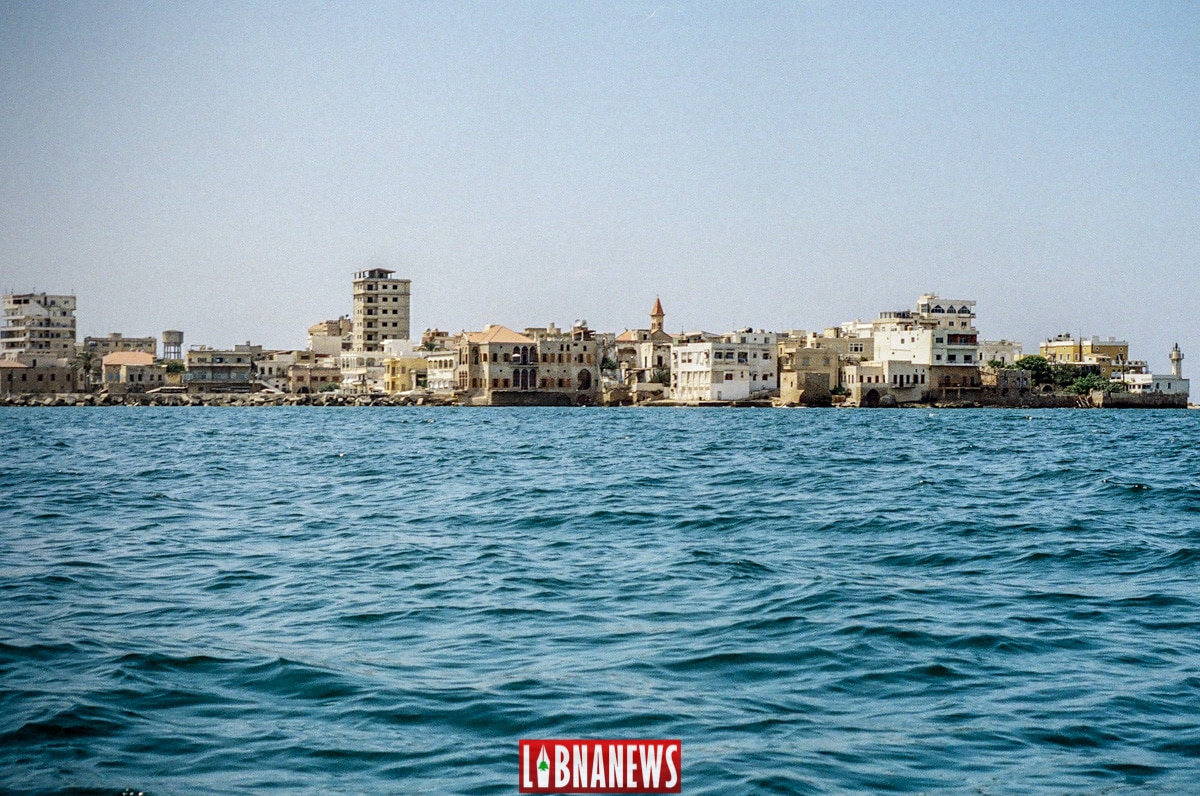
Before being the great Phoenician power of the sea roads, Tyre was also told as a city emerged from a miracle: two floating rocks, an olive tree burning without burning, a snake, an eagle and the intervention of Melqart, the protective god of the city.
In Tyre, history often begins with the sea. That makes sense. The ancient city was first a maritime power, a Phoenician city oriented towards ports, trade routes, settlements and the Mediterranean. UNESCO recalls that Tyre was one of the great cities of Phoenicia, master of the seas, founder of counters like Cadiz and Carthage, and associated with several major stages of ancient history, including navigation, purple and mythological traditions related to Cadmos and Europe.
But Tyre is not limited to its walls, its harbours, its Roman ruins or the dyke of Alexander. Like Byblos with Adonis, like Nahr al-Kalb with his guardian dog, Tyre also has his founding account. A strange, almost cosmic story, where the city is born not merely of a political decision or of a human project, but of two rocks wandering on the sea.
In the tradition reported by Nonnos de Panopolis in theDionysiacs, text of late antiquity, the god of Tyre — Melqart, assimilated by the Greeks to Heracles — tells Dionysos the mythical origin of the city. The narrative is late, but probably retains older elements of Tyrian religious memory. Nonnos describes two Ambrosian rocks floating on the water, intended to become the settlement of the city.
A city born of two rocks
The heart of the myth is simple and powerful: before being fixed, Tyre would have been mobile. Two rocks wandered on the sea. They were not yet a territory. They were not yet a city. They floated, carried by the waters, as if the very place of Tyre still sought its destiny.
In this account, Melqart instructs the first inhabitants to build a ship, to follow these rocks and to perform a ritual intended to immobilize them. The city can only be born when the sea agrees to deliver a fixed point. It is an extraordinarily fair image for Tyre: a city between land and water, between island and continent, between land trade and naval power.
UNESCO recalls that, in ancient times, Tyre was largely built on an island deemed difficult to take, before being connected to the continent by the dike built by Alexander the Great during the siege of 332 B.C. The present city has thus become a promontory, but the memory of the island remains central in its historical identity.
The myth of the two floating rocks is therefore not a free fantasy. He turned a geographical reality into a sacred narrative: Tyre was a city of rock, sea, island and passage.
Olive tree burning without disappearing
On one of the rocks was an olive tree. But not an ordinary olive tree. Nonnos describes a tree rooted in stone, in the middle of the sea. He’s burning, but don’t burn. Fire surrounds, without destroying it. A snake wraps around its trunk. An eagle is placed in its foliage. A cut is also found on the tree. The painting is dense: stone, sea, tree, fire, snake, eagle, sacrifice.
Every element counts. The olive tree represents permanence, rooting, fertility and possible peace. But here it grows on a floating rock. He’s alive in the instable. He burns without dying. It holds in the middle of the sea. He already says what Tyre means by itself: a city capable of surviving fire, sieges, storms and empires.
The fire that does not consume the tree is the image of a divine force. He doesn’t destroy, he devotes. He says the place is chosen. The rock is no longer just a stone mass. It becomes a sacred space.
The snake and eagle add another layer. In Nonnos’ account, they do not clash. The snake does not devour the eagle. The eagle does not kill the snake. They coexist in an impossible balance. The city is therefore born of a supernatural order where the opposites are maintained together: earth and sky, sea and rock, fire and tree, reptile and bird.
The sacrificed eagle and the fixation of Tyre
In order for the rocks to stop wandering, an act must be done. Melqart orders to sacrifice the eagle. The bird’s blood must fall on floating rocks. It is this sacrifice that fixes them at the bottom of the sea and allows the foundation of the city. Nonnos says that after the offering, the rocks stopped drifting and became the bases on which the first inhabitants built Tyre.
The message is brutal, but classic in the myths of foundation: a city is not born without sacrifice. You have to shed blood to fix a place, turn the instable into territory, make a rock floating a homeland.
In this reading, Tyre is not only built. It is rooted in a rite. The sea doesn’t give it for free. The city must be torn from the movement of the waters by the intervention of the god and by the blood of a sacred animal.
This idea perfectly corresponds to the imagination of ancient cities. A foundation is never just an act of urban planning. It is a pact with the gods, with the ground, with the dead, with the sea.
Melqart, founder and guardian of the city
Melqart is at the centre of the story. His name is generally understood as the king of the city or the master of the city. He is the guardian god of Tyre, the one who protects, founded, ordered and legitimate. The Greeks identified in Heracles, the Romans in Hercules, but behind these equivalences is first a Tyrian divinity.
InDionysiacsIt is he who reveals to Dionysos the origin of Tyre. He is not only a god honored by the city after its foundation. He is the one who makes the foundation possible. He gives the oracle. It indicates the rocks. He prescribes sacrifice. It turns the sea into a city.
This role explains why Tyre has always tied his power to his god. The city is not only an efficient port. It is a sacred city, protected by a divinity that accompanies its ships, kings, colonies and merchants.
The Roman currencies of Tyre also retain this memory. Some pieces hit in Tyre under Gordien III represent the Ambrosian rocks, an altar, an olive tree, a star, a crescent and a murex, with an inscription referring to the Ambrosian rocks. The catalogueRoman Provincial Coinagedocuments this monetary type, which shows that the myth was still used as the official identity marker of the city in roman times.
The myth and the real topography
As often in ancient legends, the story does not come out of nowhere. He dresses a physical reality. Tyre was linked to rocks, islets, an island site and a very special relationship between land and sea.
The scholarly tradition often brings the two Ambrosian rocks closer to the ancient topography of Tyre. Prior to the gradual transformation of the shoreline, the city was associated with an island or several nearshore rock formations. The Alexander dyke, built during the siege of 332 B.C., then permanently altered the site by connecting the island to the mainland. UNESCO notes that this dam blocked the straits and turned the old island into a promontory.
The myth thus tells in its own way the same thing as geography: Tyre is a city between two states. It is island and almost continent. It floats in memory, but anchors in stone. It comes from the sea, but eventually dominates the earth.
That’s what makes the story so effective. He’s not just saying: « Tyr was founded. » He says: « Tyr has been fixed. » And for a maritime city, this nuance is essential.
Two rocks for an identity
The theme of the two rocks is not secondary. He gives Tyre a double identity. The city is built on separation and union. Two floating masses become a city. Two moving elements become a territory. Two fragments become unified power.
This idea resonates with the very history of Tyre. The ancient city combines an island core and a continental hinterland. It links ports to land, seamen to peasants, trade to agriculture, the sea to land roads. Nonnos also insists on this singularity: Tyre is a city where the shepherd’s world is close to that of the fisherman, where the work of the land and navigation meet.
In myth, this union is already present. The rocks float on the water, but carry a tree. The serpent belongs to the earth, the eagle in heaven, the fire in the divine domain, the cup in the rite, the sea in motion. Everything that should be separated is in the same image.
Tyre therefore describes itself as a city of synthesis. It’s not just on the sea. It is the organized meeting of all elements.
An older foundation than chronology
This story must be treated for what it is: a myth, not a historical chronicle. Nonos wrote in late antiquity, very long after the beginning of Phoenician Tyre. Its text does not allow the real foundation of the city to be reconstructed directly. Therefore, the floating islands should not be read as a crude archaeological testimony.
But it would be a mistake to reject the narrative as a mere literary invention. Myths often retain memory structures. They say how a city wants to be understood. Tyre presents himself here as a city born of the sea, chosen by a god, fixed by a sacrifice, built on sacred rocks and protected by Melqart.
It is less a foundation date than a declaration of identity.
The real history of Tyre has been that of a maritime power, of a commercial city, of a Phoenician center capable of radiating in the Mediterranean. The myth gives this power a sacred origin. He claims that Tyre has not only become the master of the seas by his ships. It was wanted, from the beginning, as a sea town.
The city that refused to sink
The beauty of the myth lies in this image: a city that would have first floated, before taking root. It’s a powerful metaphor for Tyre. The city has experienced sieges, empires, destruction, reconstructions, successive dominations. She was Phoenician, Hellenistic, Roman, Byzantine, cross, Islamic, Ottoman, then Lebanese. Its visible ruins are largely Roman, but its memory is much older.
UNESCO points out that the site preserves important remains, including Roman baths, colonnade streets, the necropolis of El Bass, the aqueduct, the hippodrome and medieval traces, while recalling that the city was one of the major Phoenician metropolises of the eastern Mediterranean.
The myth of the Ambrosian rocks gives another reading of this continuity. Tyre is the city that floats but does not disappear. She moves in history, but keeps her core. It burns without being consumed, like the olive tree of its own founding story.
This image may be stronger than any chronology.
A Legend to Re-enter in Lebanese Memory
Today, Tyre is often looked at through its archaeological sites, coastline, racetrack, columns, old quarters and its role in the history of South Lebanon. But his ancient imagination remains insufficiently told. The myth of the floating islands, the fiery olive tree, the snake and the eagle makes it possible to restore an essential part of this depth.
It recalls that ancient Lebanon has not only produced ports, merchants and artisans. He also produced founding stories. Stories able to explain a city by a miracle, a geography by a symbol, a maritime power by a pact with the sea.
In Byblos, the river was blushing with the blood of Adonis. In Nahr al-Kalb, a dog reportedly barked to warn the inhabitants of the arrival of the invaders. In Tyre, two rocks would have floated on the sea until the blood of an eagle fixed them forever.
It’s not a story in the strict sense. It’s better than that to understand an ancient city: it’s the way Tyre saw herself. A city born of the sea, rooted by the sacred, protected by Melqart, and confident enough of its power to record on its coins the memory of its founding rocks.
References used:Nonnos de Panopolis,DionysiacsBook XL; UNESCO, World Heritage notice on Tyre;Roman Provincial Coinage, monetary type of Tyre under Gordien III representing the Ambrosian rocks ; numismatic works on the Ambrosian rocks and the sanctuary of Melqart.




