





In the aftermath of the war, the return of the people of the South did not sum up reopening the roads and allowing families to return to their villages. Housing had been destroyed or rendered uninhabitable, some communities remained exposed to Israeli operations and schools continued to house internally displaced persons several months after the most intense phase of fighting. In this space between the ceasefire and a still incomplete reconstruction, a Hezbollah-related scheme, Saidoun, has taken an important place in the organisation of accommodation and assistance to families.
The phenomenon deserves to be observed beyond humanitarian aid alone. Samidoun intervenes in an area where the State, municipalities, public bodies, associations and political networks cross without the same resources and speed of action. The scheme accompanies displaced families and participates in the search for accommodation solutions, while the gradual return to certain localities constantly changes needs. As the school year approaches, this organization faces a very concrete problem: schools used as reception centres have to find their pupils while some families still do not have a place to return.
This situation reveals an ancient feature of the Lebanese system, made more visible by the war. When the state cannot respond quickly enough to a social emergency, partisan or community structures occupy part of the space. They do not necessarily replace all public institutions, but sometimes become the immediate interlocutor of people who cannot wait for the administrative pace of reconstruction. The real issue begins when the urgency continues: an organisation created to respond to a crisis ends up performing functions similar to those of a social administration.
Massive return does not mean the end of displacement
In several villages in the South where return is physically possible, between 80 and 90 per cent of the population are said to have already returned. This rate gives the image of rapid normalisation. However, it masks large disparities. Returning to a locality does not necessarily mean returning to housing, economic activity, school or pre-war services. Some families may return permanently; Others alternate between their village and a temporary accommodation solution; Still others remain displaced because their house is destroyed or their area remains too exposed.
This difference between geographical return and return to normal life is at the heart of the problem. A public policy can account for a family as income as soon as it leaves a reception centre. For this family, the exit of the trip only occurs when it has a sustainable roof, access to essential services and a perspective to stay there. In areas where destruction is significant, return therefore becomes a process rather than an event.
Samidoun intervenes in this interval. The scheme has accompanied families whose needs have evolved over time: immediate accommodation during the war, maintenance in collective structures, search for temporary solutions, and accompanying the return when it becomes possible. This continuity gives him a fine knowledge of family and territorial situations. It also gives it a clear social power: the one who knows where the displaced are, which housing is destroyed and which families need help has an organizational capacity that goes beyond the mere point-of-aid distribution.
The challenge now is to gradually reduce this function without abandoning those who cannot yet return.
Schools at the centre of an equation that has become impossible
Back to school changes the urgency. During the war and the displacements, the schools served as shelter for families who had no alternative. This function was immediately understandable: a school offers relatively large buildings, sanitary facilities and a well-known settlement of municipalities. But what works during an emergency phase quickly becomes unsustainable when the school year has to start over.
It is then necessary to choose between two equally legitimate needs. Families need a roof. Children need to get back to their classes. Leaving the displaced in schools helps to preserve their accommodation but prevents or complicates the resumption of courses. Leaving them without an alternative solution makes it possible to return schools to their teaching mission, but simply moves the problem to another place.
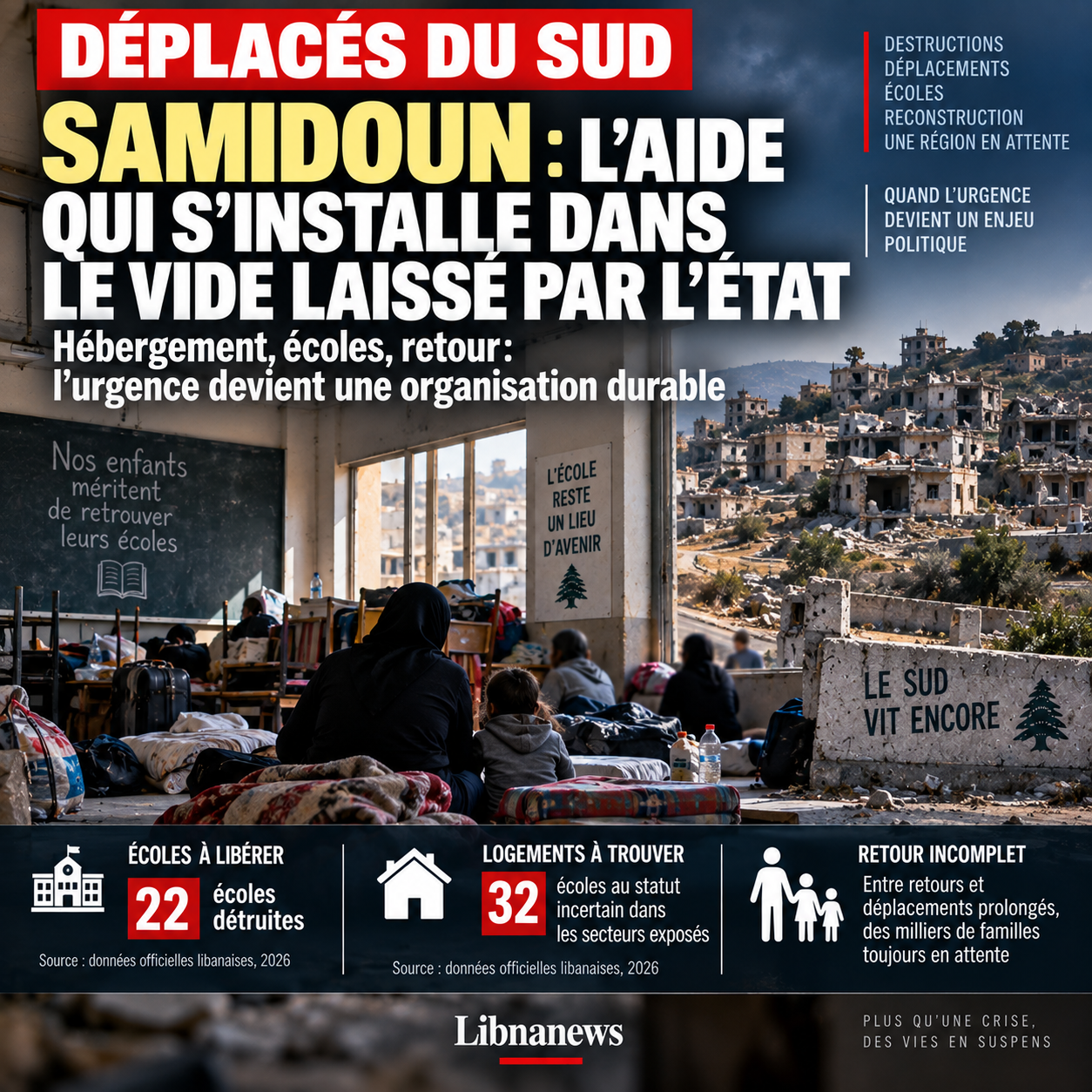
This contradiction is compounded by the damage suffered by the school system itself. Twenty-two schools were reportedly destroyed. The situation of 32 other establishments would remain problematic in the most vulnerable sectors, particularly in the vicinity of occupied or difficult access areas. As a result, the availability of schools has declined at the same time as the remaining schools have to be released.
Displacement and education are no longer two separate crises. They fight the same buildings.
For Samidoun as well as for the public authorities, the re-entry thus requires a change of method. Collective accommodation in schools must gradually give way to residential solutions, even temporary ones. This involves finding housing, helping to pay rent, or financing repairs that are fast enough to make certain homes usable again.
From humanitarian emergency to social administration
It is at this point that the scheme takes on a more political dimension. A structure that distributes food or blankets for a few days is clearly an emergency aid. A structure that follows for months the accommodation of families, organizes their travel, participates in their return and provides for contributions to the repairs begins to perform a more sustainable function.
Hezbollah has also announced that it will continue to intervene in this area. Naim Kassem promised to participate in accommodation, repairs and reconstruction through his own means and donations. He also announced the forthcoming presentation of a specific housing project, while asking the state to assume its responsibilities.
This last clarification is important. The party does not present its action as an official state replacement. He claims to intervene because the needs exist while at the same time calling for public intervention. In practice, however, the boundary between complement and substitution becomes blurred when citizens receive the quickest response from a political organisation rather than an administration.
For a family whose home is uninhabitable, this institutional distinction obviously matters less than immediate efficiency. However, it is becoming central in the long term. If access to housing, repair or compensation depends on a partisan network for a long time, the relationship between the population and this network is strengthened. The aid then produces a political effect even when it meets a perfectly real need.
Hezbollah has an advantage that the state struggles to reproduce
The main strength of a device like Samidoun lies in its proximity to the terrain. Hezbollah’s local structures have an ancient grid in a large part of the South. They know about villages, families, municipalities and associations. They can quickly collect information and mobilize volunteers or resources without waiting for all administrative procedures that normally govern public action.
The state operates according to a different logic. A department must identify a budget line, follow procedures, coordinate several administrations and sometimes wait for government decisions. The Southern Council, municipalities and other public bodies can intervene, but their skills and resources are not always perfectly superimposed. A partisan structure can, in some situations, decide faster.
This speed is a considerable advantage in times of crisis. However, it has its setback. Public funds must theoretically be subject to rules of transparency, equality and control. A partisan aid meets its own criteria and mechanisms. The two models therefore do not offer the same guarantees or obligations.
The question is not which one can distribute aid most quickly during an emergency. It is to determine which system should organize reconstruction when the emergency becomes a policy of several years.
State prepares to return to Nabatiyah
The government seems to have understood that the problem could not be left to local networks alone. An initiative is being prepared in Nabatiyeh, where Nawaf Salam must show more directly the presence of the executive. Yassine Jaber participates in the preparations and several projects in the city and its periphery must be put forward to help the inhabitants stay there.
The approach has an economic but also symbolic dimension. A government that goes to a war-affected area claims that the South is not just a security issue that has been dealt with from Beirut or in international negotiations. He tries to show that the state can also act on the daily lives of the inhabitants.
The success of this operation will, however, depend on achievements much more than images. The people of the South have already heard many promises of reconstruction in recent decades. They will judge public action on speed of repair, access to schools, rehabilitation of roads and infrastructure, compensation and the possibility of resuming economic activity.
It is precisely on this ground that comparison with Hezbollah networks becomes inevitable. If the State announces projects that take months to start, while a local structure provides an immediate solution, the relationship of confidence remains favourable to the latter. If public institutions become able to respond quickly and transparently, balance can change.
Reconstruction becomes a battle of presence
The word « reconstruction » generally refers to houses, roads and infrastructure. In the South, it also covers a reconstruction of authority. A person who rehabilitates a school, helps a family to find their home or restores a public service does not just restore a building. It shows who is able to respond when the population needs it.
That is why reconstruction has a political significance without the need to imagine a secret strategy behind every aid. An organization that responds effectively to a crisis naturally strengthens its legitimacy with those it helps. A State that fails to perform the same function weakens its own.
Hezbollah knows this all the better because its history in Lebanon is not based solely on its military apparatus. The party has developed a set of social, health, educational and associative structures over the decades. This infrastructure contributes to its political resilience. It helps maintain a relationship with its base that is not solely dependent on discourse about resistance or the regional context.
Samidoun follows this logic of proximity, even if the device responds first to the immediate consequences of the war. By following the displaced from the reception centre until the return, it creates a continuity that fragmented public administrations often find difficult to offer.
The risk of two-track reconstruction
Lebanon could thus see two parallel circuits. The first would involve the State, public bodies, international financing and foreign partners. It should finance infrastructure, schools, roads and part of housing. The latter would rely on Hezbollah, donations and its own networks to respond directly to the needs of some families.
In the short term, this coexistence can speed up the response. In a region where there is considerable need, refusing aid on the sole ground that it does not come from the State would be difficult to defend to the victims. But in the longer term, the coexistence of two systems can replicate exactly the institutional fragmentation that the government claims it wants to reduce.
The problem arises in particular with regard to the criteria for compensation. Who evaluates the destruction of a dwelling? How much is paid? Can a family benefit simultaneously from several aids? How to avoid duplicates or, conversely, forgotten ones? Responses become particularly important when foreign financing begins to arrive.
A unified national register of damage would theoretically coordinate interventions. However, the different actors must agree to share their data and have confidence in the mechanism.
Without coordination, reconstruction risks replicating the country’s political geography: each territory depends on its own networks and recovery capacities vary depending on its membership or proximity to the best funded structures.
IDP cannot wait for the great political solution
This institutional discussion, however, comes up against the daily urgency. Families who have to leave school cannot wait until a national model of reconstruction is definitively negotiated. Some need accommodation in the coming days. Others need to repair a room or roof to be able to return before winter. Children have to go back to school.
It is precisely this time lag that gives an advantage to local structures. The great reconstruction counts in years. Accommodation counts in nights.
The state must therefore find a way to act quickly without giving up its rules. Temporary housing subsidies, accelerated light repair programmes or partnerships with municipalities can be intermediate solutions. The aim should be to prevent collective centres from becoming permanent while preventing families from simply being displaced a second time.
The release of schools is a practical test. If the institutions resume their function without the families being abandoned, the system will have succeeded in a transition. If the displaced are only transferred to other precarious solutions, the problem will have changed address without being solved.
The sensitive issue of financing
Hezbollah’s ability to sustain its efforts also depends on its resources. Naim Kassem mentioned the party’s own means and donations. But the reconstruction of an entire region requires considerable sums. The longer the period, the greater the difference between emergency aid and a real reconstruction programme.
Public funding has its own limitations. Lebanon is barely emerging from a major financial crisis, is still working on bank restructuring and must maintain a fragile fiscal balance. The needs of the South are in addition to those of public services and infrastructure in the rest of the country.
External aid will therefore be decisive. However, international donors are likely to want funds to go through controllable and transparent mechanisms. This requirement theoretically favours state institutions, provided they are able to present projects, manage financing and report on their use.
The reconstruction could thus become a credibility test for the government of Nawaf Salam. Getting money is not enough. It will have to be demonstrated that the administration can quickly transform it into visible achievements.
School reveals all the weaknesses of the system
The school record finally summarizes the whole problem. A school turned into a shelter shows that the state and society have been able to mobilize an existing infrastructure to respond to an emergency. A school still occupied several months later showed that the interim solution had not been replaced by a sustainable policy. A destroyed school finally reminds us that reconstruction is not just about relocating families, but about restoring the whole ecosystem that allows a community to live.
The twenty-two establishments destroyed and the thirty-two others whose situation remains uncertain provide a measure of this difficulty. Even when families return, their children may not immediately return to their institutions. Additional school trips are needed, with transport costs and organizational problems that directly affect households.
So a family doesn’t decide to stay in their village just because their house is repaired. She also looks at school, the road, care and work opportunities. The reconstruction of a territory is a whole. If one of these elements is permanently lacking, the return can remain fragile.
Saidoun asks a question that goes beyond Hezbollah
The system finally reveals less a singularity of the party than a recurring weakness of the Lebanese model. In many areas, citizens turn to community, religious or political networks when the state does not respond quickly enough. War simply amplifies this mechanism.
The question asked by Samidoun is therefore one of transition. Can a partisan organisation intervene during the emergency and gradually give way to public institutions? Or does the effectiveness gained during the crisis lead to the sustainability of its role?
The answer will depend much less on political statements than on state performance in the coming months. If the projects announced in Nabatiyeh translate into work, if schools reopen, if families find accommodation solutions and if compensation actually begins, the public administration will be able to take over part of the space abandoned during the war.
Otherwise, residents will naturally continue to address those who can respond.
This gives the Samidoun case its political scope. It is not just a programme for internally displaced persons. It shows how, in a fragile State, a humanitarian emergency can gradually produce a parallel service architecture. And he recalls that the restoration of sovereignty is not only played out in the debate on arms: it also begins with a much simpler question: who opens the door when a family without housing asks for help.