

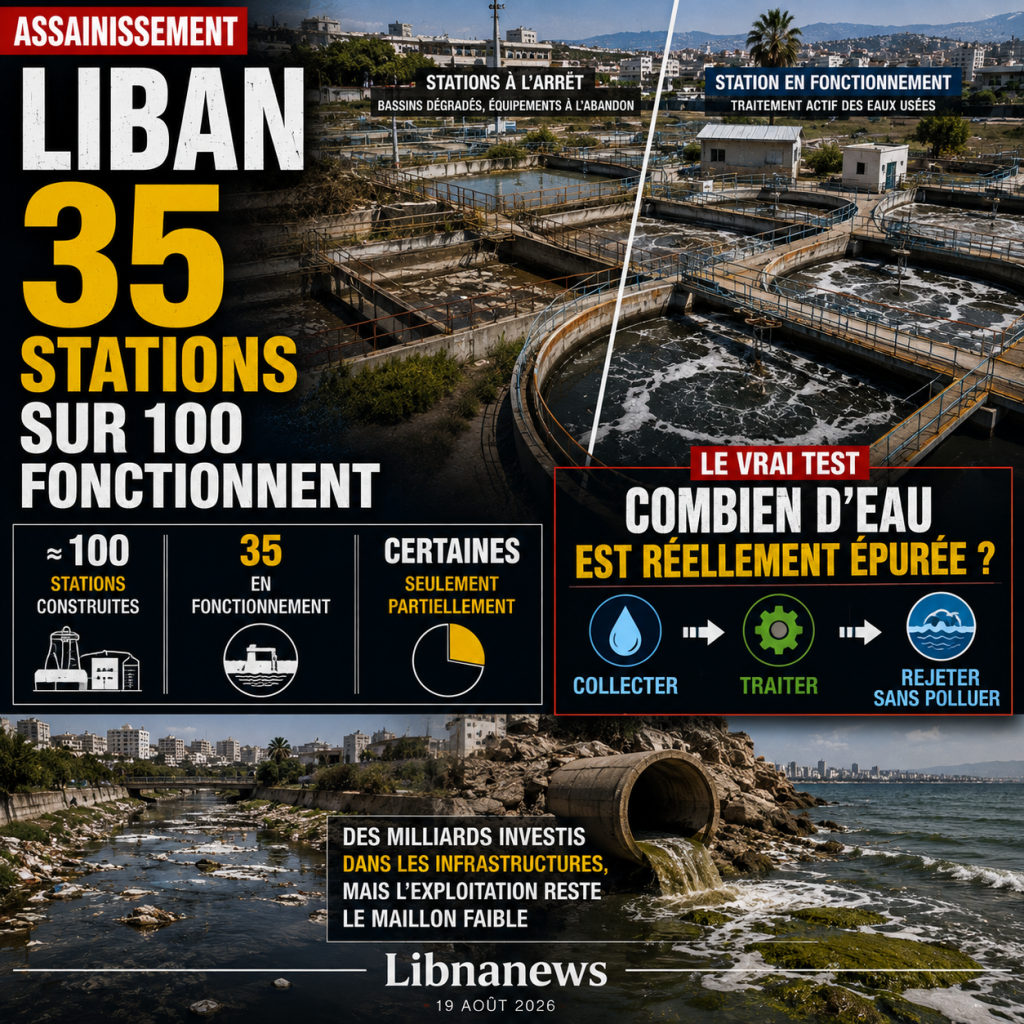
Of the approximately 100 wastewater treatment plants identified in Lebanon, only 35 operate, some partially. This does not simply mean that dozens of factories would be closed. It reveals the flaws of a system built since the 1990s in often poorly coordinated stages: stations without complete networks, pre-treatment without biological purification, private equipment with a stable power supply and installations whose financing of the operation did not follow that of the construction. The result is downstream: part of the wastewater still reaches rivers, aquifers or the Mediterranean without sufficient treatment.
To understand what the number of 35 stations in operation out of a hundred means, one must first look at what is happening inside a sewage treatment plant. Not all do the same service, and « in operation » does not necessarily mean that a waste water receives complete treatment.
A station can simply remove the largest solid waste before discharge. Another can provide a primary settling. A more complete facility uses biological processes to reduce the organic load in wastewater. Some may add disinfection or treatments for water reuse.
Between a line directly discharging sewers at sea and a station producing treated water that meets discharge standards, there are therefore several levels of performance.
It is precisely this difference that makes the Lebanese situation more worrying than the only number of stations stopped:a technically active facility may itself provide only a part of the planned sewage treatment chain.
Sewers rebuilt after the war, but without integrated system
Much of the present system has its origin in the reconstruction initiated after the end of the civil war in 1990.
Lebanon emerged from 15 years of conflict with degraded infrastructure, rapid urbanization and inadequate sanitation. In many localities, sewers drain sewage directly to streams, valleys or the sea.
The reconstruction of the 1990s must therefore simultaneously address several needs: restoring drinking water supply, developing sewerage systems and building sewage treatment plants.
The problem is considerable, especially on the coast.
Urban expansion around Beirut, Metn, Kesrouan, Tripoli, Saida and Tyre is rapidly increasing sewage volumes. Buildings and neighbourhoods are developing faster than public networks. Sepsis, local pipelines and direct discharges continue to coexist with the new infrastructure.
The State is gradually undertaking construction programmes with the Council for Development and Reconstruction, water establishments and several international donors. World Bank, European Investment Bank, European Union and Arab funds participate, depending on projects and periods, in financing the sector.
Stations appear across the country. But the model has a weakness that will become structural:building a station, building the network to supply and finance its operation do not always fall within the same project, schedule or institution.
Three decades later, this fragmentation remains visible.
Ghadir and Dora: the old model of coastal pretreatment
The case of Greater Beirut makes it possible to understand the technical origin of part of the problem.
On the coast, facilities such as Ghadir, south of Beirut, or Dora, north, have long been based primarily on a pre-treatment system associated with marine emissaries.
The principle is relatively simple. Waste water is collected and the most coarse solid waste is removed. They may undergo various physical operations before being sent off by underwater driving.
This reduces some immediate effects on the shoreline. In particular, it removes the point of rejection.
Butremoving waste water that is not equivalent to purifying.
A complete treatment must affect its pollutant load.
Domestic waters contain organic matter, suspended matter, nutrients such as nitrogen and phosphorus, microorganisms and various contaminants from household, commercial or industrial activities connected to the grid.
A marine emissary mainly uses dilution and dispersion. It does not remove most of this pollution.
This distinction explains why the modernization of coastal facilities has long been a major issue in Lebanese sanitation.
What a station really needs to remove from water
Treatment normally begins with a phase ofpretreatment.
Grids retain objects and solid waste: plastics, fabrics, wipes and other materials that could damage the pumps. A desabling then removes heavy mineral particles. Degreasing separates some of the oils and fats.
Then comes theprimary treatment.
Water stays in basins where part of the suspended matter is deposited by gravity. This decantation reduces the amount of solids but still leaves a significant pollution dissolved.
Secondary treatment changes in nature. It becomes mainly biological.
Microorganisms consume part of the organic matter in the water. In activated sludge processes, for example, effluent is put into contact with biomass in generally ventilated basins. This step requires blowers, pumps, traffic systems and relatively constant control.
Two indicators measure the effectiveness of the process:biochemical oxygen demand, or DBO, and thechemical oxygen demand, or DCO.
The more biodegradable organic matter a water contains, the more oxygen micro-organisms consume to degrade it. A high BOD thus indicates a high organic load. Discharge of such water into a watercourse can deplete the environment with oxygen and severely disrupt aquatic ecosystems.
The most advanced stations can also reduce nitrogen and phosphorus and provide disinfection to reduce microbiological load.
Only after these steps can we talk about a much more complete purification.
Why a station can work « partly »
This string allows you to understand the figure published on August 19.
A station may have its pumps in operation while not performing all the required steps. It can provide pretreatment but not biological treatment. It can also receive much less water than its nominal capacity because the collection network remains incomplete.
Conversely, it may receive a higher load than the one for which it was designed.
A station sized for a given population can be found several years later in the face of much greater urbanization. Flow increases and effluent concentration may change. If the infrastructure is not adapted, performance declines.
The quality of the connection is therefore as important as the theoretical capacity of the installation.
Lebanon has experienced several situations in which stations were completed before some collectors. The main structure then exists physically, but the wastewater from the neighbourhoods it was to serve continues to use the old circuits.
The result is paradoxical:an expensive station can be underused while sewers continue to pour into the environment a few kilometers away.
Tripoli shows what high capacity infrastructure means
The northern part of the country illustrates another generation of equipment.
The Tripoli treatment plant, built as part of the major sanitation programmes, was designed to receive wastewater from a large urban population.
This type of installation represents a technical leap from simple coastal discharge. It requires large collectors, pumping stations, permanent electromechanical operation and treatment of sewage sludge.
But its nominal capacity is not enough to measure its effectiveness.
It is necessary to know the actual flow rate received, the proportion of the population connected, the availability of equipment, the energy continuity and the quality of water at the outlet.
This is a rule for all major Lebanese stations:the capacity in cubic metres per day is only a potential. The actual performance depends on the complete system.
Zahlé and the Bekaa pose another problem: protecting inland waters
Sanitation is not just a coastal problem.
In the Bekaa, discharges affect the Litani Basin and inland water resources. Urbanisation, agriculture and industrial activities exert particular pressure.
Stations such as Zahlé have been developed to reduce pollution from agglomerations. Other programmes targeted the Litani Basin.
The issue is different from that of Beirut.
On the coast, the most visible consequence is rejection in the Mediterranean. In the Bekaa, inadequate collection or treatment can contribute to degrade downstream streams, allocate water resources and complicate agricultural use.
The Litani has become the most spectacular example of this accumulation.
Domestic wastewater does not explain its pollution alone. Industrial releases, agricultural activities and solid waste also play a role. But the lack of municipal sanitation contributes to the load that reaches the river and, further downstream, the lake of Qaraoun.
Building stations in the basin can therefore only work if the localities are connected and if industrial discharges are also controlled.
The forgotten problem of industrial effluents
Municipal stations are generally designed primarily to treat domestic wastewater.
The network may also receive releases from workshops, factories, garages, hospitals, restaurants or other economic activities.
These effluents do not always have the same characteristics.
High concentrations of oils, solvents, metals, chemicals or other substances can disrupt biological processing. The microorganisms that clean up are sensitive to certain toxic substances.
Control of upstream industrial releases is therefore essential.
A modern station cannot compensate indefinitely for the lack of control over what enters the network.
This problem again refers to governance: wastewater treatment depends on the operation of the plant, but also on the capacity of the state and municipalities to enforce standards even before effluents arrive.
Electricity can stop biological treatment
The Lebanese energy crisis then hit the system at the most vulnerable point.
A modern sewage treatment plant is an industrial plant. It does not work simply by gravity.
Water must be pumped when it cannot circulate naturally. The grids and equipment must be activated. Above all, air must be provided to biological basins when the chosen process is aeration.
The blowers used for this operation can account for a large part of a station’s energy consumption.
A prolonged electrical shutdown therefore shuts down not only a few machines. It can disrupt the biological process itself.
After the financial collapse of 2019, the combination of the electricity cuts in Lebanon and the rising cost of fuel made operating much more difficult. Using generators for long periods quickly transforms the energy budget.
Managing agencies have found themselves faced with dollar expenditures or indexed to import prices as their revenues fell with the Lebanese pound.
International donors and organizations have had to intervene to maintain certain essential services.
This sequence demonstrates a fundamental fragility:a station designed without sustainable energy solution remains dependent on the electricity sector crisis.
After water, the sludge remains
Another problem is much less visible: treatment does not remove pollution. He’s transforming a part of it.
When solids are separated from water and the biomass of biological treatment develops, the plant producessewage sludge.
These sludges must in turn be thickened, stabilized, dehydrated and then disposed of or recovered according to their composition and applicable standards.
A station that treats water properly but does not have a reliable system for its sludge therefore solves only part of the problem.
The issue becomes particularly important when effluents contain industrial contaminants. Sludges that may contain certain metals or undesirable substances cannot be used without control.
They must be transported and adapted sites or routes must be available.
The cost of this step must be integrated as soon as the station is designed. Otherwise, a liquid problem simply becomes a solid problem.
2019 revealed a weakness that already existed
The financial crisis did not create all the shortcomings of Lebanese sanitation.
She amplified them.
Prior to 2019, problems of connection, institutional fragmentation and operational financing already existed. The monetary collapse then removed from the system some of the means still available to compensate them.
Wages have lost much of their real value. Imported parts have become much more expensive. Fuel had to be paid at more market-related prices. Maintenance contracts were disrupted.
The public water establishments themselves have faced a revenue crisis.
This period has shown that an infrastructure financed by an external lessor can be built with capital available at the time of construction, but that no lessor can forever replace the daily financing of a public service.
That’s the difference betweenCAPEX, the capital expenditure necessary for construction, andOPEX, the recurrent costs necessary for operation.
Lebanon has often managed to mobilize the first. The second became his Achilles heel.
Why coastal concentration worsens everything
Finally, the problem has an exceptional geographical dimension.
The Lebanese population is heavily concentrated on the coastal strip. Greater Beirut is the country’s main urban complex, while Tripoli, Jounieh, Saida and Tyre add several densely populated poles along the Mediterranean.
Networks therefore receive large volumes in a small space.
When the system works badly, the way to the sea is short.
Strongly urbanized rivers can themselves become vectors of pollution to the coast. Direct or insufficiently treated discharges also reach the Mediterranean.
This situation affects the environment, but also an essential part of the urban economy.
Beaches, beach clubs, restaurants, fishing, recreational harbours and tourism all use the same coastal area that receives part of the discards.
The cost of failing sanitation therefore spreads well beyond the water budget.
New projects will have to be judged differently
Several rehabilitation, extension or completion projects are announced for the coming years. Some target existing stations. Others concern collectors or improved treatment.
They can substantially increase the available capacity.
But the history of the last thirty years now requires a change in how their success is measured.
The number of stations built is no longer sufficient.
We need to know theeffective connection ratepopulation. The flow rate actually processed must be measured against the nominal capacity. Inlet and outlet water quality, including suspended material, BOD and COD, must be published. It is necessary to know how many days a year the installation works normally.
Sludge treatment and energy costs must also be integrated.
Finally, every project should have credible funding for operation and maintenance throughout its lifetime as soon as it is launched.
It is this last question that best summarizes thirty years of Lebanese sanitation.
A station can cost tens of millions of dollars and be technically well designed. If the collector does not reach it, if the pumps lack electricity, if a part cannot be replaced or if no one has the budget to treat the sludge, the investment exists but the public service disappears.




