

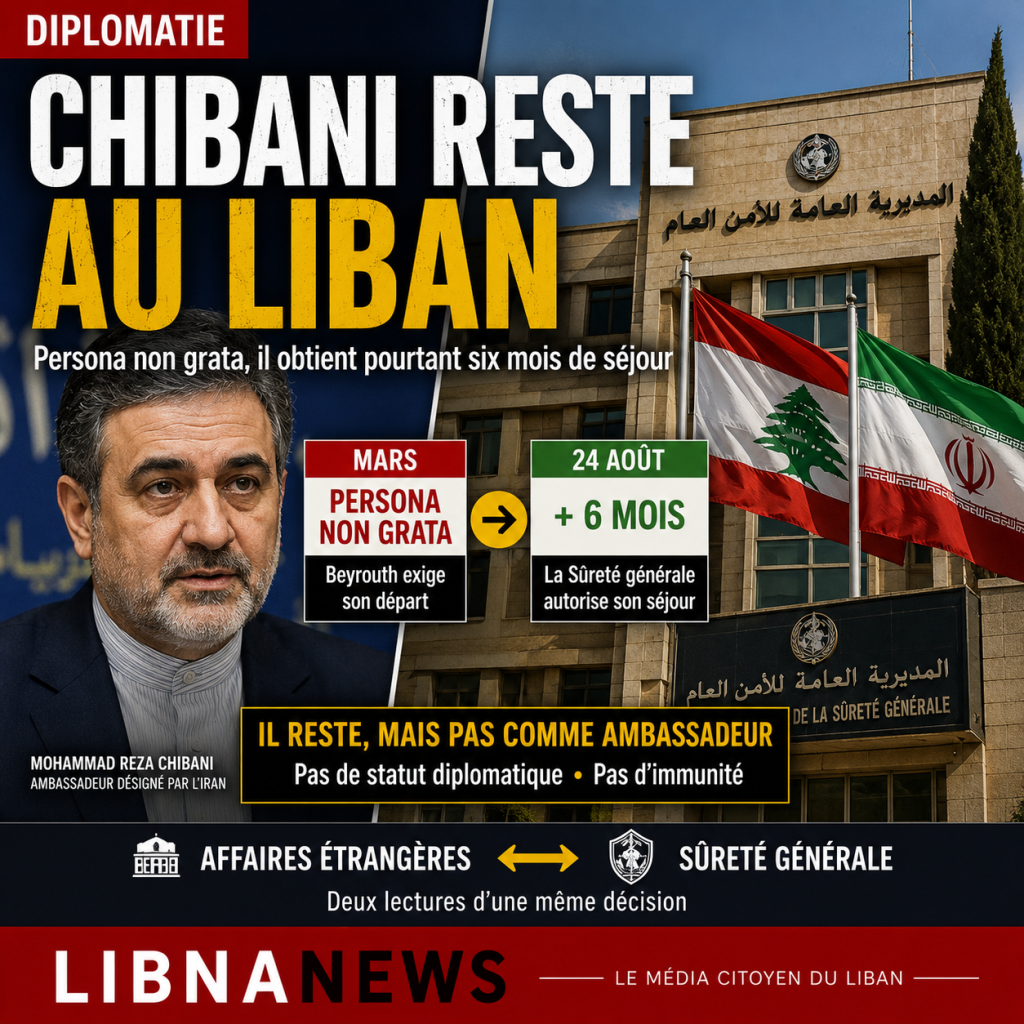
Mohammad Reza Chibani can finally stay in Lebanon. The ambassador appointed by Iran, declared persona non grata by Beirut in March, obtained on Monday 24 August a six-month residence permit issued by the General Security, while his right of residence expired at midnight. The formula allows him to remain in Lebanese territory in a personal capacity, without restoring his ambassadorial status or diplomatic immunity. It temporarily defuses a political confrontation around his expulsion, but opens a new controversy over the consistency of the Lebanese State’s decision.
Mohammad Reza Chibani’s case went back a few hours from the deadline of 24 August. While the Foreign Minister, Youssef Raggi, had said a few days earlier that no extension of the Iranian diplomat’s stay could legally be granted after his designation as a persona non grata, the General Security finally accepted an application for residence made on the basis of his Iranian passport.
According to several Lebanese media outlets, General Hassan Choucair, the Director General of General Security, granted Chibani a six-month residence. The scheme is presented as a « courtesy » residence permit, an administrative formula that allows it to remain in Lebanon without being recognized as ambassador of the Islamic Republic of Iran. The diplomat thus loses the privileges attached to the office he was to exercise in Beirut, including his diplomatic immunity.
This distinction is the core of the compromise. Chibani did not recover the approval that Lebanon had taken from him in March and did not become the Iranian ambassador recognized by the Lebanese authorities. Nor is he forced to leave the territory immediately, contrary to what was required by the decision announced by the Ministry of Foreign Affairs five months earlier.
Chibani remains in Lebanon without ambassador status
The solution therefore changes the status of Mohammad Reza Chibani rather than formally reverts to the diplomatic decision of March. Iran had appointed him to head its embassy in Beirut, but Lebanon had withdrawn its agreement before its mission could normally be carried out. Its retention in the Territory is now based on a residence permit and not on diplomatic status.
According to information from Lebanese media sources, the application was filed with the secretariat of the General Directorate of General Security on the basis of an Iranian passport in force. The permit was reportedly granted for a period of six months pursuant to the Decree-Law of 18 July 1962 regulating the entry, stay and exit of foreigners in Lebanon.
Another media source describes the device as a « courtesy » residence. This type of stay is used in particular in certain special situations to enable an alien to legally reside in Lebanon without granting him diplomatic status. Its application to a diplomat declared persona non grata is, however, a politically sensitive case, precisely because the Ministry of Foreign Affairs had defended a much more restrictive interpretation of his situation.
The immediate result is clear: Chibani can legally stay in Lebanon for another six months, but not as an accredited ambassador. The Embassy of Iran must continue to function without him as head of mission recognized by Beirut, unless the Lebanese authorities decide again or Tehran appoints another ambassador to obtain approval.
In March, Beirut ordered him to leave
The compromise of 24 August came after five months of diplomatic arms. On 24 March 2026, the Lebanese Ministry of Foreign Affairs had summoned the Iranian official, Tofiq Samadi Khoshkho, to officially notify him of the withdrawal of the agreement given to the appointment of Mohammad Reza Chibani.
Beirut had simultaneously declared the diplomat persona non grata and demanded his departure from Lebanese territory before Sunday, 29 March. The decision was based on article 9 of the Vienna Convention on Diplomatic Relations, which allows a host State to declare at any time a member of an undesirable diplomatic mission.
The ministry had said a few hours later that this decision did not constitute a break in diplomatic relations with Iran. She personally targeted Chibani and her behaviour since her arrival in Lebanon. Beirut claimed to want to maintain normal relations with Tehran, but on the basis of mutual respect for sovereignty and non-interference.
In particular, Lebanese diplomacy blamed Chibani for statements on domestic policy and government decisions. She also reproached him for meeting unofficial Lebanese actors without going through the Ministry of Foreign Affairs, contrary to the rules Beirut intended to impose on foreign missions.
In the same context, Lebanon had recalled its ambassador to Iran, Ahmad Sweidan, for consultations. The episode had thus provoked one of the most important diplomatic tensions between Beirut and Tehran in several years.
The departure required in March never happened
Despite the ultimatum set for 29 March, Mohammad Reza Chibani had not left Lebanon. Its continuation had quickly transformed a diplomatic decision into an internal political problem. The case no longer concerned only relations between Beirut and Tehran, but also the ability of Lebanese institutions to implement a decision taken against an Iranian representative.
The diplomat had received political support from the Lebanese allies of Tehran, in particular the Amal-Hezbollah tandem. His forced expulsion could thus lead to a new internal confrontation at a time when the government had to deal with the consequences of the war, Hezbollah’s weapons file and negotiations on Israeli withdrawal.
Chibani had therefore continued to stay in Lebanon for the following months, while the question of his legal status remained open. The approach to the expiry of his residence permit, set at 24 August, has placed the case at the forefront in recent weeks.
Two scenarios then seemed possible: his departure from Lebanon, in accordance with the decision of the Ministry of Foreign Affairs, or an administrative formula allowing his continuation without restoring his diplomatic accreditation. Finally, the second option was chosen.
Youssef Raggi excluded any regularization
This solution, however, is in direct tension with the position publicly defended by the Foreign Minister. On 20 August, Youssef Raggi claimed that the decision to declare Chibani persona non grata was final and, in his view, left no room for interpretation.
The Minister considered that a person declared undesirable had to leave the territory of the host State and that no visa or residence permit could then be used to circumvent that decision. He had even described a possible regularization as « legal heresy », believing that it would be unfounded.
Raggi had also placed the issue in the broader issue of relations with Iran. He called on Tehran to respect Lebanon’s sovereign decisions and to adopt a « State-to-State » relationship. In his view, the complete normalization of relations with the Iranian mission should begin with the implementation of the decision concerning Chibani and the appointment of another ambassador.
The residence granted on Monday is not legally rebuttal to the withdrawal of diplomatic approval. However, it circumvents its most immediate practical effect: the departure of Chibani from the territory. It is on this difference between diplomatic status and the individual right of residence that the compromise is now based.
A decision that reveals two readings within the State
The case thus highlights a difference in approach between two Lebanese institutions. The Ministry of Foreign Affairs reason from the Vienna Convention and the sovereign decision declaring a diplomat persona non grata. The General Security Service has administrative powers over the entry and stay of foreigners.
The formula adopted on Monday seems to consider that the termination of diplomatic status does not necessarily prevent Chibani from obtaining another residence permit as an Iranian national. This interpretation allows the Ministry’s decision to be maintained diplomatically while avoiding expulsion.
However, it raises an institutional question. The decision of 24 March was not limited to the withdrawal of Chibani’s authorisation. The official statement of the Ministry explicitly asked the diplomat to leave Lebanese territory. The permit granted five months later therefore produces a situation in which this requirement remains formally enshrined in the diplomatic decision, while another authority authorizes the same person to legally reside in the country.
This contradiction explains the political sensitivity of the case. It no longer concerns only the presence of an Iranian diplomat, but the way in which a foreign policy decision taken on behalf of the State is linked with the administrative powers of another institution.
A compromise to avoid a new crisis with Tehran
The six-month solution, however, allows the Lebanese authorities to avoid immediate confrontation with Iran and its allies in Lebanon. An effective expulsion of Chibani would probably have provoked a reaction from Tehran at a time when relations between the two countries were already strained by several cases.
The Lebanese Government has been seeking for several months to redefine these relations around the principle of non-interference. This commitment has become particularly important with the debate on Hezbollah’s weapons and statements by Iranian officials concerning the decisions taken by Lebanese institutions.
Beirut considers that these positions directly affect its sovereignty. Tehran continues to defend its alliance with Hezbollah and to present the movement as an essential player in the resistance against Israel. This divergence regularly puts bilateral relations under tension.
The Chibani case has become one of the concrete manifestations of this balance of power. In March, Lebanon wanted to show that a foreign diplomat could not intervene in the domestic political debate without consequence. Five months later, his retention with a personal residence permit shows the political limitations encountered when it comes to transforming this position into an effective departure.
Six months that push back the problem without solving it
The residence granted to Mohammad Reza Chibani regulates his immediate status, but not the diplomatic dispute between Lebanon and Iran. The diplomat may remain in the territory without officially representing his country to the Lebanese authorities. Tehran will always have to decide whether to present another candidate for the post of ambassador or maintain a representation conducted at a lower level.
For Beirut, the question will also be whether this formula remains exceptional or whether it opens a precedent for the application of a persona non grata declaration. The Vienna Convention allows the host State to withdraw recognition from a diplomat and to demand his recall. The Lebanese case now adds a situation in which the person concerned loses his diplomatic status but retains a right of residence granted by the national administration.
The deadline is simply moved by six months. At its conclusion, the question of the renewal of the Chibani residence will again arise if it is still in Lebanon. Meanwhile, the authorities will also have to clarify the Iranian representation in Beirut and the conditions for a return to normal diplomatic relations.
The decision of 24 August therefore avoids the immediate departure that the Ministry of Foreign Affairs required since March, without formally canceling the designation of Chibani as persona non grata. The Iranian diplomat remains in Lebanon, but he now remains as a foreign national with a six-month residence permit and not as a recognized ambassador. It is precisely this distinction that should fuel the institutional and political debate in the coming days.




