

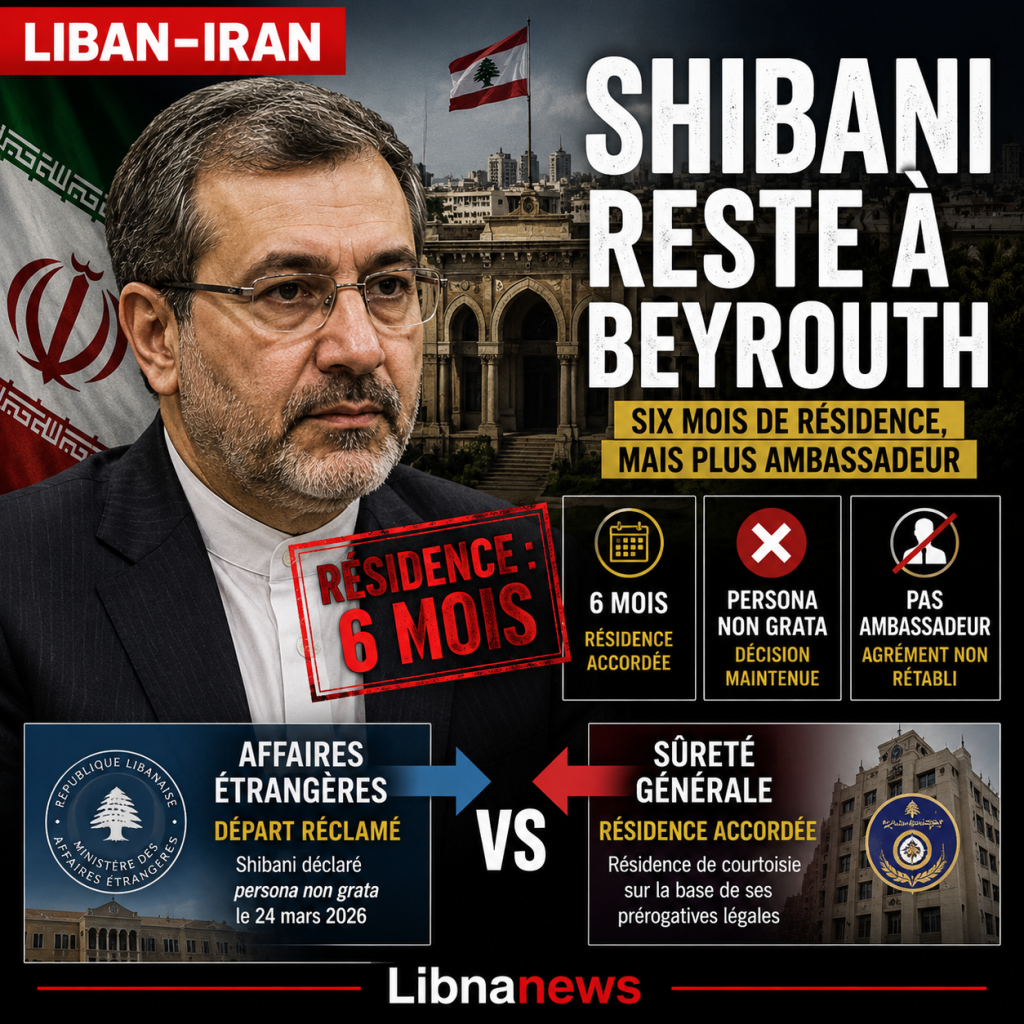
Mohammad Reza Shibani will eventually remain in Beirut. The former Iranian Ambassador obtained a six-month residence on 24 August 2026 issued by the General Security, while his right to stay expired. This formula does not give him his approval or his status as ambassador. However, it avoids his immediate departure and temporarily closes a case which threatened to provoke a new tension between Lebanon and Iran.
The compromise is administrative in its form, but political in its effects. Since March, the Lebanese Ministry of Foreign Affairs considered Shibani as a persona non grata and requested his departure. The retention of the former diplomat in the Territory therefore seemed difficult to reconcile with that decision. At a few hours before the deadline, the General Security has taken another reading: to distinguish the permanently lost diplomatic status from the personal right to reside in Lebanon.
A start that seemed inevitable
The file dates back to March 24, 2026. The Ministry of Foreign Affairs then gave the Embassy of Iran an official note withdrawing the agreement to the appointment of Mohammad Reza Shibani. Beirut had also declared persona non grata on the basis of article 9 of the Vienna Convention on Diplomatic Relations. His departure was requested before 29 March.
The decision did not mean a break in relations between Beirut and Tehran. She was targeting Shibani personally. In particular, Lebanese diplomacy blamed him for positions on internal affairs and for contacts with Lebanese actors outside the framework the Ministry intended to impose on foreign representatives.
Shibani had not left the country. Over the months, his case had changed in nature. The question was no longer just whether Lebanon agreed to accredit it as an ambassador. It also sought to determine on what legal basis he could continue to stay in Beirut after being declared undesirable.
The deadline of 24 August made this contradiction impossible to postpone. The Foreign Minister, Youssef Raggi, defended a strict line: the status of persona non grata was to lead to the departure of Shibani. According to this reading, an extension of the scope of the diplomatic decision could be rendered meaningless.
Shibani gets six months without becoming ambassador again
The solution adopted on 24 August is based precisely on a separation between two issues. Mohammad Reza Shibani was not reinstated as Iran’s ambassador to Lebanon. He did not recover the approval withdrawn in March and his stay was no longer based on diplomatic recognition. On the other hand, General Security grants him a six-month legal residence.
According to reports published by several Lebanese media, Shibani submitted his application to the General Security with his Iranian passport. The formula is described as a « courtesy residence » granted under the prerogatives of the Aliens Residence Authority.
This construction solves the immediate problem. The former Ambassador may remain in the territory without the Ministry of Foreign Affairs formally reverting to the March decision. For Tehran, it avoids the image of expulsion. The Lebanese authorities argue that Shibani’s diplomatic status has not been restored.
The compromise, however, does not remove the political contradiction. He’s moving it. The question now relates to the authority which decided on this residence, the officials who were informed of it and the compatibility of this administrative decision with the position defended by Lebanese diplomacy.
Al Akhbar puts Hassan Choucair at the centre of the compromise
In its 25 August edition, Al Akhbar presents General Security Director, General Hassan Choucair, as one of the main architects of the post-crisis situation. According to the newspaper, he conducted a political mediation with the President of the Republic, Joseph Aoun, in order to find a formula that avoids an escalation with Iran without returning to Shibani his diplomatic status.
The daily also claims that the process was coordinated with the Speaker of the Chamber, Nabih Berri. In this version, the six-month residence is not simply an isolated administrative act. It is the result of a compromise search with political coverage at the state summit.
Al Akhbar links the decision to the powers of the General Security in matters of residence. The newspaper invokes the Decree-Law of 18 July 1962 and, in particular, the provisions allowing the Director-General to grant certain residences of courtesy. This reading gives the compromise a dual basis: an administrative competence for form and a political agreement to avoid confrontation with Tehran.
The daily goes further in its political interpretation and presents the continuation of Shibani as the failure of those who demanded his departure. This assessment, however, belongs to the newspaper’s editorial line. The verifiable fact remains narrower: Shibani remains in Lebanon for six months, but without regaining his status as ambassador.
Annahar and Asharq Al-Awsat stress the absence of diplomacy
Annahar’s reading introduces an important difference. The daily reports that contacts have resulted in a formula confident of the General Safety issuing a residence of courtesy. He points out, however, that the Lebanese Ministry of Foreign Affairs would not have been informed of the decision in the same way as the other actors involved.
Asharq Al-Awsat reports a comparable version, but provides clarification on the decision chain. According to a security source quoted by the newspaper, Hassan Choucair proposed the residence on the basis of his legal powers and informed the political authorities concerned before signing it, including the Presidency of the Republic, the Presidency of the Government and the Ministry of the Interior.
In the same article, however, sources from the Ministry of Foreign Affairs state that the Ministry had not been informed of the granting of residence. This difference is central. It does not concern the existence of the six-month permit, which is acquired, but the manner in which the State has produced its decision.
The narratives are therefore not totally incompatible. Al Akhbar describes a political mediation aimed at building a compromise. Annahar and Asharq Al-Awsat place more emphasis on the gap between this solution and the position of the Ministry of Foreign Affairs. Together, they draw a decision whose outcome is clear, but whose institutional circuit remains to be discussed.
Why Youssef Raggi challenged Shibani’s maintenance
The position of Youssef Raggi is based on the decision taken in March. According to the Minister for Foreign Affairs, declaring Shibani persona non grata should not only result in the loss of his ambassadorship. This also involved his departure from Lebanese territory.
In this context, granting him a right of residence as a mere Iranian national creates a problem of legal and political coherence. The change of administrative category makes it possible to distinguish the diplomat from the foreigner residing in Lebanon. But it also allows the same person to stay in the country despite a decision whose objective was precisely his departure.
It is on this point that the fracture between the two readings lies. For the advocates of the compromise, the competences of the General Security allow to deal separately with residence and diplomatic accreditation. For Raggi’s line, this separation may circumvent the consequences of a sovereign decision taken by the ministry responsible for external relations.
An administrative solution that raises a State question
The Shibani case no longer boils down to the presence of a former Iranian ambassador in Beirut. She asked a question about the Lebanese decision-making chain. If the six-month residence falls solely under the powers of the General Security, the episode may be presented as an exceptional administrative solution to manage the stay of a foreign national without altering his diplomatic status.
If, on the contrary, this solution was developed politically without full association of the Ministry of Foreign Affairs, the file reveals a deeper divergence. One institution would then have maintained the effects of its diplomatic decision while another would have used its own powers to prevent its most immediate effect: the departure of Shibani.
For the moment, the compromise is based on a precise distinction. Mohammad Reza Shibani remains in Beirut, but he is not recognized as an ambassador. His stay is limited to six months. The next step will depend, inter alia, on how Tehran will organize its representation in Lebanon and on what the Lebanese authorities will decide upon the expiration of that residence.




