

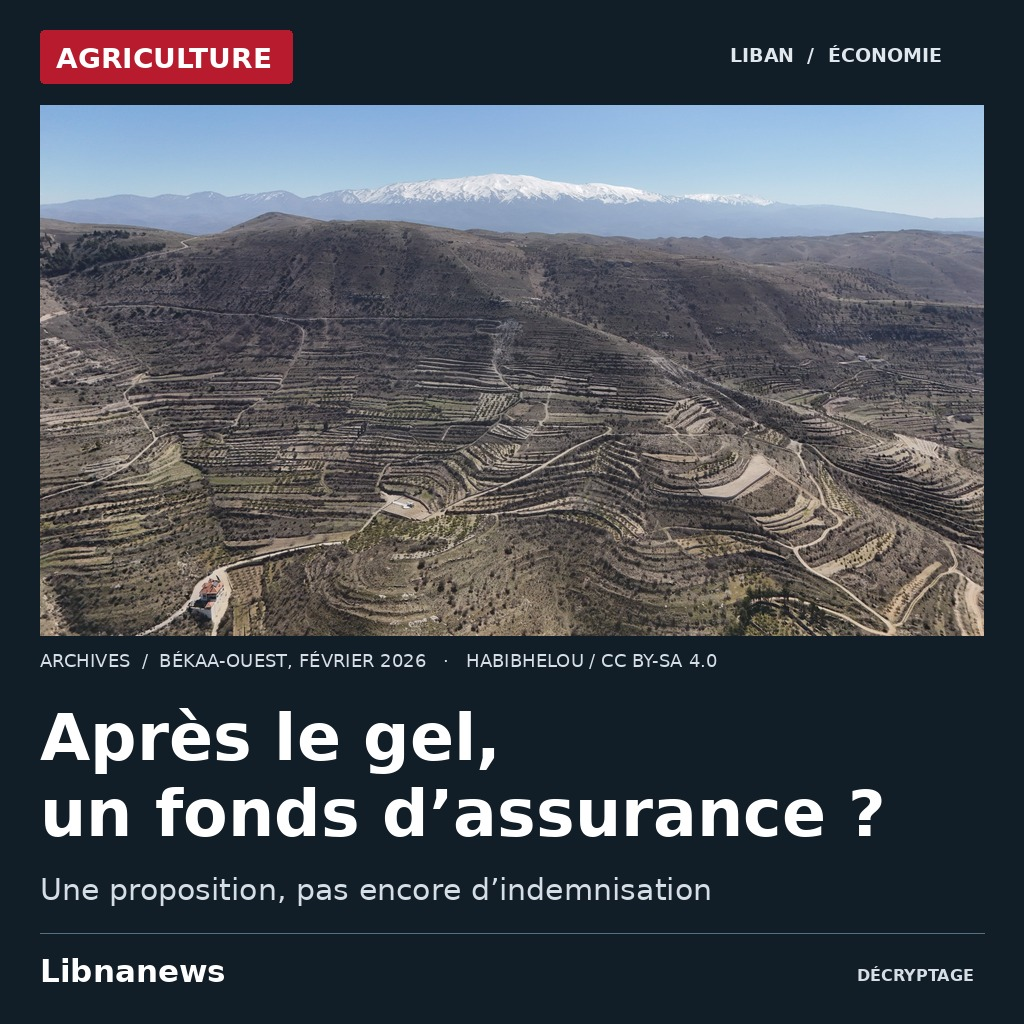
After the freezing that affected part of the autumn crops in Bekaa, the Minister of Agriculture, Nizar Hani, proposes an agricultural insurance fund. His department announced the move on November 20 at Agri Lebanon. Neither funding nor compensation terms nor an opening date were announced. On the other hand, the project raises a concrete question: how can a crop accident also prevent the operator from preparing the next one?
A proposal arising from fall losses
In front of the participants, Hani took as an example the freezing in the center and north of the Bekaa. According to the Ministry’s report, it is not just about crops: it is about protecting production equipment and farm income from several hazards, including freezing, hail, drought and fire. The text does not define the coverage of each of these risks. Nor does he say whether the guarantee would work as a pre-season insurance, as a public emergency fund or as a combination of both.
The distinction will change what producers can expect from the scheme. A harvest allowance covers a portion of the lost production according to the rules. A guarantee on the productive tool can help restore a greenhouse or equipment. Protecting income, on the other hand, involves looking at what the farm could have sold and what it can still sell after the disaster. A crop can remain marketable at reduced prices without being totally destroyed. Conversely, repairing a tool does not make the income of an already lost season. These are three different problems, even if they sometimes occur on the same farm.
The register identifies the operators; it does not encrypt damage
The announcement is in line with the priorities of the National Agricultural Strategy 2026–35, which the Minister recalled in three areas: better understanding of farms, monitoring of products and financing of activities according to their production cycle. The register of farmers already exists. FAO confirmed on 20 April that it continued to work with the Ministry on its development and on the agricultural census. Registration is a means of identifying producers; The November 20 Report does not state that it will trigger compensation or that only the owners will be able to claim protection.
The difference is important for an operator who grows a leased parcel or whose crops change from one season to another. A register allows to know who is active; The assessment of a disaster must then determine what was actually cultivated, at what stage of the season and where. On 13 June, the Ministry and the National Council for Scientific Research presented a national assessment of agricultural damage. The ministry also reported the development of a monitoring platform. These tools can inform priorities. They do not replace a public rule to find a loss, calculate compensation and challenge a refusal.
Financing the next cycle rather than promising repayment of the old
After freezing, a producer may have to buy the following plants or inputs, while the previous harvest reported almost nothing. A seasonal credit can advance these expenses; However, he must be reimbursed. A farm risk guarantee meets another need: it allocates part of the loss when the expected event occurs. The previous agricultural strategy, covering 2020-2025, already distinguished risk insurance and access to credit. The proposal presented on 20 November puts the first subject in the foreground, without specifying the share which would be owed to producers, public authorities or potential insurers.
It also remains to be seen how the fund would react to a shock affecting many farms at the same time. Extended frost can trigger many demands in the same pool; drought can affect several seasons. If the resources of the fund are capped, the text should indicate in advance how the aid will be distributed. The destruction of war and the loss caused by the impossibility of joining a plot are separate problems. The Minister referred to the agricultural recovery of damaged areas, but the news release does not say that the proposed guarantee will cover these losses. Nor should it be allocated the rural aid already announced.
Before the fund can be used, it will therefore require a text that identifies the manager, sets the losses covered, specifies who can file an application and provides resources and a processing time. Nothing in the announcement allows an operator to file a file for this new fund today. To judge its usefulness, the first benchmark will be less the promised amount than the possibility of obtaining a decision before spending the following season.





Comments