

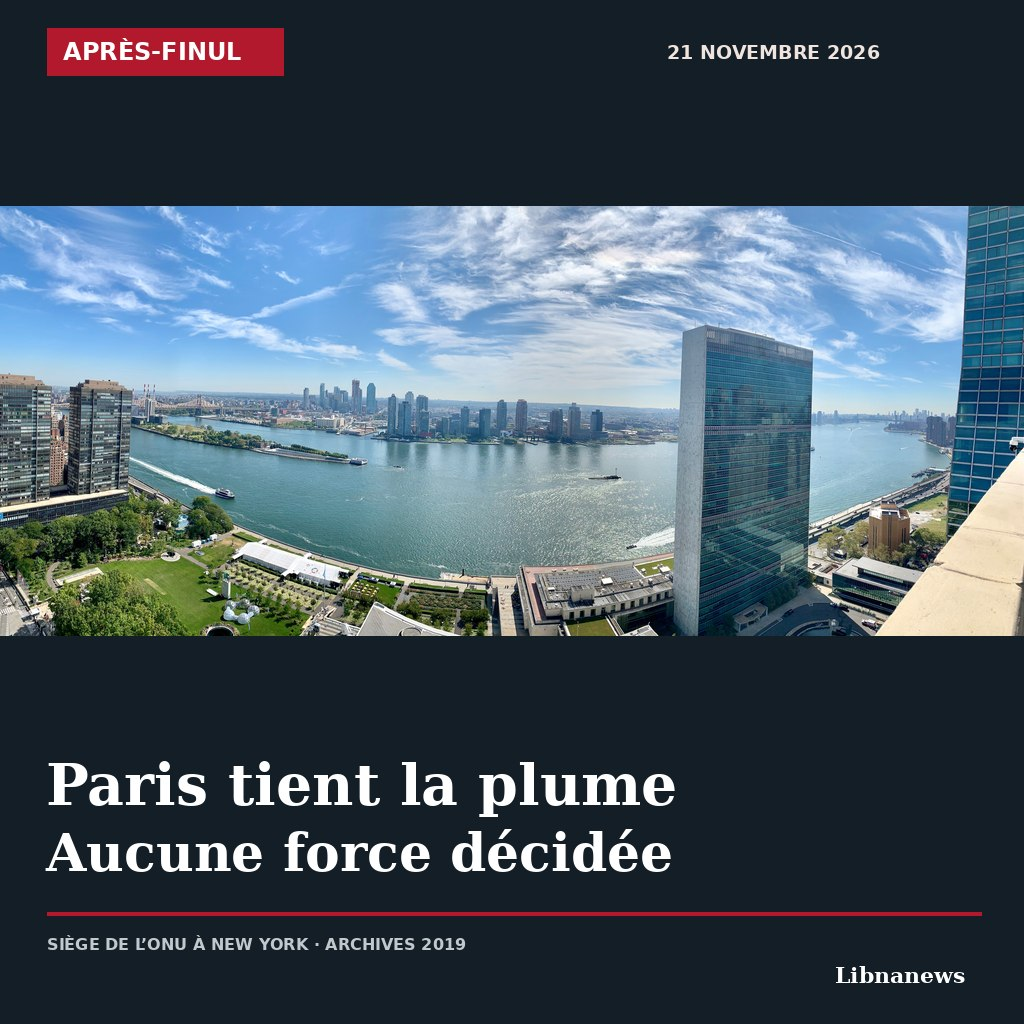
Washington confirms that France is leading the drafting of the post-FINUL Security Council. The Lebanese channel MTV reports that a working agreement was reached on Thursday in camera for Paris to start preparing a text. However, no draft was made public or put to a vote. The composition of any device remains contested, including on the Israeli side.
Paris holds the pen, not yet the mandate
On 20 November, MTV reported on several Franco-American meetings to bring positions on Lebanon and the period following UNIFIL’s withdrawal. The channel sees a change from previous American reluctance. The existence of cooperation is publicly confirmed by Mike Waltz: the US Ambassador to the UN said that France was leading the editorial and that Washington would work with it. However, this does not confirm the details of the meetings mentioned by MTV or the existence of a common position on the future mechanism.
On 12 November in Paris, Jean-Noël Barrot discussed with his American counterpart Marco Rubio how to avoid a security vacuum after UNIFIL’s withdrawal. On 18 November, French diplomacy also indicated that the initiative with Italy was still under discussion. These approaches do not determine the number of participating countries or the command of a possible mission.
France’s role is not based on a vote made public on Thursday. Paris usually leads the drafting of Security Council texts on Lebanon. As such, he could prepare a first version and discuss it with other delegations. This work does not give France the command of any force and does not even guarantee that the text will be put to the vote. The Council will still have to arbitrate the tasks, duration and legal framework. Its rules require at least nine votes and no veto of a permanent member to adopt a substantive resolution.
The United Nations public record confirms the 19 November consultations on the implementation of resolution 1701. It does not confirm a formal agreement on a French project or the circulation of a text to the fifteen members. The Presidency of the Council reaffirmed the support of the members of UNIFIL and called for respect for the security of United Nations personnel and facilities. It did not announce a replacement.
On composition, diplomatic channel and public position diverge
MTV reports that Israel would refuse a force composed exclusively of European countries and commanded by France, while considering French participation in a broader force. This is about information from the channel about the discussions, not a commitment announced by the Israeli government. The Israeli ambassador to the UN, Danny Danon, publicly expressed a more restrictive position: he rejected the idea of another international force and called for the Lebanese army to take over. His remarks were published on Friday by the Washington Post. There is nothing to suggest that the Israeli authorities have accepted the wording mentioned by MTV.
French participation in a multinational mission would also be distinct from the creation of an exclusively European force. Nor would it be confused with the European Union support mission set up in October at the request of Lebanon. The latter must strengthen the capacities of Lebanese institutions; its mandate does not transfer the oversight and liaison functions of UNIFIL.
What Beirut says it wants to preserve in the South
Before the Council, Jean Arnault, head of the Office of the United Nations Special Coordinator for Lebanon, conveyed the Lebanese authorities ‘ fear of the disappearance of functions that were not solely the responsibility of foreign troops. He cited the monitoring of the Blue Line, the maintenance of a liaison between the two armies, the access of civilians and humanitarian workers, and the possibility of reporting incidents. He presented resolution 1701 as the legal basis that the Lebanese want to keep for any future arrangement.
In Yarzeh, the Lebanese Minister of Defense, Michel Menassé, explained on Friday to American Ambassador Michel Issa that the cessation of Israeli attacks and the withdrawal of Israeli forces from Lebanese territory would allow the army to continue its deployment. This sequence constitutes the position expressed by the department. It does not set an Israeli withdrawal schedule or the conditions for international rotation.
Resolution 2790 maintains the mandate of UNIFIL until 31 December 2026. It then provides for a gradual withdrawal, within a maximum period of one year, with limited functions during this phase. It does not repeal resolution 1701. This is the text in force: at this stage, France’s role in the negotiation is public, while the mandate and composition of a possible successor are not agreed.





Comments