

Behind milk, labne and cheese, the milk workers in Lebanon remain little visible. A survey conducted in 2024–25 in four governorates sheds light on their contracts, schedules and social security coverage. It calls for a distinction between two ambitions: to support production and to protect those who provide it.
Milk workers in Lebanon: an investigation
The report of the Lebanese Workers & Rights Observatory, produced under the SAFE programme with WeWorld and Mada, covers Akkar, the North, Bekaa and Baalbek-Hermel. It brings together 107 workers’ questionnaires, 136 employers and 18 interviews with other actors. These 261 interlocutors are therefore not 261 employees.
Of the workers surveyed, 33 per cent reported a written contract and 64 per cent did not register with the National Social Security Fund. In terms of hours, 42% say they work nine hours or more a day. The table is not uniformly negative: 90% report receiving their wages on time.
These results describe respondents, not all Lebanese agriculture. Investigators report, among other things, the fear of employer reactions and difficulties in accessing certain stakeholders. This dated diagnosis does not measure the situation of November 2026.
Three different obstacles behind the lack of protection
An uncovered worker is not necessarily in the same situation as his neighbour. The workshops organized in April 2024 by the Arab Development NGO Network with the International Labour Organization identified three problems. Some people have insurance, but there are gaps in the protection they receive. Others should be registered by their employer and are not. Finally, categories of non-permanent or self-employed workers remain outside compulsory insurance.
This distinction changes the response to be made. To enforce a registration obligation does not address the case of a person excluded from the device. Conversely, announcing an extension does not exempt the application of existing obligations. This included discussions on employer compliance, transitional coverage and expansion of the system. These were avenues for reform, not new rights already opened.
An ILO analysis published in September 2024 placed this debate in the national social protection strategy adopted in November 2023. It stressed the gap between the eligibility of certain categories of agricultural or agri-food workers and their actual coverage. Occupational status must therefore remain at the centre of the diagnosis, rather than disappear behind the only label of « agricultural work ».
Financing an operation does not replace a contract
Economic support for the sector takes another channel. On 26 June 2025, FAO and the Ministry of Agriculture presented a project funded by a $4.5 million grant from PROSPECTS through the World Bank. It targeted some 3,175 dairy and feed producers.
The programme involved investment aid, technical assistance, energy-efficient equipment and strengthening veterinary services. Mobile clinics, laboratories and the digitization of corporate services were also among the measures announced. These elements describe a framework and its objectives, not a record of achievements.
In particular, the number of holdings should not become a number of jobs created. An assisted farm can employ multiple people, work with family or maintain an existing activity. The announcement alone does not make it possible to know the contracts signed, the social registrations made or the evolution of the timetables. Measuring the economic strength of a farm and measuring the quality of the jobs it offers answer two different questions.
Monitoring jobs as much as equipment
The SAFE programme, scheduled for January 2024 to December 2026, seeks precisely to reconcile livelihoods and decent work. In the four governorates concerned, it provides training, training and support for income-generating activities. It includes women-led enterprises and cooperatives, as well as prevention of child labour. Again, the existence of these objectives does not prove their achievement.
In order to assess a concrete improvement, future balance sheets would benefit from bringing the two sides closer together. Information on contracts, social affiliation and working conditions should be provided to installed equipment and training. An investment indicator can progress without informing about these rights. It is in this gap that the social stake of the dairy sector lies.
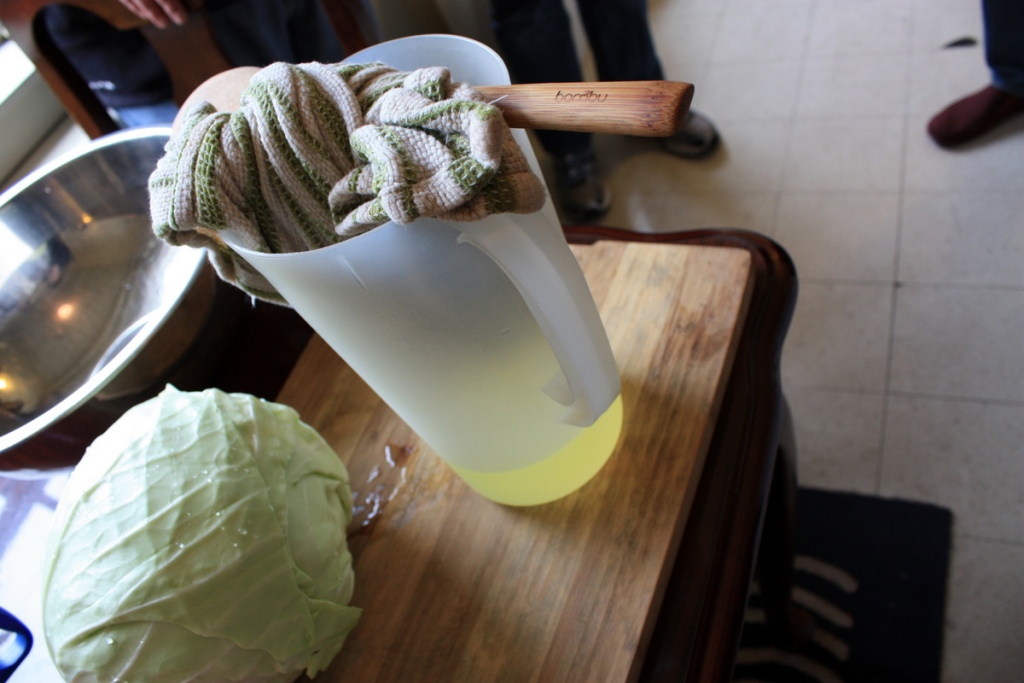
Photo of illustration: domestic draining of labne in Seattle, 2010. This is not a Lebanese workshop. PhotoLeslie Seaton / Wikimedia Commons,CC BY 2.0. Original untouched photograph.






Comments