

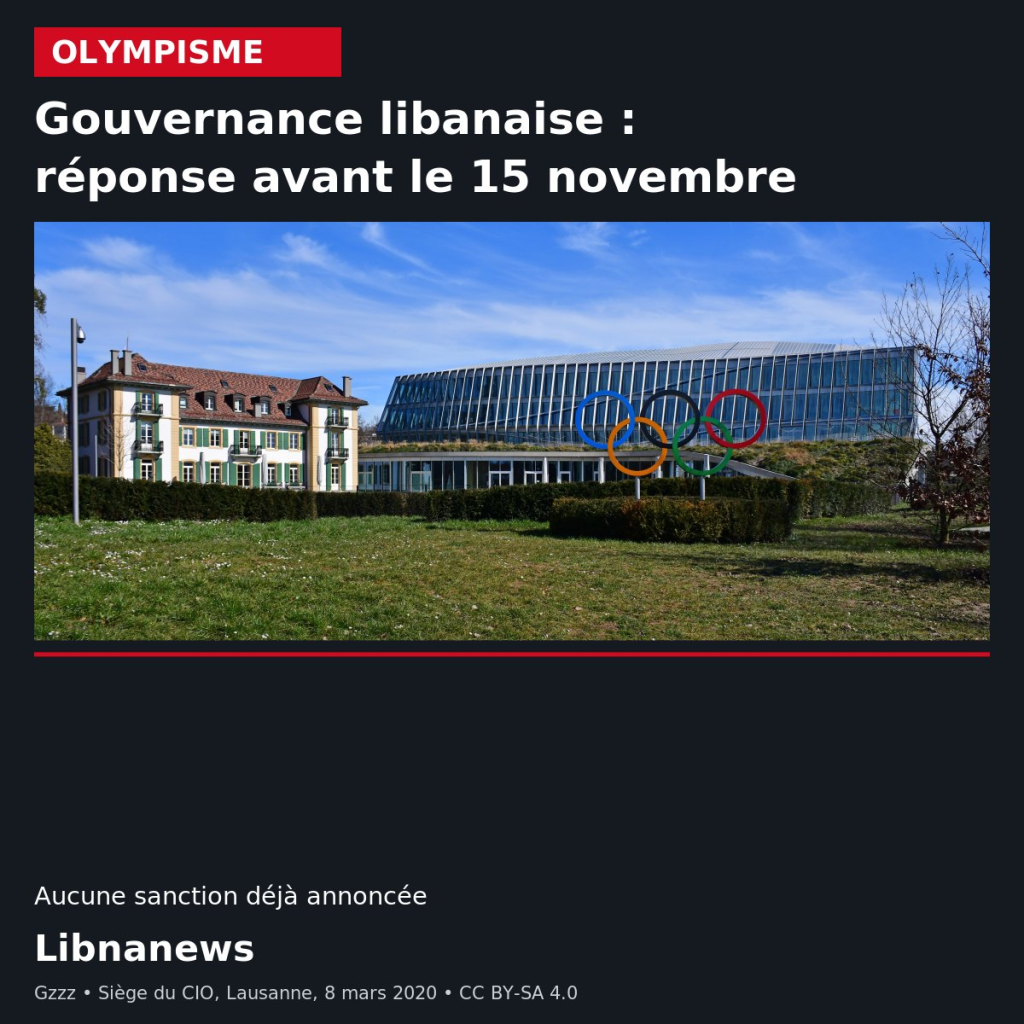
The dispute over the leadership of the Lebanese Olympic Committee is reaching a new deadline. In a joint letter addressed to the Minister of Youth and Sports, Nora Bayrakdarian, the International Olympic Committee and the Asian Olympic Council requested a response by 15 November 2026. The mail, whose content has been made public, calls on the authorities to work with the leadership recognized by the international Olympic authorities.
The letter refers to protective measures and possible sanctions. It does not announce a suspension already pronounced against Lebanon. For athletes, this difference is essential: an institutional warning should not be presented as an acquired exclusion from competitions.
Lebanese Olympism: two competitive directions
The conflict between two teams resulting from elections held two days apart in May 2025. The leadership chaired by Boutros Jalkh was elected on 16 May. The IOC recognizes it, according to the terms of the letter. Another team, chaired by Jihad Salameh and elected on 14 May, obtained an administrative certificate from the Ministry.
This overlap creates two levels of recognition. It is the responsibility of the international sports authorities. The other concerns an act of the Lebanese administration. Considering them as equivalents would prevent understanding the disagreement: each one produces its effects in a different context, and it is precisely their articulation that is problematic.
The management of Boutros Jalkh contests the certification granted to the rival team. This challenge must remain distinguished from a judicial decision annulling the ministerial act. International mail calls on the authorities to re-establish exclusive cooperation with the management it recognizes.
The arbitral award invoked
The letter refers to a decision of the Arbitral Tribunal for Sport dated March 20, 2026. She presented the cooperation with the management elected on 16 May 2025 as the implementation of this decision. The full text of the award remains necessary to detail its reasoning, its addressees and the exact scope of its provisions.
It would therefore be excessive to turn that reference into a judgement on all administrative acts in Lebanon. The point made by the mail is more circumscribed: the Olympic authorities ask the public authorities to recognise, in their relations with the sports movement, the leadership they consider legitimate.
Their request also concerns national federations which are regularly affiliated and recognised by the corresponding international federations. The dispute thus exceeds the appointment of a president. It affects the sport representation chain and their relationship with the Olympic movement.
A warning, not a penalty acquired
The letter refers to Article 27.9 of the Olympic Charter to discuss possible measures for the Lebanese Olympic and Sports Movement. It calls for rapid action to avoid this outcome and to restore the coherence of institutional relations.
At this stage, no fixed penalty may be deducted from that indication. Neither its form, duration, nor the competitions it may concern must be invented. The consequences for athletes would depend on a possible decision and its terms.
The November 15 deadline is for the Minister’s response. It does not constitute, in the information available, the automatic date of entry into force of an exclusion. These are two different events: to respond to an institutional demand and to undergo a formal measure.
The next decisive element will therefore be the response to the IOC and the Asian Olympic Council. Its content will allow us to know whether the Lebanese authorities announce measures of cooperation, contest reading the file or ask for clarification of the steps expected.





Comments