

The gap between real estate prices and the means of Lebanese buyers does not start with the bank collapse of 2019. It was already visible in the early 2000s. Public archives, field surveys and the latest sales statistics allow us to trace its formation: an offer designed in part as an investment, revenues that do not follow, a credit long mobilized to support acquisitions, and then a market that became dependent on the available dollars.
An apartment can be offered for months at the same price without this stability proving anything about the amount that its owner could actually cash. When buyers consider the amount excessive and the seller refuses to reduce it, the transaction disappears. The housing remains, the announcement also, but no exchange confirms the valuation. At the level of a neighbourhood or a category of property, this block eventually weighs on moving, household projects, developers’ cash flow and construction activity.
Lebanon has experienced this problem long before the disappearance of regular bank financing. In 2001, a formal report already described new buildings that remained vacant for several years before finding a buyer or tenant. Two decades later, Beyrouthine surveys still found a high vacancy, particularly in expensive segments. The financial crisis has changed payment conditions and aggravated access difficulties. She did not create disadjustment of all parts.
Understanding this history requires several indicators at a time. The price charged, the price actually signed, the number of sales, the availability of credit, the rents and the occupancy of housing do not tell the same thing. Their differences are precisely the subject of this dossier, based on the information available on 8 November 2026.
Less sales in 2026, more value recorded
The latest figures illustrate the problem. According to Crédit Libanese’s economic research department, the number of real estate sales between January and September 2026 reached 41,138, compared to 51,683 in the first nine months of 2025. The decrease is 20.4 per cent, or 10 545 fewer operations. At the same time, their cumulative value increased by 3.3 per cent, from 394,090 to 407,100 billion pounds, about 4.40 to 4.55 billion dollars at the rate of 89,500 pounds.
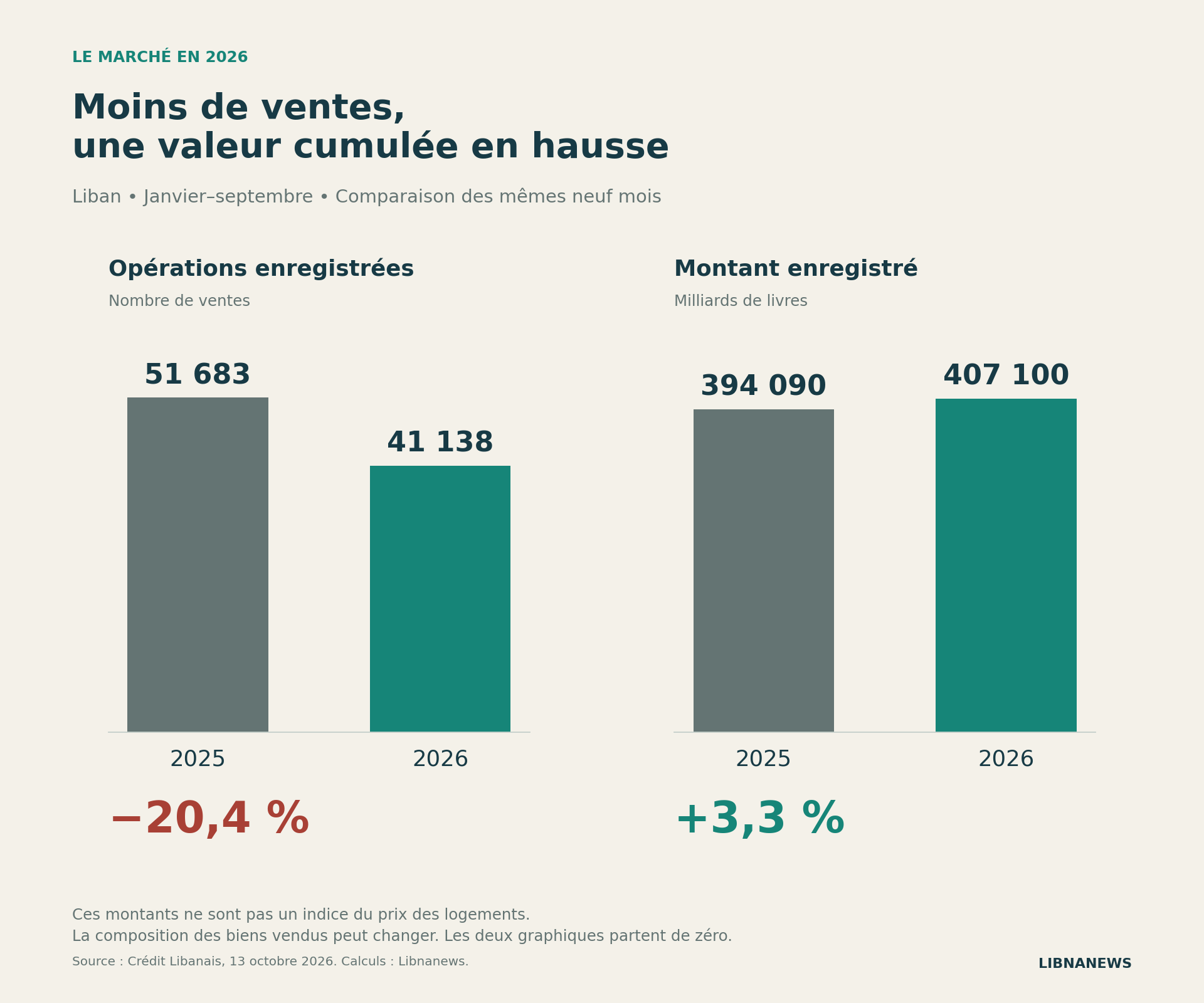
This divergence does not measure a general increase in the price of apartments. The average amount per operation increases mechanically as the total value increases while the number of acts decreases. But sales mix housing, land and other goods, of different sizes and locations. A higher proportion of large transactions is sufficient to raise this average. Without knowing the composition of sales and comparing equivalent goods, a price effect cannot be isolated.
The decrease in the number of registrations also does not allow for direct counting of buyers or unsold dwellings. A buyer may intervene several times; an act may involve more than one property. The administrative schedule may shift the schedule of the trade agreement. These reserves do not erase the observed decline. They specify what it means: the flow of recorded transactions has been reduced, while the accumulated amounts have not followed the same direction.
To assess the health of a market, the question is therefore wider than that of price resistance. How many people can still buy? What goods are sold? At what time and with what negotiation? Can households without external savings finance themselves? An activity focused on cash holders can support certain values while leaving behind a large part of the demand for housing.
An official alert already existed before 2000
The State of the Environment Report 2001 of the Lebanese Ministry of Environment contains a finding rarely recalled in the real estate discussions. Resuming the work of the Central Statistical Office, it recorded 182,798 empty residential units in 1996–1997, or 17.2% of the total. Empty non-residential units are counted separately: 103,278 or 26.4%.
The report describes several causes: new constructions that remain for a long time without sale or rental, insufficient quality, buildings located in sectors where demand is lacking and operations intended for a speculative market rather than effective use. It also distinguishes empty units from unfinished or demolition buildings.
These old data do not constitute an inventory of the only apartments offered for sale. They cannot be compared directly with recent Beyruthine surveys, whose territory and method differ. On the other hand, they establish an essential point: the coexistence of an unused park and difficulties in accessing housing was already recognised by a public source in the mid-1990s.
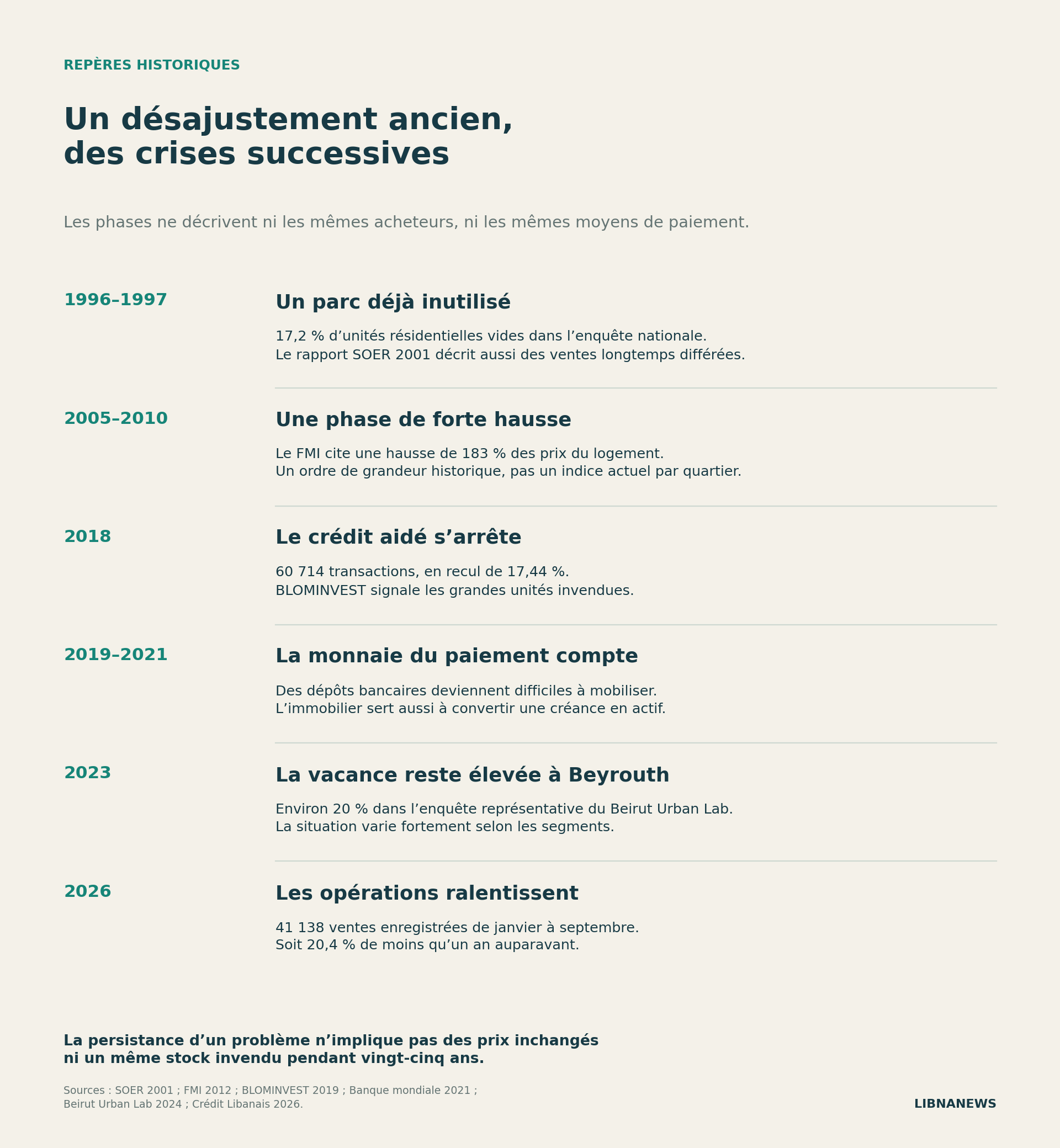
So talking about a problem at the turn of the 2000s is well-founded. Making the year 2000 a precise statistical break would be less rigorous. The phenomenon is part of post-war reconstruction and the accompanying funding cycles. It had different phases, with periods of recovery, increase in values, stagnation and correction.
Successive cycles, rather than a fixed market for 25 years
An analysis of Information International published in January 2003 shows a rise in real estate activity in 1997, followed by a slowdown marked by a lack of liquidity and declining or stable prices by sector. It also recalls the role of housing loans and migrant capital in the construction of the 1990s.
This description is important to avoid a story that is too simple. Lebanon has not gone through the last 25 years with exactly the same prices, the same buyers and the same unsold stock. Part of the property has changed hands. Some owners have accepted discounts. Periods of capital inflows have revived transactions. The seniority of dysfunction does not mean the absence of movement.
The next cycle was strongly bullish. In its 2012 work on Lebanon, the International Monetary Fund mentions an increase in housing prices of 183 per cent between 2005 and 2010, followed at the time by an estimated 10-15 per cent decline from the peaks. This is an order of magnitude quoted in an economic analysis, not a homogeneous national index that can now assess each neighbourhood.
The distinction between the general trend and the situation of a particular good is decisive. An increase fuelled by external capital can create real transaction prices in the desired segments. It does not guarantee that the incomes of the rest of the population will absorb all production. The commercial success of some programs may even encourage other sponsors to replicate a product for a limited clientele.
The gap becomes more visible when financing becomes scarce or investors withdraw. The built surfaces are already there, but the demand profile has changed. A large unit does not instantly transform into several affordable housing units. The length of construction and the immobility of the land make the adaptation slower than in a trade able to quickly modify its assortment.
Land transfers price expectations to the whole chain
The price of the land comes before that of the apartment. A promoter calculates what he can pay for a parcel based on marketable areas, construction costs, financing, taxes, delays and anticipated sales. If it considers future prices high, it can offer more to the landowner. A expensive transaction then becomes a reference for neighbouring parcels.
This reasoning can work as long as final buyers follow. It becomes fragile when the land remains valued on the basis of the best years while households have less resources or credit disappears. The historical cost paid for the land explains the proponent’s resistance to a decline. However, it does not oblige any purchaser to cover this cost. Past expenditure is not a guarantee of future revenue.
In its 2021 guide on housing in Lebanon, UN-Habitat describes a lasting disadjustment between income, price and supply characteristics. The paper highlights the role of land speculation, external capital and home ownership policies. He challenged a reading that would reduce high prices to a mere physical shortage of urban land.
The relevant rarity is both economic and geographical. A land may exist without being offered at a price that allows for an accessible program. Conversely, a much sought after plot may retain a premium justified by its location. The difficulty is to distinguish between a rarity actually paid by buyers and a revaluation maintained solely by the expectations of landholders.
The mechanism can also curb investment. If the seller of the land expects a price that the promoter cannot finance and the promoter anticipates prices of apartments that households cannot pay, the project will not start. There is no new offer, no land transaction, no necessarily visible decline in ads. The disagreement appears in the form of a deferred yard or a preserved plot.
Credit expanded access, but did not resolve all the gaps
Credit transforms future revenues into immediate purchasing capacity. It allows a household to finance a dwelling without having the full price on the day of signature. Extending the term of the loan or reducing its rate may reduce monthly payments. This mechanism really opened up access to property to part of the Lebanese middle classes.
UN-Habitat describes an expansion of aided funding between 1999 and 2018. The guide reports over 130,000 housing loans outstanding in 2018, with an outstanding amount of $12.88 billion, usually subsidized. It also notes that households with low or irregular incomes remained largely excluded from these schemes.
Two shortcuts should therefore be avoided. The first would be to present all the credits as an unnecessary operation: families have obtained housing and repaid their loan. The second would be to consider the increase in funding as proof that prices were becoming sustainable. When the adapted offer remains limited, part of the additional purchasing capacity can be found in the prices of land or housing.
The subsidy then reduces the monthly payment at some point, but it does not necessarily solve the question of the total price. It can help the household and simultaneously support the value requested by the seller. Measuring its effectiveness requires looking at who benefits from the loans, what categories of goods are purchased and how prices change with comparable quality. The number of loans distributed is not sufficient.
Access to finance also depends on the contribution, the stability of employment, guarantees and the duration of repayment. Two households with the same monthly income may have very different purchasing capacities if one has a family saving and the other does not. A market oriented almost exclusively towards purchasing leaves few options for those who do not meet the credit criteria and find no suitable rental.
Before the banking collapse, the unsold ones already weighed on the developers
The diagnosis is not based solely on retrospective analyses. In a study published on 9 March 2019 on 2018, BLOMINVEST describes a large stock of large unsold units. The bank is associated with the economic slowdown that began in 2011, with the withdrawal of some of the affluent Gulf customers and the weakening of local demand. The remaining buyers are looking for more small areas.
The same document shows 60,714 transactions in 2018, down 17.44% year-on-year. He stressed the effect of the cessation of subsidized loans during this year and the importance of unsold loans on the liquidity of promoters. It also states that the country does not have an accurate and complete account of the unsold stock, its value and the discounts charged.
The timetable is unambiguous: this description precedes the banking crisis of autumn 2019. Marketing difficulties, the problem of large areas and insufficient reliable information were already present. The closure of credit has aggravated an existing fragility.
For a developer, an apartment completed but not sold immobilise capital. There are still charges, while the proceeds of the sale were eventually to finance a maturity or a new construction site. If the cash flow declines, it can make a discount, defer a project or negotiate with its creditors. If its situation allows it to wait, the stock can stay on the market for a long time.
These different responses explain the coexistence of one-off discounts and high ad prices. The forced seller and the owner without debt do not make the same decision. A reduced-price transaction is not enough to set the value of an entire neighbourhood; An unchanged advertisement also does not prove that the other goods could be sold at the same level.
2019–2021: selling more didn’t mean the same thing anymore
The banking crisis brought about an additional break: dollars in an account no longer provided the same opportunities as freely transferable dollars. Real estate has been used as a means of heritage conversion. Some depositors have purchased goods to exit a bank claim that is difficult to raise.
In its spring 2021 economic report, the World Bank noted that real estate sales flourished in 2020 because depositors sought to use assets that had become otherwise intransferable. Bank Audi’s analysis of the sector in 2021 also describes the place of bank cheque payments and the evolution of seller requirements.
A price expressed in dollars should therefore be accompanied by a question: what was the dollar? An amount settled by external transfer, an amount in cash and an old bank debt did not have the same conditions of use. Directly comparing two face prices without looking at the regulation could lead to an increase or decrease that partially reflected this difference.
This period did not only change the amounts. She redistributed the positions. A seller could accept a cheque to repay a debt in the banking system. Another, without debt to be extinguished, could require funds available. A buyer with external dollars could negotiate differently from a depositor seeking to turn his blocked asset into property.
Therefore, years of high activity after 2019 cannot be interpreted as the outright return of ordinary residential demand. A real estate act can meet a housing need, investment strategy, debt repayment or asset protection. These motivations can be combined, but they do not have the same relation to local income.
Vacancy and unsold: what the surveys really show
A research by the Beirut Urban Lab, presented by the Lebanese Center for Policy Studies in July 2020, focuses on the park built between 1996 and 2018 in municipal Beirut. It saw 23% of unoccupied dwellings, or more than 7,000 apartments. Of these empty dwellings, 65% are unsold and 35% have already been acquired but remain unoccupied.
This distinction changes interpretation. Unsold housing can affect the cash flow of the builder. A dwelling sold and then kept empty may be an investment the holder accepts the absence of income. Both remain unused, but incentives to sell or rent differ. Adding vacant housing therefore does not automatically make it possible to know the number of goods available for purchase.
The representative survey conducted by the Beirut Urban Lab in the summer of 2023 in municipal Beirut provides another light. It estimates the vacancy at about 20% of the park, with a rate of 31% in the luxury segment. Nearly three quarters of the vacant dwellings studied have been empty for more than two years. Researchers observe an association between high price levels and higher vacancy.
An update to the database, published in August 2025, states that 43% of the 1,955 dwellings in 208 buildings completed between 2019 and 2022 were vacant in the 2023 survey. This result concerns recent constructions, not the entire capital. It cannot be extended to the whole country.
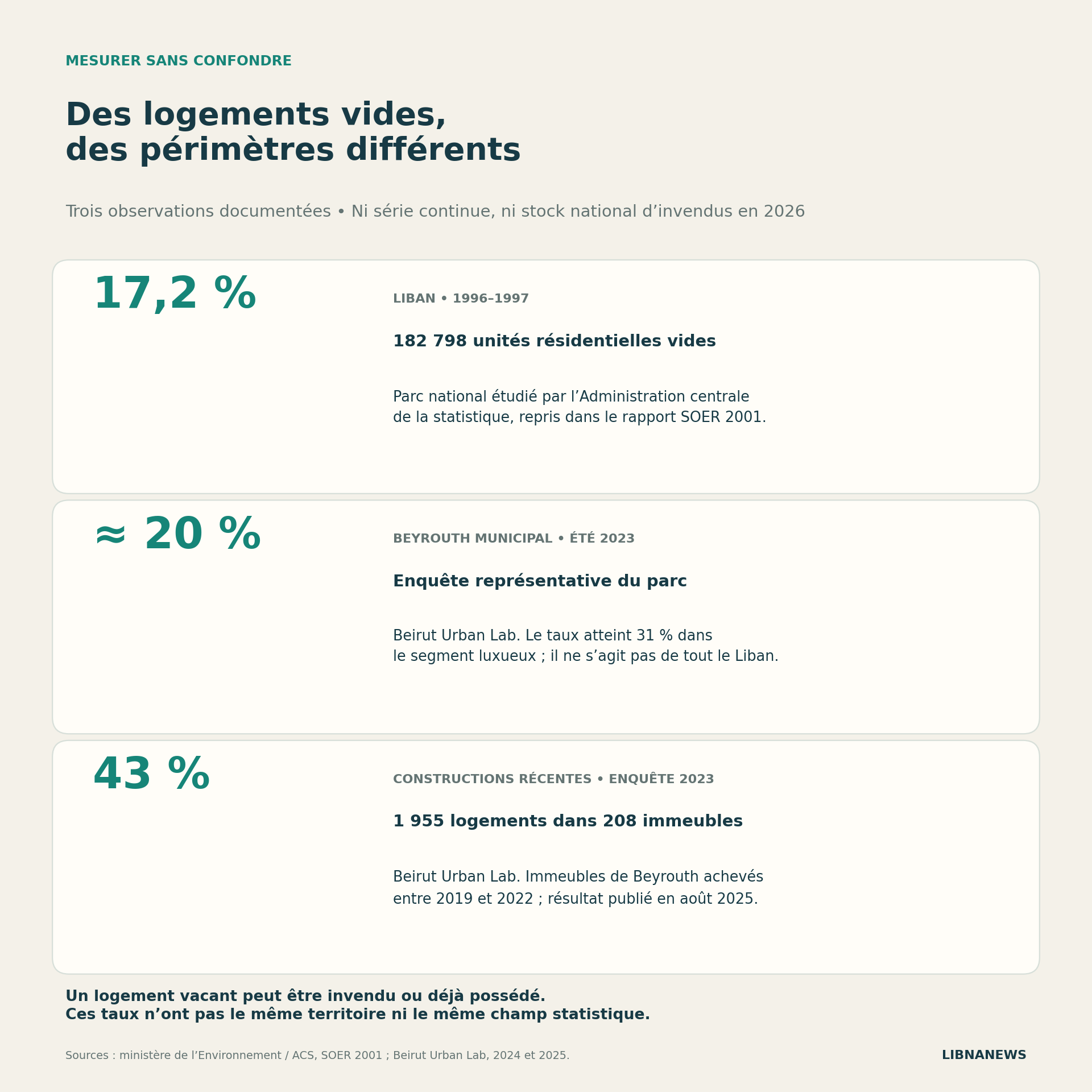
This work documents a continuing underutilization of the park and its concentration in some segments. They do not provide an updated national measure of the unsold only in 2026. They also do not prove that every empty apartment is only because its price is too high. The state of the property, estates, return projects, security, litigation and heritage strategy can occur.
The strong conclusion is more precise: disadjustment exceeds individual cases and can be observed in systematic investigations. Its scope, causes and consequences vary according to property categories. Differences in scope prevent the conversion of available rates into a single Lebanese vacancy curve since 1996.
How too high a price can survive the absence of buyers
The price is a proposal. To become a transaction price, you need a willing and able-to-pay buyer, a ready-to-accept seller and a legally feasible transaction. The absence of agreement can last if the cost of waiting appears to be lower than the concession requested.
The case of an apartment displayed three times its estimated achievable value reveals considerable disagreement. If this estimate is based on comparable sales, the condition of the property and serious offers, maintaining the price charged may explain the absence of a transaction. However, this assessment basis should be examined. The amount desired by the seller as an isolated estimate must be confronted with characteristics of the property and comparable transactions.
A property does not have an observable economic value regardless of its conditions of sale. A sale within a normal time, an urgent assignment, an occupied or free property, a payment spread or immediately available can produce different amounts. This diversity does not make all estimates equivalent. It requires clarification of what is being measured.
The resistance of ads can also become collective. An owner relies on the price demanded by his neighbour; It cites other comparable announcements. If no sale validates these references, prices circulate without information about their realization. The few transactions actually concluded then become particularly important, but their small number makes comparisons more difficult.
The possible result is a market where sellers and buyers are waiting for a concession. The former hope for an improvement in the economic situation or the arrival of a better equipped buyer. The latter retain their liquidity or turn to other assets. Tensions result in delays, unsuccessful visits, interrupted negotiations and a stock that flows only slowly.
Taxation influences the cost of waiting
In their 2020 study, the Beirut Urban Lab researchers published by the LCPS analyse exemptions for vacant properties in the Lebanese tax system. They explain that a low holding cost facilitates the preservation of empty units. The 2024 vacancy report further recommends that incentives be reviewed to re-use part of the park.
Economic reasoning is direct. If keeping an empty apartment costs little and if its owner hopes a surplus value, he may prefer to wait rather than reduce his price or accept a tenant. An additional annual expense may change this arbitration. But its effect depends on the level of the levy, the capacity of the owner to pay and the credibility of the application.
A re-use policy must also address exceptions. An uninhabitable unit, an estate dispute, necessary work or an impossibility of access do not fall within the same case as an available housing that is kept empty for heritage reasons. Without a reliable inventory and without a challenge procedure, a poorly designed system could hit the most fragile situations or multiply statements that are difficult to control.
Therefore, the question is not limited to claiming an additional fee. It focuses on the coherence of incentives: what does it cost to preserve an empty dwelling, what does its rental cost, and what legal or material risks does the owner associate with it? Vacancy taxation does not replace functional rental justice, clear contracts or household-friendly support.
Income without funding does not replenish solvent demand
The banking crisis eliminated much of the financing capacity that linked future revenues to current purchases. In its December 2025 macroeconomic review, the Bank of Lebanon reports that all bank loans increased from $58.1 billion in January 2019 to $5.2 billion at the end of 2025. This total is not limited to housing. Its contraction also reflects exchange-related repayments and valuation changes.
The same publication noted a limited recovery in the amount of credits and advances in fresh funds: $794 million at the end of 2025, compared with $418 million a year earlier. It points out that this channel remains modest. It would therefore be incorrect to say that no loans exist, as it would be misleading to see the restoration of mass real estate financing.
A household may have enough income to support a reasonable monthly payment and may not have the capital necessary for a cash purchase. Without a lender, the difference between his savings and the price charged must be covered otherwise: family help, sale of another asset, external contribution or cheaper housing. Households deprived of these opportunities remain excluded even if their employment is stable.
Conversely, a buyer with liquidity may continue to purchase in a desired sector. The presence of these operations does not prove that the price is accessible to the local population. It indicates that a particular segment is receiving funding. Diaspora transfers and external assets can support certain markets without solving the problem of those who live solely from income and savings generated in Lebanon.
Display price, real price and achievable value: three readings to separate
Common language often calls « real price » the amount a buyer would actually agree to pay. In economics, a real price usually refers to a nominal price adjusted for a price index. Both concepts must be separated. The first debate concerns the realization of the sale; the second, on the purchasing power of the sum obtained.
A price expressed in dollars remains nominal. In order to examine what it is possible to consume in Lebanon, a deflator corresponding to local expenditure is needed and the amounts are converted in a consistent way. To compare an investment with the purchasing power of a household living elsewhere, the relevant basket may be different. The choice of the deflator must follow the question asked, not just the currency entered in the advertisement.
Similarly, a household’s income provides information on what it can finance, but does not set the value of all housing on its own. An apartment can be too expensive for most residents while finding an outside buyer. The structural problem arises when production and valuation are concentrated on this clientele while the housing needs of the rest of the population remain unanswered.
Rents give another point of comparison. They make it possible to bring the price of an asset closer to its potential income by deducting expenses, maintenance, vacancy and risks. Low returns may indicate a high price for rental income. However, it is not enough to establish a universal discount: some buyers also value personal use, transmission or a rare location.
One announcement, four questions
Open each window to distinguish the displayed price from what the market allows to achieve.
1. Price charged: what amount is announced?
The owner sets a waiting. This amount remains nominal, even if expressed in dollars. It does not prove that a sale took place.
To watch:currency, terms of payment, date of announcement and possible decreases.
2. Realizable value: what exchange could be achieved?
Comparable sales, housing status, title, serious offers and time to sell allow an estimate. A transaction concluded gives a price actually observed.
Attention:a comparable ad price is not necessarily a comparable selling price.
3. Real price: what purchasing power does this amount represent?
The nominal price of a relevant price index is corrected. Currency, reference period and basket of consumption must be consistent.
Not to be confused:this inflation correction does not automatically calculate the discount needed to sell.
4. Liquidity: How long does it take to sell?
If buyers and sellers do not agree, the property may remain unsold. The price posted remains stable while delays increase and transactions decrease.
Possible consequence:a market seems resistant in advertisements and is blocked in trade.
Explanatory diagram Libnanews. It is not an estimate of a particular property.
Why empty housing can coexist with a shortage
Housing needs and solvent demand are two distinct realities. Households can look for a roof without being able to pay for the goods offered. A stock available in a expensive category does not automatically meet a demand for small housing, stable rental or close to employment.
Localization adds a constraint. An empty apartment in an area away from work, underserved or exposed to risk does not immediately replace an accessible accommodation near work. The surface also counts. The costs of a large unit can remain high even if its price per square metre seems attractive. The possibility of dividing it depends on the structure, title and applicable rules.
Conflicts reinforce this fragmentation. They can destroy housing in some areas, move demand abruptly to others and raise some rents while goods for sale remain without a buyer. A family seeking immediate accommodation has neither the same horizon nor the same means as an investor. The presence of empty apartments therefore does not cancel the severity of a displacement crisis.
The collective cost of disadjustment exceeds the missed sales. It includes longer journeys, deferred family projects, unused maintenance expenses and difficulties for companies in attracting employees to their workplaces. A housing policy must look at the use of the park as well as its heritage value.
What could restore more and more transparent trade
The first priority is statistical. There is a lack of regular measurement of the stock offered for sale, delays in marketing, withdrawals of advertisements and the difference between price charged and price signed. Monitoring by neighbourhood, surface, condition of the property and method of payment would help to avoid that the references are mainly made up of advertisements that are not realized.
A price index should compare similar dwellings or track the resale of the same goods, explaining its limits. Aggregated cadastral values and average amounts per act perform other functions. Presenting them as a price index weakens the diagnosis and may have unfounded expectations.
The second priority is financial. The return of sustainable credit requires banks capable of lending, sound balance sheets, credible assessment of collateral and sufficiently predictable income. Redistributed loans without dealing with these conditions could shift the problem. Acquisition aid should be assessed on the basis of households actually served and housing made accessible.
The third priority concerns supply. Releasing living units, adapting some large areas where possible, supporting renovation and diversifying access forms can be more useful than increasing buildings indiscriminately. Needs are not limited to individual ownership. Reliable rental solutions and collective arrangements can complete the purchase without pretending to substitute a single response.
Finally, recognition of potential losses must be distinguished from the search for price collapse. A sharp correction would also penalise households whose housing accounts for most of the wealth. The objective of a functional market is to bring available goods closer to actual uses and financing, with informed transactions and clearly distributed risks.
Blockage is not only measured in the price of the ad
The archives of the late 1990s, the difficulties of large units before 2019, the vacancy investigations and the recent decline in sales draw a long history. Lebanon has built, financed and maintained part of its fleet on expectations that do not always coincide with the revenues, needs and liquidity of buyers.
The result is neither that all the goods are overvalued by the same amount nor that they will all undergo the same correction. The country has different markets, more or less constrained owners and very unequal buyers. But maintaining a high price cannot be taken alone for proof of strength.
When a property does not find a buyer, economic information is lacking: the price at which the exchange could actually be made. If this gap persists on a large scale, tensions accumulate over time, unsold, vacant and access to housing. It is in these indicators, as well as in the values displayed, that the reality of the Lebanese real estate market must be sought.





Comments