

Plestia Alaqad continues with the book the witness work that made him known during the war in Gaza. His story,The Eyes of Gaza: A Diary of Resiliencenow has an Arabic translation published in Lebanon by Dar Hashem. In an interview published in the Palestinian press on 8 November, the journalist recounts this approach. It wants to tell the inhabitants, their ties and aspirations, beyond the images of destruction. Beirut, where she joined the American University for a master’s degree, occupies a place on this course.
The book is not an exhaustive chronicle of war. He collected newspaper fragments from his personal experience during the first weeks of the conflict. The passage to Arabic gives access to this story to another readership. It extends a project committed in English, a language of numerous videos by which the young Palestinian woman addressed the international public.
Plestia Alaqad tells the lives behind the images
The interview on 8 November makes it possible to specify what she wishes to transmit. According to her, the bombardment images made Gaza known without necessarily making those living there known. It emphasizes the memories, ambitions and daily life of Palestinians. His remarks relate to this gap between a visible population in the disaster and people who are still unheard of.
She thus evokes the ties established during her visit to Al-Quds Hospital. A family met at the scene had welcomed her. She also remembers mutual assistance between neighbours, even in the most ordinary food needs. These memories occupy a central place in his account of Gaza. They describe specific relationships, rather than a reduced population on the victim’s record.
The journalist does not present these gestures as an erasure of suffering. They are part of the experience she intends to retain. Displacement, fear and loss coexist with forms of solidarity. It is this proximity to the people met that feeds his testimony, including after his departure from Palestinian territory.
An English story, then an Arab edition in Lebanon
English edition ofThe Eyes of Gazaappeared at Macmillan’s on April 17, 2025. His editorial presentation describes a succession of newspaper excerpts. The book follows a 21-year-old woman facing war, attentive to the emotions and reactions of her entourage. This construction distinguishes the personal narrative from a retrospective survey of multiple sources.
The Arabic edition bears the titleOuyoun Gaza: Yawmiyyat Sumoud« The eyes of Gaza: Journal of Resilience ». Dar Hashem I published in Lebanon in 2026. The English translation comes back to Zaynab Diya, whose name appears in the presentation of the book and in the media coverage of its publication.
The catalogue of foreign rights already mentioned Dar Hashem among publishers who acquired translation rights. The bookshop Antoine today refers to the book in Arabic under the number ISBN 9781918373097. The story thus joins the catalogue of a Lebanese publishing house after its circulation to English-speaking readers. This translation provides direct access to text for Arabic-speaking readers.
Language change does not change the nature of the testimony. Plestia Alaqad writes from an experience she has lived and memories she is wearing. In the interview, she simply defends this status as a memoir. She lets readers appreciate her writing and how she expresses her feelings. It does not demand a word that would summarize all Palestinian experiences.
Beirut, a university stage after exile
The link with Beirut precedes the publication of the book. On 28 August 2024, the American University of Beirut announced its arrival for a master’s degree in media studies. She came from Australia, where her family found refuge after leaving Gaza in November 2023. She had previously graduated from Eastern Mediterranean University in New Media and Journalism in Cyprus in 2022.
His curriculum at AUB is awarded the Shireen Abu Akleh Memorial Scholarship. The university was founded in May 2022 with the Yafa Foundation. She supports Palestinian women enrolled in a master’s degree in media studies. The training thus combines a concrete opportunity to pursue studies in memory of a Palestinian journalist.
Upon his arrival, Plestia Alaqad explained that he was looking for social proximity in Beirut that reminded him of Gaza. The interview published this Sunday presents her always engaged in her master’s degree. His academic background and his activité d’autress meet around the same subject: how to tell a society to an outside audience.
Social media, an audience without a guarantee of action
In her responses to the Palestinian daily, she refused to allow the influenceful label to erase her job as a journalist. Social networks have provided direct access to Palestinian voices, she explains. The filmed people could be heard without relying solely on an external narrative. Daily exchanges with its audience have made individual experiences visible.
However, it highlights the limitations of this visibility. At the beginning of the war, she thought that the dissemination of the images would provoke a reaction capable of stopping the violence. His observation is now more reserved. The existence of a broad audience is not enough to produce political decisions. It therefore asks to look also at the acts following access to information.
This reserve illuminates the passage of videos to the book. The testimony changes its support without promising to transform the situation alone. The book retains a word and memories beyond the succession of online publications. At the same time, the journalist continues her interviews and articles on Gazans.
Continue to work from outside
Plestia Alaqad also describes more concrete forms of help. She says she uses her Instagram account to publicize the activities of Gaza Palestinians living in Egypt. Some created their work there after they left. To give them visibility is, she explains, a way of using the hearing at her disposal.
It recognizes the limited scope of these individual initiatives and calls on Governments and international institutions to act. For her own work, she retained an objective: to transmit a knowledge of Gaza that was not limited to the dead and the ruins. The Arab edition of her first book now circulates in Lebanese bookstores, while she continues this work of narrative from a distance.
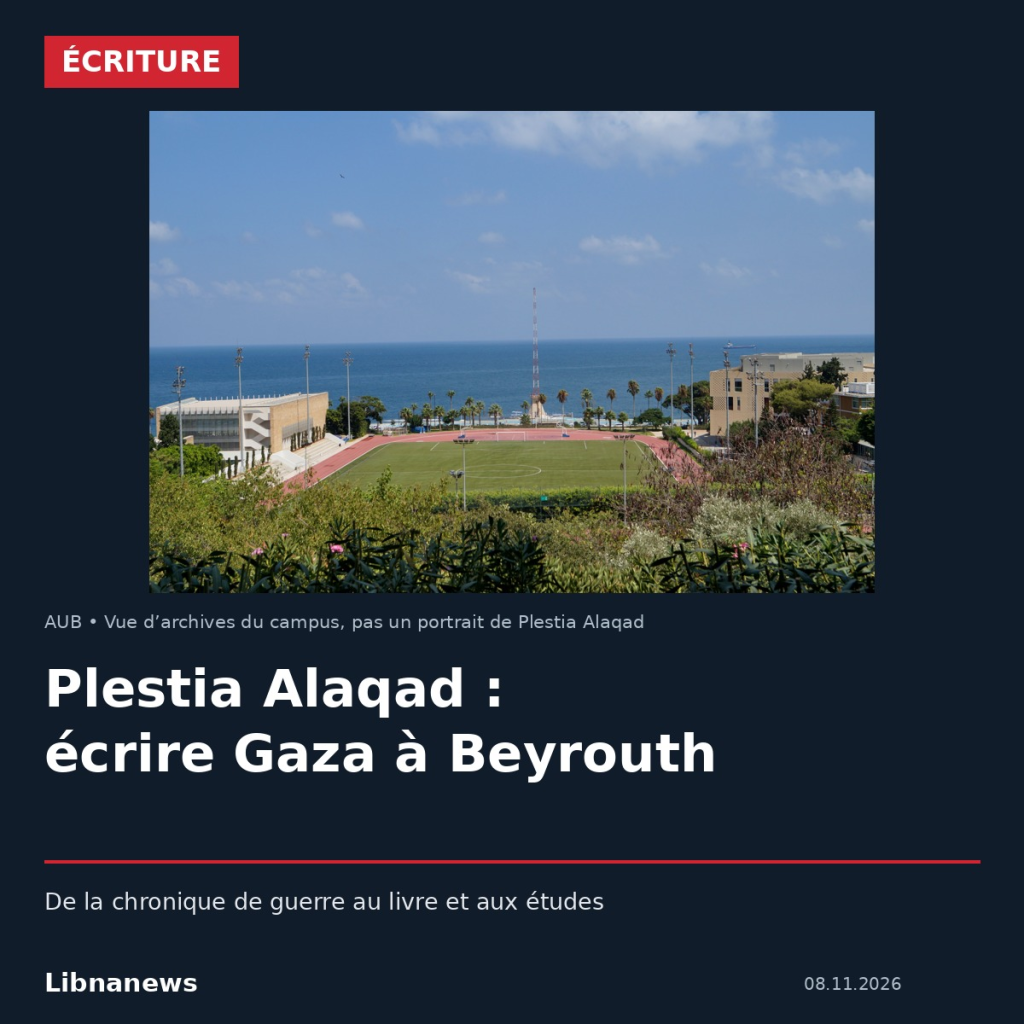
Photo from AUB campus: marviikad / Flickr, via Wikimedia Commons. This view does not show Plestia Alaqad. Whole photograph preserved, assembly Libnanews. Photo and licensed editing CC BY-SA 2.0: https://creativecommons.org/licenses/by-sa/2.0/.





Comments