

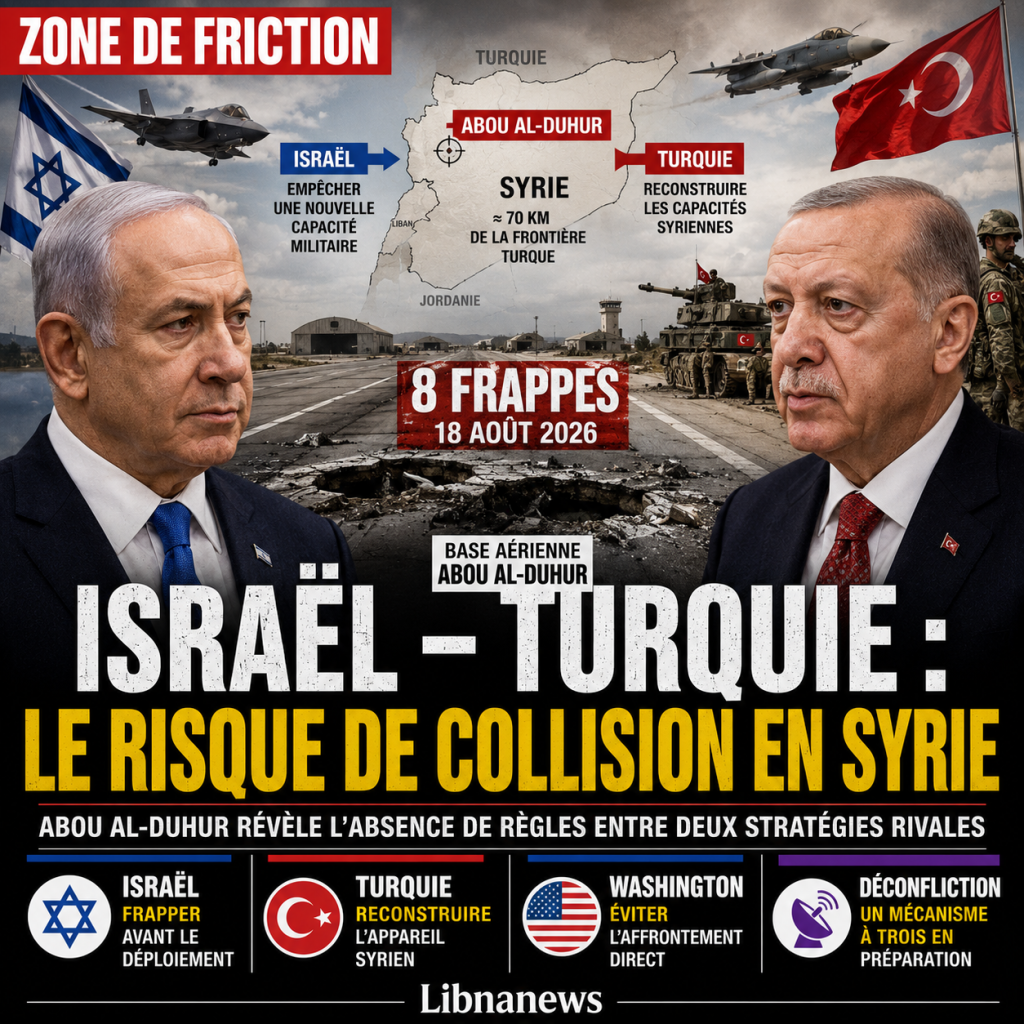
On 18 August 2026, eight Israeli strikes targeted the Syrian air base at Abu al-Duhur in north-western Syria. Israel then acknowledged the operation and justified it by the prospect of a Turkish military deployment at the site, which Ankara contests. The incident reveals a much broader problem: since the fall of Bashar Al-Assad, Turkey has helped the new Syrian authorities rebuild the state’s capabilities while Israel intends to maintain the possibility of preventing the appearance in Syria of forces or equipment that it considers threatening. Between these two strategies, no common rules yet define how far Ankara can go. Washington is now seeking to establish a de-conflict mechanism to prevent this rivalry from causing direct confrontation.
The Abu al-Duhur runway became unusable even before it recovered from real military activity. During the night of 17-18 August, Israeli aircraft struck this former air base in Idlib Province, near Aleppo Province and about 70 kilometres from the Turkish border.
The strikes hit the runway and storage facilities. No deaths were reported. However, the importance of the operation does not lie in its human and immediate military value of a base that has not been fully operational for more than a decade.
She resides in her justification.
Israel eventually recognized its responsibility. Prime Minister Benjamin Netanyahu’s office states that the Syrian government was about to authorize the deployment of Turkish forces to Abu al-Duhur. According to the Israeli version, this facility would have altered the « security status quo » and created a threat to Israel.
Ankara rejects this statement. On 19 August, the Turkish Ministry of Foreign Affairs denounced « unbearable » accusations aimed, according to him, at justifying Israeli operations in Syria.
The incident thus marks a new stage. Israel no longer strikes only in Syria to prevent the transfer of weapons to Hezbollah, combat an Iranian settlement or destroy equipment from the former regime. He now assumes a strike explicitly linked tothe possibility of a turkish military presence.
It is this change that makes Abu al-Duhur a regional file.
Turkey wants to rebuild a Syrian state capable of acting
To understand confrontation, we must start with Turkish objectives.
The fall of Bashar Al-Assad in December 2024 profoundly altered Ankara’s position in Syria. Turkey has moved from being a major supporter of the Syrian opposition to being a privileged partner of the new authorities led by Ahmed Al-Charaa.
His first interest is political: to stabilize the new power.
After more than thirteen years of civil war, Ankara wants to prevent Syria from falling back into lasting territorial fragmentation. A weak Syrian State would allow areas controlled by armed groups to remain, maintain instability on the Turkish border and complicate the return of some Syrians living in Turkey.
The second interest is safe. Ankara wants to prevent the sustainable settlement, near its border, of Kurdish autonomy dominated by organizations which it considers to be linked to the Kurdistan Workers’ Party (PKK).
The third is strategic. The reconstruction of the Syrian power offers Turkey the possibility of establishing a lasting influence in a country with which it shares more than 900 kilometres of border.
This influence goes beyond diplomacy.
Turkey participates in the formation of the new Syrian forces. It brings its expertise to the reconstruction of military and security capabilities destroyed or severely weakened during the war. Work also covered military infrastructure and monitoring or defence systems.
Abu al-Duhur must be placed in this policy.
The base had ceased to function normally during the war. Its rehabilitation could provide the new Syrian authorities with air infrastructure in the north-western part of the country. For Ankara, helping Damascus to rehabilitate this type of site is part of the reconstruction of state institutions.
For Israel, the same process is observed from a radically different angle.
Israel does not want Syrian military power to be reborn
The Israeli strategy since December 2024 is based on another principle:the replacement of the Assad regime must not allow Syria to rebuild military capabilities that may one day be used against Israel.
In the days following the fall of the former regime, Israeli aviation had launched a massive campaign against Syrian military infrastructure. Aircraft, anti-aircraft systems, depots, missiles and other equipment had been destroyed.
The logic was to prevent the arsenal of the old state from falling into the hands of new leaders or other groups.
But this doctrine now produces a contradiction.
The government of Ahmed Al-Charaa is seeking precisely to rebuild a centralized state. To achieve this, it must have an army, control its airspace, resume its bases and rebuild a chain of command.
Israel can consider the same process as the gradual reconstitution of a threat.
Turkey is in the midst of this contradiction because it possesses the technical, military and financial capabilities to help Damascus.
Thus, what Ankara presents as a contribution to Syrian stabilization can be interpreted in Jerusalem as the installation of a regional military power in the Syrian strategic space.
Abu al-Duhur: Israel strikes before deployment
The incident of August 18 allows us to measure how far this logic can lead.
According to Israeli justification, no major Turkish force needed to be already installed on the base to trigger a strike.The prospect of his arrival would have been enough.
Israel claims to have repeatedly warned the Syrian authorities against a Turkish deployment to the site. The Israeli government maintains that Damascus was on the verge of crossing that limit.
Turkey contests this version.
Ankara claims that Israeli accusations about its military position are unfounded and accuses Benjamin Netanyahu of using Turkey to justify a policy of destabilizing Syria.
This divergence is important as it shows the absence of a common definition of red lines.
What does Israel consider a threatening Turkish presence?
Some instructors? A permanent unit? Aircraft? Drones? Radar? An air defence system? Rehabilitating a track for the future deployment of Turkish aircraft?
The answer is not clear.
Without a definition accepted by both parties, a facility that Turkey considers to be part of normal military cooperation with Damascus can become a target for Israel.
This is where the structural risk lies.
A precedent had already taken place in 2025
Abu al-Duhur does not appear in a strategic vacuum.
By the spring of 2025, tensions had been concentrated on several Syrian military bases that might be of interest to Ankara, notably T4, in Homs Province, and Palmyra.
Israel had hit these installations when the possibility of a Turkish presence was mentioned. Ankara and Israel then engaged in contacts to avoid an accidental confrontation of their forces in Syria.
The problem was already clearly identified: Israeli aircraft must be able to operate in Syrian airspace according to Israeli security doctrine, while Turkey is developing a military and technical presence with the new authorities.
The two uses of the same space may become incompatible.
A base equipped with Turkish radars, for example, could detect Israeli air operations. A more advanced anti-aircraft system could limit their freedom of action. Turkish aircraft stationed in Syria would further increase the risk of an Israeli strike directly reaching Turkish personnel or equipment.
Abu al-Duhur therefore turns a theoretical risk into a concrete incident.
Washington criticises « unnecessary escalation »
The American reaction to the bombing was particularly significant.
Tom Barrack, United States Ambassador to Turkey and United States Special Envoy for Syria, described the Israeli strike as a « strike »« unnecessary escalation ». He also pointed out that the new Syrian authorities favoured de-escalation, according to Washington.
This criticism is unusual in its sharpness.
It reveals above all the problem facing the United States.
Israel is their main strategic partner in the Middle East. Turkey is a member of NATO and has the Alliance’s second largest army. Washington also supports the stabilization of Syria under the new authorities.
The United States therefore has an interest in three conflicting objectives: to guarantee Israeli security, to maintain its alliance with Ankara and to avoid further destabilization of Syria.
Abu al-Duhur shows how fragile this balance is.
Turkey had not been warned in advance of the Israeli strike. According to Tom Barrack, Ankara detected the aircraft and could have reacted militarily.
This precision allows us to measure the danger: a decision taken in Jerusalem against a Syrian settlement could have caused, by misidentification or defensive reaction, an incident with a NATO army.
The United States now wants a three-way deconflict
Washington is precisely trying to prevent such a scenario from happening again.
Tom Barrack announced that the United States was working on ade-conflict mechanism between Israel, Turkey and Syria.
The principle is simple: create channels of communication that allow the three parties to know enough about the intentions and movements of others to avoid an involuntary military collision.
Such arrangements do not constitute alliances and do not imply that the parties accept their respective policies. Their function is to prevent a strategic disagreement from accidentally turning into an exchange of fire.
In the Syrian case, however, the difficulty is deeper.
A mechanism can prevent an Israeli aircraft and a Turkish unit from meeting in the same place without knowing it. It does not solve the central political question:Will Israel accept Turkey’s help Syria rebuild military capabilities that Jerusalem considers a potential threat?
And, conversely, will Ankara accept that Israel has de facto veto power on the bases Turkey can use or rehabilitate in Syria?
This question remains unanswered.
First scenario: Ankara and Israel set their red lines
The least conflicting scenario is based on an enhanced de-conflict mechanism.
Israel and Turkey could define certain practical limits, either directly or through the United States.
Ankara could provide sufficient advance information on its significant deployments. Israel could identify the equipment it considers an immediate threat. Areas or categories of facilities may be subject to specific notifications.
This formula would not suppress their rivalry.
It would simply prevent an Israeli strike from killing Turkish soldiers and then forced Ankara to retaliate.
Discussions since 2025 show that both governments already understand the need for such a mechanism. The Abu al-Duhur incident shows that it remains insufficient.
Scenario 2: A succession of strikes and limited crises
A second trajectory would be that of repeated but contained incidents.
Turkey would continue to rebuild certain Syrian infrastructure. Israel would strike those it considers incompatible with its security interests. Ankara would condemn the operations without responding directly to Israel.
This scenario partly resembles the already observable dynamic.
However, it has an obvious limit: the higher the Turkish presence, the higher the likelihood of a strike reaching Turkish personnel.
The death of Turkish soldiers would immediately change the nature of an incident.
The internal pressure on Ankara to respond would then be much stronger, even if neither Recep Tayyip Erdogan nor Benjamin Netanyahu sought direct confrontation.
Third scenario: Syria becomes the ground for indirect confrontation
The third scenario is more structural.
Israel and Turkey could avoid direct confrontation while pursuing opposing strategies across the Syrian state.
Ankara would help Damascus rebuild its armed forces, radars, bases and defence capabilities. Israel would also seek to prevent some of these capabilities from reaching a level that it considers dangerous.
The confrontation would then focus less on the presence of Turkish soldiers than on thethe nature of the Syrian army that Turkey is helping to rebuild.
This situation would create a lasting paradox.
The more the Syrian state regains its capacity, Ankara could see its policy as successful. But the more some of these capabilities progress, the more Israel could be tempted to destroy them.
Damascus would then find itself in a situation where the reconstruction of its military apparatus would regularly cause foreign strikes.
Risk is not war, but lack of rules
Abu al-Duhur does not allow to announce a war between Israel and Turkey.
Both countries have strong reasons to avoid it. A direct confrontation between Israel and a NATO member would create a considerable regional and international crisis. It would threaten American interests and could destabilize the Syrian government which Turkey is seeking to consolidate.
The immediate danger lies elsewhere.
He resides in the absence of accepted rules on the Turkish presence in Syria.
Israel has just indicated that it can hit a facility even before a Turkish deployment announced or supposed to materialize. Turkey replied that it would continue its cooperation with Damascus to strengthen Syrian stability, institutional capacity and reconstruction. Washington, for its part, now considers it necessary to build a specific mechanism to prevent these two strategies from colliding.
The next stage will therefore not only depend on the fate of the Abu al-Duhur track. It will depend on the ability of the three capitals to answer a much more difficult question: how far can Turkey help rebuild the Syrian military power without crossing an Israeli red line whose limits remain, to date, disputed?




