





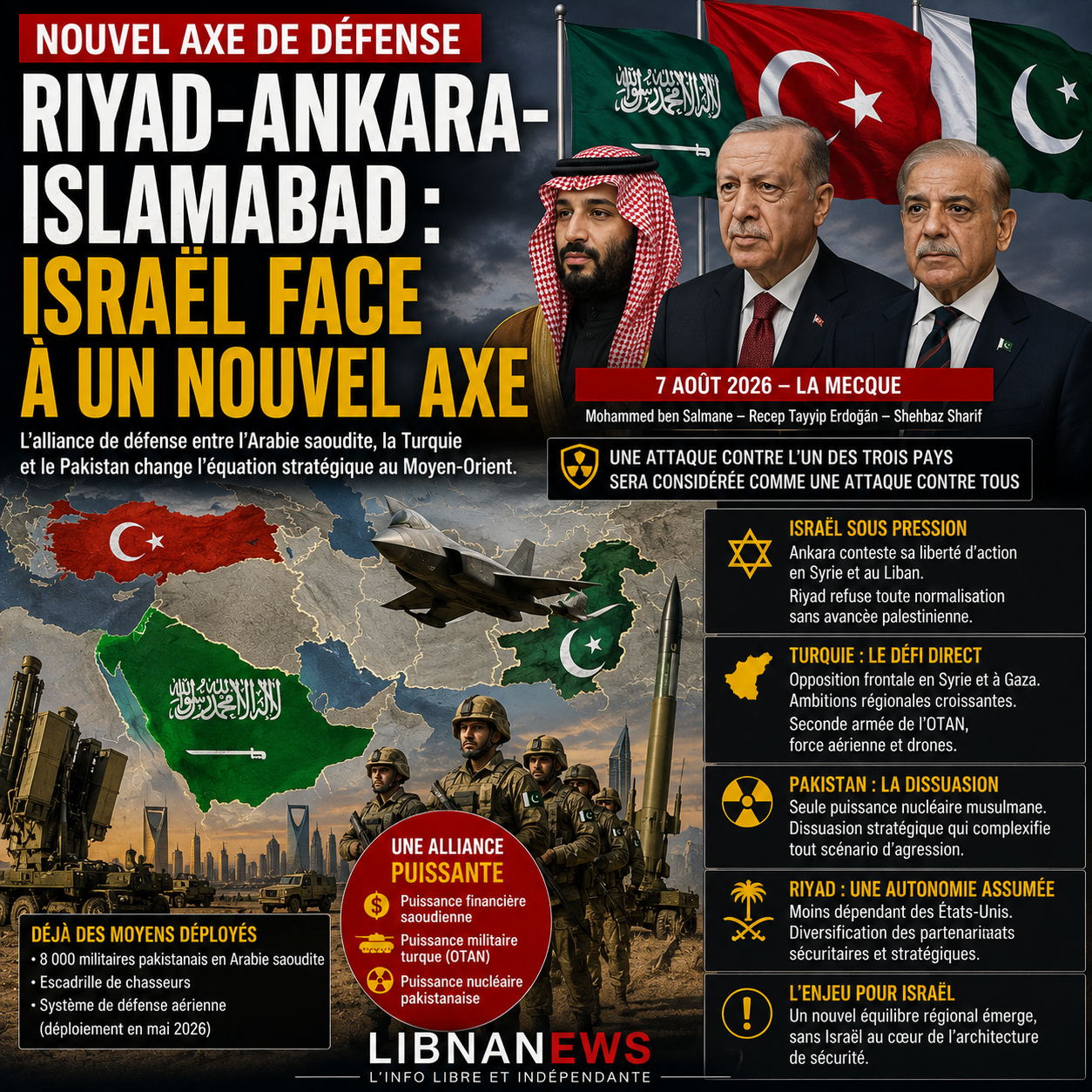
The defence alliance concluded on 7 August 2026 between Saudi Arabia, Turkey and Pakistan directly alters the balance of forces in the Middle East. Signed in Mecca by Mohammed bin Salmane, Recep Tayyip Erdoğan and Shehbaz Sharif, the agreement provides that an attack against one of the three countries will be considered an attack against the others. It combines Saudi financial power, one of NATO’s main armies and the only nuclear power in the Muslim world. For Israel, this development comes at a particularly sensitive moment: Iran is weakened, Hezbollah has lost some of its capabilities, but Ankara increasingly directly challenges Israeli freedom of action in Syria and Lebanon, while Riyadh still refuses to normalize its relations with Israel without a Palestinian political perspective. There is no evidence to suggest that Saudi Arabia and Turkey would be Israel’s next military targets. On the other hand, they become two major obstacles to a regional order in which Jerusalem would retain strategic superiority without any real state counterweight.
The new agreement does not come out of nowhere. Riyadh and Islamabad had already signed, on 17 September 2025, a mutual defence agreement considerably more binding than their historical military cooperation. Discussions with Ankara then lasted almost a year. As early as January 2026, Pakistan’s Minister of Defence Production indicated that a draft trilateral agreement was being prepared. The regional war of spring and summer accelerated negotiations. On 7 August, the three governments finally reached a stage which several Turkish officials now compare, in principle, with NATO Article 5.
Hakan Fidan, the Turkish Foreign Minister, was particularly explicit. For Ankara, aggression against one of the signatories engages the other two politically and can result in various forms of assistance, ranging from intelligence to military intervention. A permanent secretariat should be established in Saudi Arabia and the Ministers of Foreign Affairs and Defence should meet regularly. The pact remains presented as defensive and does not officially designate any adversaries. But the planned institutions show that this is more than a one-off diplomatic declaration.
The Mecca Pact is already based on military means
The importance of the new axis lies mainly in the fact that it does not start from scratch. Saudi-Pakistani cooperation became operational during the war with Iran. By May 2026 Islamabad had deployed approximately 8,000 troops to Saudi Arabia, a fighter squadron and an air defence system. This deployment was part of the bilateral agreement signed in September 2025 to strengthen the protection of the kingdom while the region suffered the consequences of the war against Tehran.
This figure gives a more concrete measure of what a Pakistani guarantee can mean. Islamabad is not just signing press releases. It has the capacity and experience to quickly send thousands of soldiers, combat aircraft, technicians and defence systems to the Gulf. Pakistan’s forces are also familiar with Saudi territory through decades of cooperation, exercise and training.
This relationship has limits. Pakistan had refused in 2015 to participate directly in the Saudi war in Yemen. His Parliament did not want to be dragged into a regional confrontation that could affect relations with Iran or increase religious tensions within the country. The episode remains essential to understand the 2026 pact: military solidarity does not necessarily imply that the Pakistani army will execute all Riyadh’s demands.
But the situation is now different. The mutual defence clause creates a political obligation that did not exist in this form in 2015. The challenge is no longer to participate in an offensive war in Yemen, but to respond to a possible attack on a partner. This distinction greatly broadens the scenarios in which Islamabad could be led to intervene.
The entry of Turkey further increases the scope of the scheme. Ankara has the second largest NATO army, large air forces, an expanding navy and a defence industry that produces drones, missiles, ships, armoured vehicles, electronic warfare systems and guided ammunition. The three countries thus combine capacities that few regional coalitions can bring together.
Pakistan nuclear changes calculations without becoming an umbrella
The nuclear issue is obviously the most sensitive aspect. Pakistan is the only Muslim-majority nuclear power and has an arsenal developed primarily to deter India. None of the public documents of the Mecca Pact explicitly provide for an extension of this deterrence to Saudi Arabia or Turkey.
It would therefore be incorrect to write that Riyadh now automatically has a Pakistani nuclear umbrella. Pakistani officials themselves stressed the defensive nature of the agreement without detailing the employment thresholds of their strategic capabilities. A conventional attack against Saudi Arabia would not mechanically result in a nuclear response.
However, ambiguity is not anomaly. When a nuclear power undertakes to consider an attack against a partner as an attack against itself, any opponent must integrate a new unknown. A major crisis could lead to an escalation whose limits would no longer be determined solely by Saudi forces.
This development is of direct interest to Israel. The Hebrew state is widely regarded as the only nuclear power in the Middle East, even if it maintains its historic policy of ambiguity. The emergence of a security architecture close to Riyadh d’Islamabad therefore gradually changes the environment in which this strategic superiority is exercised.
Moreover, Israeli concerns do not concern Pakistan alone. In July 2026, the debate on the Saudi civilian nuclear programme had already provoked strong reactions in Israel. Several Israeli officials, including former Defense Minister Avigdor Lieberman, warned that an enrichment capacity in Saudi Arabia could eventually trigger a regional race.
The combination of a Saudi civilian nuclear programme, extensive military relations with Islamabad and a collective defence pact does not mean that Riyadh is preparing a bomb. It means that Saudi Arabia now has more strategic options than five years ago.
Riyadh learned from American addiction
This diversification responds to specific experience. For several decades, Saudi security has relied mainly on the United States. Washington provided aircraft, Patriot systems, intelligence, training and, ultimately, the military capability to defend the Gulf monarchies.
The September 14, 2019 attack on Abqaiq and Khurais had shaken that confidence. Infrastructure essential to the Saudi oil industry had been reached despite the American presence in the region. The absence of a massive US military response had convinced some Gulf leaders that the alliance with Washington was not automatic insurance.
Another shock was the Israeli attack on Doha in September 2025. For the Gulf monarchies, the question was no longer just whether Washington would protect them against Iran or the Houthis. It was also necessary to determine how far the United States would be prepared to coerce Israel when an Israeli operation touched an Arab partner in Washington.
The Saudi-Pakistan agreement was signed a few days after the crisis. The temporal bond is important. Riyadh did not abandon his American alliance; He was trying to add a second layer of protection.
The war of 2026 confirmed this strategy. The Gulf was exposed to confrontation between Washington, Israel and Iran, missiles, drones and disturbances in the Strait of Ormuz. A State like Saudi Arabia, whose economic strategy depends on stability, no longer wants its security to be determined solely by the decisions taken in Washington, Jerusalem or Tehran.
Trump puts normalization with Israel at the centre
This Saudi autonomy directly contradicts another project: Donald Trump’s to expand Abraham’s agreements. For Washington and Jerusalem, normalization between Israel and Saudi Arabia remains the centrepiece of a new regional order.
An agreement with Riyadh would have an uncompromising scope with previous standardizations. Saudi Arabia is the first Arab economy, exerts considerable influence in the Muslim world and houses Mecca and Medina. Its recognition of Israel would enable Jerusalem to argue that its integration into the region has become irreversible.
But Riyadh continues to impose a Palestinian condition. The kingdom demanded a credible path to a Palestinian State and refused to regard normalization as a mere bilateral transaction. This demand runs counter to the policy of the Israeli coalition.
Donald Trump tightened the pressure in July. He stated that he did not want to advance the US agreement on Saudi civilian nuclear without the Kingdom’s accession to the Abraham agreements. This position is particularly revealing: Washington is trying to attach a Saudi strategic need to normalization with Israel.
The Mecca Pact offers Riyadh more room for manoeuvre in the face of this pressure. The kingdom does not replace US nuclear technologies with Turkey or Pakistan, but it can show that its security no longer depends on a single diplomatic package designed in Washington.
The failure of Saudi normalization would be strategic for Israel
For Benjamin Netanyahu, the stakes go beyond a personal diplomatic victory. Saudi normalization must demonstrate that Israel could change the Middle East order without first resolving the Palestinian question. Abraham’s agreements had already been based on this logic: Arab States could develop their relations with Israel according to their own interests.
Saudi Arabia was the decisive step. Had Riyadh normalized, several other Muslim states could have followed. Israel would have gained wider regional recognition as the Palestinians remained divided and politically weakened.
The continuation of the Saudi refusal has the opposite effect. He recalls that Gaza and the Palestinian question remain capable of blocking Israel’s integration. Even more so, Riyadh is now building parallel defence mechanisms with powers that are not integrated into Abraham’s agreements.
Pakistan does not recognize Israel. Turkey maintains diplomatic relations with him, but his political relations with Netanyahu are deeply degraded. A security architecture built around these three capitals is therefore not structured by cooperation with Israel.
It is this evolution, more than the prospect of a Saudi-Israeli war, that can cause Jerusalem to worry.
Turkey is the real military challenge
The Turkish case is much more direct. Unlike Riyadh, Ankara already has several potential military friction points with Israel. Recep Tayyip Erdoğan stated on 10 June that Israeli operations in Syria and Lebanon had reached a level where they also threatened the security of Turkey.
This formulation marks a turning point. Turkey no longer presents only its criticism of Israel as a defence of Gaza or Palestinian law. It now considers that the evolution of the ratio of forces to the Levant affects its own national security.
Syria is the main scene of this indirect confrontation. Ankara has a considerable influence on the new Syrian order and wants to contribute to the reconstruction of the country’s military institutions. Israel pursues the opposite objective when it considers that certain Syrian capabilities could become a future threat.
For Turkey, a sovereign Syrian State must be able to control its territory and airspace. For Israel, part of this reconstruction can diminish its freedom to strike targets that it considers dangerous.
This contradiction cannot be solved by mere diplomatic declarations.
Syrian battle over bases and air defence
The issue of military installations is particularly sensitive. Ankara has considered various forms of assistance to the new Syrian forces and is interested in air capabilities, bases and territorial defence. Israel closely monitors any project that would enable Turkey to establish a lasting military presence further south.
For Jerusalem, the problem is operational. The Israeli air force used to intervene in Syrian space with great freedom. For years, it has struck weapons depots, convoys, Hezbollah officials, Revolutionary Guards and military infrastructure.
An air defence assisted by Turkey would change the equation. Radar, electronic warfare systems and ground-to-air missiles controlled by Ankara or a Turkish-trained Syrian army could complicate Israeli raids.
Even without confrontation, Israel should integrate the Turkish position before certain operations. For Ankara, this is precisely what should happen: Turkey refuses the idea that Israel would indefinitely have a unilateral right to strike a neighbouring State.
The risk would be an attack on a Turkish military facility. The death of Turkish personnel would cause a direct crisis between Israel and a NATO member. Neither Netanyahu nor Erdoğan are interested in such a scenario, but the multiplication of operations mechanically increases its probability.
Lebanon is now also integrated into the Turkish calculation
The Erdoğan declaration of 10 June explicitly included Lebanon. This clarification deserves to be stressed. Ankara is not a military actor on the Lebanese file comparable to Israel or Hezbollah, but it now considers the extension of Israeli operations in the Levant as a whole.
Turkey maintains relations with the Lebanese Government and seeks to develop its economic and political influence in the country. A prolonged Israeli presence in the South, coupled with regular strikes, thus reinforces the Turkish perception of a regional imbalance.
The problem for Israel is that Turkey has considerable State resources to transform this political opposition into influence. It can invest in reconstruction, provide equipment, develop defence relations and support diplomatically Beirut without adopting the Iranian model of armed groups.
After the weakening of Hezbollah, this dimension becomes more important. The reduction of Iranian influence does not necessarily create a vacuum favourable to Israel. Other powers may occupy it.
Ankara appears to be one of the best placed to do so.
Gaza has transformed Turkish-Israeli tension
Gaza, however, remains the political driving force behind the rupture. Before October 2023 Ankara and Jerusalem had gradually re-established their relations after years of tension. Ambassadors had returned and economic exchanges remained important.
The war has destroyed this dynamic. Erdoğan took one of the toughest positions in NATO against Israeli operations. Ankara has increased international efforts, supported the Palestinian cause and maintained ties with Hamas officials.
For Israel, these links are an ancient source of mistrust. Jerusalem believes that Turkey has provided an overly favourable political environment for some Hamas networks. Ankara replied that it distinguished political contacts from military support.
The dispute now concerns the post-war period. Turkey wishes to participate in the reconstruction and political organization of Gaza. Israel does not want Ankara to have a significant influence on an area immediately at its border.
An international force, a reformed Palestinian administration or a reconstruction mechanism can therefore become new points of diplomatic confrontation between the two countries.
Cyprus opens second theatre of rivalry
The Eastern Mediterranean adds further depth to the dispute. Israel maintains growing military and energy relations with Greece and the Republic of Cyprus. Exercises, naval cooperation, energy projects and connections with Europe brought the three countries closer together.
For Ankara, this architecture is observed with suspicion. Turkey challenges several maritime boundaries and remains the only State to recognize the Turkish Republic of Northern Cyprus. It refuses any regional energy or maritime safety organisation that would reduce its own rights.
Erdoğan warned again in 2026 that Ankara would respond firmly if Turkish or Turkish Cypriot interests were challenged in the eastern Mediterranean. The message was not only aimed at Israel, but also at a region where Jerusalem’s cooperation with Athens and Nicosia has an increasingly visible military dimension.
Israel has three simultaneous friction cases with Turkey: Gaza, Syria and the Eastern Mediterranean. Lebanon is beginning to add to it.
It is this accumulation that transforms Ankara into a potential strategic competitor, much more than the personal statements between Erdoğan and Netanyahu.
Saudi Arabia is a power to contain politically, not a military target
Riyadh’s situation is radically different and requires more caution. There is no credible evidence that Israel is considering a military confrontation with Saudi Arabia. Such an assumption would be incompatible with decades of discreet rapprochement, with American interests and with the Israeli objective of normalization.
But Israel has an interest in preventing the kingdom from becoming the centre of a regional architecture built outside of it. A Saudi Arabia capable of combining American guarantees, Pakistani partnership, Turkish technologies, dialogue with Iran and cooperation with China would be much less dependent on an agreement with Jerusalem.
The balance of forces thus becomes diplomatic. Israel can seek to use its relays in Washington to condition certain American benefits to Saudi normalization. This is illustrated by the July debate on civilian nuclear power.
There is also a more indirect military dimension. Several Israeli officials are concerned about Riyadh’s acquisition of advanced systems that could reduce Israel’s qualitative military advantage. This concern is old and influences US debates on arms sales in the Gulf.
The Saudi nuclear programme adds an even more sensitive issue. Israel could more easily accept Saudi nuclear infrastructure closely controlled by Washington than an autonomous enrichment capacity. The Israeli statements of July show that the case has already become a matter of national security.
The new axis bypasses the very principle of Abraham’s accords
The Riyadh-Ankara-Islamabad alliance produces above all an architecture contrary to the pattern of Abraham’s accords. This model was based on the idea that Iran was the main common threat and that Israel could become a natural security partner of the Sunni Arab States.
The Mecca Pact shows that another solution exists. Sunni powers can build defence cooperation without Israel and without designating Iran as an official enemy. The Iranian reaction of 10 August is significant in this regard: Tehran chose to carefully accept the agreement rather than denounce it.
The spokesman for the Iranian Ministry of Foreign Affairs, Esmaeil Baghaei, presented the pact as being able to contribute to a move towards greater regional security autonomy. Iran obviously seeks to prevent the alliance from becoming a front against it.
This further increases the Israeli problem. While Riyadh can maintain a dialogue with Tehran while being protected by Islamabad and associated with Ankara, the logic of an Israeli-Arab coalition built exclusively against Iran becomes less indispensable.
The emerging Middle East is not necessarily divided between an Israeli-Sunni bloc and an Iranian bloc. Several States seek to build cross-relations and avoid exclusive alignment.
The agreement could attract other states
The pact could also exceed its three founders. Hakan Fidan indicated that he was likely to open up to other countries. Egypt was mentioned among those States that might be interested in the mechanism.
Egyptian membership would significantly change its weight. Cairo has the largest Arab army, controls the Suez Canal and shares a border with Israel and Gaza. His relations with Jerusalem remained governed by the peace treaty, but political tensions related to Gaza had regularly complicated their cooperation.
Other Gulf States are also observing the development of Pakistani safeguards. Kuwait discussed further military cooperation with Islamabad, while Bahrain expressed interest in similar arrangements. Jordan is also seeking to strengthen some training and disarmament partnerships.
It would be premature to announce the formation of a « Muslim NATO ». The interests of these countries remain too different and no integrated command exists. But the regional security market is clearly evolving.
States that depended almost entirely on Washington are now seeking complementary assurances between regional powers.
Iran is paradoxically no longer the only engine of rapprochement
The triangle initially had all the characteristics of a device that could respond to Iran. Saudi Arabia has been attacked by groups supported by Tehran. Pakistan shares a long border with Iran. Turkey and Iran are both economic partners and historical competitors.
Yet the signatories carefully refuse to define Iran as an adversary. This caution is strategic. Riyadh has invested several years in relaxing with Tehran and does not want to return to a permanent confrontation. Islamabad cannot afford a hostile Iranian border. Ankara generally prefers to manage its competition with Iran by arrangements rather than by a logic of blocks.
Israel therefore gradually appears as another variable of their cooperation. This does not mean that the pact is directed against him. But Israeli operations in Doha, Syria, Lebanon, Gaza and Iran have changed the perception of the limits of Israeli power.
When several capitals begin to fear not only their traditional opponents but also the lack of constraints on a US partner, they are looking for balance instruments.
It is this process that can cause long-term concern for Jerusalem.
Israel’s « New Middle East » Meets its Limits
Israel’s military successes since 2024 have profoundly changed the Middle East. Hezbollah has been weakened. Iranian architecture in Syria has been disrupted. Key figures in Iran’s system were eliminated during the war. Tehran’s military capabilities have been severely hit.
These results can give Israel a strategic depth that it did not previously have. But they also produce a reaction from other regional powers. A situation where no State force could balance Israel is not necessarily considered desirable in Ankara, Riyadh or Islamabad.
Turkey does not want Israel to turn Syrian weakness into a permanent right of intervention. Saudi Arabia does not want to depend on normalization with Israel for its security. Pakistan sees the extension of its partnerships in the Gulf as a way to increase its own international weight.
The new axis is therefore not a reconstruction of the old « axis of resistance ». It works according to a completely different logic. It is based on states, regular armies, relations with Washington and industrial cooperation.
For Israel, this difference counts. Militia can be struck and their leaders eliminated without necessarily causing a crisis between major powers. A member Turkey of NATO, a central partner Saudi Arabia of the United States and a nuclear Pakistan cannot be treated in the same way.
Ankara could become the main regional counterweight
Among the three, Turkey is therefore the most likely to become the direct counterweight to Israel. It has the necessary demographics, army, industry and geography. It is located in the Caucasus, the Black Sea, the Mediterranean and the Levant. It also has a military presence or agreements across its borders.
Its economy remains vulnerable and its ambitions sometimes exceed its resources. His NATO membership also imposes constraints on him. But no other Sunni power currently has a comparable combination of industrial and military capabilities.
If Ankara consolidates its influence in Syria, develops its cooperation with Riyadh and deepens its partnership with Islamabad, Israel will need to integrate Turkey into its strategic planning on a sustainable basis.
This does not mean that both countries are condemned to war. Their history shows on the contrary that they have long been able to cooperate despite important political differences.
But the relationship can no longer be rebuilt on the same basis if Ankara now considers Israeli freedom of action a threat to its own security.
Riyadh holds the political key
Saudi Arabia has another power: to decide whether Israel can truly complete its integration into the Arab world. As long as Riyadh refuses normalization without a credible Palestinian solution, Abraham’s agreements remain incomplete.
This capacity gives Mohammed bin Salmane a considerable leverage on Washington and Jerusalem. It can negotiate with Trump on civilian nuclear, security guarantees and American technologies while keeping the Palestinian question at the centre of the issue.
The pact with Turkey and Pakistan reinforces this position because it reduces the strategic cost of a Saudi refusal. Riyadh has other partners capable of contributing to its security.
Thus, confrontation with Israel does not necessarily involve missiles or aircraft. It deals with the very definition of the regional order: a Middle East organized around Israel and Abraham’s agreements, or a multipolar architecture in which Riyadh, Ankara, Islamabad, Tehran, Washington and Beijing have a cross-relationship.
As of August 10, the Mecca Pact has not yet demonstrated its ability to function during a major military crisis. His first real test will come when one of the signatories asks for the concrete application of the promised solidarity. But political change is already visible: after years in which Israel hoped that Iran’s weakening would pave the way for a regional coalition centered on Jerusalem, Riyadh, Ankara and Islamabad now propose another security architecture, of which Israel is neither a member nor a referee.