





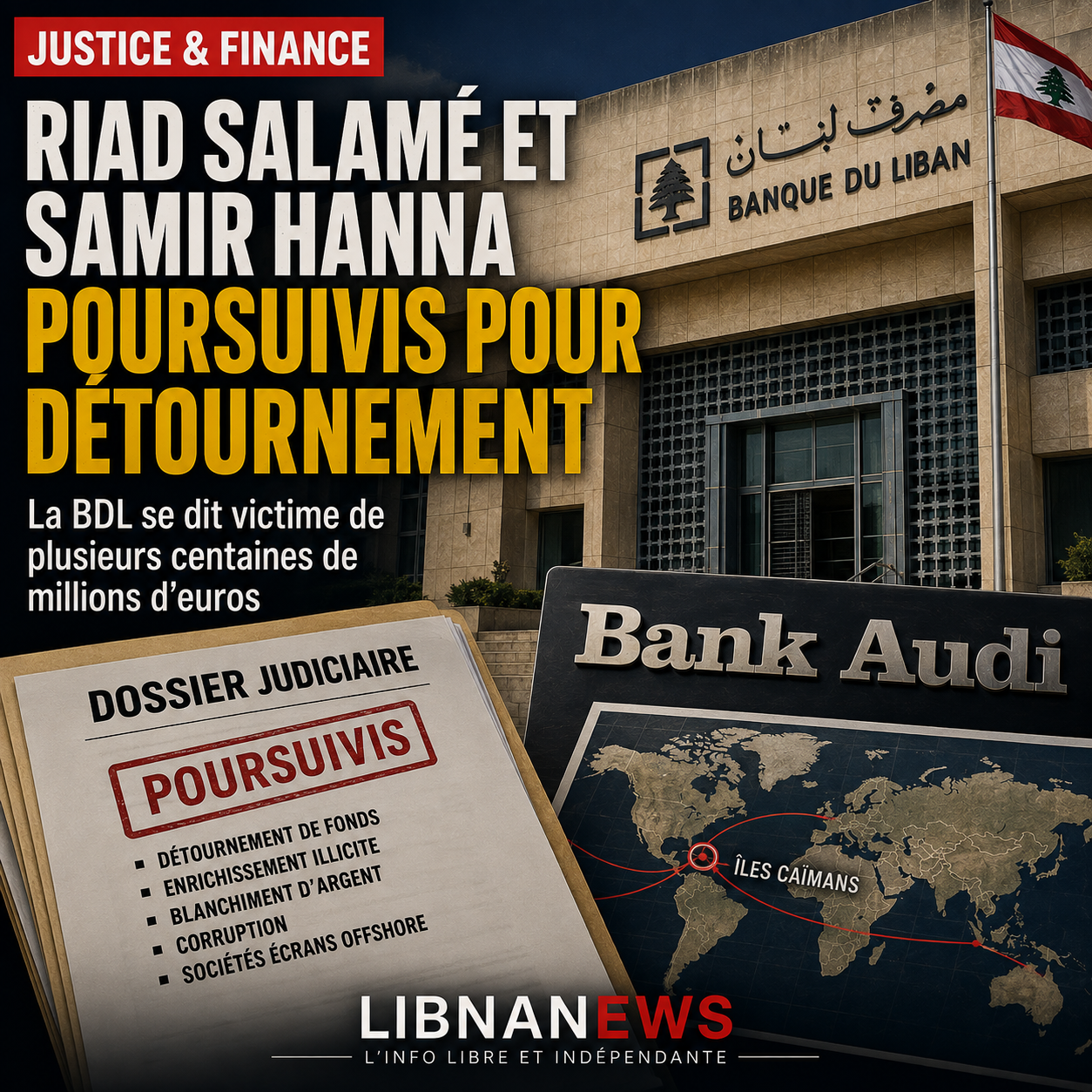
On Monday, August 10, 2026, the Lebanese State filed a lawsuit against Riad Salamé, former Governor of the Bank of Lebanon, and Samir Hanna, former President of Bank Audi, on suspicions of embezzlement, illicit enrichment, money laundering and corruption. According to a judicial source, the charges also concern the creation of front companies and the use of BDL funds to fraudulently acquire shares and bonds of commercial banks. The procedure results from a complaint lodged in January by Governor Karim Souaid. The BDL now presents itself as a victim of a loss of several hundred million euros. Salamé, 76 years old, detained since the end of July after missing a hearing, is hospitalized under enhanced surveillance. Hanna, who left office at Bank Audi, had recently paid a bond of $1 million. Justice must now determine whether transactions between BDL, offshore companies, shareholders and Bank Audi have been used to divert public resources to private interests.
The proceedings opened on Monday are a new step, not a conviction. Riad Salamé has for several years denied having diverted public funds or used his functions to enrich himself. He claims to have become a scapegoat of the financial collapse started in 2019. Samir Hanna also enjoys the presumption of innocence. The instruction will have to establish its personal role in each of the transactions examined and distinguish between ordinary and potentially irregular banking transactions.
The novelty lies mainly in the judicial rapprochement of two figures at the top of the same system. Salamé led the BDL from 1993 to July 2023. Hanna has run for decades one of the largest establishments in the country. Justice no longer seeks only to restore the fortune of the former governor. It now examines operations where the regulator, Bank Audi, offshore companies and powerful investors are found in the same financial chain.
Karim Souaid’s complaint puts the BDL on the side of the victims
Karim Souaid announced in January that a criminal complaint had been lodged after the review of the former central bank operations. The BDL claims today that several hundred million euros have been hijacked under the former leadership with the help of people from Salamé’s professional circle. This position marks a break with previous years. For a long time, the most advanced investigations were conducted in Paris, Geneva, Luxembourg or Munich. The Lebanese institution itself now calls for flows to be considered as an injury to it.
The central bank also wants to recover any amounts diverted. That’s a major difference. A criminal conviction would only have a limited effect if the assets had disappeared. Souaid therefore seeks to use internal audits, information from European procedures and the BDL archives to identify beneficial owners, monitor transfers and request the return of funds where a link can be established.
This approach comes at a time when Lebanon is still debating the sharing of bank losses. If BDL resources have actually been diverted, it becomes a pre-distribution step between the state, banks, shareholders and depositors. The amount of several hundred million euros remains low compared to the tens of billions of losses of the system, but the principle is politically central.
Four offshore companies and one purchase of Bank Audi securities
One of the mechanisms now under study dates back to 2010. According to evidence from the June hearings, the investigation involved four companies incorporated in the Cayman Islands. The first, Middle East Opportunities for Structured Finance, or MOSF, would have purchased approximately 17 million Bank Audi shares from EFG Hermes for nearly 153 million dollars. The Bank of Lebanon reportedly provided financing in the form of a loan.
The case becomes more complex in the following years. In 2012, a second structure, Levant Finance 1, was reported to have taken over the MOSF-related debt instrument and equity ownership. In 2014, Levant Finance 2 would in turn resume the operation. According to the information obtained from the investigation, the debt and its interest were finally repaid to BDL. However, this repayment does not extinguish judicial questions about the legality of the initial financing, the actual beneficiary of the companies and the role of the regulator.
The central question is simple: why did a central bank finance an offshore structure to enable the acquisition of a large stake in a bank it supervised? The BDL has extensive powers to preserve financial stability, but the Currency and Credit Code strictly regulates the conditions under which it may hold or finance holdings in banks. The investigation must determine whether offshore companies were used to circumvent these restrictions.
Samir Hanna is prosecuted because Bank Audi is at the heart of the assembly
Samir Hanna appeared in this case because he was managing Bank Audi during the transaction and because justice sought to establish the personal role of the bank’s management in financing, guarantees and securities transfers. It is not simply a matter of finding that Bank Audi had a relationship with the BDL. All major banks in the country worked with the central bank on a daily basis. The investigation involves specific transactions.
Another branch of the case concerns loans granted by Bank Audi to Najib and Taha Mikati in the early 2010s. Judicial information and several investigations indicate that the two brothers reportedly borrowed nearly $300 million, about $150 million each, to acquire instruments that were then used to buy stakes from Bank Audi. The terms and conditions of these loans and their articulation with BDL financing are now part of the elements examined.
The potential legal problem is the circular nature of the mechanism. A commercial bank would have financed investors to buy its own shares, while the central bank would have provided funds to an offshore structure linked to the acquisition of other Audi securities. This scheme does not in itself prove fraud. He explains, however, why investigators are seeking information as to whether Bank Audi, its former head and former head of the BDL, coordinated operations that should have been treated remotely.
Crossland takes Riad Salamé directly to the circuit
2016 is another important point. A fourth company, Crossland, appears in the file. According to the evidence reported during the interrogation of Salamé, the beneficial owner of the company was the former governor. Crossland reportedly held approximately $14 million in cash and nearly $25 million in Audi Bank shares.
In particular, investigators seek to explain the origin of these assets. According to the statements collected, the funds transferred to Crossland were allegedly provided by Najib Mikati and his brother Taha, who allegedly presented these payments as compensation for consultancy services. The court must determine which services were actually rendered, by whom, according to which contracts and why the payments resulted in a company whose beneficial owner was assigned to Salamé.
Liechtenstein had already requested information from Lebanon on the transfer of four million Audi Bank shares valued at over $25 million to Crossland. This international application had shown that Audi titles appeared in the heritage and structures investigations related to the former governor even before Karim Suaid’s complaint.
The juxtaposition of these operations today feeds suspicions. Salamé was Bank Audi’s regulator. A structure attributed to its profit would have held shares of the same bank. The court must therefore determine whether this participation was legal, declared, financed by private resources or linked to the contested BDL circuits.
Another transaction connects Bank Audi to a company linked to Salamé’s son
Bank Audi had already been cited in an international survey published in 2020 concerning Crossbridge Capital, a London-based wealth management company. Crossbridge shares were held by Crossland Assets Corp, a Panama-registered company related to Riad Salamé. His son Nady Salamé had worked at Crossbridge and also held interests there.
In 2016, Bank Audi acquired Crossbridge shares held by Crossland. The transaction was legal according to the parties concerned, but it had raised questions because of the potential conflict of interest: a bank regulated by Salamé purchased securities from a structure linked to its assets, in a company where its son had interests.
This transaction is not automatically included in the new proceedings of 10 August. However, it is important to understand why the relationship between Bank Audi and Salamé’s heritage environment has attracted the attention of investigators for several years. The problem is not the existence of an isolated commercial relationship, but the repetition of transactions where the governor’s public office and his alleged private interests seem to be approaching.
The documents for each transaction should be reviewed separately. No record can be used to assume guilt in another. But the repetition of these links explains why magistrates are today seeking to rebuild the Salamé-Hanna relationship over a much longer period.
2016: Bank Audi is one of the major beneficiaries of financial engineering
The year 2016 also corresponds to the « financial engineering » put in place by Riad Salamé to attract fresh dollars to the BDL. Commercial banks contributed currencies to the central bank and received instruments with extremely high yields. These operations were official and their existence is not an offence.
However, Bank Audi was one of the main beneficiaries. Surveys based on data from the Banking Control Board estimated its benefit at approximately $1.6 billion for 2016. This figure should be understood as a result of BDL’s financial mechanisms, not as an amount diverted or illegally paid.
The distinction is essential, but the context raises a question of governance. At the time when BDL granted Bank Audi very advantageous terms to attract its currencies, Salamé’s private environment also maintained financial relations with securities and companies linked to the bank. Justice must determine whether these two levels were strictly separated.
At the same time, the central bank was the regulator, one of the main financial counterparties of Bank Audi and the architect of operations capable of strongly influencing its profits. This concentration of relationships reduced the normally expected distance between supervisor and supervised institution.
Dividends paid as exposure to BDL increased
Financial engineering has enhanced banks’ short-term profits, but has also increased their exposure to BDL. Bank Audi was one of the institutions that held significant claims on the central bank. When the system stopped attracting enough new dollars, this exposure became one of the main sources of bank losses.
Surveys published since the crisis have also examined the dividends distributed by Bank Audi in recent years before 2019. In particular, they indicate that several hundred million dollars were distributed to shareholders shortly before the collapse. Major shareholders included families and officials who were strongly linked to Lebanese political and financial life.
The distribution of dividends by a profitable bank is not illegal in itself. The debate concerns the quality of the profits used to finance them and the level of risk the bank had already accumulated vis-à-vis the BDL. While profits were largely derived from the exceptional mechanisms of the central bank, the question becomes whether shareholders were able to withdraw gains while future risks remained on the balance sheet.
This issue is now directly relevant to banking reform. Depositors request that former shareholders absorb a substantial part of the losses before any contribution from the State or customers. The relations between Salamé and the major banks thus become part of the debate on the hierarchy of responsibilities.
Swiss subsidiary of Bank Audi has already been sanctioned
Bank Audi has also experienced regulatory problems related to the prevention of money laundering. In March 2024, the Swiss financial market surveillance authority, FINMA, found serious breaches of its anti-money laundering obligations. The regulator ordered the return of approximately 3,9 million Swiss francs of profits and imposed a capital supplement of 19 million Swiss francs.
FINMA had identified deficiencies in the treatment of high-risk relationships and politically exposed people. It also criticized the bank for failing to properly report certain suspicious transactions. Bank Audi Switzerland had cooperated with the investigation and implemented corrective measures.
This sanction does not constitute a conviction of Samir Hanna in the current case. It also does not make it possible to conclude that the transactions examined in Switzerland correspond to the set-up covered by Souaid’s complaint. However, it shows that the subsidiary of a central group in the Salamé system had already been the subject of a formal decision for serious shortcomings in its anti-money laundering mechanism.
For Lebanese investigators, this precedent reinforces the interest of rebuilding international flows, especially when beneficiaries are politically exposed persons or offshore structures.
Forry is the major precedent around commissions
The new case must be distinguished from the Forry case, but the two investigations cross by their method. Forry Associates, a company controlled by Raja Salamé, brother of the former governor, reportedly received over $300 million in commissions between 2002 and 2015 on operations carried out by the Bank of Lebanon with commercial banks.
The Salamé brothers have always argued that these commissions stemmed from a legal contract and were not drawn from public funds. European investigators suspect, on the contrary, that some of the money was diverted and then laundered through real estate accounts and acquisitions.
Contracts reviewed by European prosecutors showed that certain commissions were paid without commercial banks necessarily knowing who the ultimate beneficiary was. Prosecutions have since been initiated in several countries and France has maintained an arrest warrant against Riad Salamé since May 2023.
The Forry case showed above all that it was possible to track flows for years and identify financial intermediaries. It is this method that the new management of the BDL is now seeking to apply to its own files, including transactions involving Bank Audi.
Souaid now asks for accounts from the entire banking sector
The procedure against Salamé and Hanna does not seem to be an isolated initiative. In January, Karim Suaid requested the Association of Lebanese Banks to coordinate the transmission of data on fees related to the financing and debt management operations between BDL and commercial institutions between 2005 and 2019.
This demand covers a very wide period. It includes the years in which public debt accumulated, the BDL’s funding mechanisms and the financial engineering of 2016. The objective is to determine what amounts were paid to each institution, under what conditions and with which intermediaries.
The investigation does not mean that all banks have committed offences. Institutions may legitimately collect interest or commissions on authorized transactions. The issue is to identify transactions emerging from normal practices, especially when companies linked to public or private officials appear in the circuit.
The Salamé-Hanna dossier thus becomes the first major test of this new policy. If justice can accurately document decisions and beneficiaries, other transactions can be examined using the same methodology.
The question is no longer only « who made the money lose? »
For several years, the Lebanese debate on the banking crisis was dominated by an accounting confrontation. Banks accused the state of spending beyond its means and the BDL of absorbing their deposits. The political leaders were returning to Salamé. Depositors found that their accounts remained blocked without a clear hierarchy of responsibilities being established.
The new lawsuits partly alter this discussion. It is no longer just a question of what policies have created losses, but whether some resources have been diverted or used to enrich private individuals. An error in monetary policy and criminal misappropriation are not part of the same register.
This distinction is essential for Bank Audi. The bank can defend its participation in BDL policies by stating that it respects the framework established by the regulator. However, it must respond separately to questions relating to loans, shares, offshore companies or transactions in which its former manager was personally involved.
Justice must therefore avoid amalgam while examining all relevant relationships. This is precisely because Salamé and Hanna held institutional positions as powerful as each transaction must be documented more rigorously.
The next step must specify what is attributed to each individual
The decision of 10 August now opens a phase in which responsibilities must be individualized. The judge requested an arrest warrant against Riad Salamé. For Samir Hanna, the prosecution has to be consulted after his interrogation, although he has already paid a bond of $1 million. The case is referred to another magistrate for further investigation.
Future court proceedings will have to specify which companies are being held in charge, which transactions are considered fraudulent and what exact amount is being allocated to each transaction. Most importantly, they will have to explain Hanna’s role beyond his role as Bank Audi’s manager.
For Salamé, the challenge will be to respond to the rapprochement between his functions as governor, the financing of the BDL and the companies from which he is presented as a beneficiary. For Hanna, the investigation will have to establish whether he only led the bank concerned with the securities or whether he personally participated in disputed mechanisms.
It is on this distinction that the solidity of the file will be played. After years of scattered investigations between Lebanon and Europe, the proceedings initiated by the BDL now require the Lebanese judiciary to put precise names, dates, companies and amounts on the financial relations between Riad Salamé and Samir Hanna.