





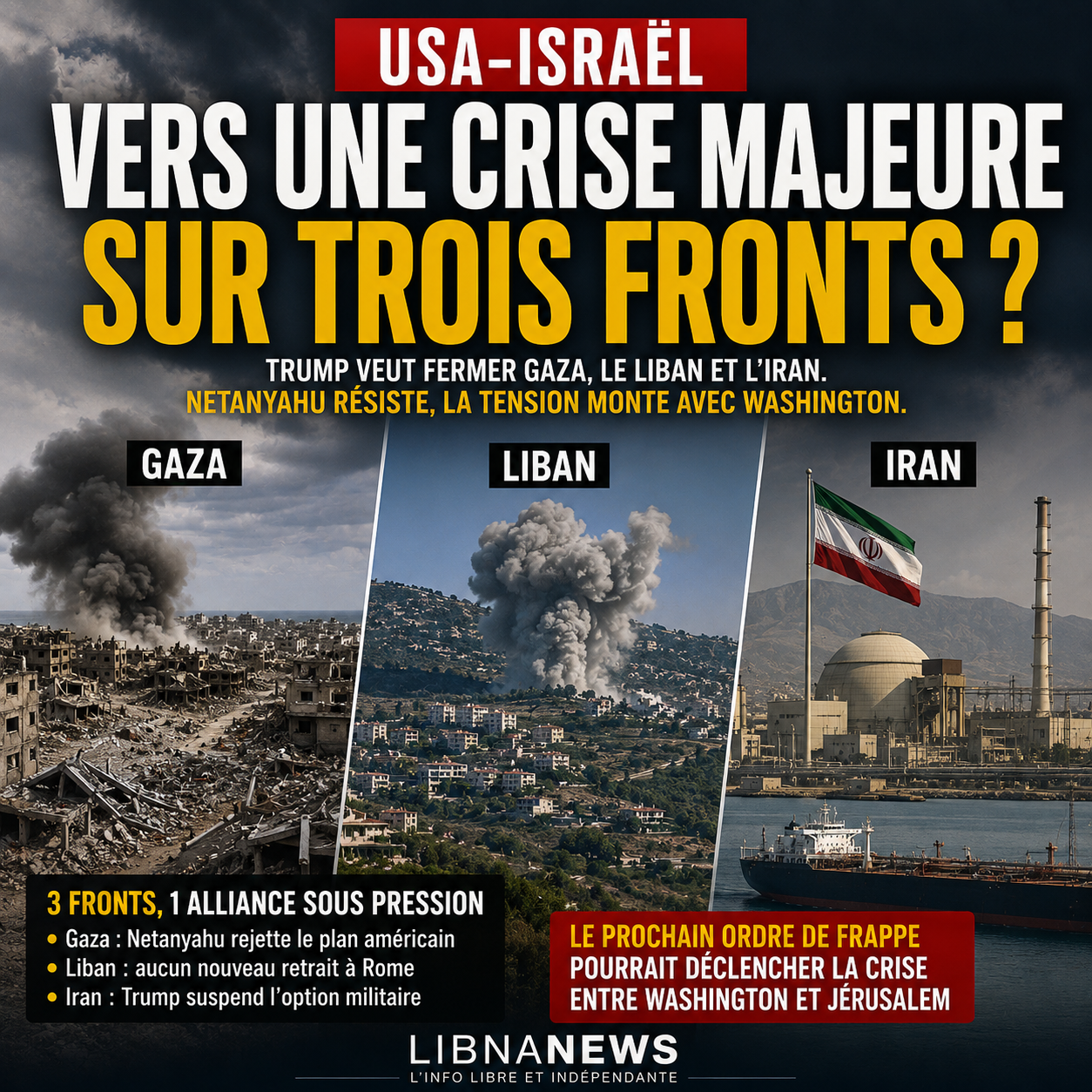
On August 10, 2026, the relationship between Donald Trump and Benjamin Netanyahu entered an unusual phase of tension. According to reports from the Israeli press, CENTCOM commander, Admiral Brad Cooper, reportedly conveyed to Israel an American message aimed at « closing » the three fronts of Gaza, Lebanon and Iran simultaneously. Washington is already pushing for a halt to the strikes in Gaza, supporting an Israeli withdrawal process from Lebanon and suspending another attack on Iran in order to give the negotiations on the Strait of Ormuz a chance. Benjamin Netanyahu, however, refused the American plan for Gaza, Israel did not grant any further withdrawal to Rome on the Lebanese front and the option of a new strike against Iran remains open. The question is no longer one of one-off disagreement. It now focuses on the regional strategy itself, with an increasing risk of a political crisis between the United States and Israel if Jerusalem continues to favour the continuation of operations where Donald Trump is instead seeking an exit from war.
Washington now wants to close three wars at once
Brad Cooper’s visit to Israel on 8 August gives new consistency to the signals sent by Washington for several weeks. The head of the United States Central Command met with the Israeli Chief of Staff, Eyal Zamir, and several security officials. According to an Israeli chain citing political sources, Cooper reportedly asked Israel to move towards closing the three fronts of Gaza, Lebanon and Iran. The formula was not officially taken over by the White House and therefore cannot be presented as a public order of Donald Trump. However, it corresponds to the succession of American decisions observed in the three theatres.
In Gaza, the Trump administration supports a 15-point plan for a gradual exit from the war, the disarmament of Hamas, the Israeli withdrawal and the establishment of a new administration. The Israeli strikes were severely reduced under US pressure, but Benjamin Netanyahu publicly rejected the road map in its current form on 9 August. It demands that Hamas be totally disarmed before withdrawal. Thus, the disagreement is less about the final objective than about the sequence: Washington wants to start disarmament, political transition and withdrawal simultaneously, while the Israeli government wants to keep its military presence until the main security demands are fulfilled.
In Lebanon, the American logic is comparable. Washington wants to turn a still active front into a political mechanism: Israel’s gradual withdrawal, the deployment of the Lebanese army, the control of evacuated areas and verification of the disarmament of Hezbollah. However, the seventh round of Rome, completed on August 6, produced no further withdrawal. Israel continues to condition its evacuations with additional safeguards and conduct strikes when it claims to identify a threat. For the United States, maintaining this situation undermines the mediation they have built themselves since the spring.
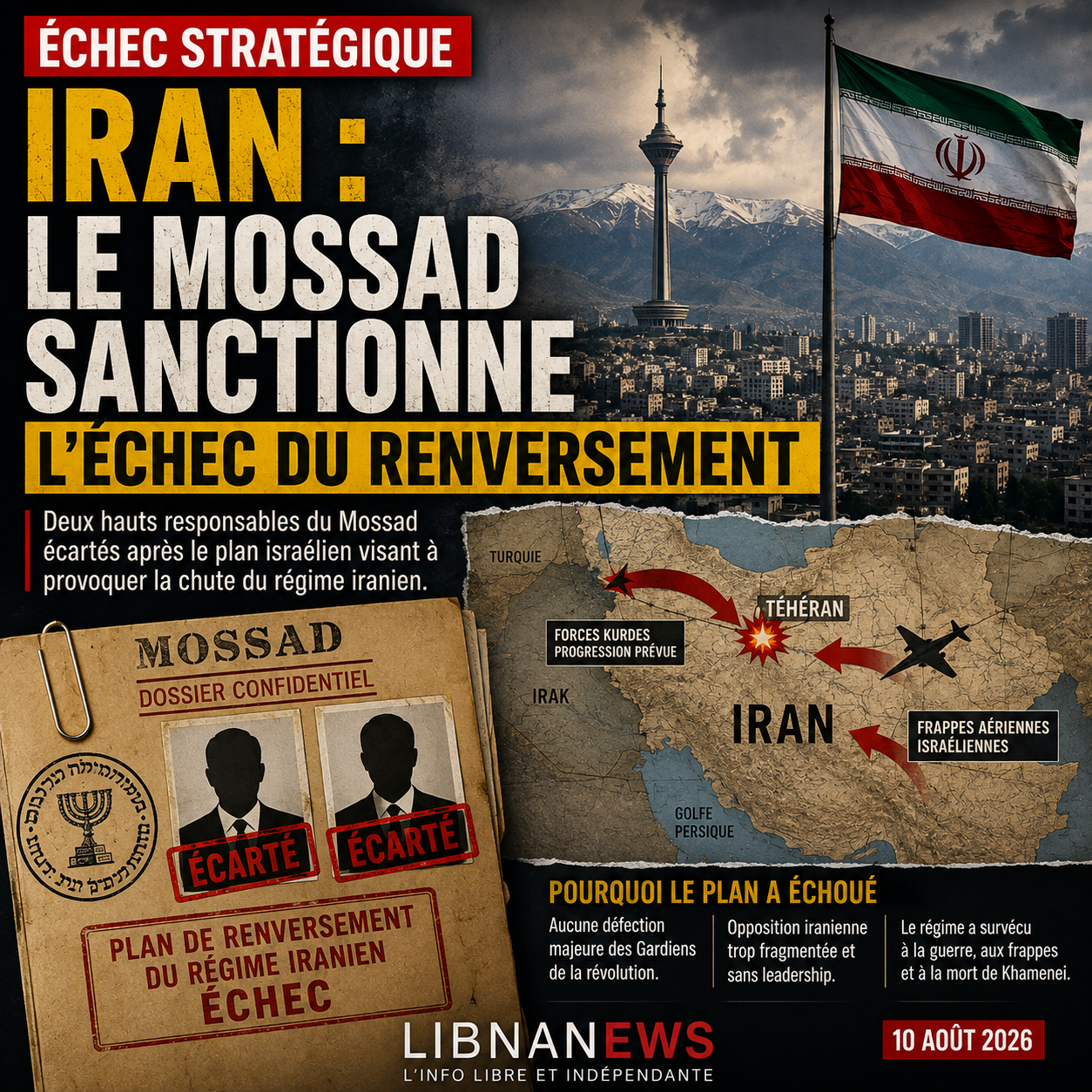
In the face of Iran, Donald Trump interrupted preparations for a new US attack in early August in order to preserve a quick agreement. Washington wants a sustainable reopening of the Strait of Ormuz and reduces the risk of further regional escalation. However, Israel retains the opportunity to intervene if Tehran restores nuclear or ballistic capabilities deemed dangerous. On the three fronts, therefore, the same divergence appears: the United States is seeking a political halt, while Israel is still reasoning on the basis of the military threats it considers not to be eliminated.
Gaza turns disagreement into public confrontation
Gaza is now the front line where the divergence between Donald Trump and Benjamin Netanyahu is most visible. To date, much of the disagreement has been handled through private consultations, diplomatic pressure or military adjustments. Netanyahu’s public rejection of the US plan marks an evolution. The Israeli Prime Minister explained that his Government could not accept a withdrawal before the complete disarmament of Hamas, including its heavy and light weapons. This position directly contradicts Washington’s proposed timetable.
The U.S. plan seeks to create a dynamic in which the various stages flow. Israel would begin to withdraw, Hamas would transfer its weapons, an international force would gradually enter the territory and a new Palestinian administration would take over civilian management. This method assumes that no actor gets all his guarantees before starting to implement his own obligations. Netanyahu specifically refuses this logic. He wants the main military result sought by Israel, the disarmament of Hamas, to precede the evacuation.
For Donald Trump, this condition threatens the very feasibility of the plan. If Israel refuses to move before complete disarmament and Hamas demands an Israeli withdrawal before handing over all of its weapons, the negotiation is back to the blockade that marked the previous phases. The White House is looking for a quick and visible result. The reduction in strikes in Gaza already shows that Washington can get operational changes from Israel, but Netanyahu’s political refusal indicates that this influence has limits.
This opposition is all the more important as it occurs a few months before the Israeli elections. Netanyahu has to deal with a coalition where several officials refuse any concession that could be interpreted as a Hamas victory. His inner calculation thus collides with Trump’s. The US President wants to be able to present an agreement in Gaza as a diplomatic success before the mid-term elections in the United States. The Israeli Prime Minister, on the other hand, does not want to be accused by his right for ending the war under American pressure without having achieved all the stated objectives.
Lebanon shows the limits of American pressure
The Lebanese case is less spectacular, but it reveals an equally important difficulty for Washington. Since the framework agreement of 26 June, the United States has pushed Beirut to accept a package of guarantees: extension of the state monopoly on arms, deployment of the Lebanese army, pilot zones and international verification. Lebanon has gradually accepted these principles, at the cost of an increasingly difficult internal debate. In return, he expects successive Israeli withdrawals.
The seventh round of Rome showed that this reciprocity was not automatic. Lebanon proposed Bint Jbeil and Khiam to continue the pilot zone mechanism. Israel has not accepted any new areas at this stage. On the other hand, discussions have progressed on the choice of countries to participate in the verification of disarmament. The result is politically embarrassing for American mediation: the guarantees demanded in Beirut become more precise, while the Israeli territorial movement remains suspended from assessing Jerusalem.
This is in contradiction with Washington’s determination to close the Lebanese front. A real closure requires, at a minimum, a reduction in strikes, a gradual withdrawal and an effective transfer of security to the Lebanese army. However, Israel continues to claim freedom of action when it considers that Hezbollah is preparing or rebuilding military capabilities. This doctrine allows it to retain a right of intervention even during negotiations and complicates the transformation of the ceasefire into a lasting arrangement.
For Trump, the problem is not only Lebanese. If the United States demands concessions from Beirut without succeeding in obtaining the corresponding movements from Israel, their mediation loses credibility. Hezbollah then benefited from Israeli retention to justify its weapons, while the Lebanese Government could hardly explain why it should make further concessions. The eighth round, expected at the beginning of September, will therefore be a direct test of the American ability to influence Israel and not just exert pressure on the Lebanese side.
Iran is the front line where a rupture would be the most dangerous
The Iranian case brings the divergence to a higher strategic level. The United States and Israel have fought together against Tehran, but they no longer necessarily define the time when the war can be considered to be over. Donald Trump is now seeking to convert military pressure into political agreement, particularly around the reopening of the Strait of Ormuz. In early August, he suspended another US attack after Tehran had requested further discussions.
This decision directly affected Israel. Press reports indicated that Israeli officials were expecting a new operation and had not all been informed in advance of the US decision change. The episode is important because it shows that Washington can now favour negotiation even when Jerusalem believes that further military action is still needed. The Trump administration no longer seems to want the calendar of the war against Iran to be defined solely by the logic of escalation.
Yet Israel is reasoning on the basis of another criterion. For his Government, the opening of Ormuz does not address the issue of Iran’s nuclear programme or ballistic missiles. A military break can therefore be considered a respite offered in Tehran. Israeli officials have repeatedly indicated that Israel would retain the opportunity to strike if the capabilities deemed threatening were rebuilt. This doctrine potentially puts Jerusalem in direct conflict with Trump’s diplomatic objectives.
A new Israeli attack on Iran during US negotiations would be much more serious than a disagreement over Gaza or Lebanon. It could provoke an Iranian response, reopen the Strait to a military confrontation and expose US forces in the Gulf again. Washington could then consider that an Israeli decision directly undermines an American interest. It is in this scenario that the current tension could turn into a real bilateral crisis.
Trump seeks to regain control of the regional calendar
The convergence of the three issues suggests a change in the way Donald Trump views his relationship with the Netanyahu government. During much of the recent conflicts, Washington supported Israel while trying to limit the regional consequences of its operations. The United States provided arms, provided part of the missile defence, used diplomatic weight and intervened when escalation threatened its own forces. This architecture gave Israel considerable military autonomy.
The situation is changing when the US President believes that continued operations prevent his own agreements. Gaza is blocking a diplomatic initiative that it wants to present as an exit from war. Lebanon is undermining a mechanism built by Washington and risks keeping Hezbollah in armed logic. Iran threatens the reopening of Ormuz and exposes American energy and military interests. In these three cases, the freedom of action claimed by Israel now colludes with immediate American objectives.
The message given to Brad Cooper comes to its sense in this context. If confirmed, it is not simply a demand for moderation on a precise strike. « Close the three fronts » means asking Israel to accept that the time of war is now subordinated to an American regional strategy. Washington wants to move from military logic to diplomatic logic in three theatres where Israel still considers that threats remain.
This development explains why the current tension does not fully resemble previous crises. The United States and Israel have often diverged over settlements, military operations, ceasefires or negotiations with Palestinians. The current problem is simultaneously with Gaza, Lebanon and Iran. It therefore affects not only a particular policy, but the way in which the two allies define their strategy in the Middle East.
Netanyahu can hardly yield on all three fronts
Benjamin Netanyahu cannot easily change his position. In Gaza, he placed the complete disarmament of Hamas among the conditions for a withdrawal. In Lebanon, his Government claimed that the security of northern Israel required verifiable guarantees against the return of Hezbollah to the evacuated areas. Faced with Iran, he presented the destruction of nuclear and ballistic capabilities as an existential issue. Simultaneously giving up these three lines would be difficult to defend before his government and his electorate.
The electoral calendar accentuates this rigidity. Israel must vote on 27 October. Netanyahu confronts opponents who can accuse him either of having prolonged wars or of having accepted insufficient compromises. To the right, any concession to Gaza or any limitation of Israeli military freedom may become a field matter. In this context, an American demand for simultaneous de-escalation is less like a political facility than an additional constraint.
Trump, however, has a favourable balance of forces. Israel remains heavily dependent on the United States for its defence systems, certain munitions, intelligence, military coordination and diplomatic coverage. This dependency is even more visible when it comes to Iran. A large-scale confrontation with Tehran mobilizes American resources that the Israeli army cannot entirely replace. So Netanyahu can resist Trump politically, but a prolonged confrontation would have an operational cost.
The Israeli Prime Minister is probably trying to avoid the binary choice between submission and rupture. It can slow down US plans, demand new guarantees, retain military options and try to convince Washington that some operations remain necessary. This is already what appears in Gaza and Lebanon. But if Trump now considers that these deadlines undermine his objectives, this method may be less and less tolerated.
A political crisis, not yet a break in the alliance
It would be premature to talk about a breakup between the United States and Israel. Military cooperation remains profound and the two countries continue to share several objectives: to prevent an uncontrolled resumption of Iranian military power, to limit Hamas’ capabilities and to contain Hezbollah. Washington does not question Israel’s security. The focus of the divergence is on means, timing and the definition of the acceptable level of risk before ending operations.
The notion of crisis, however, becomes relevant when these disagreements combine. Netanyahu publicly rejected the US plan for Gaza. American mediation in Lebanon did not produce the expected withdrawal in Rome. Trump suspended another attack on Iran when Israel wanted to maintain strong military pressure. To this is now added the message attributed to the head of CENTCOM on the closing of the three fronts. Taken together, these elements show a much more confrontational relationship than when Washington and Jerusalem coordinated their operations against Tehran.
The American reaction will be decisive. Trump can continue to negotiate with Netanyahu and accept adjustments that allow both leaders to preserve their public positions. It can also increase its pressure if Israel resumes operations that directly undermine its plans. In this second scenario, the crisis may manifest itself in restrictions on certain operations, pressure on military deliveries, more frequent public disagreements or a reduction in US diplomatic coverage. There is still no indication that such a step has been decided.
On the Israeli side, the critical threshold would be an operation conducted despite explicit American opposition. A massive resumption of strikes in Gaza, an expansion of operations in Lebanon as Washington seeks a withdrawal or another major attack against Iran during the negotiations on Ormuz would place Trump before the obligation to choose between letting his ally and defending his own regional strategy.
The next three tests are already identified
Gaza will provide the fastest test. Netanyahu rejected the American plan, but the discussions are not officially broken. The next few days will show whether Israel continues to reduce its strikes and agrees to negotiate on the withdrawal schedule, or whether it resumes a broader military campaign. A recovery despite US pressure would signal that the Israeli government believes it can resist Trump at no major cost.
The second test will come from Lebanon. The eighth round scheduled for early September must show whether Washington is capable of getting another Israeli evacuation. After the failure of Rome, a further blockade would strengthen in Beirut the idea that the United States would demand more from Lebanon than Israel. Conversely, a withdrawal from Bint Jbeil, Khiam or another area would enable Washington to demonstrate that its pressure is also on Jerusalem.
The third and most dangerous test remains Iran. Trump currently favours negotiation and hopes to secure an agreement to stabilize Ormuz. If Israel launched a new major operation before the conclusion of these discussions, the divergence would no longer be theoretical. Such a strike could cause the US process to fail and re-immerse US forces in a confrontation that their president is trying to slow down.
The question of a major crisis between Washington and Israel therefore depends less on public statements than on future operational decisions. For now, Trump and Netanyahu remain allies, but they no longer seem to define regional priority in the same way. The first seeks an exit on three fronts; the second wants to preserve the freedom to continue the war until the threats it identifies are eliminated. The next order of strike in Gaza, Lebanon or Iran will say whether this divergence can still be managed behind closed doors or whether it shifts into an open political confrontation.