





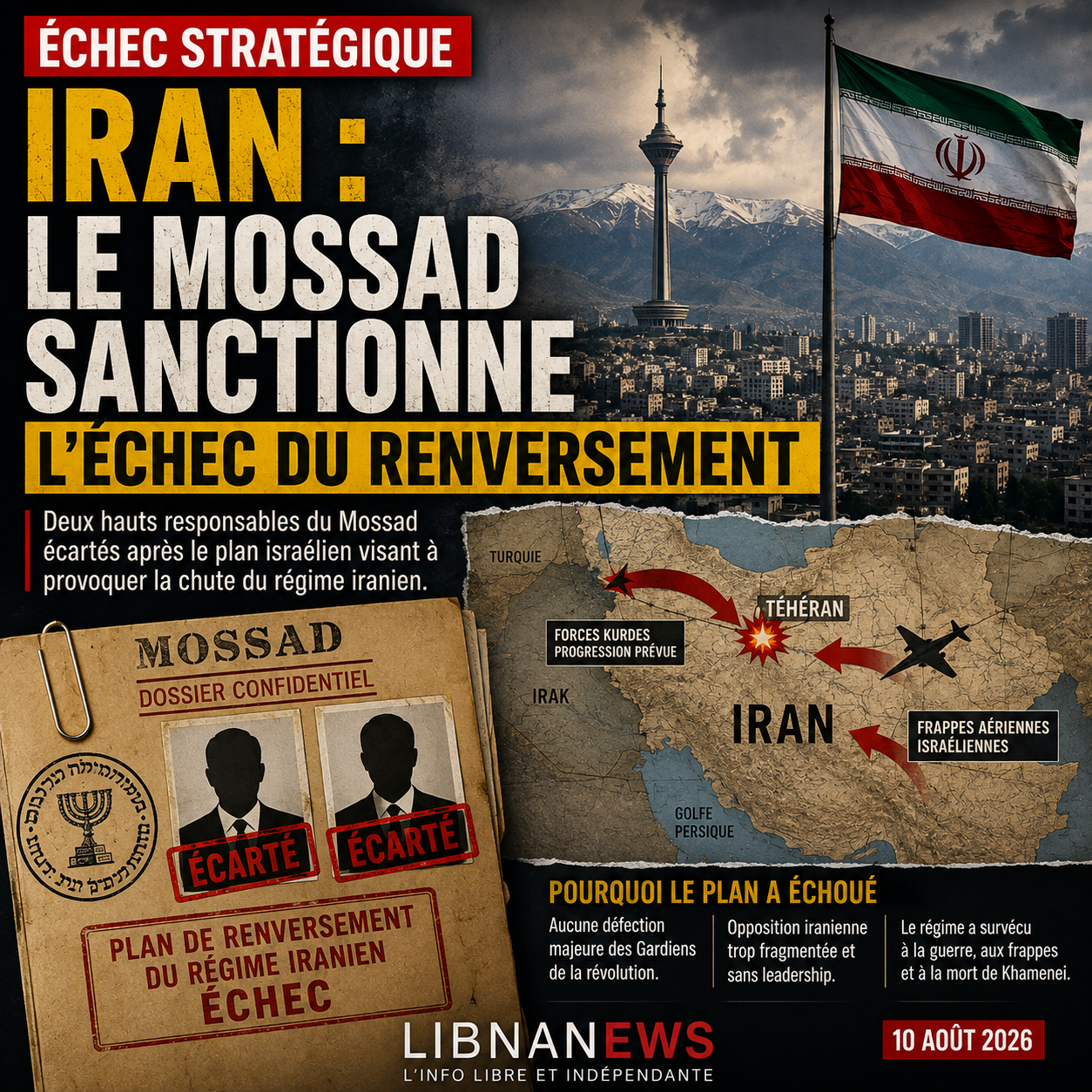
Mossad began punishing officials associated with the failure of the Israeli project to bring about the collapse of the Iranian regime. On 6 August 2026, its new director, Roman Gofman, removed the head of the intelligence directorate and the head of the Iran division, both involved in the design of a plan to promote an internal revolt against the Islamic Republic. According to the Israeli press, this scenario combined air strikes, the mobilization of Iranian minorities and the progression of Kurdish forces to the north-west of the country, with the hope of triggering a political movement capable of taking power to Tehran. Yet the Iranian regime survived the war, the strikes against its leaders and the disappearance of Ayatollah Ali Khamenei. The two dismissed officials should remain in Mossad at other posts, transforming these decisions into command sanctions rather than permanent exclusions. Above all, they open up a more sensitive debate in Israel: who should assume responsibility for an objective of regime change at the highest political level that has not been achieved?
Two Mossad officials dismissed after Iranian failure
The decisions taken by Roman Gofman concern two of Israel’s most sensitive external intelligence posts. The first official had headed the Mossad Intelligence Directorate since December 2025. The second was head of the Iran division, the unit directly responsible for Israel’s main strategic opponent. Their names have not been made public. According to Israeli television, the two men were among the architects of a written operational plan to exploit the war against Iran to bring about an internal political breakup.
The plan was not limited to weakening Iranian nuclear or ballistic infrastructure. It was intended to transform the military offensive into a regime crisis. The idea was to hit the Revolutionary Guards Command Centres and security structures hard enough to create a vacuum, and then encourage minorities and opposition groups to take action. In particular, Kurdish fighters had to take advantage of Israeli and American strikes against Iranian positions close to the Iraqi border to enter Iran and advance to several Kurdish cities.
According to information published in Israel and the United States, the scenario then predicted a knock-on effect. An increasing insurrectionary force was to rally opponents, take advantage of the disorder caused by the bombings and gradually advance towards Tehran. Former Iranian President Mahmoud Ahmadinejad has even been considered in some scenarios as a figure likely to play a role in a new political order. The paradox was considerable: the former Iranian leader was illustrated by a rhetoric that was extremely hostile to Israel and the United States, but some planners would have thought that he could be a rallying point within the Iranian system.
None of this scenario has occurred. The Iranian state apparatus was deeply beaten, several senior officials were killed and the political system went through a period of major disorganization. But he didn’t collapse. The institutions of the Islamic Republic organized the succession, the security forces remained operational and no massive defection of the Revolutionary Guards paved the way for a national insurrection. The very fragmented Iranian opposition also failed to form a structure capable of taking control of the country.
A pre-war regime change goal
The overthrow project was not an improvisation that appeared during the fighting. By November 2025, a senior Israeli official quoted by the public press had said that Israel’s goal was to bring about the fall of the Iranian regime before the end of Donald Trump’s mandate. Several months earlier, Benjamin Netanyahu had already explained that Israeli attacks could lead to regime change in Tehran. The Prime Minister then linked this objective to the need to eliminate what he presented as an existential threat to Israel.
The war launched at the end of February 2026 gave this strategy an operational dimension. Before the strikes began, Netanyahu conducted an intense campaign with Donald Trump to secure American participation. According to an international news agency, the Israeli Prime Minister personally pleaded with the US President for a joint operation that included the possibility of hitting the Iranian leadership. The available information had identified an expected meeting of l’ayatollah Ali Khamenei and several of his close collaborators, creating the possibility of a beheading strike.
Khamenei’s death was one of the most spectacular events in the country. Donald Trump then called on Iranians opposed to the regime to take advantage of the situation to take over their country. Yet the own assessments of American intelligence were much more cautious. In the early days of March, several American officials felt that it was unlikely that the opposition would quickly reverse the system, even after the disappearance of the Supreme Leader and several leading leaders.
In particular, American analysts stressed the absence of massive defections within the Revolutionary Guards. For Washington, this was an essential indicator. An authoritarian regime can survive the disappearance of its leaders as long as enforcement institutions remain organized and their middle managers continue to obey. This is precisely what happened in Iran. Partial beheading of the summit did not result in the collapse of the chain of command.
Israeli services had overestimated the impact of the strikes
The failure of the plan highlights an error of appreciation that goes beyond the military operation alone. Israeli strategists have correctly assessed their ability to hit Iranian territory deeply, reach leaders and disrupt several military structures. On the other hand, they have anticipated much less the reaction of Iranian society and the resilience of institutions. Destroying command centres was not enough to produce a revolution.
This confusion between military weakening and political collapse appears at the heart of today’s Mossad criticism. A bombing campaign may disrupt an opponent, but it does not automatically create a structured opposition, an alternative chain of command or a consensus around a replacement government. Iran also has a long experience of internal crises, sanctions and attempts to destabilize. Its institutions were designed to survive the disappearance of some of their leaders.
The bet on minorities also posed major risks. Iranian Kurdish groups have armed capabilities and local settlement, but their mobilization did not mean that they could lead the rest of the country. Any intervention from the border areas could also be presented by Tehran as an attempt to partition supported by foreign powers. This nationalistic dimension has probably reduced the ability of opponents to transform Israeli strikes into a widespread popular movement.
U.S. assessments had specifically identified this problem. Intelligence officials in Washington believed before the war that the Iranian opposition was too divided to quickly take control of the country. American contacts with several opposition figures, including Reza Pahlavi, did not resolve these doubts. The United States did not have an actor able to impose itself as a credible political authority after the possible fall of the regime.
A first eviction had already hit the Mossad direction
The sanctions announced in August are not the first movement at the top of the service since the failure of the regime change. In June, shortly after taking office, Roman Gofman had already dismissed the deputy director of Mossad, who had been publicly appointed only by the initial « Aleph ». Israeli media then linked his departure to his central role in efforts to bring about the fall of the Iranian regime.
This interpretation, however, had been challenged within the Mossad itself. Sources of the Agency had claimed that Aleph’s departure was rather the result of a change of internal power. Close to former director David Barnea, he would have been perceived as too much related to the old management. According to this version, Gofman focused on consolidating his authority and forming a loyal team around him. Mossad had not publicly confirmed that the Iranian case was the cause of his eviction.
The same ambiguity surrounds the two new decisions today. Israeli television reports that the head of intelligence and the head of the Iran division were dismissed after the failure of the overthrow plan. But security sources also describe these changes as part of a broader reorganisation and indicate that the officials concerned will remain within the agency. It would therefore be excessive to speak of a complete purge.
However, the accumulation of these departures remains significant. In a few weeks, three very high-level officials who participated in the Iranian case lost their command position. Although each decision may have several causes, this concentration shows that the failure of Iran’s strategy has become a major factor in the recomposition of the service.
Roman Gofman himself was associated with the overthrow strategy
The question of responsibility becomes all the more sensitive as Roman Gofman was not outside the project. Before taking over from Mossad, he held the position of military secretary of Benjamin Netanyahu. According to the Israeli press, he was one of the important supporters of the strategy to bring about regime change in Iran.
This data feeds an internal challenge. Critical sources within the Mossad now accuse Gofman of putting responsibility for failure to his subordinates when he himself defended the principle of operation. One of them considered that evictions served to keep Benjamin Netanyahu away from the political responsibility for Iran’s failure. These accusations do not constitute an official position of the agency, but their appearance in the Israeli press shows the extent of the malaise.
The debate therefore concerns the boundary between professional responsibility and political responsibility. Heads of units may be punished if their analyses prove to be false or if their operational plans fail. But when the objective itself—provoking the fall of the Iranian regime—is set or supported at the top of the government, the only sanction of intelligence officials does not answer the question of who defined the strategy.
Benjamin Netanyahu had publicly mentioned the possibility of regime change. He had pleaded with Donald Trump for a war against Iran and supported a campaign to hit the Iranian leadership. The leaders who have now been dismissed have therefore not drawn up their plan in a political vacuum. They worked in an environment where the fall of the Islamic Republic was seen as a desirable outcome, and sometimes as a strategic objective.
Iran came out weakened, but its regime survived
The failure of the overthrow does not mean that the military campaign has been ineffective. Iran has suffered considerable destruction, lost several major officials and seen some of its military capabilities damaged. Its regional network has also been weakened, notably after Hezbollah’s setbacks in Lebanon and the loss of its former Syrian anchor. The war changed the regional balance and forced Tehran to review several priorities.
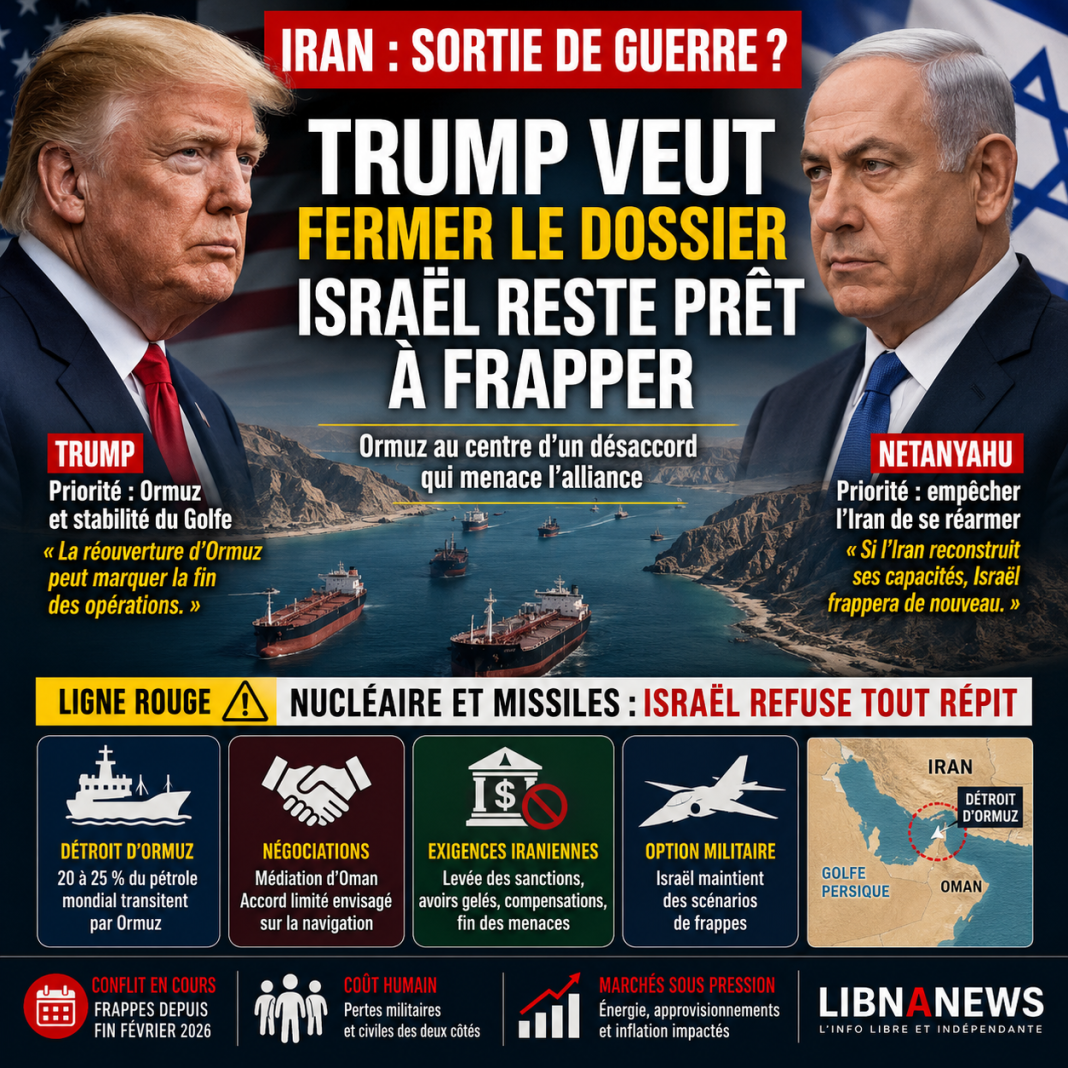
But the criterion of regime change is much simpler to measure: the Islamic Republic still exists. Its institutions have appointed new leaders, the Revolutionary Guards remain a central force and the government retains control of the main urban centres. Tehran even managed to turn the Ormuz Strait into a bargaining lever against the United States, giving the regime a means of pressure that it now uses to obtain concessions.
This survival has political consequences for Israel. The campaign was presented as a historic opportunity to change the Iranian threat in a sustainable manner. Several months later, Israel still needs to consider further strikes against Iranian nuclear or ballistic capabilities. The very fact that these scenarios remain on the table indicates that the most ambitious objectives of the war have not been definitively achieved.
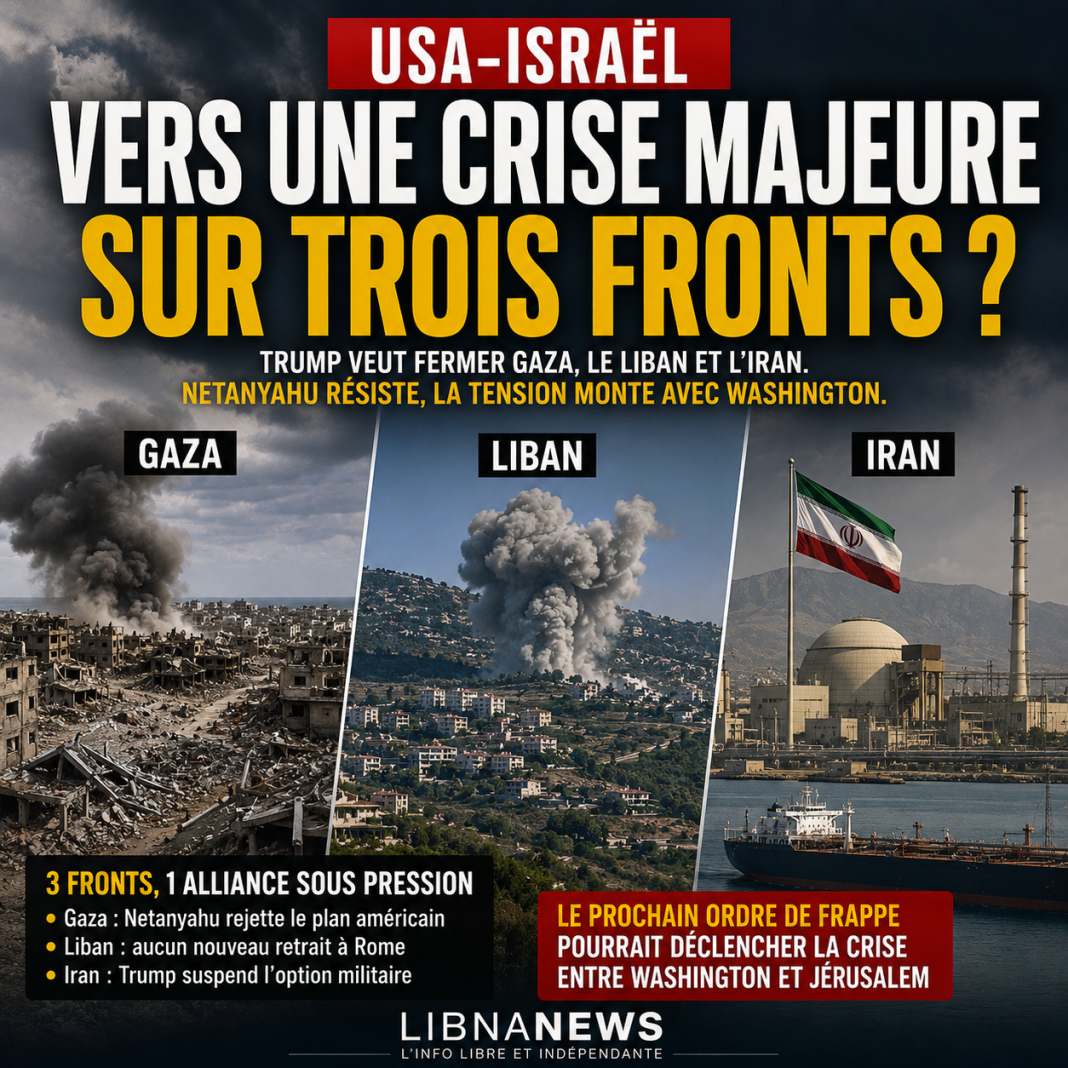
The situation is even more uncomfortable because Washington is now looking for a negotiated exit. Donald Trump suspended another attack in early August in order to give a chance to discussions on the reopening of the Strait of Ormuz. For Israel, this trend further reduces the likelihood that a new US campaign will be used in the short term to pursue the goal of regime change.
Evictions intervene as Trump changes priorities
The timing of decisions in Mossad is therefore notable. The two leaders are dismissed a few days after Donald Trump gave up immediately launching new massive strikes. The US president now wants to test the diplomatic path and get a reduction in the intensity of the war. This evolution leaves Israel facing the balance sheet of its own strategy.
At the beginning of the conflict, Netanyahu had managed to convince Trump to join a campaign that the US President had long hesitated to engage. The death of Khamenei, the attacks on Iranian infrastructure and the weakening of several components of the military apparatus had fueled the idea that a political shift could be close. A few months later, however, the White House was negotiating with the authorities that survived the campaign.
This is a political setback for Israeli officials who have made regime change a strategic horizon. It does not mean that Washington has given up putting pressure on Iran, but priorities have changed. The United States wants to secure energy routes, reduce its military exposure and prevent further regional escalation. The fall of the Iranian regime no longer appears to be a necessary condition for seeking an agreement.
Internal sanctions in Mossad thus take on a broader dimension. They come at a time when Israel must reassess a strategy that was based not only on the destruction of military capabilities, but also on the hope of a political collapse. This collapse did not occur, and Israel’s main ally is now seeking to deal with the power that was to disappear.
Israeli debate on responsibilities is just beginning
The movement of Mossad officials therefore does not close the case. On the contrary, it opens a battle over the interpretation of war. For part of the security apparatus, the question is why the assessments on the fragility of the regime were too optimistic. For Gofman’s critics, the problem lies in the fact that the sanctions are aimed at the perpetrators while the political promoters of the strategy remain in place.
The retention of the two leaders in Mossad also gives an important indication. Had they been considered totally incompetent or responsible for serious operational misconduct, their departure from the agency could have been considered. Their transfer to other functions suggests a loss of confidence in their ability to lead the case or a willingness to reorganize the chain of command after failure.
The proximity of the Israeli elections adds a political dimension. Benjamin Netanyahu must defend the record of the war against Iran while explaining why the regime he wanted to see disappeared remains in place. Part of its legitimacy has been based for years on its ability to present Iran as the main strategic threat and to convince the United States to support a hard line. Washington is now seeking to reduce operations, while Israeli results remain incomplete.
The accusations that Roman Gofman is seeking to protect Netanyahu must be treated with caution. They come from sources cited by the Israeli press and have not been confirmed by Mossad. However, they show that the issue of responsibilities is now beyond the internal functioning of the service. It directly affects the Prime Minister and the way in which war was decided, presented and conducted.
Mossad needs to rebuild its Iranian strategy
The new leadership must now decide what strategy to adopt in the face of a weakened Iran still governed by the Islamic Republic. The replacement of intelligence officers and Iran division can allow Gofman to change priorities. In particular, Mossad will have to reassess opposition networks, minority capacities, the strength of the Revolutionary Guards and the real possibility of an internal challenge capable of surviving without massive external military support.
The service will also have to draw the consequences of American change. A scenario based on Kurdish forces advancing under Israeli-American air cover presupposes a degree of cooperation with Washington that is no longer guaranteed. If Trump favours negotiations with Tehran, Israel can no longer build its Iranian policy on the assumption of automatic American participation in a new attempt to overthrow.
It remains possible that Israel will continue clandestine operations, sabotage or targeted strikes against Iranian capabilities. But these actions meet a different objective. Weakening a nuclear program, disrupting a missile chain or eliminating a military official is a defined mission. Provoking the fall of a regime of more than 40 years requires a combination of political, social and military forces much more difficult to control from abroad.
The changes at the Mossad summit show that this difference is now recognized as an operational problem in Israel. After relying on a combination of strikes, internal insurrection and institutional breakdown, the service must rebuild its device around a surviving opponent. The next step will be the appointment of successors to the Intelligence Directorate and the Iran Division, while Roman Gofman still has to respond to internal criticism of his own participation in a strategy whose main political objectives have not been achieved.