

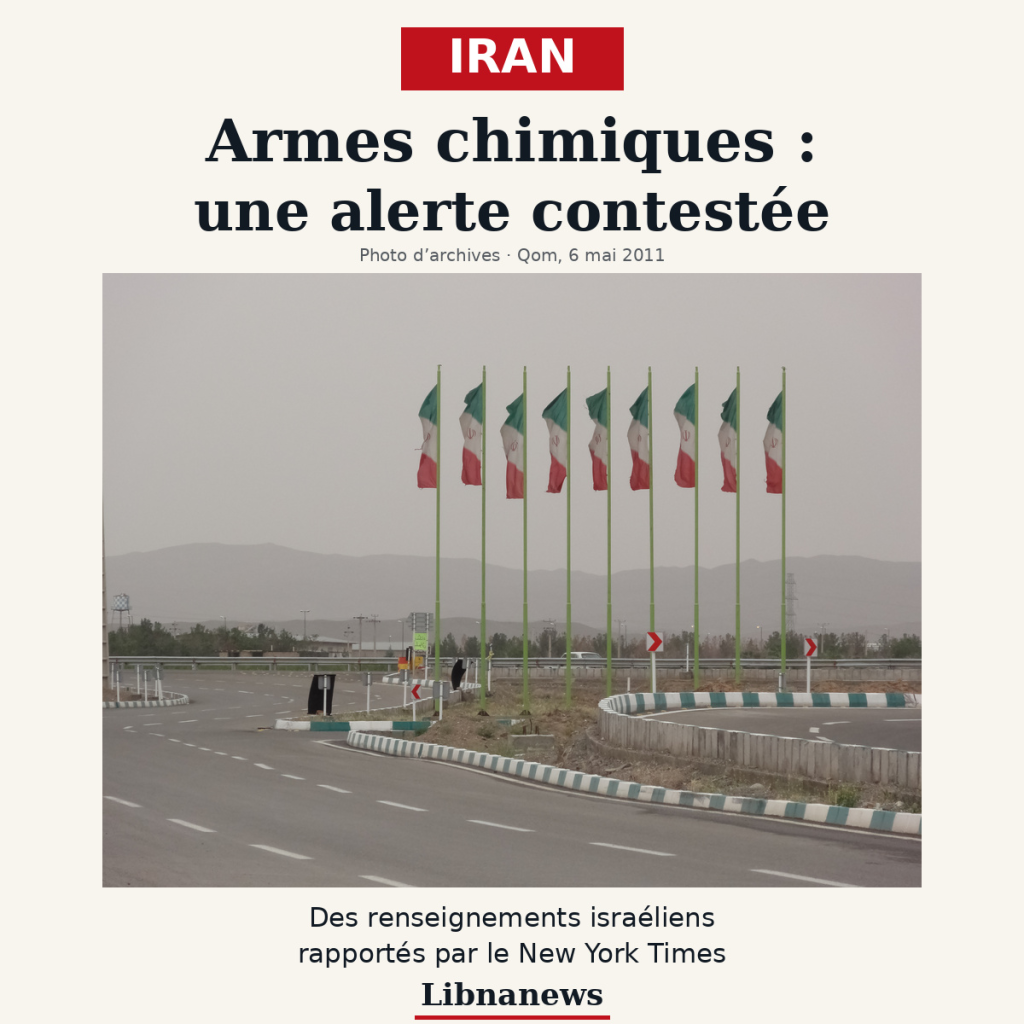
Israel provided the United States with information that Iran would consider using chemical weapons against its opponents, reports the New York Times Tuesday, November 3, 2026. The story of the American daily newspaper, repeated by several Israeli media, describes reactions shared in Washington and the Gulf. It does not constitute an independent confirmation of an Iranian attack project.
According to the newspaper, Israeli officials present this threat as more pressing than the nuclear issue. They refer in particular to the possibility of transporting chemical agents by missiles or introducing them into opposing countries. This information comes from American and regional officials quoted by the daily newspaper. The information itself is not available in the records consulted.
Chemical weapons: differing assessments
Some American officials consider warnings of concern. Others suspect a move to convince Donald Trump to resume major military operations against Iran. The New York Times also describes the scepticism of Gulf officials informed by Israel. Their receipt of this information therefore does not mean that they share the Israeli assessment.
These differences concern a decisive issue: the difference between an assumed capacity and an intention to work. The alleged existence of a programme, its status and a decision to launch an attack are three distinct issues. None can be automatically deducted from the previous one.
Libnanews could not independently verify the information referred to. Available media coverage refers to the same work of the New York Times. Their proliferation confirms the circulation of the story, but does not provide several independent investigations into Iranian capabilities.
It is therefore not possible to present a chemical attack as decided or imminent. The accessible information also does not make it possible to establish a specific target, date of execution or operational order. The serious nature of the charge requires that this distinction be retained in the assessment of the regional situation.
An earlier dispute between Washington and Tehran
The American suspicions about Iranian chemical activities precede the information published on Tuesday. In a national declaration filed with the Organization for the Prohibition of Chemical Weapons in November 2025, Washington already accused Tehran of developing pharmaceutical agents for offensive purposes. The United States presented these activities as contrary to the Chemical Weapons Convention.
This official document establishes the American position. Its publication on the OPCW website, however, does not transform this national declaration into the conclusion of the organization’s technical secretariat. This distinction also applies to positions taken by other Member States.
Tehran rejected previous American charges. In a right of reply filed with OPCW in July 2024, his delegation described them as unfounded. It requested that compliance issues be dealt with through the procedures provided for in the Treaty, in particular Article IX thereof.
This response constitutes a diplomatic precedent. It should not be presented as an Iranian reaction to the account of November 3, 2026. A specific response to this new information remains to be established.
The OPCW Audit Framework
Iran signed the Convention on 13 January 1993 and ratified it on 3 November 1997. The Treaty entered into force for him on 3 December. It requires the State not to develop, produce, acquire, conserve or use chemical weapons. Article 1 also prohibits military preparations for use.
The Convention provides tools to address suspicions of non-compliance. Article IX of the Convention provides for requests for clarification between States parties and for referral to the Executive Council. It also provides for formal inspections in the territory of another State party, in accordance with the conditions laid down in the treaty.
These mechanisms are intended to establish facts. They differ from the exchange of information between governments and public statements by a belligerent. In the latest OPCW news viewed on Tuesday night, no communication specifically responded to the accusations reported by the New York Times.
Charges in the midst of mediation efforts
This case comes as Qatar continues to mediate between Washington and Tehran. On Tuesday, the spokesman for his Ministry of Foreign Affairs, Majed Al Ansari, indicated that both sides were considering the proposals of the mediators. Doha is seeking an interim agreement to restore confidence, without announcing a signature or timetable for implementation.
The Qatari official also warned that military escalation would complicate negotiations. This diplomatic approach remains distinct from the assessment of chemical information. It nevertheless explains the immediate issue of their discussion: the governments concerned must assess a serious accusation as they examine ways of avoiding further intensification of the conflict.
The possible publication of verifiable elements, a precise Iranian response and a position taken by the OPCW would make it possible to better assess the scope of this information. At this stage, the information reported remains disputed by some of the officials who have known about it, according to the New York Times.
Sources and references
- New York Times, original November 3, 2026
- The Times of Israel, New York Times cover, November 3, 2026
- Israel Hayom, New York Times cover, November 3, 2026
- OPCW, Islamic Republic of Iran
- Chemical Weapons Convention, article I
- Chemical Weapons Convention, article IX
- United States, national declaration at the 30th Conference of States Parties, November 2025
- Iran, right of reply to US accusations, July 2024
- OPCW, latest news viewed on November 3, 2026 around 8:00 UTC
- Libnanews, Iran–US: Qatar Targets Interim Agreement, 3 November 2026
The original New York Times article is identified above. The information attributed to him was verified in his recaptures accessible by The Times of Israel and Israel Hayom, which do not constitute independent confirmations of intelligence.
Coverage: Iranian flags in Qom, May 6, 2011. Archive photography: Mostafa Meraji / Wikimedia Commons, CC0 1.0. Integer photo preserved, resized proportionally; Classic graphic dress Libnanews added outside photography. This image shows no chemical weapons or attacks.Photographic source·CC0 1.0.






Comments