

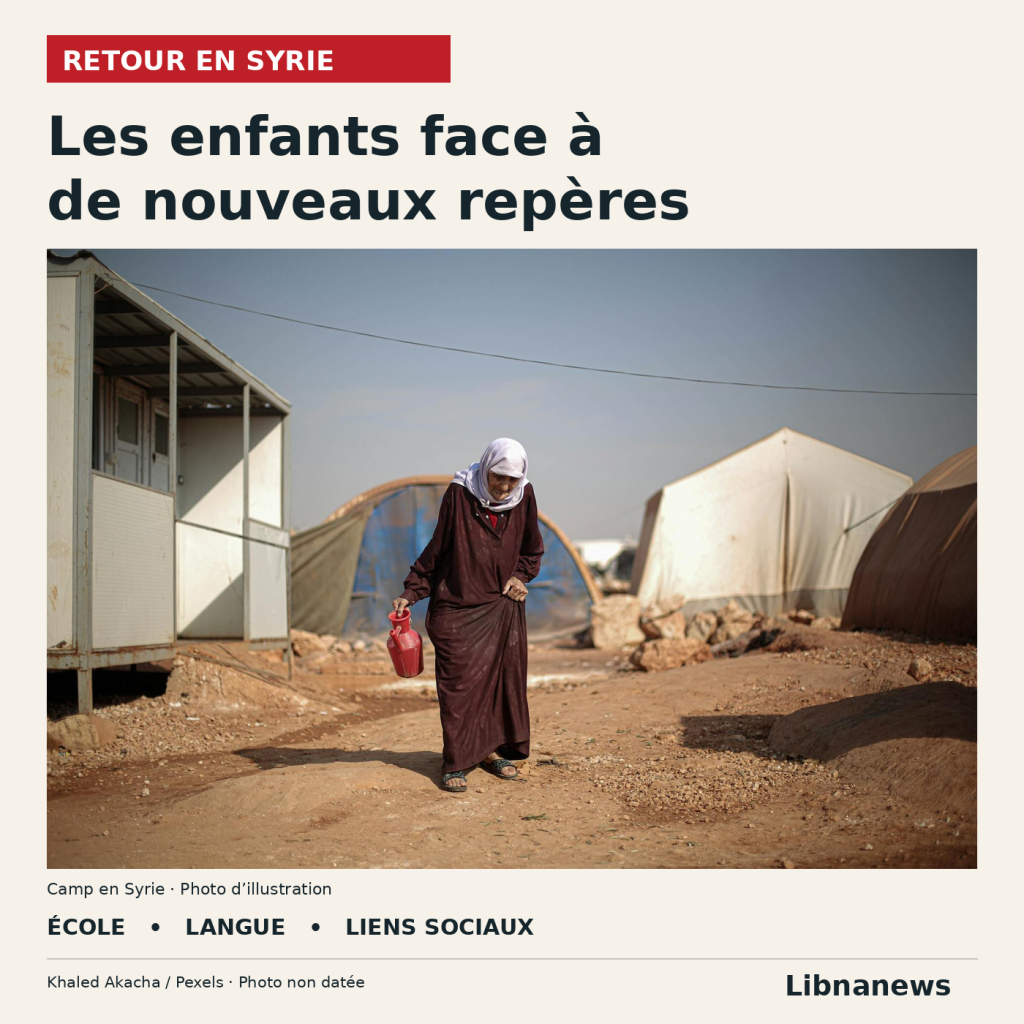
Returning to Syria can bring together a family around a country to which its members are attached in different ways. For parents, it opens the possibility of finding known places. For their children born or raised abroad, it sometimes involves leaving school, friends and learning language.
On October 1, 2026, Catherine Russell, Executive Director of UNICEF, asked to place the children in the Syrian recovery centre. After a three-day visit, she insisted on education, health, water and protection. The needs of children accompany the entire resettlement process, well after crossing the border.
The return to Syria, two stories in one family
The writer Samar Yazbek explores this gap in a stand on 3 November 2026 dedicated to the memory of l’exil. She stressed that some children were first familiar with the schools and streets of the host country. Their parents’ cities are familiar with their stories, without necessarily belonging to their daily experience.
The parent can try to reconnect with an interrupted life. His child approaches a place where he must build new landmarks. Yazbek invites us to recognize this difference without asking the younger generations to reproduce the experience of previous generations to prove their family loyalty.
This reflection joins the concept of post-memory developed by researcher Marianne Hirsch. It refers to the subsequent generations’ relationship to the traumatic experiences of their elders, transmitted through narratives, images and behaviours. This transmission can affect the lives of descendants, even when they have not experienced the events. The concept illuminates a relationship to the past; It does not constitute a diagnosis applicable to all refugee children.
School, a change of language and reference
Families interviewed by Refugees International report difficulties in school integration after a return from Turkey. They refer to differences in programmes and lack of support. The association presents these testimonies in a study published on 15 October 2026.
A mother named Noura explains that her children demand their former school in Turkey. It describes difficulties in understanding the Syrian agenda, building relationships and escaping bullying. This testimony provides information on a family situation, without measuring the frequency of these difficulties.
The study is based on consultations in Turkey between November 2025 and April 2026, as well as on five visits to Syria. The authors recommend language training and teacher support to accommodate students from other school systems.
School paths to be recognised
Re-registration also involves administrative procedures. UNHCR indicated that students returning from abroad must submit documents attesting their education. The procedures differ according to the level achieved and the course followed.
For basic education, a level test may allow admission when school certificates are missing. Some incomplete files may also result in conditional registration, pending supporting documentation. For certificates from foreign programmes, additional tests may be held on Arabic, history and geography.
UNHCR also relays a Syrian decision of 27 April 2026 concerning students holding a Turkish certificate attesting to the success of the eighth year. It provides for conditional admission in the ninth year, followed by an examination of admission to their establishment. Administrative procedures do not guarantee adequate teaching support in each school.
Housing also conditions the stability of children
Save the Children conducted its investigationOne Shock Awaybetween September and November 2025. It includes 90 household surveys, 12 focus groups and 12 child case studies. The research concerns Aleppo, Deir ez-Zor and the Damascus campaign.
Of the households surveyed, nearly two thirds reported having found damaged or destroyed housing. Three out of four say that further economic deterioration could prompt them to return. These results describe the households studied. They are not a national estimate of all Syrian returns.
Published in 2026, the study jointly examines the physical safety, material conditions, rights and psychosocial well-being of children. It thus underlines the risk of a further breakup after the return. Unstable housing or failing services can compromise family settlement and continuity of education.
Rebuilding a daily life and preserving ties
UNICEF is seeking sustainable funding to strengthen schools, health services, water supply and child protection. During her September visit, Catherine Russell visited a rehabilitated school in the Damascus region. The agency also supports the communities that welcome returning families.
UNHCR directs children and their loved ones to community centres offering activities, counselling and assistance in accessing services. It recommends that families maintain daily habits and maintain contact with friends and relatives.
Its teams and partners can support educational, social or protection needs, depending on the services available locally. Children’s spaces include games and learning activities. They give a place to ordinary relationships and occupations in accompanying the return.
Sources
- Samar Yazbek, « … « … » » « The memory of the distant countries », Al Arabi Al Jadid, 3 November 2026
- Unicef, press release of 1 October 2026 after Catherine Russell’s visit
- Marianne Hirsch, post-memory presentation on her site
- Refugees International, Kinda Hawasli and Natasha Hall, Ten Challenges to Syrian Refugee Returns, 15 October 2026
- UNHCR Syria, information on education
- Save the Children Syria, primary notice One Shock Away, publication 2026
- Save the Children International, press release of 18 June 2026
- UNHCR Syria, assistance to children





Comments