

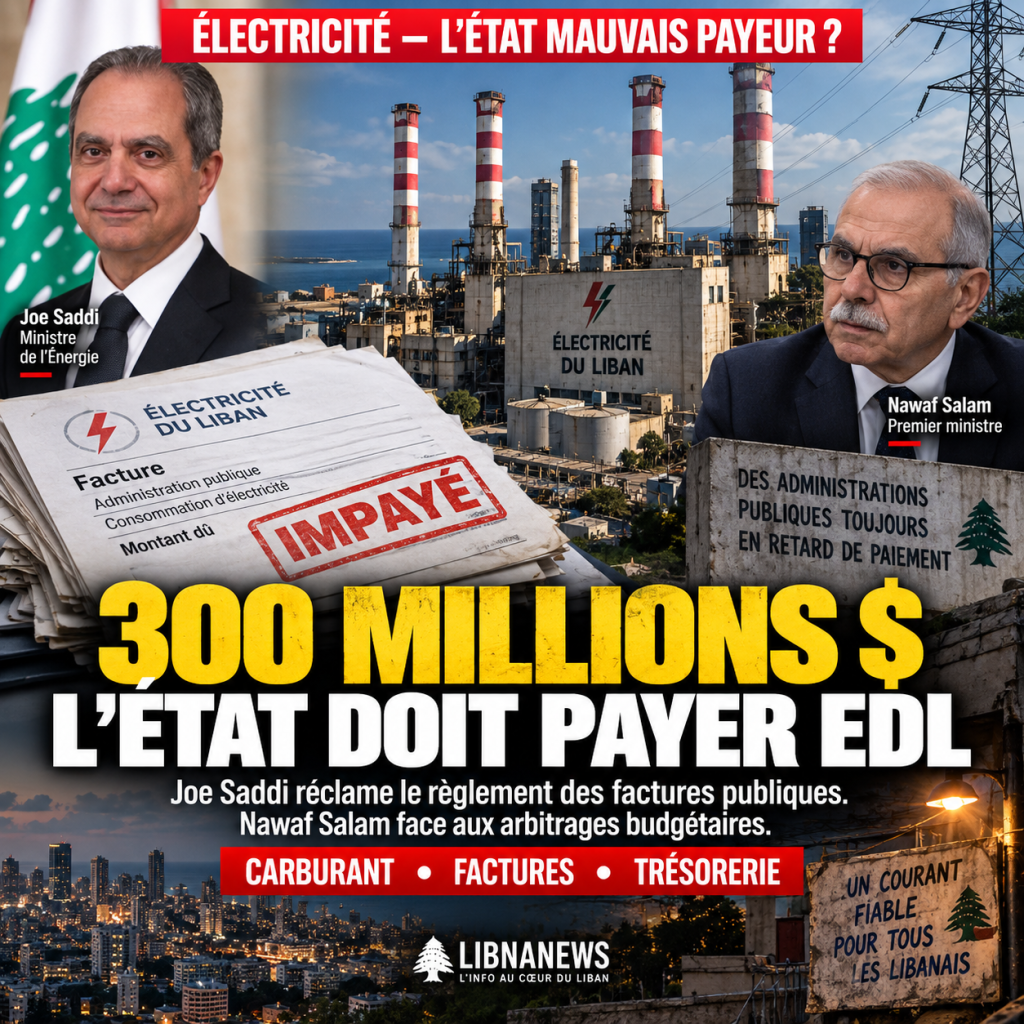
A State debt to its own supplier
About $300 million: this is the amount of money that public administrations and institutions should have at Electricity Lebanon, according to the elements advanced in the government debate of October 8, 2026. The figure comes at a time when Energy Minister Joe Saddi is suspending his participation in Council of Ministers meetings. He does not resign and continues to manage his portfolio. But his supporters point to the settlement of public bills as one of the conditions of the electrical adjustment. The paradox is considerable: the state asks its institution to operate with more financial discipline, while some of its own components would not pay for their consumption. However, this alleged claim is not an amount of cash immediately available. We still need to know who has to do what, how long, and on what basis the sums have been calculated.
The dossier should not be confused with the historical losses of the sector or with the total cost of public subsidies. An unpaid invoice represents a claim recorded or claimed by the supplier; an operating loss measures an imbalance between revenue and expenses; Another type of flow is an advance from the Consolidated Revenue Fund. These categories can cross without being interchangeable. However, the information published does not give a table of accounts receivable or reconciliation of accounts between Electricity of Lebanon and each administration. Nor can they establish what part of the 300 million would be recognized without dispute. This is the first limit of the case: the amount is already the subject of a political battle, whereas its detailed composition is not made public in the press documents examined.
Claims that may block fuel purchases
The question of payment is central because electricity production requires regular expenditure. Fuel purchases do not settle with promises of recovery. Cash is required at a given date, supply contracts are organised and payments are maintained. A large claim on public bodies can therefore weaken the operation of the institution even if it is included in its accounts. But it would be abusive to say that the only recovery of the 300 million would guarantee a continuous diet. The amount of energy produced also depends on the state of the plants, contracts, networks and distribution capacity. An exceptional cash flow can relieve cash flow without lastingly correcting the causes of the structural deficit.
The difficulty is greater when the debtor belongs to the State. The department or institution concerned may not have the credits required for the settlement. In this case, a payment to Electricité du Liban requires a budgetary arbitration: moving an expenditure, opening appropriations or staggering payments. The transaction improves the supplier’s cash flow, but does not create public wealth alone. It moves a charge between entities. The net effect on the finances of the State should therefore be known, not only the amount received by electricity from Lebanon. The sources consulted do not detail these arbitrations. Above all, they establish that the settlement of debts has become a central argument of the minister’s relatives in their confrontation with the executive.
Who has to pay? Missing link to the file
A serious audit should begin by identifying debtors. Central governments, autonomous bodies and public institutions do not necessarily comply with the same financing rules. Some can pay their bills directly; other depend on budgetary transfers; Still others may challenge consumption or billing arrangements. Without ventilation, it is impossible to determine where the main block is. The figure of 300 million does not say whether some large debtors concentrate most of the arrears or whether the unpaid ones are dispersed between many institutions. Nor did he say what part could be recovered within a few weeks and what part would require a multi-year plan.
The chronology of claims is equally decisive. An old debt may have been recorded under different tariff and monetary conditions than today. It may also have resulted in partial payments, compensation or administrative challenges. The dollar value therefore requires an explicit conversion method. Without these details, any estimate of the return of a recovery operation remains fragile. For decision-makers, the priority should be to publish a statement dated, verified and disaggregated, and then to distinguish the amounts due immediately from those that require a legal or budgetary decision. This approach would help to emerge from an opposition between political statements and general denials.
Joe Saddi makes electricity a test for Nawaf Salam
The crisis erupts in a context of tension between Nawaf Salam and the Lebanese Forces. Joe Saddi chose not to sit on the Council of Ministers while maintaining the management of his ministry. He met President Joseph Aoun and then Prime Minister on 7 October. The option of resignation is mentioned in political information, without being retained. The Lebanese Forces defend the minister and blame the government for delaying decisions that could reduce the burden on citizens. The issue of public arrears thus becomes more than an accounting problem: it is used to question the executive’s ability to enforce its own financial obligations.
Saddi’s method, however, presents an institutional contradiction. The measures it is calling for require inter-ministerial cooperation and collective decisions, precisely within a body in which it refuses to participate. The boycott may increase political pressure, but it does not replace a budgetary decision or a payment schedule. Nawaf Salam prefers dialogue for the moment. The information available does not confirm that a compromise has been reached on the claims or that the debtor administrations have received a settlement order. The file therefore remains suspended from verifiable acts: a statement of amounts, a decision on their taking over and actual payments.
The 300,000 pounds of fixed costs, another front of the dispute
Unpaid payments are not the only claim in the debate. The Minister’s support also challenges an increase of 300,000 Lebanese pounds applied to the fixed portion of the invoice for each additional five amperes. The mechanism is distinct from the price paid for energy actually consumed. It affects the subscribed power and can therefore affect a subscriber even when its consumption remains limited. Its removal is presented as an immediate relief measure. But it raises a question that the available information does not allow to quantify: how much does this component contribute to the electricity of Lebanon over a year, and how can it compensate for its disappearance?
Comparison with private generators reinforces the political scope of the debate. Media favourable to Saddi argue that the public current would cost about 15 cents less for a comparable amount of electricity. However, this claim requires a uniform comparison: the same amount of energy, the same periods, including fixed costs and the same power conditions. The real cost to a household depends on the combination of public and private food. An increase in the hours of supply by the national network could reduce purchases from generators, but the economy would depend on the actual availability of power. Without a consumption profile simulation, the advertised differential remains an argument to be examined, not a guaranteed economy for each household.
Five hundred million announced savings: what does this figure measure?
Another amount goes in defence of the minister: up to $500 million in potential savings for citizens and the state. It gives the controversy a much broader dimension than the unpaid invoices alone. But its method of calculation is not detailed in the available elements. The period chosen is not clearly established; the breakdown between households and public finances is not specified; the necessary investments are not quantified. The amount must therefore be presented for what it is: a politically sustained projection, not an accounting result already recognized. It would be particularly misleading to add up to 300 million claims, as recovery of debt and savings are two different transactions.
To verify such a projection, the measures assumed to produce the gains should be identified. Is it a matter of reducing power purchases from generators, improving network efficiency, recovering more bills or reducing some public spending? Each of these levers has its own schedule and costs. Some can benefit households without immediately improving the institution’s accounts. Others can increase Lebanon’s electricity revenues without reducing the total consumer bill. Until these effects are separated, the figure of 500 million works more as a marker of the government arm than as an independent evaluation of the plan.
Zahlé’s precedent and the limits of a local solution
Zahlé’s power supply model regularly returns to discussions on the reform. Its interest is to show that a local organisation can, under certain conditions, offer a more regular service than is known in other regions. But the case cannot serve as automatic proof that generalisation would be simple. The national network must serve very different areas in terms of density, consumption, infrastructure and connection costs. Local arrangements are also based on contractual and technical conditions that are not necessarily reproducible on a large scale. The subject deserves a separate inquiry, based on contracts and actual costs, rather than invoking the model as a universal response.
The Zahlé debate nevertheless highlights a useful question for the public debt file: quality of service and payment discipline must be studied together. Subscribers are more likely to accept high rates when service hours are low. For its part, a private establishment with regular revenues is struggling to finance a stable service. Leaving this circle requires mutual, measurable and public commitments. This involves simultaneously tracking receipts, current hours, fuel costs and service interruptions. None of these detailed series are provided with the political amounts discussed in early October.
A file that requires accounting decisions before declarations are made
The first useful decision would be to make an inventory of sums owed to Electricity of Lebanon by public entities effective against third parties. It should specify, for each debtor, the amount claimed, the amount recognized, the periods concerned and any disputes. The second would be to establish a settlement schedule compatible with budgetary capacity. The third would be to publish the use of additional revenues, such as fuel purchases, maintenance, repayment of bonds or the creation of a cash reserve. These steps would not replace a comprehensive reform of the sector, but would help to assess whether public payments actually improve service.
As of October 8, 2026, the available evidence does not confirm that the $300 million has been audited, that a schedule has been adopted or that new payments have begun. They show, however, that the issue has become one of the main points of friction between Joe Saddi and Nawaf Salam. The Minister wants decisions on revenues and tariffs; the Prime Minister must arbitrate between the needs of the sector and those of all administrations. Behind the spectacular amount is therefore a more precise question: is the state able to organise its own payments and report publicly, before asking subscribers to bear new charges?





Comments