

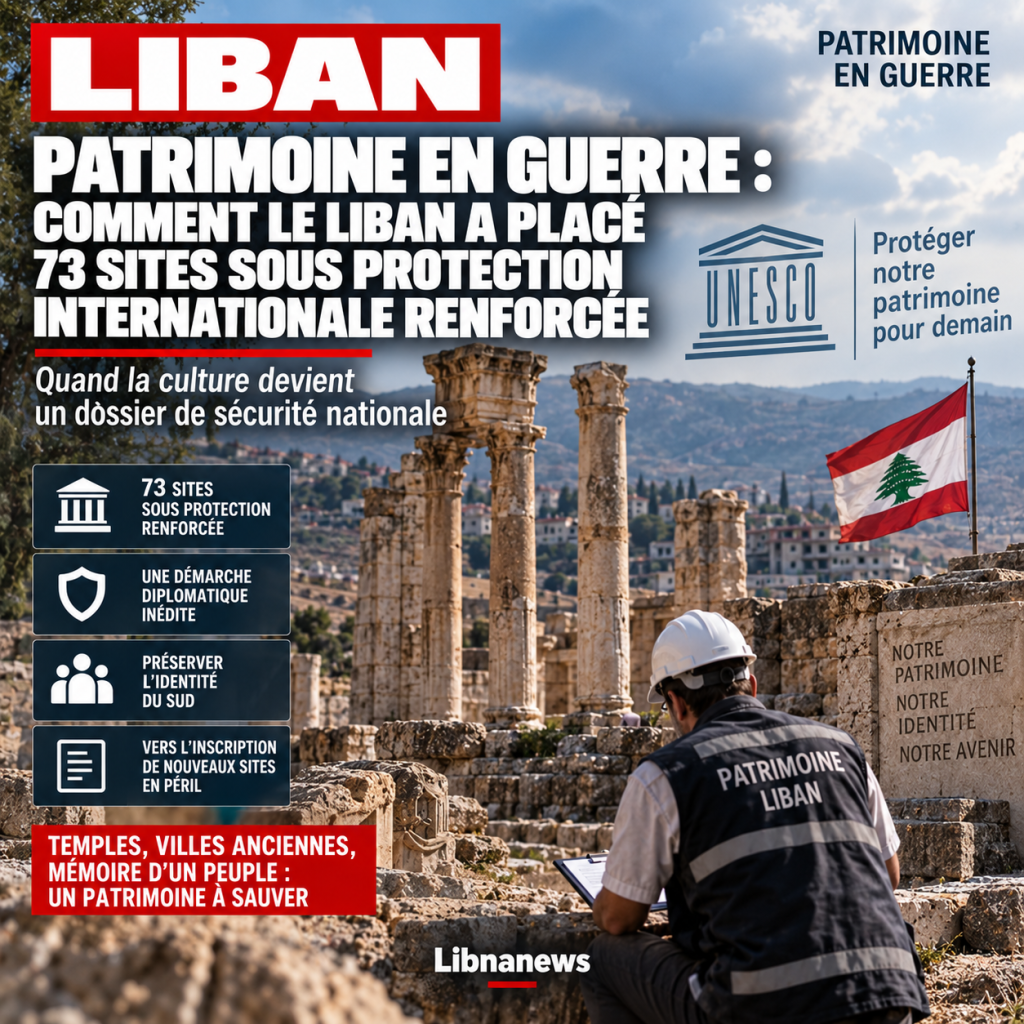
When culture becomes a national security issue
Ghassan Salamé, Minister of Culture, summarized the problem in unusual terms for a cultural administration: war put his ministry before an « existential test ». The formula does not only concern the conservation of ancient monuments. In southern Lebanon, where strikes, destructions and displacements directly affect the territory, protecting an archaeological or heritage site also protects part of the country’s material memory. Heritage then ceases to be a dossier reserved for museums and specialists. It becomes a question of sovereignty, identity and international law.
This reading led the ministry to look for what Ghassan Salame described as the highest form of protection available in international law. The process led to the convening of an emergency meeting of the World Heritage Committee in early April 2026. The Committee comprises 21 States. It unanimously adopted a decision placing 73 Lebanese archaeological and heritage sites under a strengthened protection regime.
The figure of 73 is important, but it must not obscure the meaning of the approach. The ministry was not content to ask for a statement of support for Lebanese culture. It sought to bring specific sites into a more protective international legal framework. In other words, cultural diplomacy has been used as an instrument to reduce risk in wartime.
A diplomatic battle waged while the South remained under fire
The process is part of a sequence where the heritage of the South could no longer be treated as an ordinary case. The fighting and strikes exposed ancient localities, historic buildings, archaeological sites and cultural landscapes to direct or indirect destruction. Even when a monument is not targeted, an explosion nearby can damage a fragile structure, cause cracks, destroy local archives or make it impossible to maintain a site.
The displacement of the inhabitants creates another danger. A heritage abandoned for months is more vulnerable to weather, looting, uncontrolled work and degradation. The protection of a site, therefore, is not just to prevent a bomb from touching it. It also involves preserving its environment, maintaining documentation and enabling Lebanese institutions to access it.
The ministry has chosen to respond on the ground where it has a lever: law and international cultural institutions. Ghassan Salamé describes this approach as a « cultural diplomacy », i.e. the use of heritage networks, conventions and organizations to obtain protection that cannot be guaranteed by military power alone.
The decisive role of a committee of 21 states
The passage through the World Heritage Committee gives the initiative a special focus. The decision was not taken by a single foreign administration or non-governmental organization. It was adopted unanimously by the 21 Member States of the Committee meeting in urgent fashion. This unanimity gives Lebanon an additional diplomatic argument when it reports a threat to a protected site.
However, the vote does not create a physical barrier around monuments. No international cultural mechanism can physically prevent a strike as would a defence system. Its strength is of another nature: it officially identifies the property concerned, raises its protection status and increases the legal and diplomatic cost of an infringement to them.
This distinction is essential to avoid presenting international protection as an absolute guarantee. The world heritage has already been destroyed in many conflicts despite the conventions. But the existence of a formal status facilitates the documentation of a violation, reinforces diplomatic approaches and can weigh in the subsequent establishment of responsibilities.
Seventy-three sites: a list that turns places into an international record
The available corpus confirms the number of 73 sites and their placement under enhanced protection, but it does not provide a complete nominative list of these 73 properties. It would therefore be imprudent to invent a detailed mapping or to assign this status to a particular monument without any additional documentation. What the evidence suggests is that the approach involves Lebanese archaeological and heritage sites and that war in the South is the central context for the ministry’s action.
This documentary limit is important. In a subject of heritage, the accuracy of the lists legally counts. A site located a few hundred metres from another may not have the same status. The article therefore cannot substitute a supposed list for the official decision. The fact that the Ministry is now seeking to expand protection further also shows that not all sites fall under the same regime.
The selection of 73 locations, however, means that Lebanon has set up a sufficiently structured file to convince committee members of the need for a collective measure. This requires documentation, identification and diplomatic arguments. Culture thus becomes an area where the administration must be able to produce evidence and records with the same rigour as in political negotiations.
Enhanced protection and heritage at risk: two different approaches
The department does not consider the April decision to be the culmination of its strategy. Ghassan Salamé indicates that he is now working to have certain Lebanese sites already on the World Heritage List on the World Heritage List at Risk. Both approaches should not be confused. They meet different logics, even if they pursue a common objective of protection.
The listing of heritage at risk indicates that a globally recognized asset faces serious threats requiring exceptional attention. For Lebanon, obtaining this status for war-exposed sites would make it possible to attract more international attention, strengthen monitoring of their condition and facilitate mobilization around their preservation.
The choice also has a symbolic dimension. To place a property at risk is to publicly acknowledge that its preservation can no longer be considered normal. However, the Department seems to believe that the protective benefit and international visibility outweigh the fear of giving an image of vulnerability.
Why the South is also an identity battle
Ghassan Salamé explicitly links heritage protection with a battle over Lebanon’s identity and, more particularly, the identity of the South. This formulation deserves to be taken seriously. A territory is not only defined by a border line. It is also made by its villages, places of worship, remains, buildings, traditions and traces left by successive generations.
Heritage destruction therefore has an effect that goes beyond aesthetic loss. When a historic building disappears, it is a material proof of continuity that disappears with it. In areas where the population is displaced, preserving the places can help maintain the link between the inhabitants and their territory until they return.
This dimension explains why cultural diplomacy can become a component of national policy. International recognition of the value of a site also means registering its existence in archives, decisions and obligations that go beyond the immediate conflict. Even if protection does not physically stop weapons, it prevents destruction from being treated as an event without memory or documentation.
Jordan as a forum for explaining the Lebanese strategy
Ghassan Salamé outlined this policy in Amman during an official visit to Jordan. Invited to give a lecture entitled « Cultural diplomacy: does it succeed where politics fails? », he chose to present the protection of Lebanese heritage as a concrete example of what culture can achieve when conventional political channels are limited.
The conference was held at the headquarters of the Lebanese Embassy, at the invitation of the Lebanese-Jordanian Association and under the supervision of Ambassador Brigitte Tawk. Among the personalities present were Lakhdar Brahimi, former international official, Marwan Muasher, former Jordanian Minister of Foreign Affairs, and Princess Wijdan Al-Hashemi, Chairman of the Board of Directors of the National Museum of Fine Arts, alongside officials, diplomats and cultural actors.
The choice of Amman is not trivial. It allows Lebanese heritage to be placed in a regional environment where several countries have themselves been confronted with the destruction, trafficking or endangerment of cultural property. Cultural diplomacy also works by creating understanding coalitions: convincing other states that the protection of a Lebanese site is a shared heritage interest.
Meetings that prolong technical work
On the margins of his visit, Ghassan Salamé met Haifa Najjar, Chairman of the Committee on Culture and Youth in the Jordanian Senate, and Michel Nazzal, Chairman of the Committee on Tourism and Antiquities. Further meetings with Jordanian ministers were planned. These exchanges show that cultural diplomacy is not limited to major multilateral forums.
Parliamentarians, antique leaders, museums and ministries can play a role in building support, sharing expertise and preparing future decisions. A file submitted to an international organization is often built long before the vote, through a series of bilateral contacts where technical and political arguments are explained.
For Lebanon, this method is particularly useful because its financial and military resources are limited. Heritage is an area where it can turn material weakness into a legal and diplomatic record, provided that it has accurate documentation and a network of support.
Protection to be accompanied by an inventory of damage
The international status does not exempt Lebanon from its own work. After each episode of violence, the cultural authorities must be able to document the state of the sites: photographs, records, description of damage, location and estimation of the necessary interventions. Without a reliable inventory, it becomes difficult to prove that degradation is linked to a specific event or to prepare a restoration.
This requirement is all the more important in the South as access to certain areas remains dangerous or impossible. Heritage teams may not be able to inspect a site immediately after a strike. It is therefore necessary to provide for remote documentation methods, collect available images and keep information until physical inspection is possible.
The corpus does not provide a complete balance of damage to 73 sites or the cost of restoration. It would therefore be artificial to advance an overall amount. This lack of figures is itself an issue: the next step in protection will require a detailed site-by-site assessment when security conditions permit.
International law does not replace reconstruction
Getting a protective status is a first battle. Restoring damaged heritage is another. Interventions on an ancient monument require specialists, suitable materials, prior studies and sometimes years of work. Rapid reconstruction using modern techniques can itself destroy the heritage value that one seeks to save.
Lebanon must therefore articulate urgency and conservation. Some structures may require immediate slatting to avoid collapse. Others must be protected from weather. But definitive restorations cannot be launched without diagnosis. International mobilization can help finance this expertise, but it does not replace national institutions that define priorities.
The protection of 73 sites then takes on an economic dimension. Saving a heritage not only means preserving the past. Historic sites participate in tourism, local activity, catering and international image of the country. Their destruction therefore adds an economic loss to cultural losses.
A diplomatic victory that opens a longer battle
The unanimous decision reached at the beginning of April was a clear diplomatic result: 73 Lebanese sites had been placed under a strengthened protection regime. But Ghassan Salamé himself presents this advance as a stage in a cultural war that is not over. The Ministry is now seeking additional status for assets already listed as World Heritage and threatened by the conflict.
The real success of this strategy will depend on several factors. Sites should be monitored, damage documented and potential violations reported. Lebanon must maintain diplomatic contacts, prepare technical dossiers and mobilize international institutions when restoration becomes possible. Above all, it must prevent legal protection from remaining a title without operational translation.
In a country where the debate on the South is dominated by arms, negotiations and borders, this battle recalls that a territory can also be lost by erasing its memory. The protection of archaeological and heritage sites does not regulate war or occupation. It seeks to ensure that, at the end of the conflict, the inhabitants find not only land, but also the traces that tell why this land is theirs.





Comments