





At the heart of the Eastern Mediterranean, Cyprus, long under British rule, reached a decisive stage in its history on 16 August 1960. On that day, the official proclamation of independence marked the culmination of a process negotiated fiercely between the United Kingdom, Greece, Turkey and representatives of the Cypriot communities. This event, the result of the Zurich and London agreements signed in February 1959, ended more than eight decades of British colonial control, while creating a complex constitutional framework to balance the aspirations of the Greek and Turkish populations on the island. In a context of accelerated decolonization following the Second World War, this independence reflects the nationalist tensions in the region, opposing the ideals of union with Greece to those of partition or maintenance of the status quo.
The history of Cyprus under British guardianship dates back to 1878, when the Ottoman Empire, weakened, ceded the island’s administration to the United Kingdom in exchange for support against Russia. This transfer, formalized by the Cyprus Convention, places the island under a British administration while maintaining a nominal Ottoman sovereignty. In 1914, with the entry into war of the Ottoman Empire alongside the Central Powers, the United Kingdom officially annexed Cyprus, transforming it into a protectorate. Then, in 1925, it became a Crown colony, fully integrated into the British colonial empire. During this period, the British administration developed infrastructure, modernized the economy and established an education system, but these advances mask growing frustrations among the population.
The Greek majority, representing about 77% of the population, has long been a strong supporter of the aspirations of the enosis, union with the mother Greece. Influenced by the Greek revolution of 1821 and the ideals of Greek nationalism, this community saw Cyprus as a natural extension of the Greek world. Conversely, the Turkish minority, about 18% of the population, fears Greek domination and often prefers to maintain the British presence as a guarantee of security. These ethnic and religious divisions, inherited from centuries of coexistence under the Ottoman Empire, exacerbate in the post-war years. The rise of anti-colonial movements in Asia and Africa inspired Cypriots, while Greece, a weakened exit from the civil war (1946-1949), revived the Cyprus question on the international scene.
The roots of exacerbated nationalism
In the 1930s, sporadic riots broke out against the British administration, especially in 1931, when Greek-chypriot protesters set fire to the governor’s residence in Nicosia. These disturbances lead to increased repression, with the ban on political parties and strict censorship. The Second World War accentuated disparities: thousands of Cypriots joined the British army, hoping for later recognition, but the promises of self-determination remained a dead letter. In 1948, the United Kingdom proposed a limited constitutional plan, rejected by the Greek-Cypriot people who demanded that it be.
A turning point occurred in January 1950, when the Orthodox Church of Cyprus, under the leadership of Archbishop Makarios II, organized an informal plebiscite on the enosis. Although the Turkish Cypriots boycott the vote, 96% of Greek Cypriot participants voted in favour of union with Greece. This referendum, although unofficial, galvanizes the nationalist movement and attracts international attention. Greece brought the case before the United Nations in 1954, invoking the right to self-determination, but the debates were simmering against the British and Turkish opposition. The United Kingdom argues that Cyprus is strategic for its military bases, essential in the context of the cold war and the proximity of the Suez Canal.
At the same time, internal tensions are worsening. The Turkish community forms organizations such as the Turkish National Party, defending the Taksim, or partition of the island. Intercommunal clashes broke out sporadically, exacerbated by rival propaganda. It is in this climate that the idea of an armed struggle, inspired by guerrilla movements in Algeria or Ireland, arises. Greek-chypriot leaders, aware of the limits of diplomacy, opt for a strategy combining political pressure and military actions.
The birth of EOKA and the breakdown of violence
1 April 1955 marks the official beginning of the armed campaign with the founding of EOKA, the National Organization of Cypriot Fighters, led by Colonel Georgios Grivas, an experienced Greek officer, known as the Digenis War. Grivas, a veteran of world wars and Greek resistance, arrived clandestinely in Cyprus in November 1954 to organize an underground network. The EOKA, with about 300 regular fighters and 1,000 active members, recruits Cypriot farmers through the Union of Cypriot Farmers (PEK) and young people via movements such as the Christian Youth Organisation (OHEN) and the Pancyrian Youth (PEON). The objective is clear: to harass British forces to force concessions leading to the enosis.
On the night of 29-30 March 1955, a series of 18 bomb attacks targeted British installations, police stations and military sites across the island. Among the notable actions, the explosion at police headquarters in Famagusta and the destruction of the transmitter of the Cyprus Broadcasting Station. A revolutionary proclamation, signed Digenis, calls on the Cypriots to fight. In June 1955, more than 204 incidents were recorded, including shooting and sabotage. The EOKA initially avoids the Turkish-chypriot, focusing on the British and Greek collaborators.
Grivas and Archbishop Makarios III, elected in September 1950, work closely together, although differences are emerging. Makarios prefers limited sabotage to avoid loss of life, while Grivas advocates a more aggressive guerrilla. The organisation relies on a national front (EMAK) for intelligence, supplies and propaganda, and on youth (ANE) for demonstrations. Operations such as « Progress to Victory » in November 1955 included assassinations of members of the British secret service and symbolic battles, such as flag battles, where schoolchildren raised the Greek flag, causing riots.
The British repression and exile of Makarios
In the face of this insurgency, the British authorities, initially taken out of sight, reinforced their presence. Governor Robert Armitage was replaced in October 1955 by Sir John Harding, a seasoned soldier. On 26 November 1955, the state of emergency was declared imposing the death penalty for carrying weapons, collective punishment and repressive laws. Mass raking operations, such as « Kennett » or « Pepperpot », target the Troodos maquis, capturing guerrillas but suffering losses.
The repression extended to civilians: house searches, mass arrests (128 members of the Communist Party AKEL in December 1955) and allegations of torture, including beatings, flogging and more sophisticated methods such as the use of hot eggs or electroshocks. The British recruited Turkish-Cypriot police officers, reaching 4,000 in 1956, exacerbating intercommunal tensions. As early as January 1957, EOKA targeted these policemen, triggering riots.
On 9 March 1956, Makarios was arrested and exiled to Seychelles, via Aden and Mombasa, accused of supporting the violence. This led to a wave of attacks: 246 in March 1956 alone, including an attempt against Harding. Makarios, since his exile, continues to work diplomatically, as an assistant to the UN General Assemblies, and pleading for lenosis. Freed a year later, he moved to Athens, banned from returning to Cyprus.
Climbing and early signs of compromise
1957 saw a truce from March to October, allowing EOKA to reorganise, but negotiations failed. Under the new Governor Hugh Foot in December 1957, violence resumed. The 1958 MacMillan plan, proposing a de facto score, was rejected, leading to an indiscriminate campaign against the British: 104 incidents in two months, causing 8 deaths. In total, the guerrillas killed 104 British soldiers, 54 police (15 Greek, 22 Turkish, 12 British) and 238 civilians (26 British, 203 Greek, 7 Turkish).
At the same time, the Turkish community formed the Türk Mukavemet Teşkilatı (TMT) in 1958, with British tolerance, as a counterweight to EOKA. Intercommunal violence broke out, with 55 Greeks killed by Turks and 59 Turks by Greeks in 1958. These tensions, coupled with the fear of a Greek-Turkish war and instability in NATO, lead to a compromise. Greece, under Konstantinos Karamanlis, and Turkey, under Adnan Menderes, opt for independence rather than leenosis or taksim.
Zurich agreements: foundations for a precarious balance
Negotiations accelerated at the end of 1958. On 11 February 1959, in Zurich, Karamanlis and Menders, with their foreign ministers Evangelios Averoff and Fatin Rüştü Zorlu, signed the basic agreements. These texts include the Treaty of Guarantee and the Treaty of Alliance. The Treaty of Guarantee commits the United Kingdom, Greece, Turkey and Cyprus to preserve the independence and territorial integrity of the island, prohibiting any union with another State or partition. Article 4 states: « To the extent that joint or concerted action may not be possible, each of the three guaranteeing powers reserves the right to act solely for the purpose of restoring the state of affairs created by this Treaty. »
The Treaty of Alliance provides for military cooperation between Greece, Turkey and Cyprus. These agreements lay the foundations for a bicommunal and bizonal federation, with ethnic quotas to balance powers.
London Accords: Towards a Bi-Communal Constitution
On 19 February 1959, in Lancaster House in London, the Zurich agreements were extended with the participation of the United Kingdom and Cypriot leaders: Makarios for the Greeks and Fazıl Küçük for the Turks. Initially reluctant, Makarios accepted under pressure, marking an abandonment of the neosis in favour of independence.
The new constitution divides the Cypriots into two communities. The President is Greek-Cypriot, elected by the Greeks; the Turkish-Cypriot Vice-President, elected by the Turks, has a final veto on the laws and decisions of the Council of Ministers. The Council has ten ministers, three of whom are appointed by the Vice-President. The House of Representatives, elected separately, may not amend the basic articles without agreement; other laws, such as tax or municipal laws, require separate simple majorities, preventing a community from legislating alone.
The quotas extend to the administration: 70% Greek, 30% Turkish in the civil service and the army. The United Kingdom retains sovereignty over the bases of Akrotiri and Dhekelia.
The central figures of the movement
Makarios III, born Michael Christodoulou Mouskos in 1913, embodies spiritual and political leadership. Monk at Kykkos Monastery in 1926, graduated in theology in Athens and Boston, he became bishop of Kition in 1948 and archbishop in 1950. Ethnarch of the Greeks-chypriots, he binds the Church to the national cause, organizing the plebiscite of 1950 and supporting the EOKA without admitting direct involvement.
Georgios Grivas, born in 1897, leads EOKA with a military discipline. A Greek veterinarian, he formed guerrilla groups in the mountains and cities, coordinating attacks and ambushes. His visceral anti-communism distinguishes him, also targeting the members of the AKEL.
Fazıl Küçük, Turkish-chypriot doctor and leader, defends the interests of his community, favoring the taksim initially but accepting independence as a compromise.
Karamanlis and Menders, Greek and Turkish prime ministers, play a pivotal diplomatic role, avoiding regional conflict.
The establishment of the Republic of Cyprus
On March 1, 1959, Makarios returned triumphantly to Nicosia, welcomed by immense crowds. The presidential elections of 13 December 1959 brought him to power with two thirds of the Greek votes against Ioannis Klerides. Küçük becomes Vice-President.
The total population is 573,566: 77.1% Greek, 18.2% Turkish and 4.7% other. The Constitution, promulgated in 1960, established a joint system, with separate courts for community affairs and a mixed army.
Solemn proclamation and international guarantees
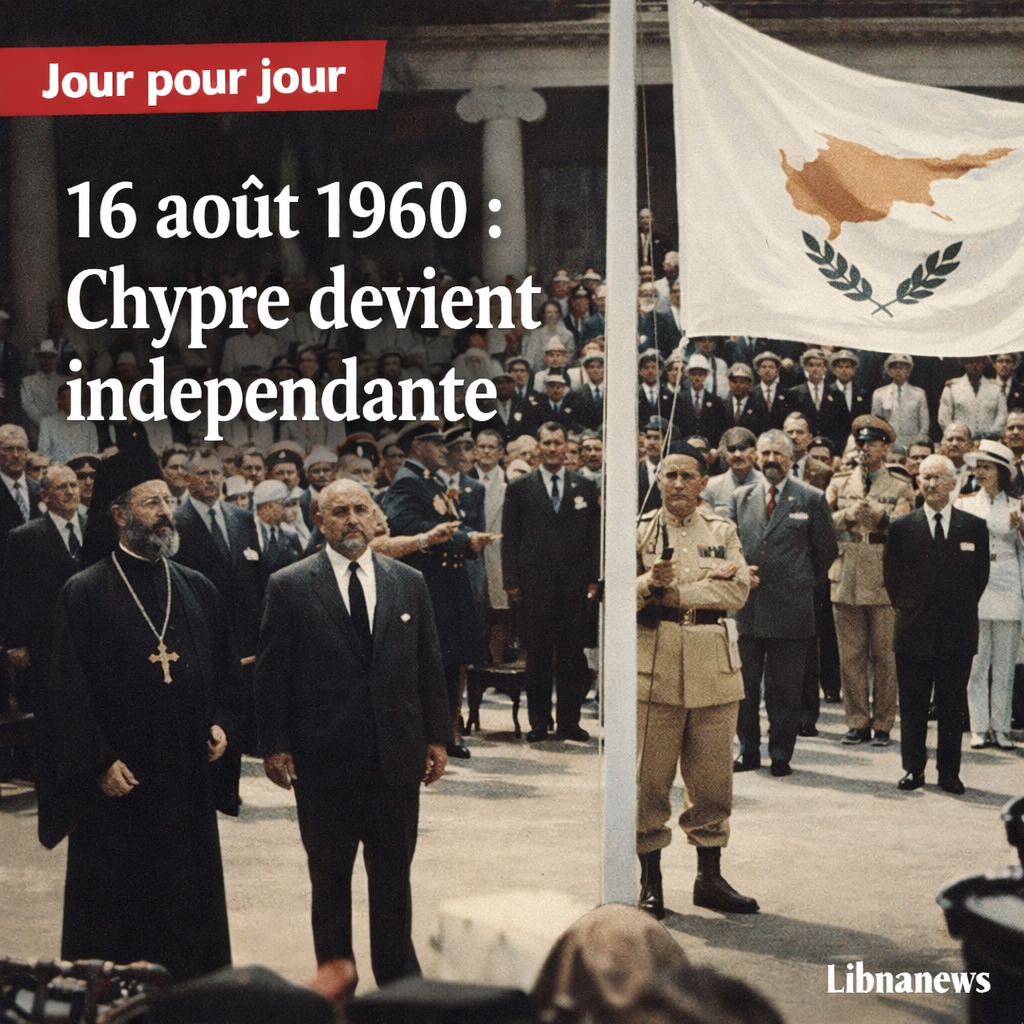
On 16 August 1960, in Nicosia, the Republic of Cyprus was declared independent at a formal ceremony. The Cypriot flag, neutral with a copper island map on a white background, symbolizes unity. Makarios takes the oath as President, Küçük as Vice-President. Treaties are signed: the Treaty of Establishment confirms the British bases; The Treaty of Guarantee calls on the powers to ensure respect for the Constitution.
This independence creates an immediate balance between communities, with quotas protecting the Turkish minority. Greek and Turkish forces stationed on the island under the Treaty of Alliance, while the United Kingdom maintained its strategic installations. The immediate implications are manifested in the formation of government, where appointments scrupulously respect ethnic ratios, ensuring proportional representation in emerging institutions.