

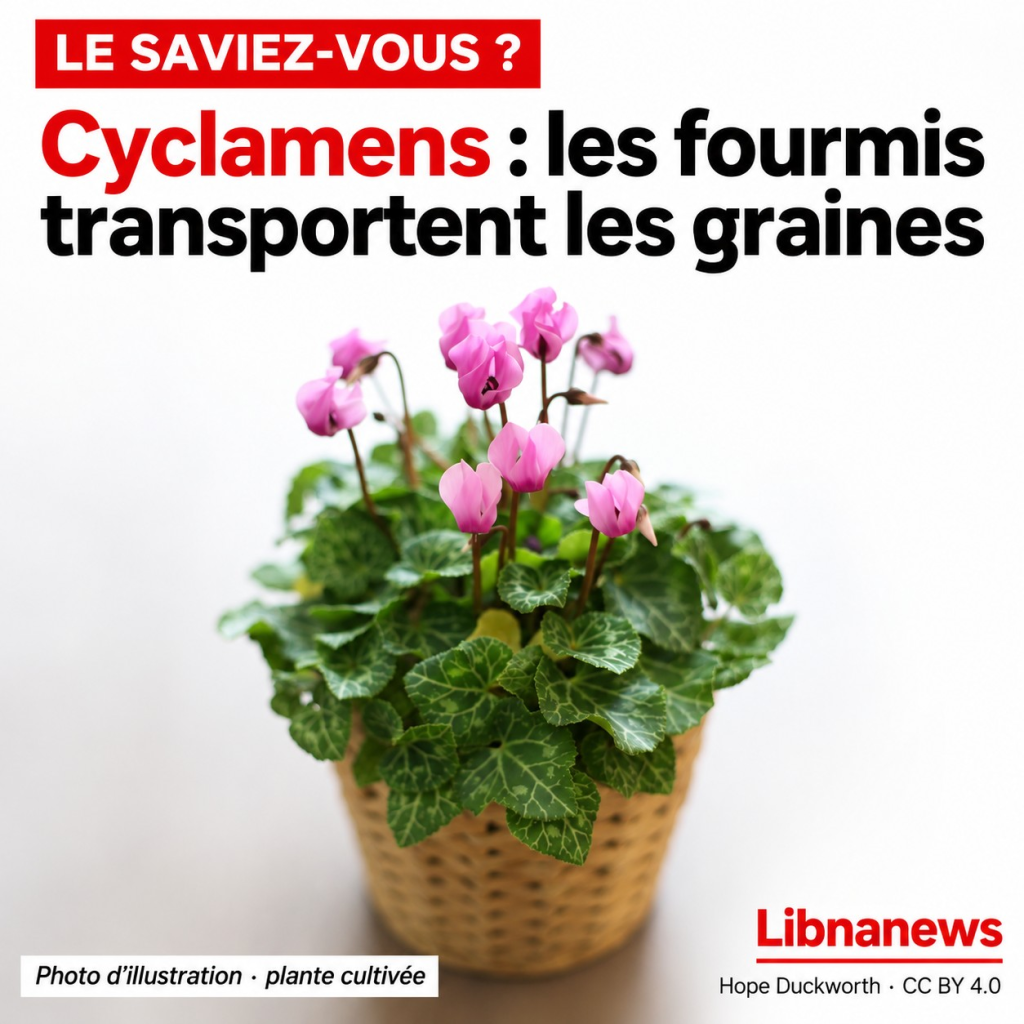
Did you know that? Cyclamen can entrust their seeds to ants. This method of dispersion, described for the botanical genus, gives another look at plants present in the flora of Lebanon. At Cyclamen persicum, a native species of the country, sweet and sticky seeds attract these insects.
Cyclamen and their travelling seeds
A plant remains attached to the ground, but its descendants can move away from it. For cyclamen, ants participate in this movement. They do not come to admire the flowers: the seeds have an envelope that attracts them. Their transport can thus move the future plant even before germination.
The botanical sheet of the North Carolina State University describes this gender-scale dispersion Cyclamen. It indicates that fruits are capsules containing sticky and sweet seeds. At maturity, these capsules open and make the seeds accessible.
The Royal Horticultural Society details the mechanism Cyclamen coum. Ants carry the seeds away from the original foot, attracted by their sticky coating. They consume this coating, but leave the seed itself. Other small animals, such as blisters, can also intervene. The movement therefore requires neither wing nor fruit carried by a bird.
A species present in Lebanon
This general mechanism should be distinguished from the information established for each species. Cyclamen persicum, often called cyclamen de Persia, belongs to the native flora of Lebanon. The Royal Botanical Gardens of Kew place its natural area from Algeria to the Eastern Mediterranean, with a presence in the botanical complex Lebanon-Syria. So it’s not just an imported florist plant.
For this specific species, the academic record describes a five-compartment capsule containing between five and forty seeds. She reports that these seeds attract ants. However, this is not a measure of their transport to the Lebanese population. The documents consulted do not allow a distance to be travelled to Lebanon or to name the ants who perform that role.
The surprising fact remains well established: in cyclamens, interaction with tiny animals contributes to dispersal. But all the peculiarities observed in C. cum shall not be automatically assigned to C. persicum.
The visible flower, the hidden tuber
The rose petals are the most recognizable part of the cyclamen. Under ground, a tuber allows the plant to go through an unfavourable period. This makes it a geophyte: a plant whose reserve organ is in the soil.
A botanical presentation from Macquarie University recalls the importance of this reserve in the face of hot and dry Mediterranean summers. The foliage can disappear while the tuber remains alive. When conditions return to favourable conditions, growth resumes. The disappearance of leaves does not necessarily mean the death of the plant.
The potted cyclamen and its wild parent should not be confused either. Marketed plants include horticultural forms derived from C. persicum. A photograph of flower pot may illustrate this relationship, but it does not document a Lebanese wild population. Here, the image shows a plant cultivated in North Carolina.
Finally, carrying a seed is not pollinating a flower. Pollination involves pollen transfer prior to seed formation. The ants described here intervene later, when the ripe fruit releases its contents.
Photo of illustration: Cyclamen persicum potted, Cabarrus County, North Carolina. Hope Duckworth, via NC State Extension, license CC BY 4.0. Cover layout Libnanews.





Comments