

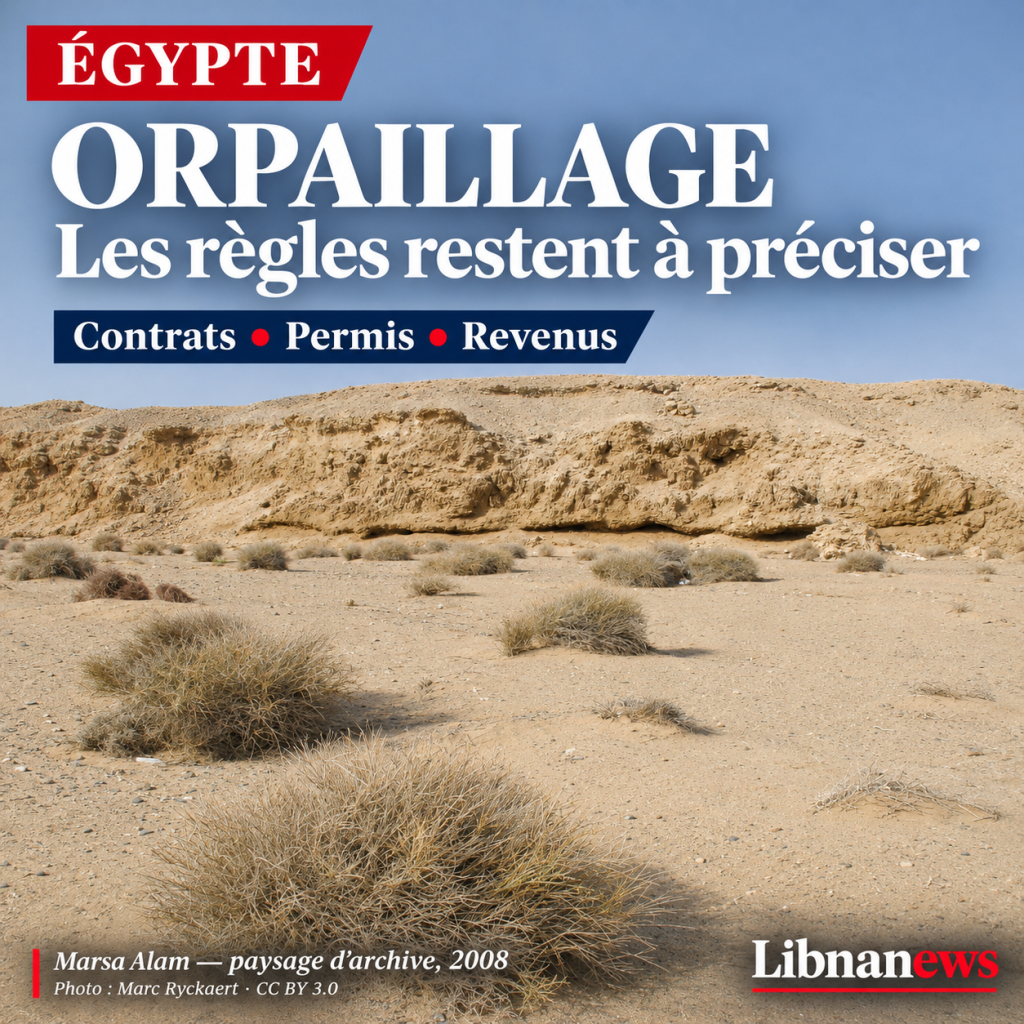
In Egypt, discussions on the regularization of artisanal researchers took a new stage in Marsa Alam. A meeting on 16 November brought together representatives of Mostaqbal Misr and the Union of Egyptian Tribes and Families. The aim is to integrate unauthorized workers into an official framework. However, the available declarations still describe arrangements to be specified, not a fully implemented mechanism.
A follow-up meeting in the Red Sea region
Marsa Alam’s appointment extended the exchange in Cairo the previous week, according to Egyptian reports. Senator Fayez Abu Harb, Ahmed Raslan, head of the Tribes Union, and MP Moustapha Bakri are among the announced participants.
Discussions focused on the « dahaba », the name given to artisanal gold exploration workers. The organizers present regularization as a means of protecting their income while preserving the resources of the State. The meeting was to discuss the next steps and the expansion of the initiative to include those involved.
This timetable provides an important clarification: it is a follow-up to negotiations, not a documented announcement of a general licence remission. The reports do not provide a complete list of the sites awarded, contracts signed or workers already regularized.
Mostaqbal Misr at the centre of the proposed installation
In an interview published on 14 November, the Member of Parliament for Assouan Mona Chaker described a mechanism for contract work. In her view, the prospectors would operate in an organisation under Mostaqbal Misr, so that the State and the workers would each receive a share of the extracted gold.
The Member defends the conformity of this approach with the Egyptian institutional framework. It stresses above all that the agreement is preliminary and that the practical arrangements have yet to be completed. Its political assessment alone does not constitute an enforceable text or a binding contract.
Fayez Abu Harb, for his part, refers to the creation of a company under the aegis of Mostaqbal Misr. It assigns it a role in the organisation of work and authorisation procedures. These announcements converge on the envisaged intermediary. They are not sufficient to confirm the registration of a new company or its start-up.
Liberations announced as a goal
Another aspect of the discussion was the fate of those detained for prospecting. Mona Chaker claims that the arrangements envisaged also concern persons already convicted. However, it distinguishes these cases from other offences, including those related to narcotics or accidents in mining areas.
Fayez Abu Harb also talks about exclusions in murder or drug cases. The formulations of the officials do not give a name list, a number of beneficiaries or judicial decisions executed. It would therefore be incorrect to turn their statements into statements of detainees already released.
The professor of constitutional law and former deputy Abdallah al-Maghazi recalls, in statements reported on 15 November, that criminal situations are the responsibility of the judicial authorities. An agreement between political and tribal representatives does not automatically resolve each individual file. This distinction remains essential for families waiting for a concrete decision.
Security objective highlighted
During a television intervention on 17 November, the adviser to the College of Commanders and Staff Osama Kabir defended the project on behalf of resource protection. According to him, the management of work in the South-East must limit smuggling and combine security and development.
It also presents regularisation as an opportunity for employment for people in the South. These are the objectives put forward by a supporter of the initiative, not a measure of its results. No verifiable balance sheet of additional revenue or jobs created shall accompany these declarations.
For prospectors, the concrete questions remain those of the contract, the workplace and the conditions of sale. A direction for their integration does not yet specify how revenues will be distributed or disagreements between stakeholders will be resolved.
How to document
The publications examined do not permit verification of the announced company’s capital, its ownership structure or a gold purchase schedule. Nor do they provide a comprehensive specification to compare the future organisation with the activities already regulated in the sector.
The continuation of the case will therefore depend on verifiable elements: constituent acts, authorized scopes, proposed contracts and decisions concerning detainees. At this stage, meetings and statements attest to a regularization process. They do not yet demonstrate that all its components operate in the field.





Comments