

An old project returns to the moment when access to care has become critical
Lebanon is putting back on the table an old but much more urgent project with the economic collapse: to offer medical coverage to people who do not benefit from any existing protection regime. The aim is not to create additional insurance for employees already affiliated with a system, but to build a net for those who remain outside. The proposal is now before the joint parliamentary committees, with a question that is a condition for all the others: how can we finance a health system in a state whose resources remain limited?
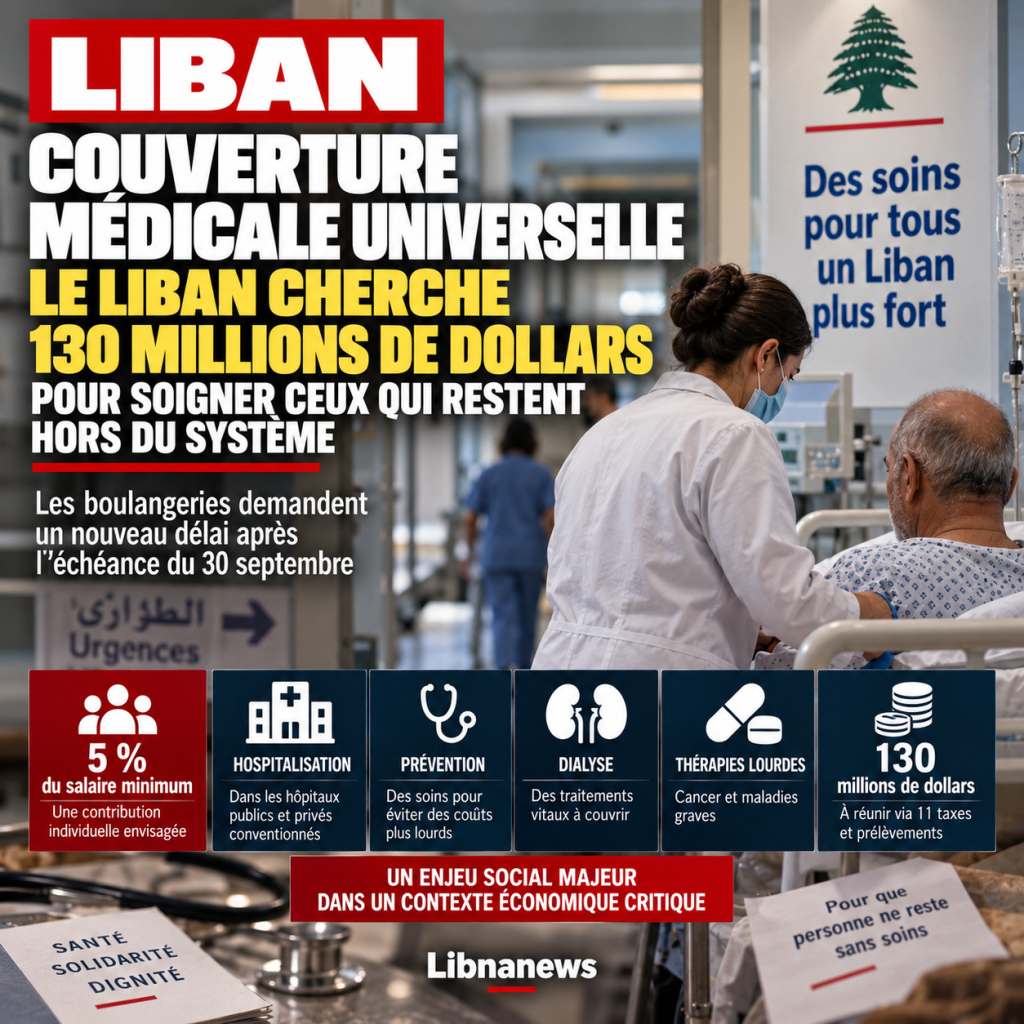
The principle studied is based on an individual contribution equivalent to about 5 per cent of the minimum wage. In return, beneficiaries would have access to a basket of care including prevention, hospitalization in public or private institutions, dialysis and some heavy therapies. The project therefore targets expenses that can become catastrophic for a household when they are to be paid directly.
However, the debate is not just about the level of contributions. A medical coverage plan must know who is affiliated, what care is reimbursed, at what rate, in which institutions and under whose control. It must also prevent several organizations from funding the same act or, conversely, that a patient be rejected by each of them. It is this administrative architecture that will determine whether the project becomes a real social protection or an additional mechanism in an already fragmented landscape.
Five per cent of the minimum wage: a contribution that must remain bearable
The choice of a contribution representing about 5% of the minimum wage seeks to create a regular participation without replicating the cost of private insurance. But even an amount calculated on the minimum wage can weigh heavily on households with irregular incomes. Some of these people work in the informal economy, live on seasonal incomes or do not have a stable monthly wage. Collection is therefore as important a problem as the rate itself.
A system designed only around the classic employee might leave aside precisely those he wants to protect. Provision should be made for self-employed persons, the elderly without a sufficient pension, the unemployed, families with several members working without a declaration and persons whose incomes vary greatly. The project will also need to determine whether the contribution is individual or family and how children and dependants are treated.
The logic of solidarity finally assumes that the contribution does not only fund the expenses of the person who pays in the same month. Medical coverage mutualizes the risk: healthy people contribute to the financing of those who become ill. In order to function, the scheme must therefore bring together a sufficiently large population and prevent affiliation from occurring only when a serious disease appears.
Hospitalization, dialysis and heavy treatment: the basket of care at the heart of the device
The basket envisaged includes several categories of essential care. Prevention is important because it can reduce the future cost of certain diseases. Hospitalisation is the financial core of the scheme, particularly when the patient is to be admitted to a private contracted facility. Dialysis is a regular and vital expense that cannot be interrupted. Finally, some heavy therapies, particularly against cancer and serious diseases, are mentioned among the needs to be covered.
This list immediately raises the question of ceilings and protocols. Medical coverage cannot abstractly promise to pay for « cancer » or « hospitalisation ». It must define the medicinal products concerned, the medical indications, the reimbursed tariffs and the authorisation procedures. Without precise rules, expenses can become uncontrollable and patients discover too late that certain acts are not covered.
The choice of institutions will be equally sensitive. Lebanon has a large private hospital sector, but financial relations between the State and hospitals have often been marked by delays in payment. A new regime will only be credible if institutions know when they will be reimbursed. Otherwise, the patient may remain confronted with the prepayment claims that the coverage is precisely supposed to reduce.
Eleven taxes and levies to raise approximately $130 million
The main project involves financing. The travaux préparatoires examined eleven taxes or levies that could generate approximately $130 million. This figure gives an order of magnitude of need, but it does not address the issue of sustainability. A recipe can be important one year and decrease the next. A health care system must continue to pay for care even when tax revenues slow down.
The use of eleven different sources can offer useful diversification. It avoids that only one tax bears all the financing. But it can also make the mechanism opaque if revenues are dispersed in several jurisdictions and their allocation is not guaranteed. So the question is not just how much each sample can bring back. It is important to know whether the money will actually be paid to the fund, on what timetable and with what protections against its use for other budgetary purposes.
The figure of $130 million must also be faced with the actual number of beneficiaries and the average cost of care. If membership is higher than expected, expenditures may exceed revenues. If it is too weak, the principle of mutualization becomes less effective. The project will therefore need to have actuarial estimates capable of integrating the age of insured persons, the frequency of hospitalizations, chronic diseases and the cost of medicines.
The risk of creating a new body in an already fragmented system
Lebanon is not starting from scratch. It already has the National Social Security Fund, schemes covering various categories of civil servants and mechanisms financed by the Ministry of Health for persons without insurance. Adding a new structure without clarifying its relationship with these organizations could increase rather than reduce fragmentation.
One of the issues discussed is therefore that of the managing body. The Ministry of Health has experience in caring for unmet patients, but it operates within the state budget. Social security has a more traditional insurance structure and an administrative network, but it already has its own constraints. The choice of direct management, an autonomous fund or a link with existing institutions will have consequences on administrative costs and speed of processing.
Above all, the project must prevent duplication. A person already covered must not be financed a second time under the new scheme. This requires compatible databases and reliable identification of insured persons. In a system where public information is often dispersed, this technical dimension can become one of the most important obstacles.
The crisis has changed the meaning of universal coverage
Before the financial collapse, a large part of households could still absorb certain medical expenses directly or purchase private insurance. The crisis has reduced this capacity. Revenues have lost value, while many medical procedures, equipment and medicines remain tied to the dollar. Unplanned hospitalization can destabilize a family budget within a few days.
Universal coverage is no longer just a debate on improving the social state. It becomes a response to an immediate economic risk. A family may defer a consultation, abandon an examination or discontinue treatment because it cannot pay. The human cost then appears in the worsening of diseases, but the financial cost also increases when diseases that could have been treated early eventually require heavy hospitalization.
That is why the prevention provided for in the basket of care deserves a real and not symbolic place. To finance only the hospital would be to intervene when the disease is already advanced. Regular consultations, screening and follow-up can reduce some of the complications and thus the future costs of the system.
The decisive question: a permanent right or budget-dependent aid?
A medical coverage system makes sense only if the patient can count on him when he falls ill. This distinguishes a social right from one-off aid. If funding depends on an uncertain budget negotiation each year, beneficiaries will remain exposed to the risk of certain benefits being suspended when the State lacks liquidity.
The construction of an affected recipe is precisely designed to avoid this problem. But a legal allocation is not always sufficient if revenues are low or transfers are delayed. The project will therefore have to include reserve mechanisms and rules to maintain payments during periods of financial tension.
Credibility will also depend on transparency. Recipients and hospitals must be aware of the plan’s resources, expenses, debts and repayment deadlines. In a country marked by the banking crisis and a deep distrust of financial institutions, asking for a new mandatory contribution without regularly publishing accounts would be difficult to accept.
A social project that becomes an administrative capacity test
The challenge therefore far exceeds the $130 million sought. Lebanon must show that it can identify a population, collect contributions, manage several tax revenues, contract hospitals, control bills, purchase or refund medicines and process files without creating a new unmanageable bureaucracy.
Abuses will also have to be controlled. Any reimbursement scheme may be exposed to overbilling, unjustified hospitalizations or multiple acts. Medical and financial checks must be rigorous enough to protect the system’s money without turning every demand for care into an endless administrative path.
Digitalisation can play an important role, but it requires reliable data and coordination between institutions. A coherent medical and administrative record would enable us to verify affiliation, acts already reimbursed and prescribed treatments. Without this infrastructure, the risk of duplication and fraud increases.
Universal coverage will be played in the details
The political principle is easy to formulate: no resident should be deprived of essential care due to lack of coverage. Implementation is much more difficult. It is necessary to determine who pays, how much, for what care and under what authority. Above all, it is important to ensure that resources follow when spending increases.
The 11 proposed levies and the target of about $130 million are therefore the beginning of the debate, not its outcome. Sustainability will depend on the population actually covered, the health basket, the rates negotiated with hospitals, the cost of medicines and the ability to control spending.
If these are addressed, the project can fill one of the most important gaps in Lebanese social protection. If they remain blurred, it may become a promise of coverage that patients will discover when they need it most. It is this difference between a written right and an effectively accessible care that is now the real issue.





Comments