

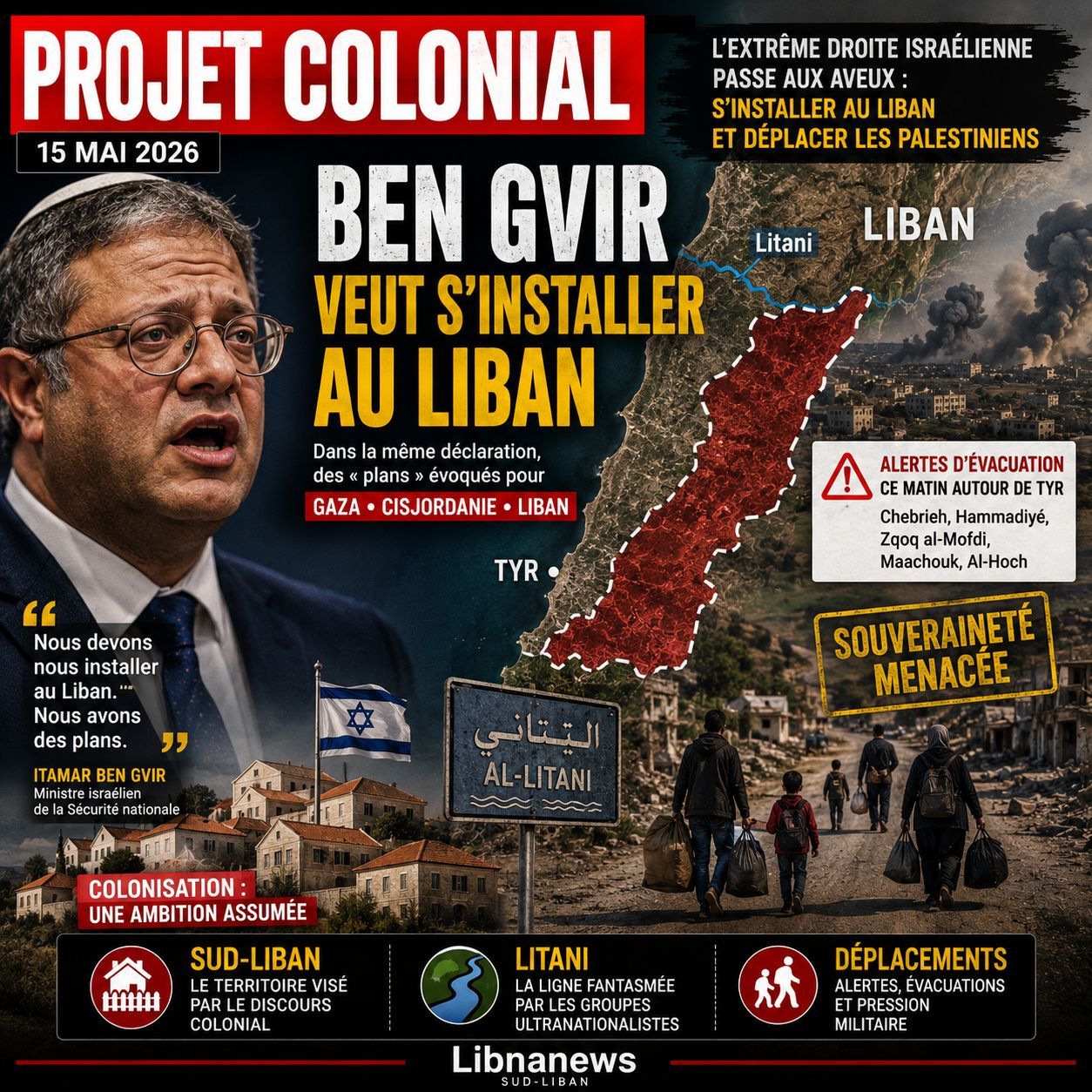
Israel’s Minister of National Security, Itamar Ben Gvir, crossed a new threshold by calling for a settlement in Lebanon, while referring to plans to « encourage » Palestinians from Gaza and the West Bank. The sequence, reported by an Israeli public media and taken over by agencies, is part of a moment of extreme tension in Lebanon. At the same time, residents of several southern localities received new Israeli evacuation notices. The colonization of South Lebanon, long carried by ultra-nationalist groups, now appears in the public discourse of a minister in office. It is no longer just a militant slogan. It becomes an assumed political project, even if no official plan adopted by the Israeli government has been confirmed.
A statement that transforms the debate
The words chosen by Itamar Ben Gvir do not fall within an isolated formula. At an event in Jerusalem, the minister said he wanted to move to Lebanon and linked this idea to plans for Gaza and the West Bank. The message comes in an Israeli political scene where the far right is already defending the revival of settlements in Gaza, annexation of the West Bank and the extension of military control over neighbouring territories. The highlight is the addition of the three lands in the same sentence: Gaza, the West Bank and Lebanon.
This articulation gives a broader meaning to the declaration. It does not treat South Lebanon as a mere military theatre. It places it in a territorial vision where occupation, displacement of populations and settlement of settlers become the three stages of the same strategic imagination. Ben Gvir did not just call for a security operation. He talked about implantation. He also suggested that plans exist. This clarification feeds Lebanese concern, as it suggests an already structured reflection, not verbal improvisation.
Colonization of South Lebanon: a declared plan
The colonization of southern Lebanon now has several levels. The first is ideological. Israeli ultra-nationalist groups claim that Israel’s northern border should move to or beyond the Litani River. They describe this extension as a historical and religious return. The second level is militant. Networks organize meetings, distribute maps, recruit families and evoke a permanent civilian presence in Lebanese villages. The third level is political. Ministers and Members of the extreme right now validate these speeches, sometimes openly, sometimes through gestures of support or silence.
The novelty of Ben Gvir’s statement is therefore due to his function as a bridge. It links the dreams of settler groups to the Israeli government apparatus. The minister does not lead the army. It does not set foreign policy alone. But he sits in the government, controls the national security portfolio and weighs heavily on the coalition. His words cannot therefore be treated like those of a mere activist. They give institutional visibility to a project aimed at transforming Lebanese sectors into Israeli settlement space.
This distinction is essential. There is no public source at this stage to say that a formal government settlement plan for southern Lebanon has been adopted by the Israeli cabinet. On the other hand, it is confirmed that a minister affirms the existence of plans and calls to settle in Lebanon. It is also established that settler movements have been working for several months to make this perspective concrete. The boundary between radical discourse and state strategy becomes more blurred when these ideas circulate in places of power.
The precedent of settler groups
Since 2024, a movement called Uri Tzafon, or « Awake, Wind of the North, » has been driving the idea of a permanent Israeli presence in South Lebanon. Its leaders describe a simple scenario: the army enters, takes control, the Lebanese population flees, the border moves, then Israeli civilians settle. This vision explicitly contains a mechanism for non-return of residents. It turns war displacement into a territorial tool. In the Lebanese context, this is a historic issue, as the South has already experienced occupation, safe areas and returns prevented by the destruction of villages.
The movement does not represent the majority of Israeli society. It belongs to the toughest margins of the colon camp. But its networks are not non-existent. Press reports describe dozens of families, messaging groups, maps, border trips and meetings with politicians. Some activists claim to have equipment to prepare for future settlements. Others claim symbolic incursions across the border. These actions remain limited, but they test opinion, army and government.
Their method is similar to that which accompanied other colonization fronts. A minority begins by formulating the unthinkable. It then maps space. She creates family groups, symbols, documents and events. She finally gets political relays. The changeover occurs when the discourse ceases to be only marginal and becomes a security argument. South Lebanon is then presented not as a neighbouring sovereign territory, but as a buffer zone to be conserved, and then as a land for permanent occupation.
From security vocabulary to colonial vocabulary
This evolution requires a shift in vocabulary. « Safety zone » may mean a military presence assumed to be temporary. It becomes more dangerous when combined with the idea of a civilian facility. The army then opened a space that the settlers wanted to make irreversible. Evacuees, roads cut off and abandoned lands become elements of a possible territorial recomposition. This scenario is not theoretical for Lebanese. It recalls the decades of occupation in the South, but also the practices observed in the West Bank, where the military presence, roads and civilian settlements are mutually reinforcing.
Ben Gvir’s comments add to this risk. He is not just talking about preventing Hezbollah from operating near the border. He’s talking about settling in. He’s not just talking about Gaza. He talks about Gaza, the West Bank and Lebanon in a single sequence. The term « migration », used by the Israeli far right for Palestinians, is used to make acceptable a massive departure that does not occur under normal conditions. In a war, when people no longer have homes, more security and more access to their lands, the « incentive » at the start can become direct or indirect pressure.
International law clearly distinguishes between temporary evacuation for the protection of civilians and forced displacement. It also prohibits an occupying Power from transferring its civilian population to occupied territory. An Israeli settlement in southern Lebanon would violate Lebanese sovereignty and place the region in a major legal crisis. That is precisely what makes Ben Gvir’s words so heavy. They do not only describe a military option. They suggest a change of territory by force, followed by a civilian installation.
A South Lebanon under pressure
The statement comes as the morning in Lebanon opens on alert. According to the dispatches of the national agency, the Israeli army sent an urgent opinion to the inhabitants of Shebrieh, Hammadiyah, Zqoq al-Mofdi, Maashuk and Al-Hoch in the surroundings of Tyre. The message asks them to leave the place and move away to open spaces. These opinions are not neutral. They produce departures, block schools, disrupt care and disrupt traffic. They also set up the idea that some villages may become uninhabitable in the very short term.
In this context, the call to colonize South Lebanon has a direct impact. This is not a statement made in a vacuum. It falls while Lebanese families leave their homes, sometimes for the second or third time. It overlaps with the strikes, destructions and negotiations in Washington. It gives evacuations a more worrying political sense. People can see this not only as a measure linked to a raid, but also as a step in a process to empty certain areas in a sustainable way.
The Lebanese authorities are seeking to document the violations of the ceasefire. Figures published in recent days indicate hundreds of raids, artillery fire and destruction operations since the April truce came into effect. The Lebanese Minister of Information also presented an official count of violations, pointing out that civilians, journalists and rescue workers had been affected. These data feed the Beirut line: the ceasefire cannot remain a diplomatic text if the strikes continue and the inhabitants of the South cannot return.
Tyre, the Litani and the fear of an imposed line
The choice of the target localities this morning increases concern. They are located around Tyre, a strategic coastal city and a vital centre for the South. The maps of settler groups and statements by some activists often refer to the Litani as a desired new line. Between the border and the river, dozens of Lebanese villages form a continuous fabric of families, cultures, municipal networks and places of memory. Talking about a border displaced to the Litani thus amounts to talking about the fate of entire populations.
Israel presents its operations as a response to Hezbollah. Lebanon replied that security could not justify the destruction of villages, the continuation of strikes or the establishment of prohibited areas. The issue becomes even more serious when Israeli officials are no longer limited to the military argument. The transition to colonial argument changes the nature of the conflict. It is no longer just a matter of repelling fighters or neutralizing weapons. The aim is to open up the possibility of an Israeli civilian presence in Lebanese territory.
This perspective also complicates international mediation. The mandate of UNIFIL is based on the implementation of resolution 1701, respect for the Blue Line, support for the Lebanese army and protection of civilians at risk. An Israeli settlement project in southern Lebanon would enter into a frontal collision with this framework. It would call into question the very idea of withdrawal, restored Lebanese sovereignty and a border area managed by the Lebanese State with the support of the United Nations.
Washington facing a major contradiction
The Washington talks are therefore taking place in an adversarial atmosphere. On the one hand, Beirut calls for a complete ceasefire, a halt to the strikes, Israeli withdrawal and guarantees for the return of the inhabitants. On the other hand, Israel wants to maintain freedom of attack and conditions any progress towards the disarmament of Hezbollah. Ben Gvir’s comments add an explosive element: if part of the Israeli government talks about settling in Lebanon, the issue is no longer only safe. It becomes territorial.
For Lebanon, this contradiction must be placed at the centre of the negotiations. A country cannot discuss a withdrawal with a neighbour whose settlement plans are being discussed at the same time by ministers. He could not accept an indefinite buffer zone if settler movements already presented it as a step towards a civilian settlement. He cannot ask his inhabitants to wait if they understand that their displacement could be used to change the border.
This tension makes the American role more delicate. Washington sought to avoid an extension of the war, but its mediation lost credibility if it allowed the colonial vocabulary to settle without a clear answer. The guarantees expected by Beirut are not limited to strikes. They also concern the refusal of any de facto annexation, any Israeli civilian presence and any change in the border line. The colonization of South Lebanon should therefore be treated as a diplomatic red line, not as a provocation of a meeting.
A speech that also targets Gaza and the West Bank
Ben Gvir’s statement cannot be separated from the Palestinian file. The Minister associated the Lebanon settlement with plans to encourage the departure of Palestinians from Gaza and the West Bank. In the language of the Israeli far right, this « migration » is presented as voluntary. But international organizations and jurists examine these formulas in the light of real conditions: bombing, destruction, closure of passages, humanitarian crisis and expansion of settlements. A decision to leave does not make the same sense when alternatives disappear.
In the West Bank, colonial expansion remains a central fact. Hundreds of thousands of settlers already live in settlements considered illegal by most of the international community. The International Court of Justice recalled in 2024 that the Israeli presence in the occupied Palestinian territories and settlements raised legal obligations for States. This legal basis enlightens the Lebanese case. If a prolonged occupation is accompanied by a transfer of a civilian population, it is not an ordinary security measure.
Ben Gvir’s link between Gaza, the West Bank and Lebanon therefore gives coherence to a territorial domination project. It shows that South Lebanon no longer appears only as a military border. It becomes, in the discourse of the Israeli far right, a space available for an extension of colonization. This vision reinforces the accusations of forced displacement by Palestinians and many Lebanese. It does, however, require a distinction to be made between political recognition and legal qualification, which will depend on facts, orders, policies adopted and acts carried out on the ground.
The risk of a regional precedent
The stakes go beyond Lebanon. If an Israeli minister can call on a neighbouring country to settle without immediate political cost, the precedent becomes regional. Syria, already hit and crossed by reported incursions in recent weeks, also observes these speeches. Jordan is following with concern the transfer projects targeting the Palestinians. Egypt refuses any expulsion from Gaza to Sinai. In this tense geography, every statement by an Israeli official does not remain internal to Israeli policy. It becomes a message to neighbouring borders.
For Lebanon, the answer must be threefold. The first one is documentary. Each evacuation notice, strike, destruction and displacement shall be recorded. The second is diplomatic. Mediators must receive an explicit request to reject any Israeli settlement in the South. The third is inside. The Lebanese State must strengthen its capacity to speak with one voice on sovereignty, the return of displaced persons and the protection of civilians. The debate on Hezbollah’s weapons remains central, but it cannot erase the question of occupation or of colonial ambitions expressed by Israeli ministers.
The morning of May 15, then, takes place on two levels that meet. On the ground, villages in southern Lebanon live under notice of evacuation and threat of attack. At the political level, an Israeli minister said that Lebanon should be settled and plans for Gaza and the West Bank should be discussed. Between these two facts, the link is now difficult to ignore. The next few hours will say whether the international mediators will treat this as an overstatement or as the public announcement of a project to prevent before it passes from speech to cards, then maps to the field.




