





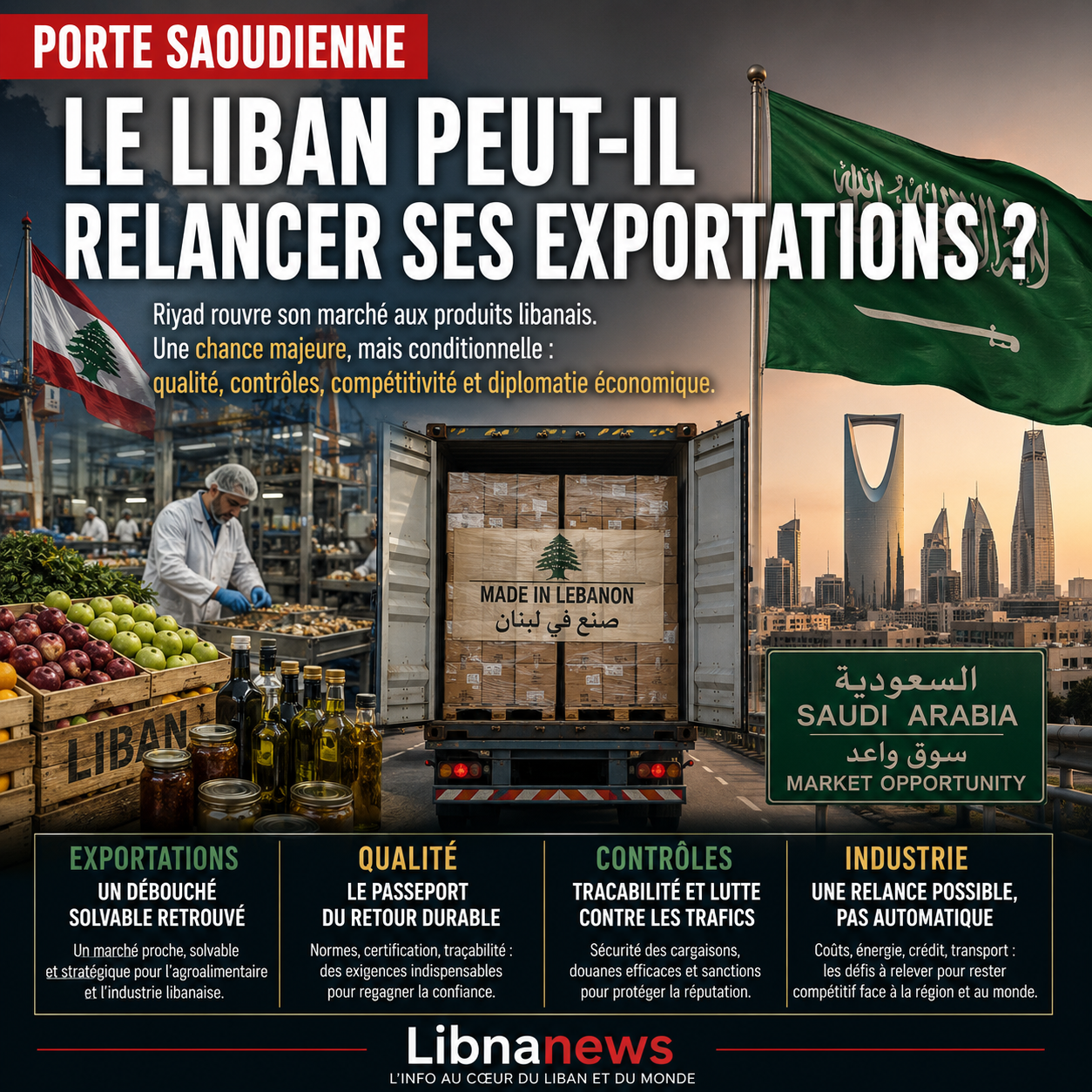
The Saudi market is reopening a door that the Lebanese industry has been waiting for for five years. Riyadh’s decision to lift the ban on Lebanese imports marks a major political and economic signal. However, it alone is not enough to revive a productive economy weakened by the financial crisis, rising costs, energy instability and the loss of regional opportunities. For Lebanese manufacturers and farmers, Saudi Arabia is a culturally close solvent market capable of generating foreign exchange and restoring confidence with the Gulf. But this return also imposes requirements: quality, traceability, border control, certification, competitiveness and continued economic diplomacy.
A Saudi market full of symbols
The resumption of Lebanese exports to Saudi Arabia exceeds the mere reopening of a trade outlet. It reports a gradual improvement in relations between Beirut and Riyadh, after years of tension related to Hezbollah’s place, the accusations of trafficking in Captagon and the diplomatic crisis of 2021. Saudi Arabia had initially banned Lebanese fruits and vegetables, following the discovery of millions of Captagon tablets hidden in a shipment of grenades. The measure was subsequently extended to Lebanese products in a degraded political context.
The decision announced in June 2026 was presented by Riyadh as a response to the positive steps taken by the Lebanese authorities to rebuild the institutions and strengthen the necessary technical commitments. According to the Associated Press, it is an important step towards rebuilding relations between Lebanon and the Gulf countries. For theFinancial TimesIt also reflects the Saudi will to support the Lebanese State at a time when the country is trying to stabilize its institutions and limit the security risks associated with trafficking and armed groups.
For Beirut, the signal is valuable. Lebanon has suffered from a deep economic crisis since 2019. His banks remain paralyzed. Its energy infrastructure is failing. Its industry often operates with private generators, high costs and limited access to credit. In this context, recovering a market like Saudi Arabia can restore oxygen to entire chains. The stakes are not limited to farmers. It also affects food, packaging, non-alcoholic beverages, processed products, consumer goods, cosmetics, furniture, materials and certain specialized productions.
The symbol is even stronger as the Saudi market once served as a regional showcase. An accepted product in Riyadh can be more easily accepted elsewhere in the Gulf. The Emirati, Qatari, Kuwaiti and Bahraini importers observe Saudi choices. The Lebanese return to Saudi Arabia can therefore open up wider than the only kingdom. But this logic also works in the opposite direction. A health, customs or security incident can suddenly close several doors at once.
Currency, jobs and a signal of confidence
The first profit expected is the entry of currencies. Lebanon imports much of its needs, including energy, raw materials, medicines and industrial goods. Any additional exports therefore help to reduce the pressure on the exchange rate and provide businesses with strong currency revenues. In a country where the banking crisis has broken confidence in financial channels, export earnings are becoming vital to maintain activity.
Before the ban, Saudi Arabia was one of the major markets for Lebanese products. Reuters reported that in 2020, Lebanese exports to the kingdom amounted to about $240 million.BusinessNews Lebanonstresses that Lebanese agricultural exports fell from 550 000 tonnes to 200 000 tonnes after the ban, and that Saudi Arabia previously absorbed more than 22 per cent of the country’s agricultural exports. These figures show the extent of the loss of profits for producers, carriers and packaging companies.
Industry can benefit indirectly from this recovery. Agri-food plants using local agricultural products can find volumes. Manufacturers of packaging, cartons, bottles, labels and pallets can receive more orders. Refrigerating warehouses, transport companies and freight forwarders may resume part of their activities. Exporting therefore creates a chain of jobs that exceeds the original producer.
The second benefit is psychological. A country that exports again to the Gulf sends a message of standardization. Investors, banks, insurers and business partners view Saudi decisions as indicators of political confidence. If Riyadh reopens its market, some economic actors may conclude that the Lebanese risk decreases, at least partially. This perception can help companies renegotiate contracts, find customers or obtain payment lines.
But trust remains conditional. It will depend on Lebanon’s ability to prevent recurrence of traffic, control cargo, certify products and respond promptly to alerts. The Saudi market is not just buying. It tests the reliability of the Lebanese State.
Industrial recovery hampered by costs
The reopening of the Saudi market does not address the structural weaknesses of the Lebanese industry. The first is the cost of production. Companies have to deal with insufficient public electricity, expensive private generators, fuel subject to international fluctuations, imported raw materials and high logistical costs. A Lebanese factory can have real know-how, but lose competitiveness against a Turkish, Chinese or Saudi competitor who produces on a larger scale and with cheaper energy.
The second weakness is credit. Since the banking crisis, many companies no longer have normal access to finance. They find it difficult to invest in new machines, modernize their production lines, finance their stocks or grant payment deadlines to their customers. Exporting to a demanding market often requires pre-investment: standards, packaging, analysis, certification, customs compliance, marketing campaigns and local presence.
The third weakness is transport. Land access to the Gulf depends on regional roads, including through Syria and Jordan. The Syrian situation remains an important variable. Enab Baladi points out that the resumption of Lebanese-Saudi trade can also benefit Syria, whose geographical location makes a potential corridor to the Gulf. But any corridor requires security, functional customs, predictable costs and controlled transit times. If land transport remains uncertain, exporters will have to rely more on the sea or air, often more expensive depending on the product.
The fourth weakness is the size of the Lebanese industrial market. Many enterprises are small or medium sized. They have a large adaptability but limited volumes. To meet regular Saudi orders, they will have to ensure consistent, consistent and consistent production. A good product is not enough. We must be able to deliver it at the right time, with the same level of quality, throughout the year.
These obstacles do not cancel the opportunity. They define the conditions for its success. The Saudi market can revive part of the Lebanese industry if companies prepare for a sustainable return, not a mere wave of enthusiasm.
Quality as an economic passport
The question of quality is central. The Saudi ban had been triggered by security concerns related to drug trafficking hidden in cargoes, but it had a wider impact on the reputation of the Lebanese product. Restoring this reputation will require rigorous controls. Exporters will have to prove that the products are safe, traceable, in accordance with health standards and protected against illicit handling.
Lebanese Minister of Economy Amer Bisat has repeatedly stressed the link between economic recovery, institutional reforms and security. According to the Associated Press, he stressed that the country’s financial recovery also depended on political and security changes, including border control, the fight against trafficking and the strengthening of state sovereignty. This approach applies directly to the return to the Saudi market.
Controls must be carried out at several levels. The first is the company: production quality, hygiene, packaging, labelling, expiry date, compliance with Saudi standards and documentation. The second is certification, laboratories, chambers of commerce, professional associations and traceability of suppliers. The third is the State: customs, scanners, port security, border control, sanctions against offenders and cooperation with Saudi authorities.
Any incident could be costly. A non-compliant product does not only harm its manufacturer. It can weaken the entire industry. If Riyadh identifies a serious risk, all Lebanese exporters can be punished by mistrust. Therefore, the reputation of the Lebanese product must be treated as collective capital. It cannot be left to companies alone.
This requirement can become a chance. By strengthening its standards for the Saudi market, Lebanon can improve the quality of its exports to other countries. Certifications, laboratories and traceability procedures can be used for the entire productive economy. Returning to the Gulf can therefore lead to useful modernisation, provided that controls do not only become bureaucratic.
Regional competition harder than before
Lebanese companies do not find the Saudi market as they left. In five years, importers have replaced their suppliers. Products from Turkey, Egypt, Jordan, China, India, Europe and Saudi Arabia have been used for distribution and distribution. Saudi local producers have also developed as part of Vision 2030, which encourages economic diversification and domestic production. Lebanon therefore returns to a more competitive market.
Turkish competition is strong in food, textiles, furniture, consumer goods and processed products. Chinese competition dominates prices in many industrial segments. Saudi competition is growing thanks to local investment, cheaper energy and direct access to distribution channels. The Lebanese product will not always be able to win by the price. It will often gain by quality, niche, taste, brand, speed or commercial relationship.
Some sectors have advantages. Lebanese agri-food has a favourable image in the diaspora and among consumers attached to the Levantine cuisine. Confectionery, canned goods, bakery products, Mediterranean specialities, beverages, natural cosmetics, certain furniture, jewellery or goods with a strong identity can find their place. But this place must be reconquered. Saudi importers will request guarantees of continuity, price and compliance.
The return to the Saudi market must therefore be accompanied by a commercial strategy. Companies will have to participate in fairs, reconnect with distributors, invest in marketing, adapt packaging, understand regulatory expectations and sometimes create local partnerships. The State can facilitate these efforts through economic missions, technical agreements and consular support.
The Lebanese diaspora can also help. Lebanese business networks in the Gulf know about distributors, consumption habits and administrative constraints. They can serve as a bridge between Lebanese producers and Saudi channels. But this mediation must be professionalised. Export can no longer rely solely on personal relationships.
The facilitating state, condition for recovery
Saudi reopening puts the Lebanese state in line with its responsibilities. It is not enough to thank Riyadh. We have to arrange the return. A facilitating State must identify the available channels, support businesses, speed up certifications, strengthen controls and prevent procedures from becoming an additional obstacle. It must also engage in continuous dialogue with the Saudi authorities to prevent misunderstandings.
The government can act quickly on several points. It can create a unit dedicated to exports to the Gulf. It may publish a clear list of applicable Saudi standards. It can strengthen public laboratories or approve credible private laboratories. It may establish a traceability system for sensitive cargoes. It can involve chambers of commerce, industrial unions and agricultural cooperatives.
The State must also punish. Captagon traffic cost the country a lot. It’s not just a crime. It destroyed opportunities for producers who had nothing to do with these networks. The authorities must therefore show that exported shipments can no longer be used as cover for criminal activities. Economic security is becoming a component of sovereignty.
Border and port control is therefore an industrial issue. Exporters cannot succeed if foreign customers doubt Lebanese customs. Industrialists cannot invest if a security incident can abruptly close a market. Commercial sovereignty requires a State capable of ensuring that what leaves Lebanon is what is declared.
Real potential, but not a miracle
The Saudi market can revive part of the Lebanese industry. It can offer foreign exchange, reopen export chains, support agri-food, encourage certain investments and restore part of regional confidence. It can also serve as a signal to other Gulf countries. But it cannot compensate alone for Lebanon’s internal weaknesses.
The energy crisis remains the main obstacle. An industry that produces with expensive electricity loses part of its margin before even exporting. The banking crisis remains a second obstacle. A company that cannot finance its stock or upgrade its equipment cannot sustainably meet foreign demand. Security instability remains a third obstacle. A market can reopen and then close if the war resumes or if criminal networks reappear.
The recovery will therefore be selective. The best organised companies, already certified, with contacts in the Gulf and able to produce regularly will be the first to benefit from the opening. The others must be accompanied. Without industrial policy, re-opening will mainly benefit the strongest players, leaving aside the small units that still need opportunities.
Lebanon must avoid turning this Saudi decision into an illusion of rescue. She’s an opportunity. It is not an economic policy. Economic policy must come from Beirut: energy, credit, standards, customs, commercial diplomacy, support for exporters and the fight against smuggling. Riyadh opens a door. Lebanon must prove that it can go through this door with reliable, competitive and timely products.
Sustainable recovery under conditions
Success will depend on three conditions. The first is quality. The Lebanese product must be irreproachable, as it returns to a market which has been excluded for reasons of security and confidence. The second is competitiveness. Companies must reduce costs, modernise their processes, choose their niches and avoid fighting only on prices. The third is political continuity. Relations with Riyadh must be protected from diplomatic crises, provocations and trafficking networks.
The Saudi market can become an engine again. It can encourage plants to produce more, farmers to plan, carriers to take back lines, packers to invest and distributors to renew contracts. It can also give Lebanon a broader perspective: rebuilding a production- and export-oriented economy, not just for transfers, services or external aid.
But the recovery will not come from a statement. It will come from signed orders, controlled shipments, accepted products, payments received and loyalty customers. Each successful export will strengthen confidence. Every incident will weaken her. In this new phase, the Lebanese industry plays more than a commercial return. It plays a role in proving that Lebanon can still produce, control, export and keep its word.